
Director: Olivia Wilde
Screenplay: Rashida Jones and Will McCormack
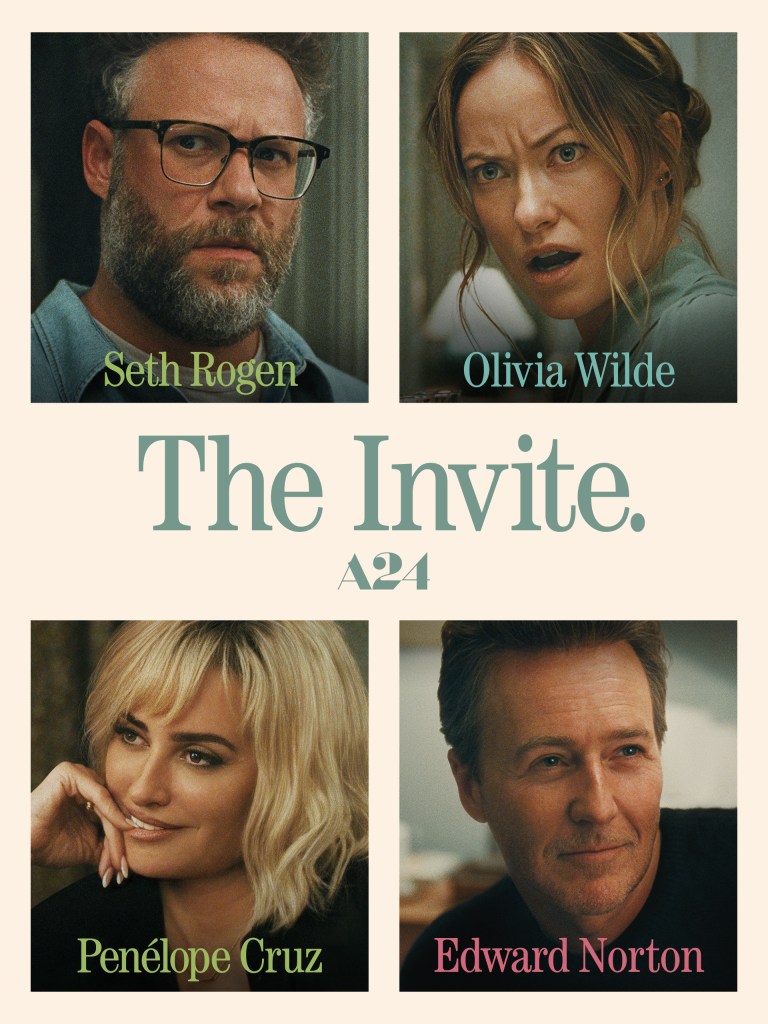
Starring: Seth Rogen, Olivia Wilde, Penélope Cruz, Edward Norton
Year: 2026
Country: United States
Genre: Comedy-drama / chamber comedy
Running time: 107 minutes
Based on: Cesc Gay’s Sentimental (2020), released internationally as The People Upstairs
Rating: ★★★★☆
What It Is
Joe and Angela are a long-married San Francisco couple whose relationship has calcified into resentment, routine and mutual disappointment. Joe, once a musician and now a music teacher, has largely withdrawn from both his former ambitions and his marriage. Angela, who abandoned her own artistic aspirations for domestic life, has invited their upstairs neighbours, Piña and Hawk, down for dinner.
The invitation is already a source of marital conflict. Making matters worse—or considerably more interesting—Piña and Hawk appear to possess everything Joe and Angela have lost: ease, curiosity, erotic energy, candour and an apparently uncomplicated delight in one another.
Then they make their hosts an unexpected proposition.
What follows unfolds almost entirely over one evening and within one apartment, as a slightly uncomfortable social engagement becomes farce, sexual negotiation, marital reckoning and something approaching an impromptu therapy session.
The remainder of this review contains spoilers.
The Review
I am, by habit, always late to the party—a tendency compounded this summer by recovery from surgery, which has kept me at some remove from the cultural conversation. So it is only now that I have finally watched Olivia Wilde’s The Invite.
There are advantages to arriving late. By this point the Sundance ovation, the bidding war and the surrounding enthusiasm have receded sufficiently for the film to be considered as something other than an event.
And considered on its own terms, it is very good indeed.
A Play in Disguise
The Invite is an English-language adaptation of Cesc Gay’s 2020 Spanish film Sentimental, whose international English title is The People Upstairs. I have not seen Gay’s film, and therefore cannot meaningfully pronounce upon what Wilde and screenwriters Rashida Jones and Will McCormack preserve, improve or lose in translation.
What can be said is that the basic dramatic mechanism belongs to a much older tradition.
Put a small number of adults in a room. Give them alcohol. Add sex, envy, disappointment and some information nobody was supposed to disclose. Then remove the possibility of escape.
The dinner party has always been one of drama’s most efficient laboratories.
The Invite understands this perfectly. Its natural lineage is the drawing-room comedy and the marital chamber drama: works in which bourgeois sociability gradually reveals itself as organised combat. Who’s Afraid of Virginia Woolf? is the unavoidable reference.
The resemblance to Albee is structural rather than tonal. George and Martha turn hospitality into ritualised destruction; Joe and Angela are neither so theatrical nor so vicious. The Invite is warmer, more sexually curious and considerably funnier. But it uses the same fundamental architecture: a marriage that has become a closed system is exposed to outsiders, and the outsiders create enough disturbance for everything suppressed inside that system to become visible.
The guests do not cause the crisis.
They reveal it.
That distinction is important.
Joe and Angela’s marriage is already collapsing before Hawk and Piña cross the threshold. The dinner merely removes the routines that have allowed husband and wife to avoid acknowledging it.
The Geometry of a Marriage
What elevates the film beyond filmed theatre is Wilde’s attention to space.
The apartment may be a single location, but it is not visually static. Rooms, doorways, walls, mirrors and depth turn domestic architecture into a diagram of the relationships occurring inside it. Joe and Angela are repeatedly separated within the frame, while Hawk and Piña are more often allowed to inhabit it together.
It is an intelligent use of cinematic grammar because the camera establishes the apparent difference between the couples before the screenplay dismantles it.
Joe and Angela look fragmented.
Hawk and Piña look whole.
For much of the evening, that is precisely how the hosts perceive them too.
This makes the visiting couple something more interesting than liberated foils. They become projections: an image of an alternative life onto which Joe and Angela can place everything they believe has disappeared from their own.
Angela sees freedom, sexual confidence and a woman apparently at ease with herself.
Joe sees pretension, narcissism and the unbearable smugness of people who seem to have solved problems he has failed even to articulate.
Both responses tell us considerably more about Joe and Angela than about the people upstairs.
Four Very Good Performances
A four-hander lives or dies by performance, and there is no weak link here.
Seth Rogen is particularly good as Joe. The familiar comic rhythms remain—his exasperation and incredulity are among the film’s richest resources—but they have hardened into something defensive. Joe was once a musician with ambitions of his own; now he teaches music while refusing even to touch the piano in his home. The instrument sits there less as furniture than as evidence.
Rogen understands that Joe’s hostility is largely grief translated into sarcasm.
He is angry at Angela, Hawk, Piña, his job, his body, his apartment and the world in general, but the person he seems least capable of forgiving is the younger version of himself who expected his life to turn out differently.
Wilde’s Angela offers another form of disappointment. Where Joe has withdrawn from aspiration, Angela has displaced hers into the home. Her preparation for the dinner—the food, the room, the details, the desperate desire to make everything appear effortless—is funny because the effort is so painfully visible.
She is performing a successful life for strangers.
And she needs those strangers to believe in it because she no longer does.
Cruz and Norton face a different challenge. Piña and Hawk must initially seem almost absurdly enviable without becoming empty fantasies. Their ease is provocative precisely because Joe and Angela experience it as effortless.
Norton is especially clever with Hawk. The name alone seems designed to irritate Joe, suggesting a man who has reinvented himself so completely that reinvention risks becoming affectation. But what first looks like ridiculous self-fashioning eventually acquires a history.
The film gradually asks a more serious question: when does reinvention constitute falseness, and when is it simply the work of continuing to live?
Desire and the Esther Perel Problem
It is impossible to discuss The Invite seriously without thinking of Esther Perel.
Piña functions almost as a dramatic conduit for ideas associated with Perel’s work: that domestic security and erotic desire do not always require the same conditions; that long relationships can imprison people inside obsolete versions of themselves; and that remaining together is not necessarily evidence of relational success.
This gives the film considerably more intellectual substance than the phrase “swingers comedy” might suggest.
The central opposition is not really monogamy versus non-monogamy.
It is stasis versus change.
Joe and Angela have effectively treated marriage as an agreement to remain recognisable to one another. Hawk and Piña offer the opposite proposition: that intimacy might depend upon permitting another person to change.
That is the film’s more serious concern beneath all the sexual comedy.
Can you continue to desire someone whom you believe you already completely know?
And what happens when the person beside you becomes evidence of all the versions of yourself that you abandoned along the way?
The sexual proposition matters because it destabilises identity rather than simply fidelity. Joe and Angela are forced to imagine themselves not merely having sex with somebody else, but being somebody else: desirable, adventurous, spontaneous, curious.
Sex becomes the mechanism through which the film asks whether a self that has gone dormant can still be recovered.
The Dinner Table as Theatre
This is also why the dinner-table setting works so well.
A dinner party is already a form of performance. We edit ourselves for other people. We become more charming, more successful, more liberal, more sexually sophisticated, more happily married.
Or we become Joe and refuse the performance altogether—which is itself a performance.
Each of the four characters arrives at the table with a theory of who they are.
Joe is the disappointed realist who believes his cynicism protects him from pretension.
Angela is the competent wife and mother whose domestic achievement is supposed to prove that the life she chose was sufficient.
Hawk is the reinvented man who has transformed loss into appetite.
Piña is the therapeutically literate observer who can diagnose the structures in which everybody else is trapped.
And one by one, the evening compromises those identities.
This, more than the mechanics of partner-swapping, is what makes The Invite interesting.
The film is a comedy of self-knowledge in which everyone discovers that their preferred account of themselves is incomplete.
Piña’s position is particularly important because therapeutic fluency initially appears to grant her authority over the room. She can name desire, repression and relational dysfunction with a vocabulary the others lack.
Yet knowing the language of emotional health is not identical to possessing emotional invulnerability.
Eventually even Hawk and Piña’s enviable openness develops fractures.
The distinction matters. Had their relationship remained perfect, the film would merely have replaced one prescription—monogamous marriage—with another form of enlightened coupledom.
Instead, it allows them to be human.
The Thriller That Never Arrives
For roughly the first third of the film, I became convinced I was watching something darker.
Hawk and Piña’s attentiveness to Angela seemed almost too practised. Their admiration of the apartment, their interest in the marriage, the ease with which they penetrated Joe and Angela’s defences: for a while I suspected an elaborate scheme.
Perhaps they wanted the apartment. Perhaps the invitation had been manipulated. Perhaps the entire evening was a long con designed to dislodge the people downstairs.
None of this happens.
But the fact that the possibility seemed plausible is revealing.
Wilde allows the arrival of erotic freedom to borrow some of the grammar of threat. The strangers upstairs are attractive precisely because they are destabilising, and destabilisation is difficult to distinguish from danger when your life depends upon things remaining exactly as they are.
Another couple’s freedom can look suspicious when it exposes your own captivity.
Nobody Is Quite What They Claim
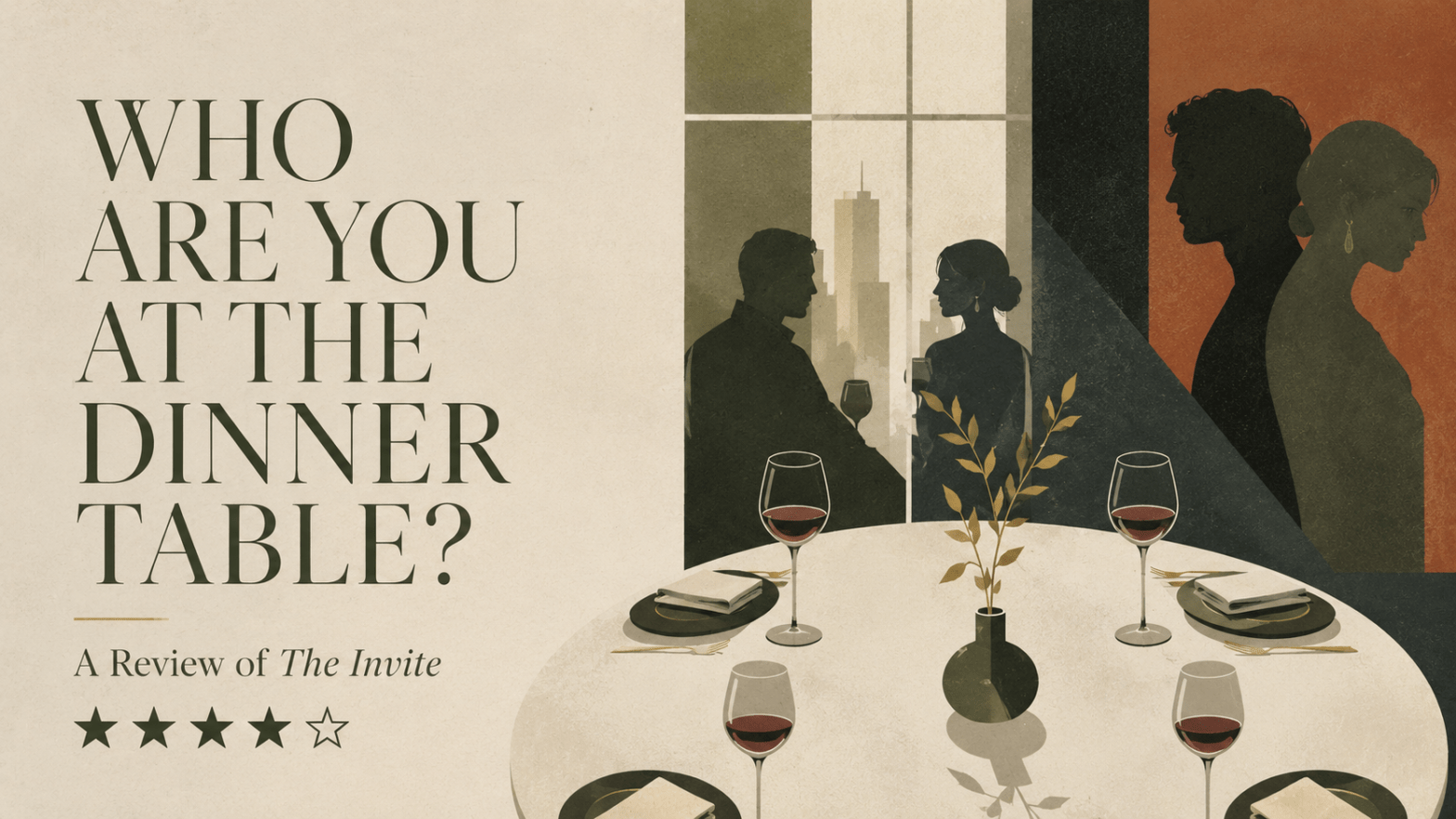
The title I kept returning to while watching was: who are you at the dinner table?
Not who do you say you are, but which part of yourself appears when another person unsettles the arrangement by which you have organised your life?
Joe responds with aggression.
Angela responds with fascination.
Hawk responds with openness that sometimes borders on performance.
Piña responds with analysis.
Each is, in some way, both sincere and self-deceived.
That makes The Invite considerably more intelligent than a film in which the sexually liberated neighbours simply arrive to teach the repressed married couple how to live.
Hawk and Piña possess something Joe and Angela need, certainly: candour. But Joe and Angela possess something that the film does not dismiss either—a history, a child, tenderness buried beneath grievance, and the complicated residue of having known another person across many versions of a life.
The film never quite allows novelty to win the argument simply by being more exciting.
A Piano and an Ending
Eventually the social comedy collapses into something much closer to confession.
The evening produces what Joe and Angela have avoided for years: an honest account of their marriage. They acknowledge resentment, lost desire, abandoned ambitions and the possibility that remaining together for their daughter may no longer constitute virtue.
Piña helps force that recognition, but importantly, she cannot decide what should follow from it.
Neither can the film.
The final image returns to the piano.
Joe has spent the film refusing to play it. Music belongs to the life he imagined he would have, and the unopened instrument has become a monument to failure. After the guests have gone and practically every defence has collapsed, he finally sits down.
Angela joins him.
They play together.
The beauty of the scene is that it refuses to tell us precisely what it means.
The piano does not necessarily signify reconciliation.
It signifies communication.
For perhaps the first time that evening, Joe and Angela produce something together without explaining, accusing, diagnosing or defending themselves.
It may be the beginning of another marriage between the same two people.
It may be their goodbye.
The film is wise enough to understand that those possibilities are not as far apart as they initially appear.
Verdict
The Invite is a smart, beautifully controlled and extremely funny chamber comedy about marriage, desire and the frightening possibility that the person beside you—and the person you have become—might no longer be the person either of you originally chose.
Its great strength is that it understands a dinner party as both social ritual and psychological experiment. Put four people around a table and everyone arrives performing some version of themselves. Add desire, comparison and enough honesty, and eventually the performance becomes impossible to sustain.
Wilde trusts her actors, Jones and McCormack trust conversation, and the film trusts the audience enough not to resolve its central marriage for us.
It does not reinvent the dinner-party-from-hell genre.
It does something slightly more difficult: it remembers why the genre works.
Because eventually someone says what should not be said.
Someone wants what they should not want.
Someone stops pretending.
And everyone at the table has to decide who they are once the story they have been telling about themselves no longer quite holds.
As any good film of this kind should, The Invite leaves you quietly auditing your own relationship—or at the very least reconsidering the wisdom of inviting the people upstairs down for dinner.
★★★★☆
Discover more from My World of Interiors
Subscribe to get the latest posts sent to your email.

