
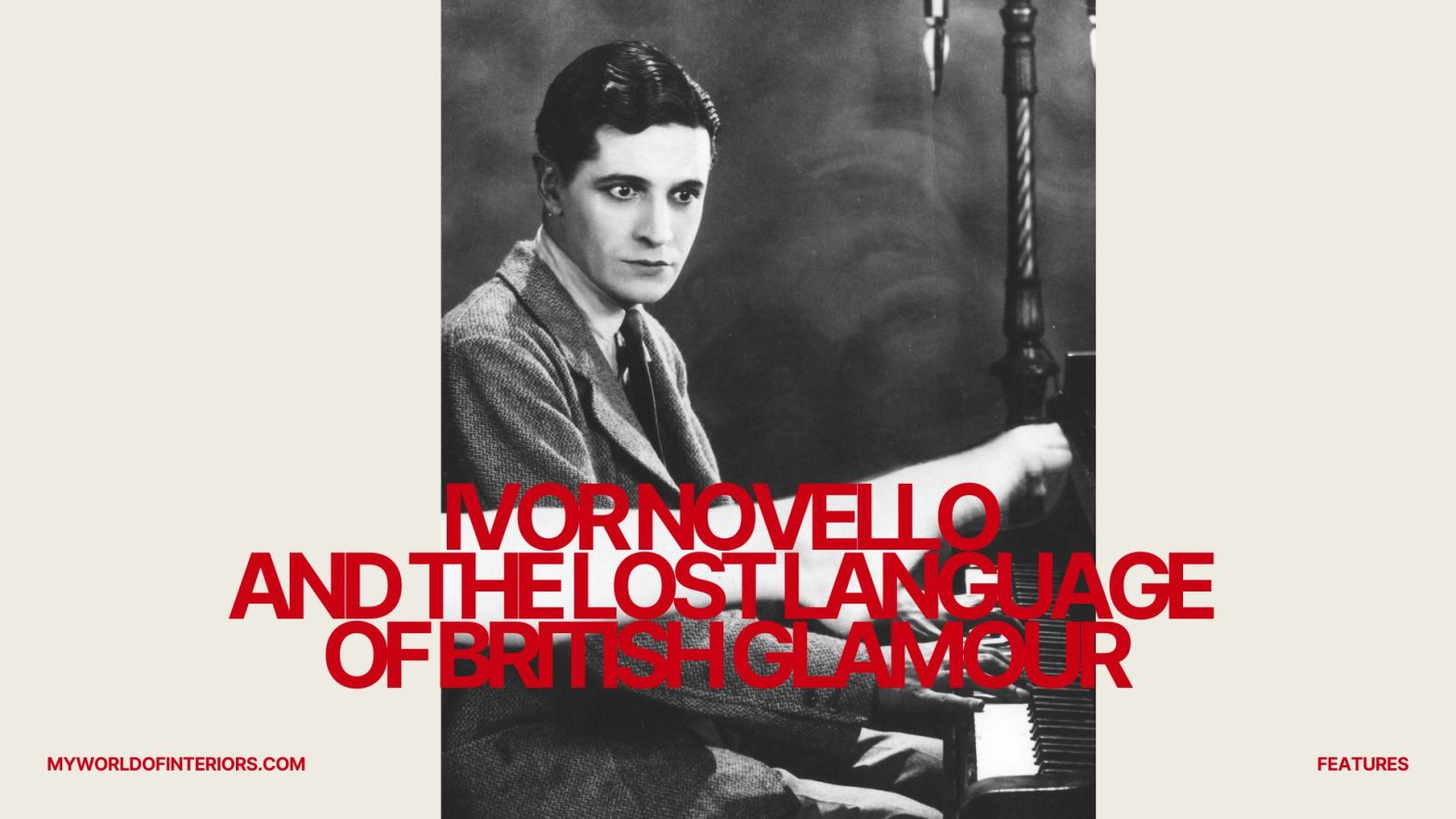
Ivor Novello has survived in British culture in a peculiarly ghostly form. His name remains everywhere, attached to one of the country’s most prestigious songwriting honours, and yet the man himself has drifted into soft focus. Many know the Ivor Novello Awards. Far fewer could say with confidence who Novello was, what he made, or why he mattered. He is one of those rare cultural figures who have become both immortal and obscure, preserved in name while receding in substance.
That alone makes him interesting. But it is not the whole story. For Novello was not some minor Edwardian curiosity with a respectable afterlife. He was one of the great architects of British popular feeling in the first half of the twentieth century: composer, actor, playwright, matinee idol, impresario of longing. Born David Ivor Davies in Cardiff in 1893, he rose first to prominence with Keep the Home Fires Burning, the song that would become one of the emotional signatures of the First World War. He later became a major silent film star and then, in the interwar years, the supreme conjuror of a peculiarly British kind of theatrical romance, filling the West End with musicals steeped in moonlight, glamour, yearning and grand melody.
What has faded, perhaps, is not simply Novello himself, but the emotional language in which he worked. To revisit him now is to encounter a world in which beauty was allowed to be earnest, in which sentiment was not automatically suspect, and in which popular entertainment could aspire to grandeur without irony. That world can seem impossibly distant. Modern culture, so alert to camp, cynicism and self-consciousness, is rarely comfortable with sincerity on Novello’s scale. His work is often dismissed as lush, decorative, overripe. But that response says as much about us as it does about him.
For Novello belonged to a Britain that handled feeling differently. His was not the Britain of brutal modernism or avant-garde rupture, but of continuity, polish and emotional ceremony. Even when the twentieth century was tearing up old structures of class, empire and certainty, British culture often preferred to drape change in melody and costume, to soften rupture into atmosphere. Novello understood this instinct perfectly. He did not challenge it. He transformed it into spectacle.
This is why his early success matters so much. Keep the Home Fires Burning was more than a hit song. It was a piece of emotional infrastructure. In wartime, songs do cultural work beyond entertainment. They steady the nerves, ritualise grief, and give people a language in which private feeling can become collective endurance. Novello instinctively grasped how national emotion required domestic symbols: home, waiting, return, memory, the promise of light against darkness. He knew how to make public feeling sound intimate.
That gift would shape the rest of his career. In the years between the wars, Novello created stage works that offered not realism but compensation. His great musicals, including Glamorous Night and The Dancing Years, presented audiences with idealised worlds of romance, aristocratic melancholy and melodic splendour. To call them escapist is true, but insufficient. Escapism is rarely a mere retreat from reality. More often it is reality’s counterweight, a way of surviving history by imagining a form of life more beautiful than the one currently available.
Novello’s theatre offered precisely that. His productions were lavish but never chaotic, opulent but deeply controlled. They were dream-worlds organised with immense care: rich interiors, moonlit terraces, noble suffering, unforgettable refrains. The feelings they staged were large, but they were never shapeless. This was not decadence. It was emotional architecture.
If Noël Coward represented one branch of interwar sophistication, Novello represented another. Coward offered speed, wit, steel and surface. Novello offered amplitude, tenderness and romantic excess. Coward’s modernity was defensive, brittle, amused by itself. Novello’s was more vulnerable. He seemed to believe, or at least to act as though he believed, that beauty could still gather experience into some meaningful order. That distinction is crucial. It explains why Coward feels closer to modern taste, while Novello can seem to belong to a more alien emotional climate.
And yet Novello was not merely a composer of melodies for others to inhabit. He was himself a star in the older, fuller sense of the term: a public presence whose image, bearing and aura helped generate the meaning of the work. In silent cinema he was one of Britain’s most recognisable romantic leads, his face carrying with it a charge of elegance, mystery and desirability. Alfred Hitchcock’s decision to cast him in The Lodger was not incidental but intelligent, a use of Novello’s pre-existing star persona to create suspense. Audiences brought assumptions with them when they looked at him. He was already a sign before the film even began.
In this sense, Novello belongs to the prehistory of celebrity as we know it now. Before the machinery of television, tabloids and digital exposure, there existed another kind of fame, more theatrical and less relentlessly confessional, in which authorship, beauty, performance and private aura fused into a single image. Novello understood how to live inside that image. He cultivated glamour not as publicity but as atmosphere.
There is something revealing in that too. British culture is often imagined as suspicious of glamour, too embarrassed by splendour to surrender to it fully. Yet it has repeatedly produced figures who embody glamour in distinctly native forms: not Hollywood vulgarity, but elegance softened by melancholy, style shadowed by restraint. Novello belongs to that lineage. His glamour was never crude. It was upholstered, theatrical, touched always by a kind of wistfulness. He made longing look civilised.
Part of his hold on the public, then, came from his ability to merge performance and fantasy so completely. But that also helps explain why his work later struggled to survive intact. The postwar world was not kind to his sensibility. Britain after 1945 moved toward austerity, social realism, irony and later pop modernity. The emotional temperature changed. The country that embraced kitchen-sink drama, angry young men and rock and roll was no longer predisposed to surrender to candlelit operetta and noble romantic sacrifice. Novello did not so much disappear as become legible as belonging to another order of feeling.
This does not diminish his significance. On the contrary, it clarifies it. Novello matters precisely because he represents a lost consensus about what popular art could do. He belonged to a moment when entertainment was still expected to console, to elevate, to furnish the inner life with melody and mood. That idea now seems almost old-fashioned, yet it was central to the way millions once encountered music and theatre.
It is striking, too, that although the works themselves have receded, the name has remained. This is one of the strangest things about cultural memory. Institutions often preserve what everyday experience forgets. The songs may no longer circulate widely; the musicals may not live in the repertoire as they once did; but the name endures because it has been transformed into a standard of excellence. To win an Ivor Novello Award is to enter, whether knowingly or not, into a tradition of British musical authorship shaped by the afterlife of one man.
There is a certain irony in this. Novello, whose own style could be dismissed as excessive or sentimental, now lends his name to a contemporary honour that encompasses vastly different traditions of songwriting and composition. Yet perhaps that is fitting. What survived was not merely his oeuvre, but the idea of craft that his name came to represent. He has become, in effect, a signifier of musical seriousness.
There are other dimensions to his legacy as well, subtler but no less important. Novello’s life forms part of the long, coded history of queer presence in British theatre and performance, a world in which feeling often had to travel obliquely, through style, decorum and indirection. One need not reduce his work to biography to notice that his aesthetic is saturated with forms of longing that exceed simple plot. In Novello, desire is everywhere diffused into setting, melody and atmosphere. Emotion does not simply belong to characters. It inhabits rooms, fabrics, staircases, intervals of silence. Longing in his work is environmental.
That may be one reason his theatre still exerts fascination even when its conventions seem dated. Beneath the polish is surplus feeling. Beneath the romance is intensity. His world is too ornate to be merely decorative. One senses in it the pressure of emotion seeking acceptable form. Like much art produced within restrictive social codes, it speaks in beautiful disguises.
His Welshness matters here as well. British cultural history has often folded Welsh contribution into the larger category of “British” and left it at that, but Novello emerged from a distinctly Welsh musical inheritance, shaped by vocal culture, lyricism and the seriousness accorded to song. He brought that sensibility into the metropolitan heart of British entertainment. The result was a body of work that sounds both national and slightly set apart from the English mainstream, more melodic, more ardent, less afraid of emotional display.
So what is Ivor Novello’s legacy? It is not simply that he wrote songs, starred in films or filled theatres. It is that he gave shape to a national appetite for romance and emotional ceremony. He understood that people do not live by information, satire or realism alone. They also need splendour. They need beauty arranged into form. They need songs that do more than entertain them, songs that dignify feeling and give longing somewhere to go.
That is why he still lingers, even now, in this half-visible way. Each time his name is invoked as a mark of excellence, some trace of his world survives with it: a world of chandeliers and curtain calls, of moonlight and melody, of feeling made ceremonious. His work may no longer be central to everyday cultural life, but the need it answered has not gone away.
If anything, our own age, for all its irony, may be newly capable of understanding him. We live amid saturation, speed and endless commentary, yet the hunger for enchantment remains. Novello knew that popular art could offer not just distraction, but emotional enlargement. He knew that style could be a shelter for feeling rather than a defence against it. He knew that glamour, at its most refined, was never only surface. It was a way of arranging desire, memory and hope into something briefly radiant.
That is why he deserves to be remembered not as a quaint relic of a vanished Britain, but as one of the great stylists of British feeling. He spoke a language the culture has partly forgotten, but not entirely. His name remains because his central intuition remains: that music and theatre are at their most powerful when they make emotion feel larger, nobler and more beautiful than ordinary life allows.
Discover more from My World of Interiors
Subscribe to get the latest posts sent to your email.

