
By Bergotte
Valerie Solanas is the writer this series was not supposed to include. She is not canonical. She is not comfortable. She wrote one major text, the SCUM Manifesto, which calls for the elimination of men, and she shot Andy Warhol in 1968, and she died alone in a welfare hotel in San Francisco in 1988, and the literary establishment has never quite known what to do with her except either dismiss her as a madwoman or canonise her as a martyr, both of which are ways of not reading her. This essay proposes a third approach: reading her. The SCUM Manifesto is a work of savage intelligence and genuine rhetorical power — one of the most ferocious pieces of satirical writing produced in the twentieth century — and its vision of the human condition, however extreme and however unacceptable in its conclusions, contains observations about power, gender, and the organisation of society that fifty years of feminist theory has confirmed to be more accurate than most of its contemporaries were willing to admit. She deserves to be read with the same seriousness that the tradition extends to Swift, whose modest proposal for eating Irish babies was also not meant literally, and whose rage at injustice was also expressed in a form that made comfortable readers reach for the diagnosis of madness as a way of not engaging with the argument.
The Life That Made the Text
Valerie Solanas was born in 1936 in Ventnor City, New Jersey, the daughter of a waitress and a father who sexually abused her from an early age and was eventually removed from the family. She was passed between relatives, lived on the streets as a teenager, worked as a prostitute to survive, put a child up for adoption, and made her way, through a combination of intelligence and absolute refusal to accept the limitations her circumstances imposed, to the University of Maryland, where she studied psychology and graduated in 1958. She went to Berkeley for graduate work, left, drifted to New York, lived in the Village, continued working as a prostitute, and began writing.
The biography is not incidental. It is the ground from which the Manifesto grew, and understanding it is essential to reading the text honestly — not as a way of excusing or explaining away the extremity, but as a way of understanding what kind of extremity it is. Solanas was not a middle-class theorist performing radicalism from a position of relative safety. She was a woman whose direct experience of male power — in its most intimate, most violent, most economically coercive forms — gave her an understanding of what that power did and how it operated that most feminist theory of her period lacked precisely because most feminist theorists had not lived it at that pitch.
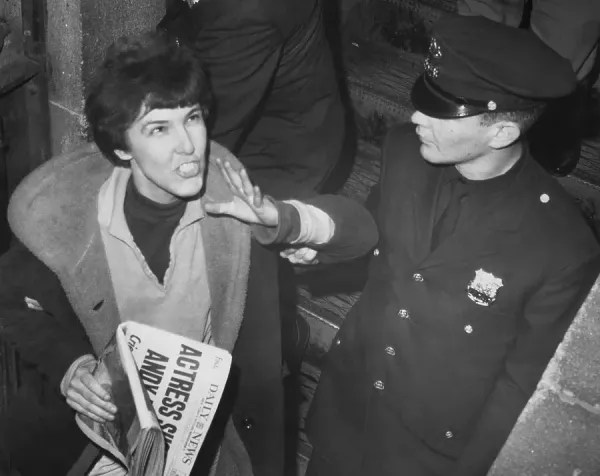
She arrived in Andy Warhol’s orbit in the mid-1960s — the Factory, the world of Pop Art and underground film and celebrity and drugs and money and the specific cruelty of a scene that collected eccentric and damaged people and used them as material and called it art. She gave Warhol the manuscript of a play she had written, Up Your Ass, which he lost or claimed to have lost, and which she believed — probably correctly, given the Factory’s casual attitude to other people’s work — had been stolen. She shot him on June 3 1968, wounding him severely and nearly killing him. She turned herself in to the police that evening, was diagnosed with paranoid schizophrenia, spent three years in psychiatric institutions, and was released in 1971 to a life of continued poverty and mental illness that ended with her death at fifty-two.
The shooting has functioned, in the cultural memory, as the thing that defines her — the act that makes her a curiosity or a symbol rather than a writer. This is exactly wrong. The shooting was the act of a woman in a mental health crisis whose grievance against Warhol was real even if her response to it was not proportionate. The Manifesto, which predates the shooting, is the work, and it is the work that deserves the attention.
The Rhetorical Machine
The SCUM Manifesto — SCUM being variously interpreted as Society for Cutting Up Men, which Solanas sometimes endorsed, and as a word she simply chose for its associations — was written in 1967 and self-published by Solanas on the streets of New York, where she sold it for a dollar to women and two dollars to men. It was adopted by Olympia Press after the shooting brought her notoriety, and has been in print almost continuously since, translated into multiple languages, discussed in feminist scholarship, staged as theatre, and argued about with an energy that texts which are simply extreme do not generate unless they contain something that the argument cannot quite dismiss.
The text opens with one of the great rhetorical gambits of twentieth century writing: it takes the logic of misogynist biology — the claim that women are defective men, that the female is an incomplete version of the male, that femininity is a deviation from the masculine norm — and inverts it entirely. Men, Solanas argues, are incomplete women, biologically deficient, lacking the Y chromosome’s compensatory gifts, driven by a testosterone-fuelled emotional incompleteness that produces the entire apparatus of war, hierarchy, money, and the subordination of women as expressions of a profound insecurity that the deficient male organism cannot resolve in any other way. The argument is not serious biology. It is serious satire — the deployment of the enemy’s logic against the enemy, using the tools of pseudoscientific misogyny to perform the same operation on its perpetrators.
The rhetorical method is Swift’s, exactly: the adoption of an extreme position and its systematic development, with a deadpan logical consistency that makes the comedy and the horror inseparable. Swift’s proposer calculates the economics of child-eating with the dispassion of an accountant. Solanas calculates the case for male elimination with the dispassion of a scientist. Both are performing reason in the service of rage, using the tools of the dominant discourse against the dominant discourse, exposing the violence that the polite version of the argument conceals by making the violence explicit.
The difference from Swift is that Solanas is speaking from inside the injured group rather than from a position of ironic distance, which changes the emotional register of the satire and which is also why it is harder to read with critical detachment. Swift could afford ironic distance. Solanas could not. Her rage is not a rhetorical posture. It is the content, and the content is real even where the conclusions are not acceptable.
What the Manifesto Sees
The SCUM Manifesto’s most serious and most lasting contribution to the human condition argument is not its conclusions — which are extreme enough that engaging with them as literal proposals is a category error, like engaging with Swift’s proposal as a policy document — but its analysis of the mechanisms through which male power perpetuates itself, which is more precise and more accurate than most of its contemporaries and which feminist theory has spent fifty years confirming and elaborating.
The analysis of money as a system for converting male anxiety into social power — for creating a world in which economic dependence substitutes for the direct physical coercion that is always available as a backstop but is less efficiently deployed — anticipates arguments that would not be systematically made until the 1970s and 1980s in academic feminism. The analysis of femininity as a performance extracted from women by the threat of economic and social consequences for non-compliance — the argument that women learn to perform the behaviour that men reward and to suppress the behaviour that men punish, and that this performance is so thoroughly enforced that most women experience it as natural — anticipates Judith Butler’s gender performativity theory by more than two decades and states it more directly than Butler’s academic prose usually manages.
The analysis of art and culture as primarily systems for the reproduction and celebration of masculine values — for making the values of the dominant group appear to be universal human values — is an argument that has been made, in more nuanced and more academically respectable forms, by feminist critics from Laura Mulvey to Griselda Pollock, and it is an argument that is substantially correct, even if Solanas states it with a violence and a totality that the nuanced versions qualify in important ways.
What the Manifesto sees, beneath all the savage comedy and the apocalyptic rhetoric, is a genuine structural analysis of how power organises itself, how the dominant group naturalises its dominance, and what it costs the subordinated group to live inside the structures that the dominant group creates and calls universal. This is not an original observation in the history of political thought — Marx saw it, the abolitionists saw it, the early feminists saw it — but Solanas states it from a position of such direct personal experience, with such complete absence of the consoling qualifications that academic discourse requires, that the statement has a force that more measured versions lack.
The Problem of the Conclusions
Honesty requires confronting the conclusions, which cannot be read as pure satire and which the essay cannot pretend away. The Manifesto calls for the elimination of men — not metaphorically, not as a thought experiment, but as a programme. It envisions a world without men and argues that such a world would be not merely survivable but vastly superior to the current arrangement. This is not a position that can be endorsed, and the essay does not endorse it.
What can be said is that the conclusions are the point at which the rage exceeds the analysis — the point at which the genuine structural insight, which is that the current arrangement is unjust and that the injustice is systematic and that the system is maintained by force whether or not the force is currently being deployed, tips into a fantasy of reversal that mirrors rather than transcends the logic it is attacking. The call for elimination is the misogynist call for female subordination inverted, and it is subject to exactly the same objection: that solving the problem of one group’s power by eliminating the other group is not a solution to the problem of power but its most extreme expression.
This is not a difficult critique to make, and Solanas’s defenders have made it on her behalf by insisting that the Manifesto is pure satire and the conclusions are not meant literally. The insistence is not entirely convincing — Solanas’s own comments about the text suggest a more complicated relationship to its conclusions than pure satirical performance — but the important point is that the critique of the conclusions does not invalidate the analysis. You can think the analysis is substantially correct and the conclusions are wrong. You can hold both of those positions simultaneously without intellectual dishonesty, and the history of feminist theory suggests that many serious thinkers have implicitly done exactly that.
The Warhol Affair and the Factory’s Mirror
The relationship with Warhol and the Factory is essential context for the Manifesto, because the Factory was, in its way, a precise embodiment of the system the Manifesto was attacking. It was a world organised around a single male ego — Warhol’s — which collected damaged and extraordinary people and processed them through his aesthetic sensibility and his commercial apparatus, generating from their damage and their talent a product that bore his name and served his vision. The women in the Factory — Edie Sedgwick, Candy Darling, Viva, Ultra Violet — were used as material in a way that was simultaneously exploitative and genuinely transformative, that gave them a visibility and a platform they would not otherwise have had and extracted from them a cost that only they paid.
Solanas was not a Factory regular in the inner-circle sense. She was a peripheral figure, a writer who brought Warhol a play and found that the transaction did not work the way she had expected — that the Factory’s relationship to other people’s work was one of absorption rather than collaboration, that the play was lost and her attempt to recover it or have it acknowledged was met with the particular indifference of a man who had so many people pressing their claims on his attention that any individual claim was too small to register. This is not a defence of the shooting. It is a description of the specific frustration — the specific experience of being made invisible by a powerful institution that had taken something of yours and could not be made to see it — that the Manifesto had been anatomising in the abstract and that the Factory had provided in the concrete.
The cultural afterlife of the shooting has been dominated by Warhol’s perspective — he survived, he was famous, he had the infrastructure of the art world to process and narrativise the event, and the shot him has become one of the defining moments of his mythology rather than of hers. This inversion — the dominant figure’s narrative displacing the marginalised figure’s — is something the Manifesto would have predicted. The Manifesto always predicted that the dominant group’s account of events would prevail.
The Last Years
After her release from the psychiatric institutions in 1971, Solanas spent the remaining seventeen years of her life in conditions of poverty and mental illness, occasionally surfacing in feminist contexts — she was claimed and disclaimed by various factions of second-wave feminism, a complication nobody quite knew how to manage — and continuing to work on writing that was never completed or published. She died in 1988 in a single-occupancy hotel in the Tenderloin district of San Francisco, found by the manager after neighbours noticed the smell. She was fifty-two. Her manuscripts were lost.
The circumstances of her death are, in their way, the final paragraph of the Manifesto: the woman who had seen most clearly how the system worked, who had described its mechanisms with a ferocity and a precision that the system could not acknowledge without indicting itself, dying alone in a welfare hotel with her work unfinished and her manuscripts lost. The system did not have to suppress her. It simply did not extend to her the conditions — economic, medical, social — that would have made continued work possible.
This is not a romantic claim about the martyred radical. It is an observation about what the absence of those conditions looks like when it is applied to a person of genuine intelligence and genuine creative energy, and what the literature loses when that person is not given the minimal support that the literature’s institutions provide to the people they have decided to value.
What Solanas Gives
What Valerie Solanas gives the human condition argument is something that no other writer in this series gives in quite the same way: the view from the absolute bottom of the social order, rendered without softening, without the literary conventions that typically mediate between extreme experience and its representation, without the professional training that teaches writers how to make their extremity palatable to audiences who have not shared it.
The Manifesto is a flawed text. Its conclusions are unacceptable. Its author was seriously mentally ill, and the illness shaped the text in ways that cannot be disentangled from the analysis. But it is also a text of genuine intelligence and genuine rhetorical power, produced by a woman whose experience of the human condition was as direct and as unmediated as experience gets, and whose analysis of the mechanisms through which that experience was produced has proved more accurate than most of her contemporaries could admit at the time.
The tradition extends serious attention to Swift and to Nietzsche and to Machiavelli — to writers whose conclusions are unacceptable and whose methods are extreme and whose vision of the human condition is partial and shaped by the damage of their own lives. The extension of the same attention to Solanas is not a political act. It is a literary one: the acknowledgement that the human condition has a bottom as well as a summit, that the view from the bottom is a view, and that the woman who described it with this ferocity and this precision deserves to be read rather than merely cited, dismissed, or mythologised.
She sold the Manifesto on the streets of New York for a dollar. It is still in print. The argument, stripped of its conclusions, is still doing its work.
Sources and Further Reading
Solanas, Valerie. SCUM Manifesto. Olympia Press, 1968. Republished with an introduction by Avital Ronell. Verso, 2004.
Solanas, Valerie. Up Your Ass. Last Gasp, 2000.
Fahs, Breanne. Valerie Solanas: The Defiant Life of the Woman Who Wrote SCUM (and Shot Andy Warhol). Feminist Press, 2014.
Ronell, Avital. Introduction to SCUM Manifesto. Verso, 2004.
Butler, Judith. Gender Trouble: Feminism and the Subversion of Identity. Routledge, 1990.
Dworkin, Andrea. Intercourse. Free Press, 1987.
Faludi, Susan. Backlash: The Undeclared War Against American Women. Crown, 1991.
Harding, James M. “The Simplest Surrealist Act: Valerie Solanas and the (De)composition of the Avant-Garde.” TDR: The Drama Review 45, no. 4, 2001.
Ultra Violet. Famous for Fifteen Minutes: My Years with Andy Warhol. Harcourt Brace Jovanovich, 1988.
Echols, Alice. Daring to Be Bad: Radical Feminism in America 1967-1975. University of Minnesota Press, 1989.
Banes, Sally. Greenwich Village 1963: Avant-Garde Performance and the Effervescent Body. Duke University Press, 1993.
Warhol, Andy, and Pat Hackett. POPism: The Warhol Sixties. Harcourt Brace Jovanovich, 1980.
Discover more from My World of Interiors
Subscribe to get the latest posts sent to your email.

