
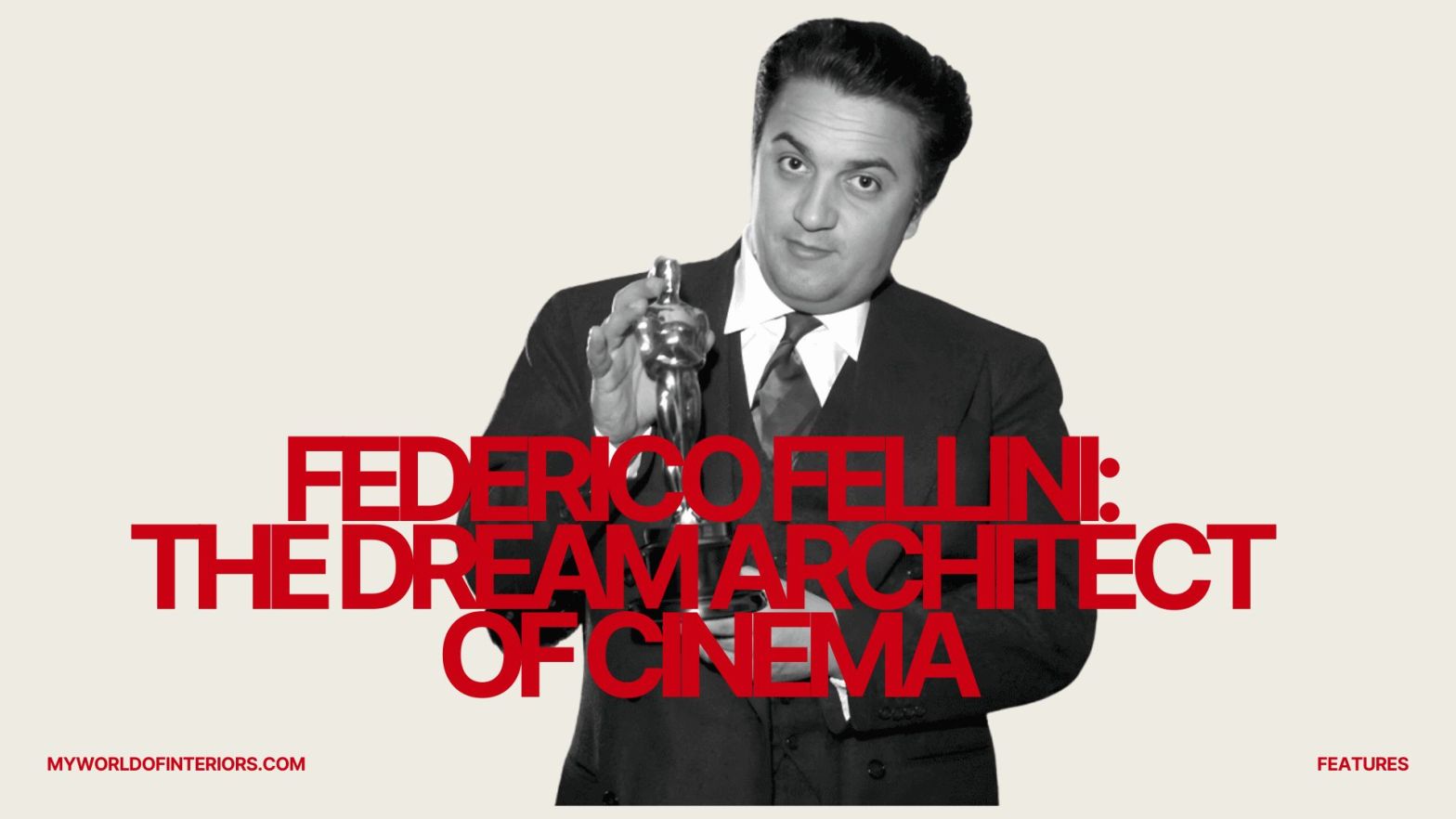
Cinema has produced few visionaries who transformed the medium so thoroughly that their very names became adjectives. Federico Fellini is one of them. “Felliniesque” has entered the lexicon to describe a sensibility that is at once surreal, carnivalesque, erotic, grotesque, and tender — a world where memory and dream coexist, and where the line between the real and the fantastical dissolves.
Across a career spanning nearly five decades, Fellini reinvented Italian cinema, moving from the neorealism of his early collaborations to a singular, baroque style that redefined film as visual poetry. He made movies not simply to tell stories, but to create worlds — ones populated by clowns, saints, prostitutes, dreamers, and lost men searching for meaning in a postwar landscape. His films are less narratives than visions: fragments of memory stitched together by rhythm, image, and spectacle.
From Neorealism to Personal Mythology
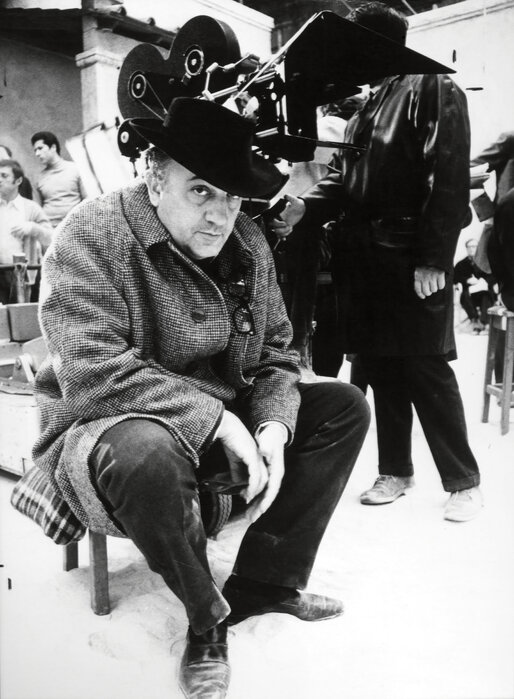
Fellini was born in 1920 in Rimini, a seaside town whose provincial life would become an inexhaustible reservoir for his cinema. In his youth, he studied art and began drawing caricatures — a practice that remained part of his filmmaking process, as he sketched characters before writing them. During World War II, he moved to Rome, where he worked as a screenwriter and cartoonist, eventually collaborating with Roberto Rossellini on Rome, Open City (1945), one of the foundational films of Italian neorealism.
Yet Fellini’s sensibility diverged from neorealism’s austerity. Where Rossellini and Vittorio De Sica pursued documentary-like authenticity, Fellini was drawn to exaggeration, to the mythic and the absurd. His first solo directorial efforts — Variety Lights (1950) and The White Sheik (1952) — already revealed a fascination with performance, spectacle, and the blurred boundary between artifice and reality.
By the mid-1950s, he had moved beyond neorealism into a cinema of inner landscapes. La Strada (1954), which won an Academy Award, told of a brutish strongman and a fragile, clown-like woman, embodying Fellini’s lifelong theme: the collision of cruelty and innocence, despair and grace.
The Felliniesque
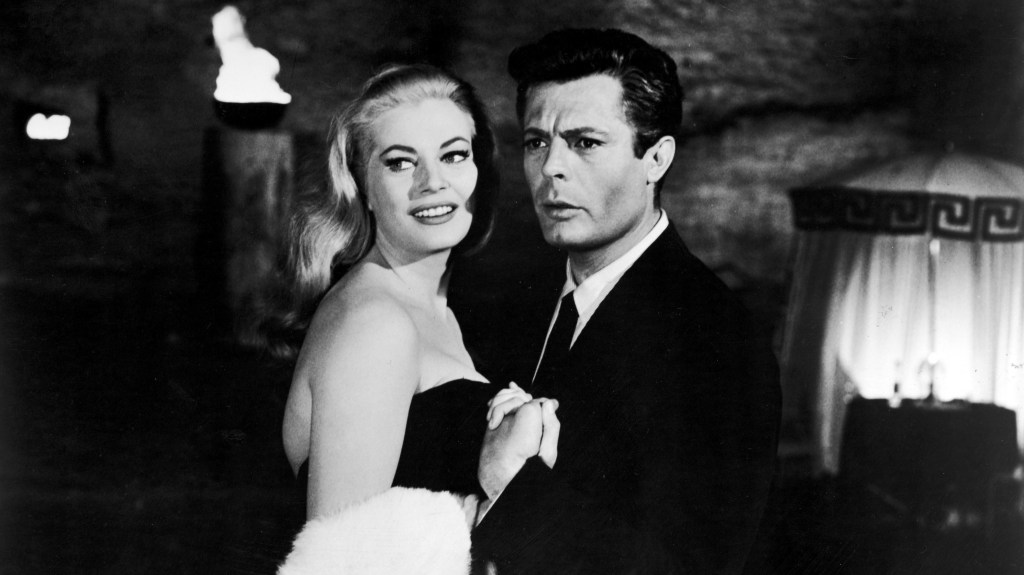
With La Dolce Vita (1960), Fellini arrived at his mature style — a kaleidoscopic meditation on fame, decadence, and spiritual emptiness in modern Rome. Marcello Mastroianni, in his white suits and existential ennui, became the director’s on-screen alter ego. The film’s imagery — Anita Ekberg wading into the Trevi Fountain, helicopters lifting statues over the city — became indelible cultural icons.
8½ (1963) pushed even further, turning inward to explore the creative crisis of a film director. It is perhaps the quintessential Fellini film: nonlinear, dreamlike, filled with visions of childhood, circus, sex, and Catholic guilt. What might have been a solipsistic exercise became instead a universal meditation on memory, imagination, and the chaos of the human mind.
The term “Felliniesque” emerges from these works: not merely surreal, but suffused with longing; not just grotesque, but profoundly humane. He embraced artifice — circus tents, processions, theatrical sets — as metaphors for life itself. In his cinema, the world was a stage, and we are all clowns playing our parts.
Themes and Aesthetics
Several motifs run through Fellini’s oeuvre:
- The Carnival and the Circus: For Fellini, the circus was a metaphor for existence — joyous, chaotic, filled with absurdity and cruelty. Films like I Clowns (1970) explicitly embrace this aesthetic.
- Memory and Autobiography: From Rimini in Amarcord (1973) to the seaside nostalgia of I Vitelloni (1953), Fellini mined his past not for realism but for mythic evocation.
- Women as Muses and Mysteries: Fellini’s female characters, often larger-than-life, represent both desire and spiritual yearning. From Giulietta Masina’s fragile Gelsomina (La Strada) to the voluptuous figures of City of Women (1980), women were central to his vision, embodying both salvation and temptation.
- The Grotesque and the Divine: Fellini’s camera lingers on faces outside the conventional canon of beauty — grotesque, exaggerated, comic — but always with compassion. He was as fascinated by the freakish as by the sublime.
- The Sacred and the Profane: A lapsed Catholic, Fellini oscillated between reverence and mockery, staging religious processions alongside carnivals of excess. This duality gave his cinema its unique texture: irreverent yet never cynical.
Visually, his style was lush, baroque, filled with elaborate tracking shots, dream sequences, and operatic compositions. Working with cinematographers like Gianni Di Venanzo and Giuseppe Rotunno, and composers like Nino Rota, he created a cinematic language instantly recognizable: at once extravagant and intimate.
International Fame and Later Years
By the 1960s and 1970s, Fellini was not merely a filmmaker but a global cultural figure. His films won multiple Academy Awards, and 8½ in particular influenced generations of directors from Woody Allen (Stardust Memories) to Pedro Almodóvar.
In later works such as Amarcord (1973), which won the Oscar for Best Foreign Language Film, Fellini returned to his childhood in Rimini, crafting a memory-piece that fused humor, nostalgia, and political satire. Films like Casanova (1976) and City of Women (1980) were more divisive but continued his exploration of desire, artifice, and excess.
Though his later films did not always enjoy the acclaim of his earlier masterpieces, they deepened his reputation as cinema’s dream architect: an artist for whom memory, myth, and fantasy were as real as stone and flesh.
Legacy
Fellini died in 1993, but his influence is inescapable. To watch contemporary cinema is to glimpse his fingerprints everywhere: in the surreal realism of Almodóvar, the carnivalesque tableaux of Baz Luhrmann, the dreamscapes of David Lynch, the self-reflexive meta-cinema of Paolo Sorrentino (The Great Beauty).
Art historically, Fellini represents a bridge between modernism and postmodernism: a director who absorbed neorealism’s social conscience but turned inward to explore the fractured subjectivity of the self. His films stand as monuments not just of Italian cinema, but of cinema as an art form — works that expanded the language of film into the territory of dream and myth.
In the end, Fellini gave us not stories, but visions: grotesque parades, sensual reveries, sacred rituals, and the inescapable laughter of clowns. He gave us cinema as dream. And once you’ve entered that dream, it never quite leaves you.
Essential Works of Federico Fellini
- Rome, Open City (1945) – Screenwriter (with Roberto Rossellini); a landmark of Italian neorealism.
- Variety Lights (1950) – Co-directorial debut with Alberto Lattuada, exploring performers on the fringes.
- The White Sheik (1952) – First solo directorial effort, satirizing Italy’s obsession with photo-romance magazines.
- I Vitelloni (1953) – A semi-autobiographical tale of provincial youth in Rimini.
- La Strada (1954) – Academy Award winner; a tragic fable of innocence and cruelty, starring Giulietta Masina.
- Nights of Cabiria (1957) – Another Masina triumph, portraying a Roman prostitute searching for redemption.
- La Dolce Vita (1960) – Iconic portrait of decadence in modern Rome; Anita Ekberg in the Trevi Fountain became a cultural emblem.
- 8½ (1963) – A self-reflexive masterpiece about a director’s creative crisis; one of the most influential films in cinema history.
- Juliet of the Spirits (1965) – Fellini’s first color film, an oneiric exploration of female subjectivity, starring Masina.
- Satyricon (1969) – A surreal adaptation of Petronius’ Roman satire, a fever dream of antiquity.
- Amarcord (1973) – Oscar-winning evocation of Fellini’s childhood in Fascist-era Rimini.
- Casanova (1976) – An austere, grotesque reimagining of the Venetian lover’s life, stripping him of romance and leaving spectacle.
- City of Women (1980) – A hallucinatory examination of gender and desire, starring Mastroianni.
- And the Ship Sails On (1983) – A meditation on art, opera, and mortality.
Discover more from My World of Interiors
Subscribe to get the latest posts sent to your email.

