
Above Florence
Villa San Michele, A Belmond Hotel, has just reopened above Fiesole after eighteen months of renovation — and the view from the terrace is, as it has always been, the finest available in Tuscany
There is a concept the Romans called otium — a form of leisure quite distinct from idleness, devoted to contemplation, conversation, and the cultivation of the self through beauty, nature, and ideas. The wealthy Romans who built their hilltop retreats in the hills above the cities understood that the recovery of the capacity for thought required removing yourself from the world at a sufficient elevation to see it whole. Cicero practised otium. Pliny wrote about it. The Florentines of the Renaissance, who had read both of them, built their own version of it in the hills of Fiesole — the ancient Etruscan settlement on the ridge above Florence that looks down on the city the Medicis made and that has, for two and a half thousand years, offered the specific quality of perspective that altitude and distance provide.
Villa San Michele, a Belmond Hotel, has occupied the finest position on those hills since its origins as a fifteenth-century Franciscan convent dedicated to Saint Michael the Archangel. It has been a private villa, a Napoleon-era residence, and since 1982 one of Italy’s most celebrated hotels. On the 28th of April 2026 — nine days ago at the time of writing — it reopened after eighteen months of renovation that constitute the most significant transformation in its modern history. The façade that tradition attributes to Michelangelo, the arched terrace from which Florence spreads below in a panorama that painters have been attempting to document for five centuries, the cloister and the loggia and the terraced gardens: all of it preserved and enhanced, the building’s character deepened rather than altered, with thirty-nine redesigned rooms and suites, the property’s first spa, and a garden that is now one of the most considered pieces of landscape design in Tuscany.
The view from the terrace has not changed. It has not needed to.
The building and its history
The convent was built over six hundred years ago on a site the Fiesolans had considered significant for considerably longer — the ridge had been occupied since the Etruscans settled it in the eighth century BC, and the Romans who came after them understood its strategic and aesthetic value immediately. The Franciscans who established their community here in the fifteenth century understood something else: that a building at this elevation, with this prospect, had a spiritual usefulness independent of whatever doctrine it housed. The view of Florence below — the dome of the cathedral, the towers, the river threading through the valley — was not an amenity but a lesson. This is what human ambition produces, seen from a sufficient height, in the light of the hills.
The façade that faces the road from Fiesole has been attributed, with varying degrees of scholarly confidence, to a design by Michelangelo — the serene Renaissance geometry of it, the proportioned arches, the quality of restraint that characterises the building’s exterior, all speak to the period and the tradition if not the hand. Napoleon Bonaparte used the villa as a private residence, and the suite that occupied his apartments on the first floor — the Grand Tour Suite, spanning the entire piano nobile — has been redesigned in the renovation to honour this specific layering of history without becoming a period recreation. History at Villa San Michele is not curated into themed rooms; it is present in the stone and the proportion and the particular quality of light that a fifteenth-century building receives when the afternoon sun comes through its western windows.
The woodland behind the villa carries the name of Leonardo da Vinci, who is documented to have tested his flying machine designs in these hills — the altitude and the updrafts from the valley making the Fiesole ridge the logical site for a man trying to understand what the air would bear. The renovation has opened the Leonardo woodlands to guests for the first time, with new walking trails and restored ancient stone benches at viewpoints that the monks and the Florentines and Leonardo himself used before anyone thought to make them accessible to paying guests.
The renovation: what Luigi Fragola Architects understood
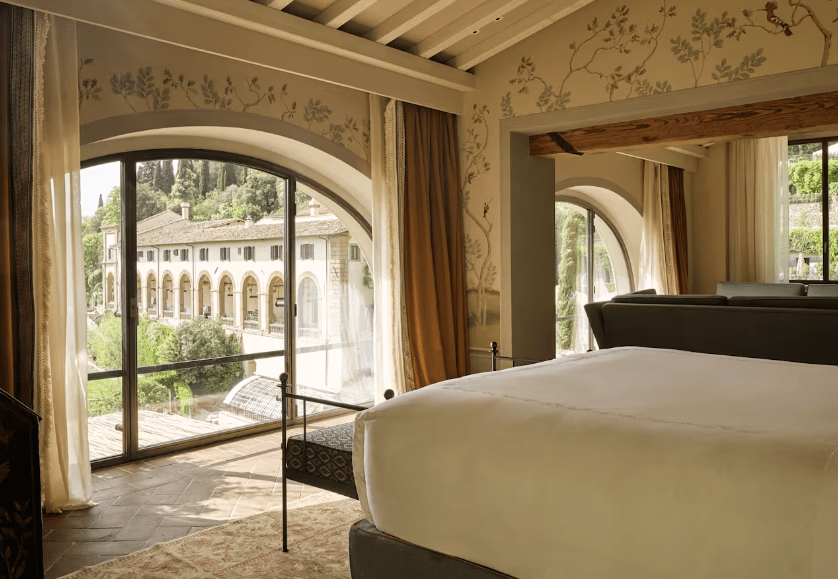
The renovation was entrusted to Luigi Fragola Architects, a Florence-based firm whose portfolio in luxury hospitality extends across Italy and whose understanding of the specific problem — how to bring a fifteenth-century building into the present without diminishing either — is evident in every decision made here. The materials answer the building: floors of Impruneta terracotta, the warm red earth of the Tuscan hills fired in the kilns that have been producing it since the Medicis used it for the floors of their own buildings; bathrooms clad in Cipollino marble from Carrara, the distinctive green-veined stone that runs through Tuscany’s quarrying tradition; bespoke carpentry and hand-painted frescoes that belong to the building’s decorative vocabulary rather than being applied to it from outside.
The thirty-nine rooms and suites divide between the main monastery building and the garden buildings, and the division is meaningful. The rooms within the main building have the quality of the building itself — high ceilings, deep-set windows, the thickness of walls built to last centuries — while the garden suites are oriented outward, their interiors in deliberate dialogue with the terraces and planting beyond. Both categories share the view, because at Villa San Michele the view is not optional. It is the building’s primary argument and has been since the monks looked up from their prayers and saw the same Florence that the guests now see from their beds.
Three signature suites anchor the redesign. The Limonaia, occupying two storeys of the former orangery deep in the garden — the room that has the quality of a private Fiesolean villa, with its own library, its accumulated curios and artwork, and a private plunge pool in the garden below. The Grand Tour Suite, Napoleon’s rooms, spanning the entire first floor of the main building with the complete panorama of Florence through its windows. The Botanica, which takes the gardens themselves as its subject — the room whose interior is in continuous conversation with the planting beyond the glass, the botanical collections and the Renaissance blooms that the garden now contains framed as views from every angle.
The garden as argument
The gardens at Villa San Michele have always been extraordinary — 9,700 square metres of terraced landscape on the Fiesole hillside, the wisteria vine that weaves along the east-facing façade marking the seasons, the citrus trees that the Medicis prized as symbols of knowledge and the golden age. The renovation entrusted their redesign to Luca Ghezzi Garden Design, whose mandate was to restore the historical aesthetics of the traditional Fiesole hillside garden while creating new points of discovery: hidden nooks, restored fountains, newly framed viewpoints that open the garden’s relationship to the landscape below.
The planting is historically specific: iris, the centuries-old emblem of Florence, whose image appears on the city’s coat of arms and which now returns to the Villa’s borders in abundance; roses of the rambling varieties that the Renaissance gardens favoured; lavender and rosemary and the herb garden that supplies the kitchen. The citrus collection — lemons and oranges and bergamot in terracotta pots across the terraces — is a deliberate echo of the Medici tradition of collecting citrus as living emblems of sophistication and taste. The garden is not decorative. It is, in the Renaissance sense, an argument about civilisation and its relationship to the cultivated landscape.
The concept the Belmond team uses for the garden’s philosophy is otium — the Roman idea with which this piece began, the form of leisure that the hilltop retreat makes possible. Paved avenues that alternate with hedges, panoramic terraces, flowerbeds, botanical collections: the garden is designed as a sequence of experiences rather than a single view, each space calibrated to a different quality of attention, from the social terraces that look over Florence to the hidden nooks in the deeper garden where solitude and the sound of the hillside are the only company.
The spa and the Bar Doccia
The Villa San Michele Spa by Guerlain is the building’s first spa in its history — a fact that requires a moment, given that the property has been in some form of hospitality use for over a century. The spa occupies space within the historic Franciscan convent, entered through a Secret Garden whose threshold is marked by hand-painted frescoes by the Florentine artist Elena Carozzi — tumbling botanical imagery that blurs the boundary between interior and garden in a way that sets the tone for what follows. Inside: three treatment rooms, including a double suite; surfaces of natural stone and glowing onyx and straw marquetry and polished marble; and a treatment menu that draws on both Guerlain’s two centuries of wellness expertise and the specific heritage of the monks who once lived in these rooms — rituals using Tuscan botanicals, stone tools, the kind of physical attention to the body that the Renaissance understood as inseparable from the cultivation of the mind.
The Bar Doccia, recently renovated, sits between the cloister and the gardens in the position a bar in a former monastery should occupy: adjacent to contemplation, opening toward the evening. The drinks programme runs from botanical cocktails — the Woodland, with gin, lemon verbena, lavender cordial, and mountain pine liquor, is the signature — to classic Negroni interpretations and the full range of Tuscan wines. In the late afternoon, when the light from the valley is going golden and the view of Florence below begins its evening transformation, the Bar Doccia terrace is one of the finest places in Italy to be doing nothing in particular.
The table and the programme
Executive chef Alessandro Cozzolino leads a new gastronomic restaurant that operates across three dining spaces, each oriented toward the Florence skyline — the view doing the work that no amount of interior design can replicate. The cooking is Tuscan in the way that the building is Tuscan: rooted in the specific traditions of the region, built on ingredients from the surrounding landscape, neither nostalgic nor aggressively contemporary. The herb and kitchen garden supplies the kitchen directly; the citrus trees supply the bar. The connection between what grows on the hillside and what arrives at the table is short and legible.
The cultural programme — a weekly schedule that the renovation has formalised for the first time — draws on the Villa’s proximity to both Florence and the Fiesole School of Music, one of Italy’s most distinguished conservatories. Classical and jazz performances take place in the garden and the cloister; creative workshops in calligraphy and watercolour painting are offered to guests who want to engage with the Florentine artistic tradition in something other than the passive register of museum visiting. The La DoubleJ partnership — the Milanese lifestyle brand whose founder JJ Martin has developed a programme of yoga, sound healing, and energy-focused workshops specifically for the Villa — adds the contemporary wellness dimension that the Guerlain spa anchors.
The renovation has also extended the season: Villa San Michele, which previously closed in winter, now operates from spring through winter. The argument for visiting outside the summer peak — when the garden is not at its most abundant but the hills are clear and the light on Florence in the cold months has the specific quality of Tuscan winter, and when the city below is navigable in a way that July does not permit — is one the hotel is now able to make for the first time.
Fiesole and Florence below
The villa’s position — above Florence, within it by shuttle, separate from it by altitude and atmosphere — is what makes it a different proposition from a city hotel, however excellent. Staying at Villa San Michele means sleeping in the hills and descending to Florence rather than sleeping in Florence and looking up at the hills, and the difference is not merely directional. The ability to return, in the evening, to a building that is quiet and high and essentially rural — to have the city as a destination rather than a context — changes the relationship with Florence in ways that a week inside it cannot.
The complimentary shuttle to Florence runs throughout the day. The journey takes twenty minutes along the road from Fiesole to the city. The Uffizi, the Accademia, the Bargello, the Brancacci Chapel, the Oltrarno neighbourhood where the artisans and the best restaurants and the less visited churches are concentrated: all of it within reach, all of it returnable from. The Fiesole archaeological site — the Roman theatre and baths carved into the hillside above the town — is a ten-minute walk from the hotel and one of the finest Roman remains in Tuscany, largely ignored by visitors who have come for the Uffizi and not looked up.
The essentials
Villa San Michele, A Belmond Hotel, Florence
Via Doccia 4, 50014 Fiesole, Florence, Italy
Reopened 28 April 2026 following 18-month renovation.
http://www.belmond.com/hotels/europe/italy/florence/belmond-villa-san-michele
Rooms
39 rooms and suites: 27 suites and 12 rooms, designed by Luigi Fragola Architects. Three signature suites: Limonaia (former orangery; two storeys; private plunge pool), Grand Tour (Napoleon’s apartments; entire first floor), Botanica (garden-facing; botanical interiors). Book directly through Belmond.
Spa
Villa San Michele Spa by Guerlain. Three treatment rooms including a double suite. Secret Garden entrance; hand-painted frescoes by Elena Carozzi. First spa in the property’s history.
Dining
Gastronomic restaurant — executive chef Alessandro Cozzolino; three dining spaces; Florence skyline views; Tuscan cuisine from the kitchen garden.
Bar Doccia — between cloister and garden; aperitivo and digestif; botanical cocktails; Negroni interpretations.
Gardens
9,700 square metres redesigned by Luca Ghezzi Garden Design. Renaissance plantings: iris, citrus, climbing roses, lavender. Leonardo woodlands with new walking trails. Hidden nooks; restored fountains; panoramic viewpoints over Florence.
Programme
Live music by the Fiesole School of Music — classical and jazz in the garden and cloister.
Creative workshops: calligraphy, watercolour painting.
La DoubleJ wellness partnership: yoga, sound healing, energy workshops.
Complimentary shuttle to Florence throughout the day.
Getting there
Fly to Florence Peretola Airport (FLR) — 20 minutes from the hotel. Alternatively, fly to Pisa Galileo Galilei Airport (PSA), approximately 90 minutes by road. The hotel shuttle from Florence city centre runs daily; taxis from the city are 25–30 minutes. The drive up to Fiesole on the Via Vecchia Fiesolana — the old road through the olive groves — is itself the correct beginning of a stay.
When to go
May through June for the garden at its most spectacular and Florence before the summer peak. September and October for the harvest light and the thinner crowds. Winter — now available for the first time — for a Florence that belongs to its own residents and the rare visitor who has thought to come.
Discover more from My World of Interiors
Subscribe to get the latest posts sent to your email.

