Makers & Rooms
Ivan Van Mossevelde built a house of raw concrete in the Flemish countryside in 1972 for an art collector who filled it with Judd and Sol LeWitt. Decades later, a young architect spotted it through the trees during a walk, was refused entry, and spent years waiting for it to come to him. The story of how Glenn Sestig came to live in someone else’s masterpiece is a story about what serious architecture does across time — and what it means to inherit a vision rather than impose your own.
By Bergotte
There is a moment, in the account that Glenn Sestig gives of the day Ivan Van Mossevelde came to see what had been done to his house, that stops you. Van Mossevelde was old by then — the house he had designed in 1972 for the art collectors Roger and Hilda Matthys-Colle in Sint-Martens-Latem, a village on the Leie river in the Flemish countryside south of Ghent, was more than four decades behind him, one of the early works of a long career that had taken him across Belgium and eventually to Italy, where he had spent years restoring a ruined medieval village in Lazio. Sestig had acquired the house in 2017, had spent years on its restoration, and had invited the architect to see the result. Van Mossevelde walked through the rooms, looked at the concrete, looked at what had been kept and what had been changed, at the natural stone floors in soft grey that had replaced the carpets, at the floating concrete staircase in the courtyard, at the skylights that had been maintained exactly as designed. And he had tears in his eyes.
The tears are the essay, really. They contain, in a single human response to a single encounter, everything that the story of this house and these two architects is about: the vulnerability of the serious maker before their own work, the particular emotion of the person who built something finding it, after decades, not merely standing but understood — inhabited by someone who had loved it from a distance long before they could possess it, who had seen in it exactly what the architect had intended and who had chosen, when the moment of possession came, to preserve rather than to impose. Van Mossevelde had spent his career building things in a formal language that the Flemish mainstream found difficult and that the international architectural press largely ignored. To find that the person now living in one of his most demanding buildings was one of the most respected architects of the next generation — and that the next generation had not changed the building but deepened it — was something that cannot be accounted for in any vocabulary except the emotional one.
This is an essay about two architects and one house, but it is also an essay about what happens to architecture across time — about the relationship between the maker and the inheritor, between the building as it was conceived and the building as it is lived in, between the formal intelligence of the original design and the different formal intelligence that chooses to receive it rather than replace it.
Wachtebeke, 1940
Ivan Van Mossevelde was born in 1940 in Wachtebeke, a small municipality in the East Flanders province of Belgium, and studied architecture at the Sint-Lucas Kunsthumaniora Institute in Ghent, graduating in 1962. The Sint-Lucas tradition — Catholic, craft-oriented, rooted in a different understanding of modernism from the more theoretically driven schools — gave him a formation that was practical and visual in equal measure, and the work he produced from the mid-1960s onward reflects both qualities: buildings of considerable formal rigour whose intelligence is manifest in the physical reality of the thing rather than in any theoretical programme surrounding it.
Belgium has produced, in the twentieth century, a tradition of domestic modernism that is among the most serious in the world and among the least internationally celebrated — a tradition that includes figures like Juliaan Lampens, whose concrete houses in the Flemish countryside pushed the raw material toward an almost spiritual severity, and Jules Wabbes, whose furniture sits in the same formal territory as the best of the Scandinavians without ever having received comparable recognition. Van Mossevelde belongs in this tradition, and his work of the 1960s and 1970s in particular — the houses built in the villages along the Leie, in concrete and with the formal economy that the material at its most honest demands — constitutes one of the most coherent bodies of domestic architecture produced in postwar Belgium.
He had an exhibition of his work from 1970 to 1980 that was called, simply, Living in Silence — a title that was given by the work rather than imposed on it, that captured the specific quality of the spaces he produced: interiors whose character was determined by the absence of the unnecessary, by the concrete that said what it was and asked the inhabitant to meet it on its own terms, by the light that entered through carefully positioned skylights and did its work without apology or decoration. Living in silence: not the silence of emptiness but the silence of the thing that has been said completely and requires no elaboration. This is a demanding aspiration for domestic architecture, whose clients typically want more rather than less, warmth rather than severity, the readable comfort of the conventional interior rather than the challenge of the unconventional one.
The clients who commissioned the houses that constitute the best of his early work were not conventional clients. Roger and Hilda Matthys-Colle, for whom he designed the house in Sint-Martens-Latem in 1972 that would eventually become Sestig’s home, were among the most significant art collectors in postwar Belgium — a neuropsychiatrist and his wife who had been at the centre of the Ghent contemporary art world since the 1950s, who had co-founded the Friends of the Museum of Contemporary Art in Ghent, whose acquisitions of work by Carl Andre, Dan Flavin, Donald Judd, and Robert Ryman had been made at a time when the Belgian institutional world was largely indifferent to American Minimalism. They were people whose relationship to the art they collected was as serious as any relationship to art can be, who understood that the space in which art was lived with was as much a part of the artistic experience as the works themselves. The house Van Mossevelde built for them was not a neutral container for their collection. It was a building that shared the collection’s formal values.
The House in the Forest
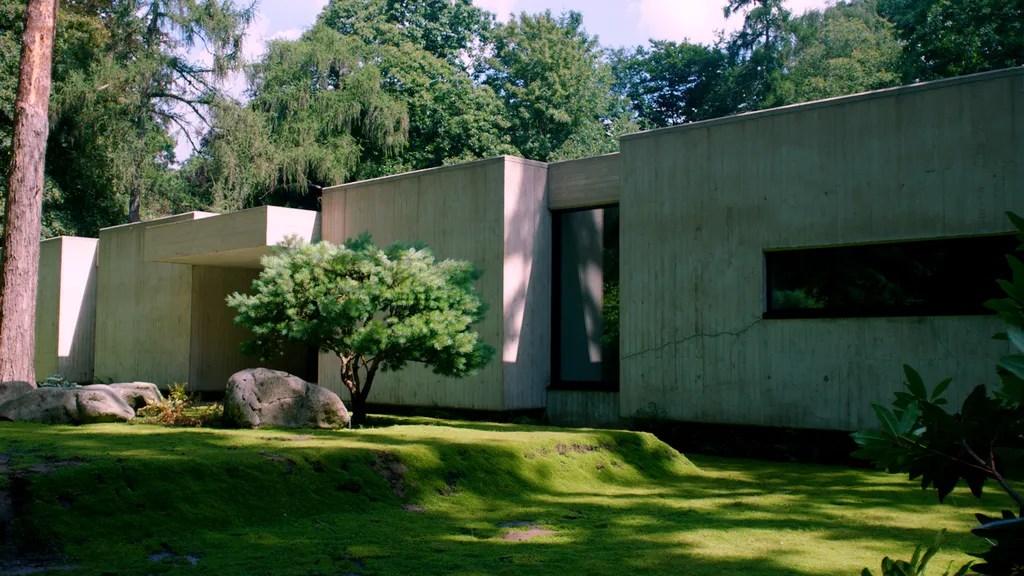
The building Van Mossevelde designed for the Matthys-Colles is a rectangular volume in raw reinforced concrete, its corners rounded rather than sharp — a detail that softens the mass without compromising the material’s honesty, that gives the building a quality of having been shaped rather than merely poured. The plan is organised around an open courtyard at the building’s heart, the main living spaces arranged on the ground level in a single continuous sequence that is simultaneously open and organised, neither the free plan of Corbusian orthodoxy nor the room-by-room compartmentalisation of conventional domestic planning. Skylights cut through the concrete ceiling at specific points, admitting light that is directed rather than general — light that falls on particular surfaces and particular spaces rather than illuminating the whole uniformly, that creates within the interior a sequence of lit and unlit zones whose rhythm gives the spaces their character.
One of the building’s most admired features — admired by Sestig himself, who has said that even he might not have thought of it — is the treatment of the garage entrance. Van Mossevelde designed a bridge one metre from the window, with a concrete wall and planting beyond it, so that the person sitting inside the house cannot see the garage ramp at all. The functional necessity is present and fully served. Its visual intrusion into the interior experience is entirely eliminated. This is the kind of solution that reveals, in a single detail, the quality of the architect’s thinking: the detail that is invisible because it has been thought about so carefully that its presence is felt only as the absence of the problem it solves.
Into this building the Matthys-Colles brought their collection. Sol LeWitt came and made a wall drawing in the house — one of the in situ works that the American Minimalist produced in the homes of collectors whose relationship to his work was serious enough to support the gesture. The wall drawing is still there. It is the only object that remains from the original inhabitation of the house, the single thread connecting the collection that filled the building for its first decades to the very different collection that fills it now. The presence of the LeWitt in a house that now belongs to Glenn Sestig — a house whose current inhabitant owns a Zaha Hadid sofa and a Carlo Scarpa sofa and an Oscar Niemeyer bench and a portrait of Robert Mapplethorpe photographed by Patrick Robyn, husband of Ann Demeulemeester — is not an anachronism. It is a continuity: the building’s capacity to hold serious art of any period or tendency, to provide, in its concrete silence, a space in which the work can be what it is without the architecture competing with it.
The Walk Through the Forest
Glenn Sestig grew up in the Ghent area and studied architecture with a formation that was, from the beginning, organised around the figures whose formal intelligence he found most compelling and most demanding: Mies van der Rohe, Frank Lloyd Wright, Carlo Scarpa. These are not casual influences. They are the architects whose work requires the most from the person who takes it seriously — whose details demand the most sustained attention to understand and the most exacting craft to execute, whose spatial intelligence is of a kind that cannot be approximated but only met or failed. A designer formed on Mies and Scarpa is a designer who has set themselves a high standard, and who knows, consequently, exactly how far short of that standard most of the built world falls.
He was a young architect, walking through the forest near Sint-Martens-Latem, when he first saw the Van Mossevelde house. The encounter was accidental — he came upon it through the trees, saw the concrete through the vegetation, understood immediately that he was looking at something serious. He approached the house and asked the owner if he could have a tour. They declined. He took a photograph of the nameplate and the street, and made himself a promise: if this house were ever to be sold, he would write a letter.
The promise was kept over approximately twenty-five years — a period during which Sestig founded his practice, established his reputation with the Soap hair salon in Antwerp in 1998, built a body of work that made him one of the most respected architects in Belgium, and did not forget the house in the forest. He acquired it in 2017, when the opportunity finally came, and began the restoration that would take the building that Van Mossevelde had designed forty-five years earlier and make it habitable for a different life without making it a different building.
The waiting matters. It is not incidental biographical detail but structural to the story of what the house has become under Sestig’s occupation. A person who has wanted a building for twenty-five years and has spent that time developing, independently and in parallel, a formal intelligence of their own that is deeply continuous with the building’s formal intelligence, brings to the act of possession a quality of understanding that the immediate acquisition can never produce. Sestig did not buy the Van Mossevelde house because he needed a house. He bought it because he understood it — had understood it, in some important sense, from the moment he first saw it through the trees — and because that understanding was the most important qualification for its occupation.
Glenn Sestig and the Monumental Interior
Sestig’s practice, founded formally in 1999 and based in Ghent, has developed over twenty-five years into one of the most consistently serious architectural offices in Belgium — serious in the specific sense that the word carries when applied to the architects who have formed this series’ understanding of what serious making looks like: not grandiose, not self-promotional, not organised around the formal gesture for its own sake, but consistently attentive to the specific problem of the specific space and the specific person who will inhabit it. He has described his work as not minimalist per se but monumental, symmetrical and sophisticated — a distinction that matters, because minimalism in the fashionable sense tends toward the ostentatiously sparse, the designed absence that calls attention to itself as much as any designed presence would. What Sestig is after is something more like the quality that Van Mossevelde’s work has: the silence of the thing that has been said completely, the room that is exactly what it needs to be and nothing less and nothing more.
His influences outside architecture — he has worked with Raf Simons, Pieter Mulier, and Olivier Theyskens, and considers fashion and architecture to be expressions of the same intelligence rather than separate disciplines — give his interiors a quality of material sensuousness that pure architectural thinking alone does not always produce. He understands how surfaces feel as well as how they look, how the body moves through a space and what the space owes the body in motion, how the selection of a specific stone or a specific textile or a specific object changes the character of a room not merely visually but physically, in the way that the room registers on the person inhabiting it below the level of conscious attention. The Van Mossevelde house, whose concrete exterior prepares visitors for an interior colder than the one they find, was the ideal test of this understanding: could the material warmth that Sestig’s work is known for be introduced into a building of extreme formal austerity without compromising the austerity? Could the building be lived in, fully and generously, without being softened?
The answer, by every account, is yes. The restoration enhanced the building’s brutalist character rather than accommodating it: discreet modern window frames replaced the original ones, the carpets were removed in favour of natural stone floors in soft greys that brought the material palette into harmony with the concrete without competing with it, the central courtyard was redesigned around a floating concrete staircase and a newly planted tree. The skylights that Van Mossevelde had used to direct light into specific spaces were not merely maintained but studied — Sestig has said that living in the house has changed his own architectural practice, that he now uses skylights more in his work having understood, from daily inhabitation of Van Mossevelde’s, what they can do to a room across the full cycle of the day and the year.
The Collection and the Conversation
The objects that Sestig and his partner Bernard Tournemenne — an artist and the creative director of Glenn Sestig Architects — have assembled in the house constitute a collection of unusual seriousness and unusual range. A Carlo Scarpa sofa from the Ultrarazionale series, the only sofa collection Scarpa ever designed. An Oscar Niemeyer Marquesa bench. A Zaha Hadid Moraine sofa. A chair that the architect Gaston Eysselinck designed for the Ostend Post Office. A ceramic by the sculptor Guy Bareff. A structure by Pierre Caille, of which only three exist in the world. Italian street furniture from an unknown designer. Light fixtures from a Tennessee collection that Sestig designed himself for the manufacturer Ozone.
What is striking about this assembly is not its prestige — though the prestige is real, these are objects of genuine significance — but its coherence. Each object has been chosen for a feeling rather than a programme, for the quality that Sestig describes as being really well done and resonating with him, and the result is a collection that is as formally various as it is formally unified: Scarpa and Hadid and Niemeyer and an unknown Italian street furniture designer, objects from a century of design history and several continents, held together by the same quality of attention that selected each one and by the building that contains them all.
The building that contains them is doing what the best architecture does: providing the conditions in which objects and lives can be fully themselves without the architecture competing with either. The concrete is present — massively, undeniably present — but it does not dominate in the way that the photographs of the exterior suggest it might. It provides, instead, a ground: a surface against which the Niemeyer bench and the Sol LeWitt wall drawing and the portrait of Mapplethorpe and the cat named Tanit after the goddess of Ibiza can all be read clearly, without the blurring that an over-designed interior produces. The building is not a neutral container. It has a strong and specific character that shapes everything that happens inside it. But it is generous enough in that character — honest enough, resolved enough — to accommodate rather than exclude the life that Sestig and Tournemenne have brought to it.
The Sol LeWitt Thread
The wall drawing that Sol LeWitt made in the house for Roger and Hilda Matthys-Colle is not a decoration and was never intended to be. LeWitt’s wall drawings — executed by assistants according to written instructions, site-specific by definition, destroyed when the wall they inhabit is destroyed or painted over — were among the most radical propositions in the art of the 1970s: works that belonged to a specific place rather than to a portable object, that existed only in the relationship between the artist’s instruction and the specific surface that received it. That the Matthys-Colles commissioned one for their home in Sint-Martens-Latem, and that Van Mossevelde designed a concrete house sufficiently serious to receive it, is a measure of the seriousness of both the collectors and the architect.
That Sestig kept it — that it is the only object from the original inhabitation that remains in the house — is the most significant decision of the restoration, and the one that most clearly expresses what the restoration was about. The LeWitt is not Sestig’s choice, in the sense that he did not select it from the open market. It came with the building, was part of the building in the most literal sense — drawn on its walls, inseparable from its concrete surfaces. To remove it would have been to damage the building’s history, to sever the thread connecting the house’s present occupation to the cultural seriousness of its original one. Sestig chose not to sever it. The LeWitt remains, and its remaining says everything about how Sestig understands his relationship to what Van Mossevelde made: not as its new owner but as its current custodian, responsible for what was there before him and for what will come after.
What the Building Teaches
Sestig has said that the house continues to teach him things about architecture — that the experience of living inside Van Mossevelde’s formal intelligence has changed his own practice in ways that no amount of critical study or professional engagement with the building could have produced. The skylight detail is the example he gives most readily: he now uses skylights differently in his own work, having understood from daily life in the Sint-Martens-Latem house what a skylight can do to a room across the hours of a single day and across the seasons of a Flemish year. But the teaching is presumably broader and less easily specified than a single detail: the teaching of what it means to live inside a sustained formal conviction, to encounter daily a set of decisions made at the highest level of seriousness and to find, in that encounter, both a standard and a resource.
This is the deepest argument that the story of these two architects and this house makes: that the relationship between the serious architect and the serious building is not exhausted by the act of making or by any single act of occupation, but extends across time in ways that neither the maker nor the first inhabitant can fully anticipate. Van Mossevelde made something in 1972 that he could not know would be inhabited, fifty years later, by a person whose formal intelligence was continuous enough with his own to understand it completely and different enough from his own to extend it in directions he had not foreseen. The building made that encounter possible. The building held the possibility of that encounter in its concrete, through the decades of the Matthys-Colle collection and through the years of subsequent ownership, until the right inheritor arrived.
When Van Mossevelde stood in the rooms he had made in 1972 and saw what Sestig had done with them — the floors, the courtyard staircase, the maintained skylights, the Sol LeWitt on the wall exactly as he had left it — he had tears in his eyes. The tears were not nostalgia. They were recognition: the recognition that the building had found, across fifty years, exactly the person it needed to find. This is what the serious building does, if it is allowed to stand long enough: it waits, in its concrete silence, for the intelligence capable of meeting it. The waiting is the work. The meeting is the reward.

Leave a Reply