
Venice · Art · 2026
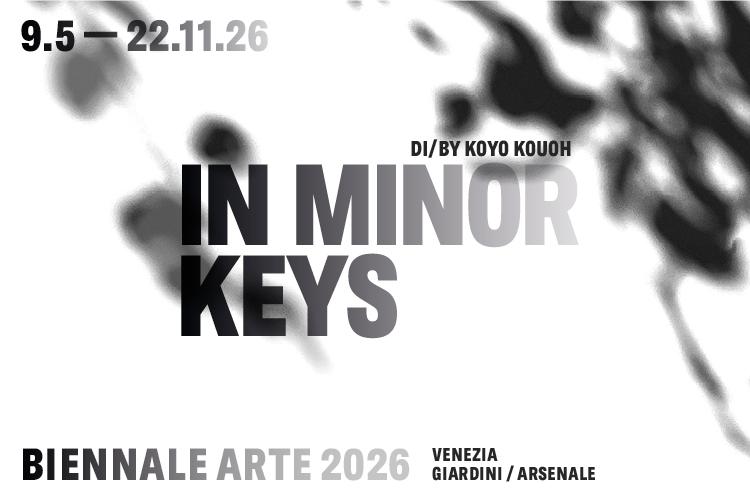
The 61st Venice Art Biennale opens on May 9th under the title In Minor Keys. Its curator, Koyo Kouoh, died a year ago. The show goes forward entirely as she conceived it — and it may be the most important Biennale in a generation.
By Bergotte · Preview, May 2026
This essay is written days before the 61st International Art Exhibition opens to the public. It is, necessarily, a preview — an attempt to understand what a show is for before the show can speak for itself.
In May 2025, Koyo Kouoh sent her curatorial text to the President of La Biennale di Venezia. The text was dated April 8, 2025, and had been completed during a gathering at RAW Material Company in Dakar — the cultural centre she had founded, the space she had built from nothing into one of the most significant platforms for contemporary art on the African continent. She had been appointed curator of the Venice Art Biennale just months earlier, in November 2024, becoming the first African woman ever named to the role. She had already selected her artists, defined her themes, assembled her team. The exhibition was, in all its essential architecture, done. Weeks later, she died. She was fifty-seven years old.
The Biennale opens on May 9th, eleven days from the writing of this essay, without her. It opens entirely as she conceived it — the institution’s decision, made with the full support of her family, carried forward by the team she had personally selected: Gabe Beckhurst Feijoo, Marie Hélène Pereira, and Rasha Salti as advisors; Siddhartha Mitter as editor-in-chief; Rory Tsapayi as research assistant. It opens under her title, with her 111 artists, structured around her motifs, in her voice. This is, depending on how you look at it, either an act of profound institutional respect or a situation without precedent in the history of the event — probably both simultaneously. What it is most certainly is a Biennale haunted, before it has opened, by the ghost of the person who made it.
She had been appointed the first African woman ever to curate the Venice Art Biennale. She had completed her curatorial vision. Weeks later, she died. The show opens entirely as she conceived it.
Who Koyo Kouoh Was
She was born in Cameroon in 1967, raised in Zurich, and educated across two continents in the institutional languages of European contemporary art and the lived languages of the African diaspora. She founded RAW Material Company in Dakar in 2008 — a space for art, criticism, and residency that operated, from its beginning, on the conviction that the infrastructure of contemporary art was a political question, that where things were made and discussed and shown mattered as much as what was made and discussed and shown. She became executive director and chief curator of Zeitz MOCAA in Cape Town in 2019, transforming it into one of the most serious platforms for African and African diaspora contemporary art in the world.
Her exhibitions were known for their historical reach and their ethical precision. When We See Us: A Century of Black Figuration in Painting, shown at Zeitz MOCAA in 2022, assembled more than a century of Black self-representation in the painted image and was received, internationally, as a reckoning — with the canon, with the archive, with the question of whose image-making the history of painting had been willing to take seriously. Still (the) Barbarians at the Aarhus Biennale in 2016, and Dig Where You Stand at the Carnegie International in 2018, both explored the residues of colonialism and the possibility of repair through collective memory. The through-line was consistent: the belief that art was not a neutral space but a contested one, and that the contest mattered, and that the curator’s job was to create the conditions in which the contest could be conducted with maximum honesty and minimum evasion.
What In Minor Keys Proposes
The title comes from music — from the minor key as a register of quieter emotional truths, of melancholy and intimacy and reflection, as opposed to the major key’s triumphalism and resolution. Kouoh’s own words for it are among the most beautiful things written about a Venice Biennale in recent memory. The minor keys, she wrote, refuse orchestral bombast and goose-step military marches and come alive in the quiet tones, the lower frequencies, the hums, the consolations of poetry — portals of improvisation to the elsewhere and the otherwise. The minor keys ask for listening that calls on the emotions and sustains them in return.
The theoretical framework draws on Édouard Glissant’s philosophy of relation — the Caribbean thinker’s argument that the world is better understood as a network of encounters and creolisations than as a set of fixed identities — and on Toni Morrison and Patrick Chamoiseau, writers whose work has always been conducted in minor keys, in the registers of the overlooked and the undercounted and the survived. This is, politically and aesthetically, a deliberate departure from recent Biennales, which have tended toward the spectacular and the numerous. Kouoh’s edition has 111 participants — compared to the 200-plus of recent editions — and the reduction is itself a statement: about attention, about depth over breadth, about the kind of looking that is only possible when you are not overwhelmed.
The minor keys refuse orchestral bombast. They come alive in the quiet tones, the lower frequencies, the hums, the consolations of poetry — portals of improvisation to the elsewhere and the otherwise.
The Structure of the Show
The exhibition is organised around a set of loose, overlapping motifs rather than rigid thematic sections: Shrines, Procession, Schools, Rest, and Performances. The word that recurs in descriptions of all of them is listening — a quality of attention that slows down rather than accelerates, that makes space for what arrives quietly rather than spectacularly.
At the centre of the exhibition is Shrines — large-scale presentations of two artists who function as guiding presences: Issa Samb, the Senegalese artist, poet, and playwright who was a lifelong mentor to Kouoh and whose work she credited with inspiring the founding of RAW Material Company; and Beverly Buchanan, the American artist whose work exploring Black Southern vernacular architecture has been significantly under-recognised. That the dead are honoured at the centre of a show conceived by someone who is also now dead gives the exhibition a dimension that could not have been anticipated — a dimension of grief that the show will carry whether or not it was intended.
The Procession motif draws on Afro-Atlantic traditions of collective movement and gathering, with works by artists including Nick Cave, Ebony G. Patterson, Pio Abad, and Alvaro Barrington. Schools foregrounds artist-led spaces of collective learning — RAW Material Company in Dakar, GAS Foundation in Lagos, the Nairobi Contemporary Art Institution — dissolving the boundary between the institution of the Biennale and the institutions it represents. Rest creates spaces of pause throughout the exhibition, a structural decision of some boldness in an event that typically organises itself around stimulation rather than its opposite. There will be rest spaces. There will be a procession of poets. There will be, Rory Tsapayi has said, the opportunity for contemplative pause — a phrase that would sound banal in most curatorial contexts and in this one feels like a political act.
The Relational Geography
What distinguishes Kouoh’s artist selection from most recent Biennales is its geographic logic. The show connects artists from Dakar, Beirut, Paris, Nashville, San Juan, Lagos, Nairobi — cities brought together not by institutional proximity to the established centres of the art world but by what Kouoh called relational geography: a network of encounters built over time, shaped by decades of dialogue and collaboration across distance and difference. The artists she has selected were chosen because they are in conversation with each other, because their practices rhyme across contexts that the conventional art world tends to treat as separate.
This is a curatorial position with deep roots in Glissant’s thinking, and it has practical consequences: the show will include artists who are well known in their own regions and largely invisible in the European and American art world — artists for whom this Biennale will be, in the fullest sense, an introduction. That Kouoh is not alive to conduct those introductions in person, to stand in the rooms and explain the connections and point out the resonances, is the loss the show carries through all of its motifs. Her team carries her intentions with what appears, from outside, to be extraordinary fidelity and care. It is not the same thing. It is what is available.
What the Absence Does
There will be no Golden Lion for Lifetime Achievement at this Biennale. Kouoh did not finalize her choices before she died and the institution has decided, correctly, that the award belongs to her selection and to no one else’s. The absence of the prize is itself a statement — about what cannot be substituted, about what a particular intelligence brought to a curatorial act that no one else can supply. The prizes for best national participation and best work in the main exhibition will be awarded. But the highest honour will not be given. The floor will hold that space empty.
This is, as institutional gestures go, a quietly devastating one. The Venice Biennale is an event organised around authority and recognition — around the question of what the art world currently values and how it distributes its attention. To open a Biennale without its highest prize, in honour of the person who cannot receive hers, is to acknowledge that something irreplaceable has been lost and to refuse to paper over the loss with a ceremony. It is, in the vocabulary of the show itself, a minor key.
To open a Biennale without its highest prize, in honour of the person who cannot receive hers, is to refuse to paper over the loss with a ceremony. It is, in the vocabulary of the show itself, a minor key.
Why It Matters
Venice Biennales are weather vanes. They tell you, with imperfect but genuine accuracy, which direction the art world’s intellectual winds are blowing — what questions it has decided to take seriously, whose voices it has decided to amplify, what it is currently able to see and what it remains unable to. Kouoh’s edition is a weather vane pointing in a direction that the institution has been slow to face: toward the Global South not as a source of exotic variety but as a centre of gravity, toward listening as a curatorial practice, toward smallness and depth over spectacle and breadth, toward the consolations of poetry rather than the bombast of the major key.
That this direction was set by a woman who did not live to see it enacted gives the whole enterprise a particular weight. Kouoh spent her career building institutions in places that the art world had decided were peripheral, making arguments that the art world was only intermittently willing to hear, insisting with patient and relentless intelligence that the infrastructure of culture was a political question and that the question had not been honestly answered. She was given the largest platform in contemporary art and she used it to make the same argument she had always made, in the same register she had always used — quiet, precise, attentive, unwilling to perform for an audience that wanted spectacle.
The doors open on May 9th. The rooms will fill with work made by 111 artists from cities that the art world is still learning to listen to, in a show structured around rest and procession and the consolations of poetry, in honour of a curator who understood that the most important frequencies are the ones you have to stop talking to hear. It is, before it has been seen, already one of the most significant Biennales in recent memory. It will be even more significant once the silence in the centre of it — the silence where Koyo Kouoh would have stood, explaining the connections — has had time to speak.
The 61st International Art Exhibition, In Minor Keys by Koyo Kouoh, opens May 9 and runs to November 22, 2026, at the Giardini, the Arsenale, and venues across Venice. Preview days May 6–8. Participating artists include Laurie Anderson, Nick Cave, Kader Attia, Sammy Baloji, Carolina Caycedo, Ebony G. Patterson, Wangechi Mutu, Pio Abad, and 102 others. The show is realised by Kouoh’s team: Gabe Beckhurst Feijoo, Marie Hélène Pereira, Rasha Salti, Siddhartha Mitter, and Rory Tsapayi. No Golden Lion for Lifetime Achievement will be awarded. Full programme at labiennale.org.
Discover more from My World of Interiors
Subscribe to get the latest posts sent to your email.

