Housed in a remarkable former brewery, Greece’s National Museum of Contemporary Art is challenging familiar ideas about artistic geography, national identity and the purpose of a contemporary museum.
In Mona Hatoum’s Fix It (2004), rusting factory equipment sits behind industrial mesh fencing, illuminated by electric bulbs that flicker unpredictably. Metal containers, shelving and mechanical components appear temporarily resurrected, accompanied by intermittent electrical sounds. The materials were salvaged from Athens’ abandoned FIX brewery, where the installation was originally commissioned and where it now belongs to the collection of the National Museum of Contemporary Art (EMST).
Hatoum’s installation is an unusually appropriate work for the institution that houses it. The former brewery has undergone several transformations, from a functioning factory to a derelict modernist landmark, before eventually becoming Greece’s national museum of contemporary art. Its history encompasses industrial ambition, architectural experimentation, abandonment and a prolonged struggle over preservation. Hatoum, whose practice frequently examines displacement, vulnerability and the unsettling potential of familiar objects, has made something particularly incisive from the building’s discarded machinery.
The architecture itself deserves attention. In 1957, the FIX brewing family commissioned Greek architects Takis Zenetos and Margaritis Apostolidis to modernise their nineteenth-century brewery on Syngrou Avenue. Completed in 1961, their design was an impressive expression of post-war industrial modernism, characterised by an exceptionally long horizontal façade, extensive glazing and a flexible internal arrangement.
Zenetos, who had studied in Paris, was interested in the relationship between architecture, technology and changing patterns of human activity. His approach to the brewery anticipated its eventual conversion: he designed a structure capable of accommodating different uses, incorporating existing buildings while allowing production to continue during construction.
By the late 1970s, however, the brewery had fallen into disuse. The building deteriorated, and in 1995 a substantial northern section was demolished despite opposition from architects and preservationists. Its survival as a museum is consequently a qualified architectural victory. An important modernist building was rescued, but only after a significant part of the original composition had been lost.
The subsequent conversion, undertaken by a team including 3SK Stylianidis Architects and Kalliope Kontozoglou, retained the surviving principal façades while introducing new circulation and exhibition spaces. One particularly thoughtful feature is the roughly textured marble wall accompanied by flowing water, referencing the course of the Ilissos River, which once ran alongside the industrial site. From the upper levels, Athens unfolds towards the Acropolis and the coast.
The building is an important reminder that Greece’s architectural history continued to develop long after antiquity. The Athens of the twentieth century produced its own radical architects, industrial monuments and experimental approaches to urban life, much of which remains overshadowed by the extraordinary concentration of ancient monuments.
EMST’s institutional history proved almost as complicated as that of its building. Established in 1997 and active from 2000, the museum spent years operating from temporary premises, including the Athens Conservatoire. Its permanent building was substantially completed in 2014, but the museum’s full opening, with a presentation of its collection, did not arrive until February 2020.
The delays reflected administrative and financial difficulties, as well as the challenges of establishing a major contemporary art institution during a period of profound economic instability in Greece. Yet the drawn-out development also produced an opportunity to reconsider what a national museum of contemporary art might represent.
Rethinking the artistic centre
Since her appointment as artistic director in 2021, Katerina Gregos has sought to give EMST an identity grounded in Greece’s actual cultural geography.
For much of the nineteenth and twentieth centuries, modern Greek cultural identity was strongly associated with its classical inheritance and its place within Western Europe. The country’s Byzantine, Ottoman, Balkan and Eastern Mediterranean histories were often treated as complications within that narrative.
EMST’s current collecting policy approaches Greece through a broader network of historical and cultural relationships. Rather than measuring Greek contemporary art primarily against developments in Paris, London or New York, the museum gives particular attention to artistic production across Southeastern Europe, Turkey, North Africa and the Middle East.
This does not imply that these regions share a unified artistic identity. Their histories are frequently marked by conflicting political interests, unequal relationships and profound cultural differences. Their significance lies precisely in the historical connections and tensions that have shaped artistic production across them.
The approach is particularly evident in South by Southeast: Re-Orienting the Collection, introduced in June 2026. Bringing together 50 artists from more than 20 countries, the exhibition reconsiders the geographical and historical assumptions through which contemporary art is commonly presented.
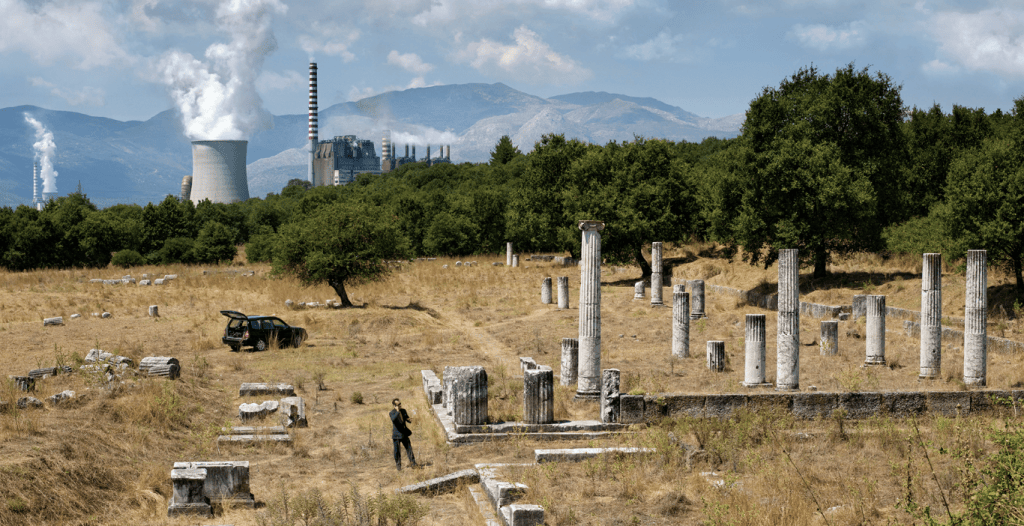
Among the works is Greek photographer Panos Kokkinias’ Arcadia (2011). A businessman stands speaking on his telephone within an archaeological landscape, while the Megalopolis power station occupies the background. Nearby, a car waits with its boot open.
The photograph is carefully staged, and its apparently ordinary details create a peculiar uncertainty. The businessman could be involved in any number of mundane activities; nothing particularly dramatic appears to be happening. Yet the juxtaposition of ancient ruins, industrial infrastructure and contemporary commercial life brings several versions of Greece into the same image. Antiquity remains present, but it no longer dominates the narrative.
Kokkinias’ photograph demonstrates the value of EMST’s approach. The work does not require a sweeping historical explanation to establish its significance. Its intelligence resides in the arrangement of specific, recognisable details and the unresolved relationships between them.
The museum as an argument
Gregos’ programme has attracted considerable attention for its willingness to address contentious social questions. Between 2023 and 2025, the exhibition cycle What if Women Ruled the World? devoted the museum’s programme to women artists and artists identifying as female. The associated collection exhibition, WOMEN, together, remained on view until January 2026.
The programme’s premise originated in a work by Yael Bartana, whose question, What if Women Ruled the World?, appears in large-scale neon lettering on the museum’s exterior.
Its wording is deliberately speculative. Rather than proposing that women would necessarily govern more effectively, it invites consideration of the assumptions underlying political authority, leadership and representation.
The decision to devote an extensive programme to women artists also had an art-historical purpose. Greek women artists, like their counterparts elsewhere, have frequently received less institutional recognition than male contemporaries. Revisiting their work requires attention to the circumstances that shaped their careers, the opportunities available to them and the conventions through which artistic achievement was historically judged.
A particularly interesting example is the museum’s current retrospective of Niki Kanagini (1933–2008), An Ode to Things, on view until February 2027. Her practice moved between tapestry, drawing, writing and immersive installation, challenging the conventional distinction between fine art and applied art. The large tapestries she exhibited internationally in the early 1970s belong to a period when textile practices were increasingly being reconsidered as serious experimental forms. Her later work expanded that inquiry into the relationship between objects, language and participation.
Another current exhibition, Jani Christou: Enantiodromia, examines the experimental Greek composer whose work crossed music, philosophy, theatre and ritual. His handwritten scores, correspondence and archival material reveal an artist whose investigations were never comfortably confined to a single discipline.
Such exhibitions demonstrate a valuable aspect of EMST’s programme: its willingness to reconsider Greek artistic history through less familiar figures and practices, rather than relying exclusively upon internationally established names.
There is, nevertheless, a question worth asking of any museum with such a strongly articulated curatorial position. When works are organised around political or historical arguments, their individual formal qualities and ambiguities must remain accessible. Art can be diminished when it becomes primarily illustrative of an institutional thesis.
The strongest exhibitions allow material, technique, form and imagination to complicate their arguments. EMST’s range of practices, from Kanagini’s textiles to Christou’s experimental notation and Hatoum’s unstable industrial installation, offers considerable scope for precisely that kind of encounter.
In June 2026, Apollo published an interview with Gregos exploring the museum’s development, financial constraints and curatorial ambitions. One of the more revealing aspects was her insistence upon building an institution appropriate to its particular circumstances, rather than creating a smaller version of an established Western museum.
That independence is increasingly visible. In September 2026, EMST received the European Museum Academy’s Art Museum Award, recognising its public engagement and ambitious exhibition programme.
For Athens, a city whose international cultural reputation remains overwhelmingly connected to its ancient monuments, EMST offers an essential perspective on artistic activity in the present. The former brewery is itself part of that story: a modern Greek building, substantially altered and imperfectly preserved, now accommodating a collection concerned with the changing cultural and political relationships of its region.
Its greatest strength may be the specificity of its position. EMST does not need to claim that Athens has replaced one artistic capital with another. It makes a persuasive case for examining contemporary art through histories and geographical relationships that established institutions have too often treated as peripheral.
Visiting EMST
The National Museum of Contemporary Art is located in the former FIX brewery at Kallirrois Avenue and Amvr. Frantzi Street, Athens, a short walk from Syngrou-Fix metro station.
The museum is open Tuesday to Sunday, 11 am–7 pm, with extended opening until 10 pm on Thursdays. It is closed on Mondays. Current exhibitions, admission information and public programmes are available through the museum’s official website.

