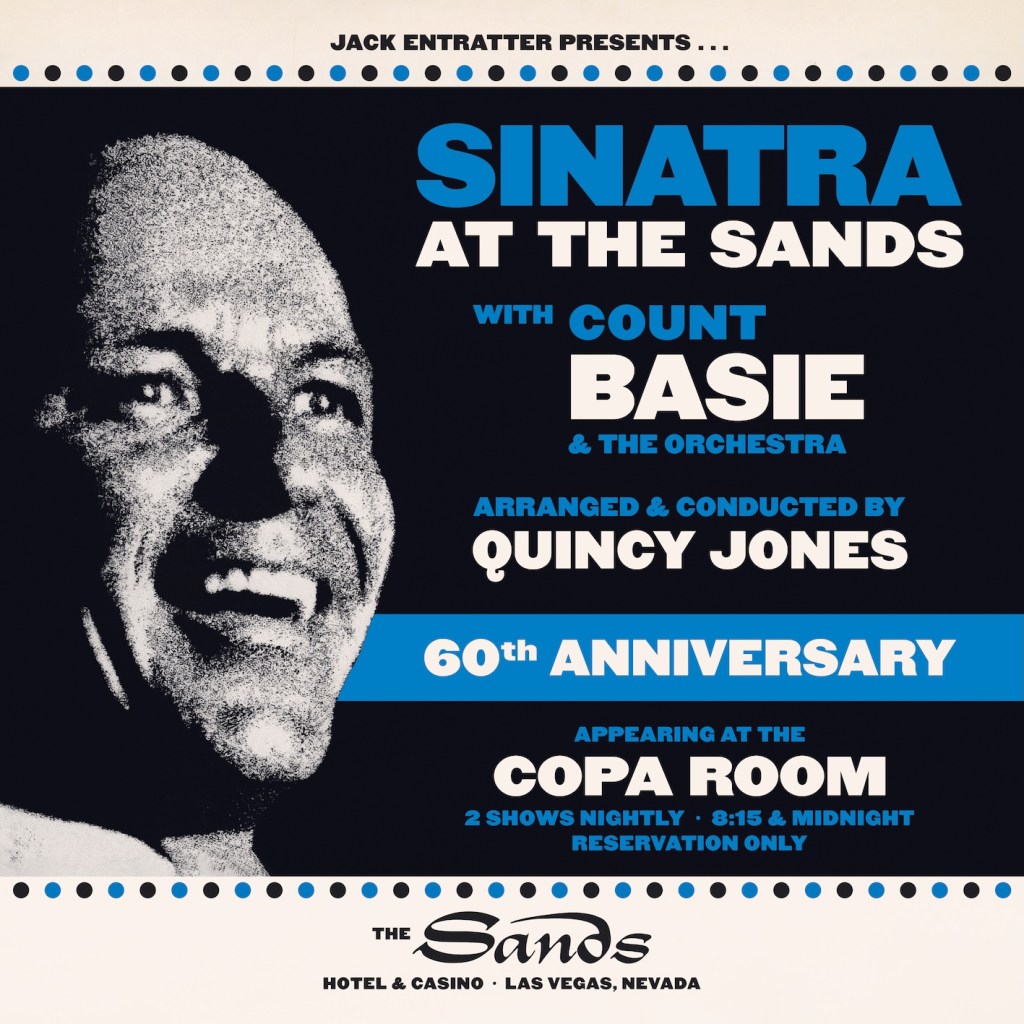
Frank Sinatra, Count Basie and Quincy Jones. Three extraordinary musical minds, one legendary Las Vegas engagement, and a live album that captures American popular music at its most exhilarating. Sixty years after its original release, a remarkable new anniversary edition reminds us why Sinatra at the Sands remains one of the greatest live recordings ever made.
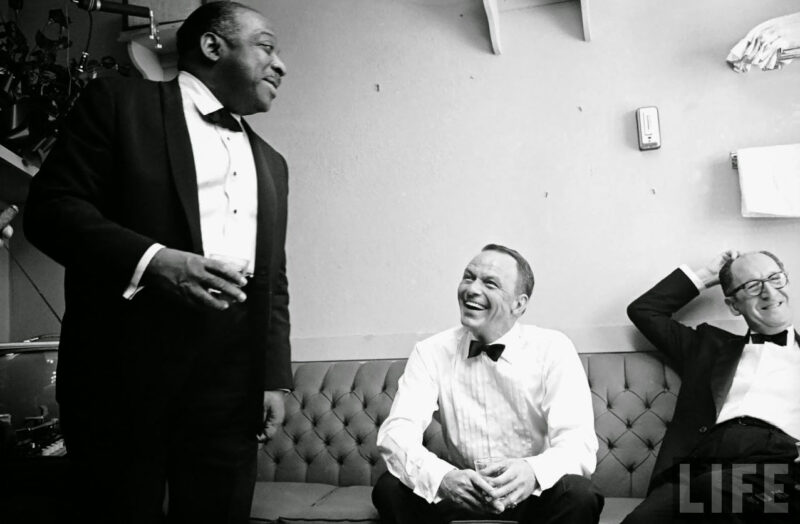
In January 1966, Frank Sinatra walked onto the stage of the Copa Room at the Sands Hotel in Las Vegas, where Count Basie’s orchestra was waiting under the direction of a thirty-two-year-old Quincy Jones. Sinatra had turned fifty the previous month. Basie was sixty-one. Between them, the three men possessed an almost encyclopaedic understanding of American popular music, acquired through decades spent in nightclubs, recording studios, ballrooms and concert halls.
The opening number was “Come Fly with Me”.
Within seconds, the orchestra was swinging with tremendous authority, its brass section delivering bright, tightly organised phrases above an extraordinarily supple rhythm section. Sinatra entered with the casual confidence of a man who understood precisely how much power he possessed over an audience, and how little effort he needed to demonstrate it.
The performance established the atmosphere of the entire evening.
Sinatra was relaxed, mischievous, occasionally outrageous and in magnificent voice. Basie’s musicians played with the precision and rhythmic elasticity of one of the finest jazz orchestras in the world. Jones conducted arrangements that gave the singer all the space he required while allowing the band to demonstrate its considerable collective personality.
The concerts were recorded between 26 January and 1 February 1966 and assembled into Sinatra at the Sands, released by Reprise Records that July.
It was Sinatra’s first commercially released live album, and it remains one of the most complete demonstrations of his extraordinary abilities as an entertainer.
On 23 October 2026, Frank Sinatra Enterprises and Capitol/UMe released a new sixtieth-anniversary edition, including a newly mixed double LP and five previously unreleased complete performances from the original engagement.
The release offers a rare opportunity to reconsider a recording that has long seemed almost impossibly accomplished.
Three Musicians at the Height of Their Powers
The partnership between Sinatra and Basie had developed over several years.
Their first studio collaboration, Sinatra-Basie: An Historic Musical First (1962), had been arranged and conducted by Neal Hefti, whose own relationship with the Basie orchestra had produced some of the most sophisticated big-band writing of the period.
The second, It Might as Well Be Swing (1964), introduced Quincy Jones as arranger and conductor.
The album included “Fly Me to the Moon”, which Jones transformed from Bart Howard’s gently romantic waltz into a crisp, swinging performance in four-four time.
The transformation was extraordinary.
The arrangement opens the song towards the rhythmic possibilities of the big band, allowing Sinatra’s extraordinary sense of timing to occupy the spaces between the instrumental phrases.
It became one of his defining recordings.
Jones and Sinatra understood one another musically because they shared a particular fascination with rhythmic precision.
Sinatra had developed his technique during the swing era, learning to sing within large orchestras while maintaining the phrasing and intimacy of a solo performer.
His relationship with rhythm was unusually sophisticated. He might approach a phrase slightly behind the beat, allowing the band to establish the pulse before drawing the melody across it. Elsewhere, he would anticipate a musical accent, creating a sudden feeling of forward movement.
These apparently small decisions gave his performances their extraordinary conversational quality.
The words appeared to emerge spontaneously, even when the underlying musical structure was carefully organised.
Basie’s orchestra was an ideal partner for such a singer.
The Count Basie sound had evolved from the Kansas City jazz tradition of the 1930s, in which blues-based improvisation, riff arrangements and an extraordinarily strong rhythmic pulse provided the foundations of ensemble performance.
Basie’s own piano playing was famously economical.
He could establish the character of an entire passage with a few carefully placed notes, allowing silence to become as important as the sounds surrounding it.
His orchestra operated according to a similar principle. The arrangements could produce magnificent passages of collective brass playing, but their effectiveness depended upon a subtle understanding of restraint.
The rhythm section maintained an apparently effortless swing, supported by Freddie Green’s extraordinarily consistent guitar playing and the powerful drumming of Sonny Payne.
Jones understood this musical language intimately.
Having worked as an arranger for Basie, Lionel Hampton, Dizzy Gillespie and numerous other jazz musicians, he possessed the technical knowledge necessary to write sophisticated arrangements without compromising the band’s rhythmic character.
For the Sands engagement, he brought these experiences together.
Sinatra supplied the voice, Basie’s orchestra provided the immense instrumental personality, and Jones organised the musical relationship between them.
What emerged was an exceptionally rare balance of authority and freedom.
The Copa Room, Las Vegas
The Sands Hotel had opened in December 1952, becoming one of the most celebrated entertainment destinations on the Las Vegas Strip.
Designed by architect Wayne McAllister, the original complex belonged to the mid-century generation of low-rise casino hotels whose architectural identity was shaped by the emerging culture of automobile travel and glamorous desert tourism.
Its famous Copa Room became the setting for performances by some of the most important entertainers of the period.
Sinatra, Dean Martin, Sammy Davis Jr., Lena Horne, Nat King Cole and Louis Armstrong all appeared at the Sands, although the history of Black performers in Las Vegas was shaped by racial discrimination that extended into hotel accommodation, restaurants and casino facilities.
The Sands became one of the hotels that helped challenge those restrictions during the 1950s, although the wider city’s racial inequalities were far from resolved.
By 1966, the establishment had become inseparable from the public mythology surrounding Sinatra and the Rat Pack.
Its atmosphere combined immense celebrity, considerable wealth, social theatre and an unusually intimate form of live entertainment.
The Copa Room was neither a vast concert hall nor a conventional theatre. Its audiences occupied a space in which the boundaries between performance and social occasion were deliberately blurred.
People came to dine, drink, encounter celebrities and participate in the glamorous spectacle of Las Vegas nightlife.
Sinatra understood that environment perfectly.
He had spent decades working in nightclubs, developing a form of performance that depended as much upon the relationship with an audience as upon the songs themselves.
At the Sands, his command of the room was almost absolute.
He could sing an affecting ballad, interrupt himself to deliver a joke, exchange remarks with the musicians and return to the next song without disturbing the musical atmosphere.
The recording preserves that remarkable flexibility.
One can hear the audience responding to his jokes, the orchestra waiting for his cues and the spontaneous exchanges that transform a polished concert into an encounter between performers and listeners.
The club itself became part of the recording.
The Sound of a Perfectly Balanced Orchestra
The opening “Come Fly with Me” is a masterclass in musical economy.
Originally recorded by Sinatra in 1957, the Jimmy Van Heusen and Sammy Cahn song had already become a familiar part of his repertoire.
At the Sands, Jones gives it a particularly exhilarating arrangement.
The brass section punctuates Sinatra’s vocal phrases with bursts of rhythmic energy. Beneath them, the rhythm section provides the unmistakable forward movement of the Basie orchestra.
Sinatra allows the melody to move with the band rather than imposing himself upon it.
His singing is relaxed, but the rhythmic precision is exceptional.
The performance acquires its excitement from the relationship between these apparently contrasting qualities.
The band generates tremendous energy while the singer remains almost conversational.
“I’ve Got You Under My Skin” offers an equally revealing example.
Cole Porter’s composition had been central to Sinatra’s repertoire for years, most famously through Nelson Riddle’s extraordinary 1956 arrangement on Songs for Swingin’ Lovers!.
That earlier recording is one of the defining achievements of mid-century orchestral pop, its celebrated instrumental crescendo building towards an exhilarating trombone solo.
At the Sands, Jones approaches the song through the distinctive language of the Basie orchestra.
The brass is punchy, the rhythmic accents are sharply articulated, and Sinatra’s phrasing acquires the relaxed confidence of a singer who has inhabited the song for many years.
The result feels fresh without discarding the musical identity that made the composition so memorable.
It is tempting to describe such performances as effortless, but that description conceals the extraordinary discipline involved.
Sinatra knew exactly how long to sustain a note, when to move towards the next phrase and how to articulate a consonant without interrupting the melodic line.
He understood the expressive value of a pause.
Most importantly, he listened.
His performances respond to the orchestra with the sensitivity of a jazz musician, drawing energy from the instrumental arrangements rather than treating them as background accompaniment.
That ability distinguishes him from singers whose interpretations depend primarily upon the power or beauty of the voice.
Sinatra’s greatest instrument was his understanding of musical time.
The Extraordinary Intimacy of Sinatra’s Ballads
For all the exuberance of the faster numbers, some of the album’s most affecting moments occur when the orchestra withdraws and Sinatra is left to explore the emotional possibilities of a song.
“One for My Baby (And One More for the Road)”, written by Harold Arlen and Johnny Mercer, had long occupied a special place in his repertoire.
Its narrative is deceptively simple: a lonely man addresses a bartender late at night, attempting to explain the romantic disappointment that has brought him to the bar.
Sinatra transforms the song into a miniature dramatic performance.
His voice changes character, acquiring a slightly weary, confidential quality. The phrasing becomes more conversational, the familiar assurance of the nightclub entertainer giving way to something considerably more vulnerable.
The song demonstrates how completely he understood the relationship between popular music and dramatic storytelling.
Every line contributes to the construction of a character.
Yet the emotional effect depends upon what remains unsaid.
Sinatra never needs to announce the character’s loneliness. The hesitations, rhythmic adjustments and changes in vocal colour provide sufficient information.
The performance is remarkable partly because it exists within the same concert as the exuberant big-band numbers.
The man who has spent the evening commanding an audience of wealthy Las Vegas spectators suddenly appears to be alone in a nearly empty bar.
The transformation is entirely convincing.
“Angel Eyes”, written by Matt Dennis and Earl Brent, offers another example of Sinatra’s ability to turn a familiar standard into a deeply personal dramatic statement.
Its atmosphere is darker, the emotional landscape shaped by romantic disillusionment and the awareness of an approaching departure.
Sinatra approaches the song with a restraint that makes its melancholy all the more persuasive.
His voice carries the accumulated experience of a performer whose personal life had been extensively documented in the press, although the song’s significance does not depend upon interpreting it as autobiography.
What matters is the precision of the interpretation.
The emotional character emerges through musical decisions rather than theatrical exaggeration.
Sinatra understood that sadness could be communicated most effectively by a singer who appeared determined to maintain his composure.
The September of His Years
The choice of material reveals an artist at a particularly interesting stage of his career.
Sinatra had turned fifty in December 1965. The previous year he had released September of My Years, an album whose arrangements by Gordon Jenkins explored ageing, memory and the gradual transformation of romantic experience.
The songs included “It Was a Very Good Year”, a reflective composition by Ervin Drake that became one of the most celebrated recordings of Sinatra’s later career.
Both songs appear on Sinatra at the Sands, introducing a note of melancholy into an otherwise exuberant evening.
Their presence is revealing.
Sinatra’s public identity depended upon vitality, masculine confidence and an apparent ability to remain permanently at the centre of the entertainment world.
Yet some of his finest recordings examined the passage of time and the impossibility of recovering earlier experiences.
The contradiction gave his performances considerable emotional depth.
In “It Was a Very Good Year”, the singer surveys the different periods of his life through remembered romantic encounters.
The song’s emotional power depends upon the increasing awareness that those experiences belong to the past.
At the Sands, Sinatra approaches the material from within a very different musical environment from the sweeping orchestral arrangement of the original recording.
The more intimate setting exposes the narrative quality of his singing, allowing the listener to attend closely to the words and the changes in vocal expression.
The relationship between the song and the performer becomes particularly affecting because of the surrounding repertoire.
A few moments earlier, Sinatra may have been joking with the audience or delivering an exhilarating swing number.
Now he reflects upon the passing of time.
The shift feels entirely natural.
His extraordinary achievement was to bring these apparently contradictory aspects of his personality into the same performance.
The confident entertainer and the vulnerable interpreter of melancholy songs were inseparable parts of his musical identity.
The Tea Break
No discussion of Sinatra at the Sands would be complete without its celebrated “Tea Break”, an extended monologue in which Sinatra temporarily abandons singing to entertain the audience with jokes, anecdotes and observations.
It is an extraordinary document of mid-century American nightclub culture.
Sinatra moves rapidly between subjects, introducing stories, teasing familiar figures and drawing laughter from the audience with the apparent ease of someone who has spent his entire adult life performing before strangers.
The monologue also reveals the peculiar intimacy of the Copa Room.
Sinatra does not appear to be delivering a formal speech. He speaks as though he has temporarily assumed the role of host at an exceptionally large and expensive private party.
The distinction between the celebrated performer and the man behind the public identity becomes part of the entertainment.
There is considerable pleasure in hearing him improvise, interrupt his own stories and respond to the audience.
But the material also belongs unmistakably to its period.
Some of the humour relies upon assumptions about women, sexuality and social identity that have aged badly. The casual privileges of the Rat Pack world are audible alongside the extraordinary musical accomplishment.
That is part of the historical interest of the recording.
The songs have endured through their musical sophistication and emotional intelligence; the spoken material offers a more complicated portrait of the culture surrounding them.
Listening to the complete concert means encountering both.
Quincy Jones and the Art of Making Others Brilliant
It is worth returning to Quincy Jones, because Sinatra at the Sands offers one of the clearest examples of his extraordinary abilities as an arranger and conductor.
Jones was only thirty-two when these performances were recorded, yet he possessed a depth of musical experience that many artists never acquire.
He had worked with some of the finest jazz musicians in America, studied composition in Paris and developed an understanding of the music industry extending far beyond performance.
His arrangements for the Sands engagement demonstrate a particular kind of artistic intelligence: the ability to give other musicians the conditions they need to perform at their highest level.
He understood Basie’s orchestra and its rhythmic personality.
He understood Sinatra’s phrasing and the importance of allowing the singer to shape a song through the timing of individual words.
And he understood how to maintain the energy of a live performance through a programme that moved between swing, ballads, instrumentals and spoken entertainment.
These are not straightforward tasks.
An arrangement that is too elaborate can restrict the freedom of a singer. An arrangement that is too restrained may fail to make use of the orchestra’s extraordinary capabilities.
Jones found the balance.
It is especially revealing to consider the Sands recordings alongside his subsequent work with Michael Jackson, George Benson and the many musicians whose careers he helped shape.
The musical environments are very different, but the underlying approach remains recognisable.
Jones understood the importance of assembling exceptional musicians, recognising the distinctive qualities of their performances and creating arrangements through which those qualities could become part of a coherent musical whole.
Sinatra at the Sands belongs to an earlier phase of that extraordinary career, but it already contains the essential characteristics of his mature work.
Sixty Years Later
The 2026 anniversary release provides an unusually revealing opportunity to examine how the album was constructed.
The original double LP was assembled from performances recorded across several evenings, creating a carefully selected representation of the engagement rather than a complete record of any single show.
The new five-CD collection offers something different: five complete performances from the residency, allowing listeners to hear how the music developed from one evening to another.
These recordings reveal the subtle variations that occur within a live performance.
Sinatra changes a phrase, extends a pause or approaches a familiar song with a slightly different emphasis.
The orchestra responds to the circumstances of the evening, adjusting its energy and interaction.
The spoken interludes vary considerably, demonstrating how much of the performance depended upon the relationship between Sinatra and the audience.
The new edition also includes previously unpublished photographs, additional liner notes and a fresh mix of the original album by engineer Larry Walsh.
The original gatefold packaging, with its celebrated notes by Stan Cornyn, has been retained for the vinyl edition.
These details are particularly welcome because Sinatra at the Sands is more than a collection of individual performances.
It documents an entire culture of musical entertainment that has largely disappeared.
The Sands itself closed in 1996 and was demolished later that year. The Venetian resort subsequently occupied the site.
The original Copa Room, with its audience seated at tables beneath the lights of the Las Vegas Strip, belongs to history.
Yet the recording remains astonishingly immediate.
The orchestra sounds alive with possibility. Sinatra’s voice retains its extraordinary flexibility and assurance. The conversations and laughter preserve the atmosphere of a room in which everyone understood that they were participating in something rather special.
For all the glamour surrounding the Rat Pack mythology, the album’s enduring importance lies in the music.
Sinatra, Basie and Jones were exceptional musicians whose artistic relationship depended upon mutual understanding.
Each knew when to take control and when to allow the others to lead.
The result is a recording of extraordinary confidence, sophistication and sheer pleasure.
Many live albums document remarkable performances. A smaller number capture the distinctive musical personalities of the performers so completely that the recording itself acquires an independent artistic identity.
Sinatra at the Sands belongs to that second category.
Six decades later, it remains a magnificent demonstration of what happens when three great artists meet at precisely the right moment in their careers, supported by a band capable of making the most demanding music sound like the easiest thing in the world.
It is one of my favourite albums, one of the few recordings that makes me both cry and laugh during a listen.
Cover Image courtesy of Capitol Records/UMe and Frank Sinatra Enterprises
Listen While You Read
All recordings below are linked to the official Frank Sinatra YouTube channel, allowing readers to listen without reproducing copyrighted recordings on the website.
Come Fly with Me — Live at the Sands, 1966
Begin here. The opening performance establishes the extraordinary relationship between Sinatra’s relaxed vocal phrasing and the rhythmic authority of Basie’s orchestra.
I’ve Got You Under My Skin — Live at the Sands, 1966
Listen to the interplay between the brass section and the singer, particularly the way Jones’s arrangement allows Sinatra to move around the rhythm.
One for My Baby (And One More for the Road) — Live at the Sands, 1966
An extraordinary example of Sinatra’s ability to transform a song into a dramatic monologue.
Fly Me to the Moon — Live at the Sands, 1966
Quincy Jones’s celebrated swinging arrangement, performed with the extraordinary rhythmic assurance of the Basie orchestra.
Angel Eyes — Live at the Sands, 1966
A masterclass in emotional restraint, phrasing and the dramatic possibilities of a familiar standard.
The Tea Break — Sinatra’s Monologue
An entertaining, occasionally uncomfortable historical document of Sinatra’s nightclub persona and the culture of 1960s Las Vegas.
Explore the 60th-Anniversary Edition
Sinatra at the Sands — 60th Anniversary (2026)
Original release: July 1966
Recorded: 26 January – 1 February 1966
Venue: Copa Room, Sands Hotel, Las Vegas
Arranged and conducted by Quincy Jones
Orchestra: Count Basie and His Orchestra
Produced by Sonny Burke
New editions released 23 October 2026: A newly mixed double LP and a five-CD collection of previously unreleased complete performances, also available digitally.
Official 60th-anniversary release information
Listen to the original album — Apple Music
The Sands Hotel — University of Nevada, Las Vegas historical archive

