
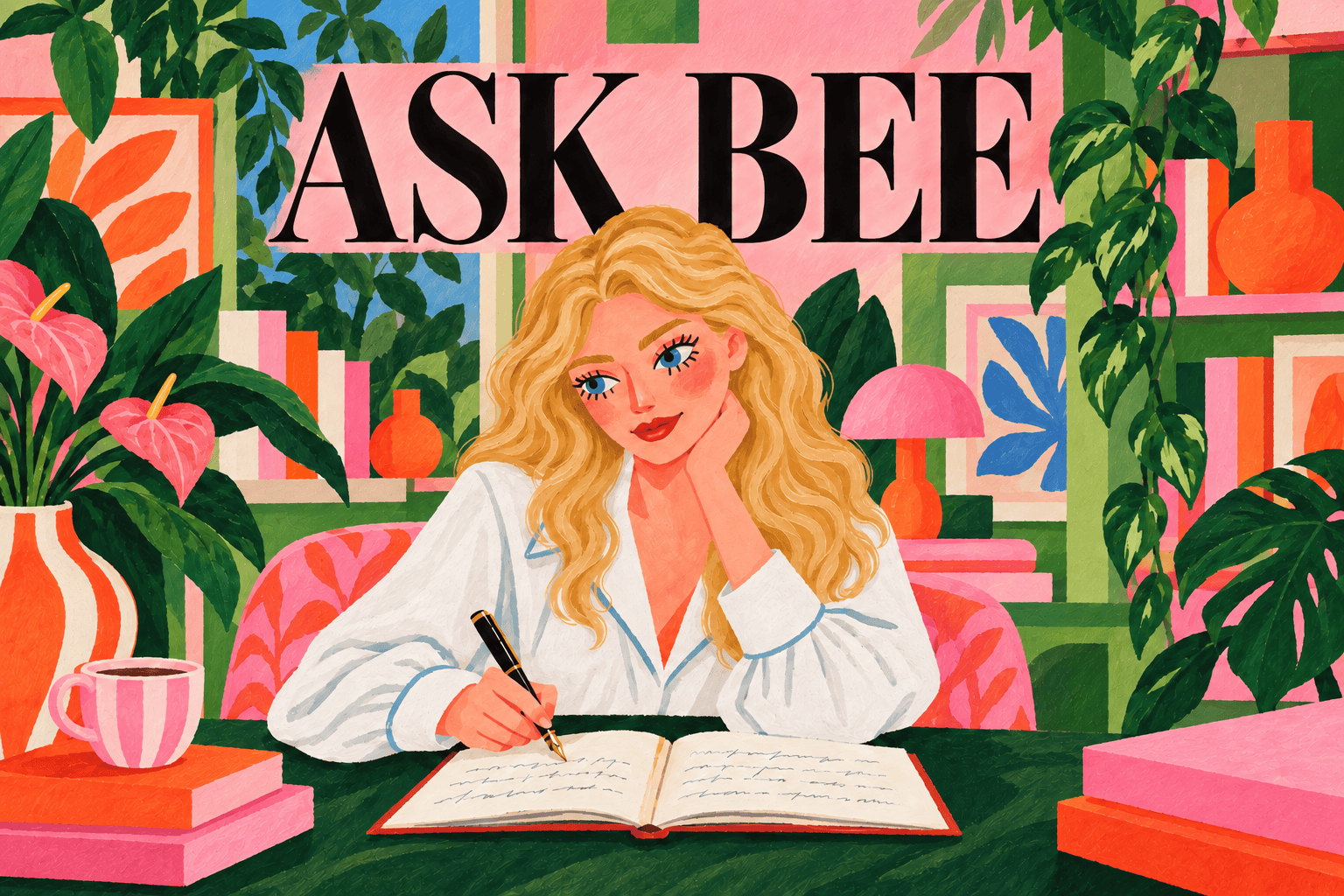
Ask Bee: How Do I Learn to Read Again?
On lost concentration, the infinite scroll and finding our way back to books.
Dear Bee,
I have a conundrum. For a long time, I have been unable to read books. I blame modern technology, the iPhone and my increasingly short attention span. I simply cannot concentrate on reading for long anymore, and I miss disappearing into something long-form.
I used to love literature. I read fiction and nonfiction, poetry, and would happily spend long afternoons completely absorbed in a book. Now I find myself spending that time on TikTok, doom-scrolling away the hours when I could be learning something new.
Do you have any advice about how I might rebuild the habit and regain my old love of reading?
Jess
Dear Jess,
First, the good news: I do not think you have stopped loving books. People who no longer care about reading do not miss it with this particular kind of longing. What you have lost is not your love of literature, but your stamina for it—and stamina can be rebuilt.
It would also be unfair to treat this entirely as a personal failure. We live inside an economy built around the capture and fragmentation of our attention. TikTok offers novelty every few seconds; a book asks us to remain. Give the mind one kind of experience often enough and, quite naturally, it begins to expect more of the same.
You are not lazy, unintelligent or culturally doomed. Your attention has simply become practised at something else.
The way back, however, is not through self-punishment. Please do not begin with an enormous classic you feel you ought to read, as though Dostoevsky were a course of antibiotics. Begin with pleasure.
Return to a book you once loved—preferably one that made the outside world disappear. Rereading removes the anxiety of achievement: you already know you are capable of finishing it, and part of you remembers the pleasure waiting inside. A novella, detective story, memoir or collection of short stories may also provide an easier point of re-entry than a six-hundred-page masterpiece.
The first book does not need to improve you. Its only responsibility is to make you want to turn the page.
Then create a small daily appointment with it. Fifteen minutes is enough. Choose the same chair, switch on the same lamp, make a cup of tea if you like—but put your phone in another room. Not face down beside you, where it can continue radiating possibility. Physically elsewhere.
Read until the fifteen minutes are over. If you want to continue, do. If you do not, stop without reproaching yourself and return the following day. The purpose is not to accumulate pages but to teach your mind that sustained attention is once again part of ordinary life.
Your concentration will wander. You may read the same paragraph three times. You may reach the bottom of a page and realise that you have absorbed none of it. This does not mean the experiment has failed. Go back. Read a sentence aloud. Follow the line with your finger if necessary. There is no dignified or undignified way to enter a book.
I would also resist turning reading into another form of administration. Do not begin a spreadsheet, announce a yearly target or challenge yourself to finish fifty books. Nothing extinguishes pleasure quite as efficiently as converting it into performance.
And try to release yourself from the thought that reading must be justified because you “could be learning something new.” A book is not merely a more respectable delivery system for information. Reading fiction may teach us something, certainly, but its deeper pleasure lies in inhabiting another consciousness and submitting to a pace that is not our own. It restores duration. It gives us back the part of life that cannot be swiped away.
So, for the next two weeks, choose one inviting book. Put your phone in another room and read for fifteen minutes each day. No targets, no public declarations and no guilt. Just you, the book and a little uninterrupted time.
The reader you once were has not disappeared, Jess. She is still there, waiting for the conditions that allowed her to exist: a quiet room, an absorbing book and an afternoon that does not have to become anything else.
You are not trying to defeat TikTok at its own game. You are restoring a private life.
With love,
Bee
Five Short Books to Rekindle the Reading Habit
All five of these novels are accessible, absorbing and short enough to finish in a few sittings—but none is intellectually slight.
1. Bonjour Tristesse by Françoise Sagan
Approximately 112 pages
A sun-drenched Riviera novel about youth, freedom, jealousy and casual cruelty. Sagan writes with extraordinary clarity and sophistication, while the increasingly dangerous emotional drama keeps the pages turning. Glamorous, psychologically acute and faintly wicked. Penguin
2. A Chess Story by Stefan Zweig
Approximately 112 pages
A seemingly innocent chess match aboard an ocean liner develops into an intensely suspenseful exploration of obsession, isolation and psychological survival. You do not need to know—or care—anything about chess. Zweig creates more tension in a hundred pages than many writers manage in five hundred. Pushkin Press
3. We Have Always Lived in the Castle by Shirley Jackson
Approximately 160 pages
Merricat Blackwood lives in near-total isolation with her sister and uncle following the poisoning of the rest of their family. Then an unwelcome cousin arrives. Strange, funny and wonderfully sinister, Jackson’s novel combines gothic suspense with a brilliant study of family, social conformity and the unreliable narrator. Penguin Random House
4. The Third Man by Graham Greene
Approximately 160 pages
In the ruins of postwar Vienna, a penniless writer arrives to visit his old friend Harry Lime—only to discover that Lime has died in suspicious circumstances. What follows is a wonderfully atmospheric story of espionage, corruption, friendship and betrayal. Literary fiction with the momentum of a first-rate thriller. Penguin
5. The Prime of Miss Jean Brodie by Muriel Spark
Approximately 128 pages
Miss Jean Brodie is a charismatic Edinburgh schoolteacher determined to shape her chosen pupils in her own image. Beneath the novel’s wit and elegance lies something much darker: a study of influence, loyalty, political romanticism and the seductive nature of authority. Spark wastes neither a sentence nor a joke. Penguin
Where to begin: If you love The Great Gatsby, start with Bonjour Tristesse. If you want immediate suspense, choose A Chess Story or We Have Always Lived in the Castle.
Do you have a question for Bee? Write to hello@myworldofinteriors.com with Ask Bee in the subject line. Questions may be submitted anonymously.
Ask Bee – My World of Interiors
Discover more from My World of Interiors
Subscribe to get the latest posts sent to your email.

