
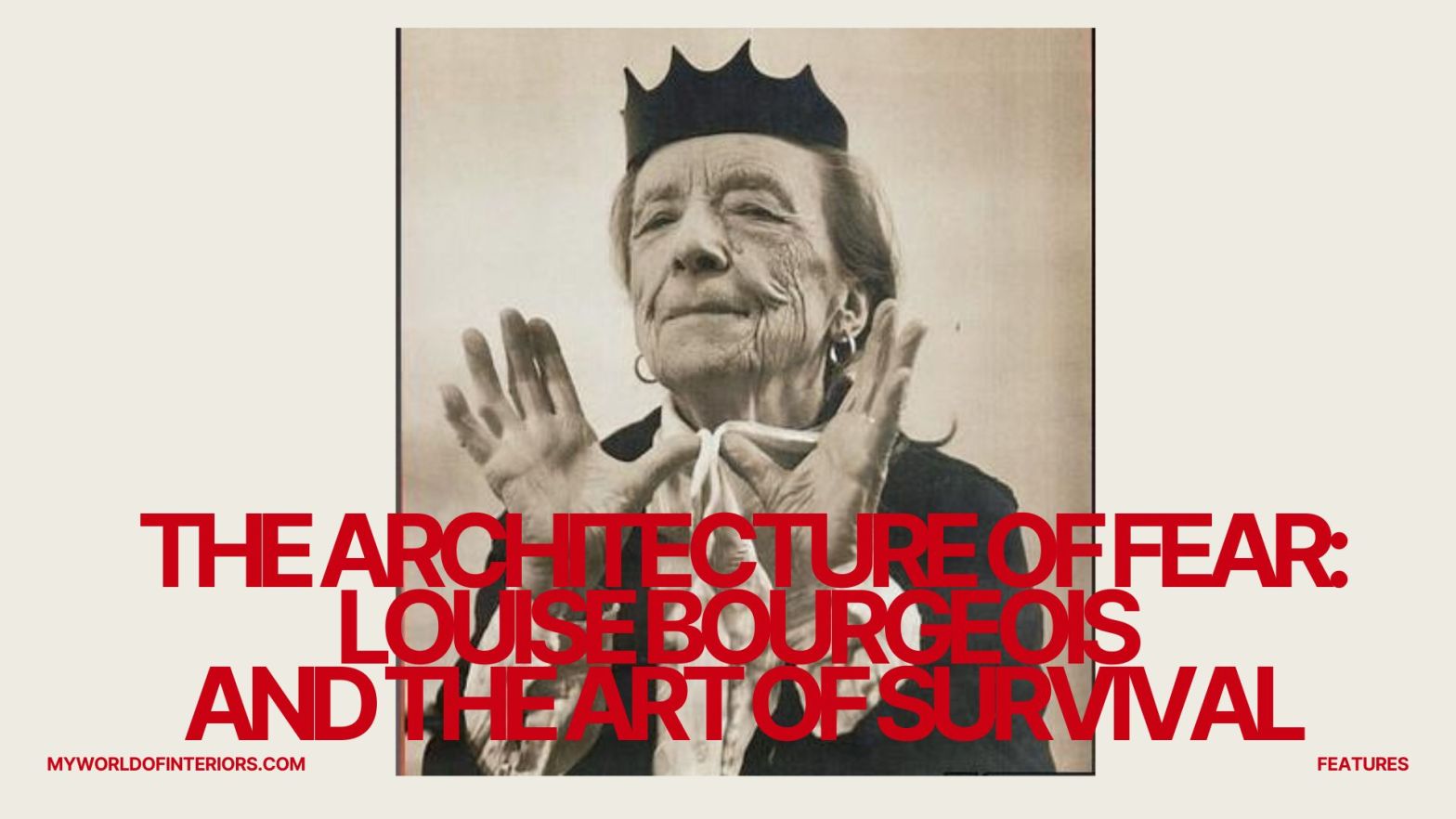
She spent seventy years making art about her childhood. She became famous at seventy-one. She worked until the day she died at ninety-eight. Louise Bourgeois was not the most famous artist of the twentieth century, but she may have been the bravest — and the most honest about what art is actually for.
By Bergotte
There is a photograph taken in 1982, the year of Louise Bourgeois’s retrospective at the Museum of Modern Art in New York — the exhibition that ended, at a stroke, decades of relative obscurity and positioned her, at the age of seventy-one, as one of the most significant artists of the century. In the photograph, Bourgeois is wearing a long coat made of monkey fur and carrying, under her arm, one of her latex sculptures: a soft, pendulous, biomorphic form that is simultaneously a body part and not quite any identifiable body part, that hovers between the comic and the disturbing in the way that her best work always does. She is looking directly at the camera with an expression that is not quite a smile — or rather, it is a smile that contains too much for a smile to comfortably hold. There is amusement in it, and defiance, and something older and harder than either. She has been waiting a very long time for this moment. She intends to enjoy it on her own terms.
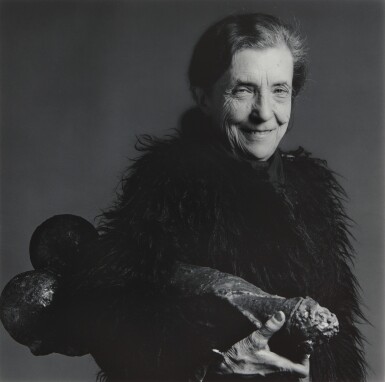
The photograph was taken by Robert Mapplethorpe, and it appeared on the cover of a magazine, and it became one of the most reproduced images in the history of contemporary art — not because of Mapplethorpe’s craft, though the craft is considerable, but because of the woman in it. Bourgeois at seventy-one, in the monkey fur coat, carrying the sculpture with the casual confidence of someone who has been carrying difficult things for a very long time, is one of those images that seem to say something true about the relationship between a life and a body of work — between the person who made the art and the art that was made. The image says: this is what it looks like when someone has been completely honest, for a very long time, about things that most people prefer not to examine. It looks like this. It looks like an old woman in a fur coat, unafraid.
She was born in Paris in 1911, into a family of tapestry restorers — her parents ran a workshop in Aubusson and then in the Paris suburb of Antony that specialised in the repair of antique Gobelin and Aubusson tapestries, and Bourgeois spent her childhood in the workshop and beside the river where the tapestries were hung to dry, surrounded by the imagery of hunting scenes and allegorical tableaux, learning to draw by filling in the missing portions of damaged weavings. This origin is not incidental. The imagery of the tapestry — the spider at its web, the thread that connects and the thread that can be cut, the surface that appears whole from a distance and reveals its repairs and its wounds up close — runs through her work from the earliest pieces to the last. And the spider, which she identified explicitly and repeatedly with her mother, became her signature image: the giant bronze and steel Maman sculptures, which have been installed outside museums and galleries on every continent, are among the most recognisable works of public sculpture in the world. They are also, when you stand beneath them, among the most unsettling.
The Wound That Would Not Close
In 1994, at the age of eighty-three, Louise Bourgeois published a text that she had written in English — the language she had adopted when she emigrated to New York in 1938 and that she always felt gave her a useful distance from the more dangerous registers of French — which began with the sentence: “Art is a guaranty of sanity.” The sentence has been quoted many times, usually in a way that treats it as an affirmation — a statement of art’s redemptive power, its capacity to organise and sustain the self. It is also, read more carefully, a confession: art is a guaranty of sanity because, without it, sanity is not guaranteed. The statement is not triumphant. It is the report of someone who has tested this proposition at some length and found it to be the truth, under conditions that required something to guarantee the sanity or the sanity would not hold.
The conditions had their origin in a single fact — or rather, in a single relationship, which became the central organising fact of her entire body of work, the wound around which everything else accumulated. Her father, Louis Bourgeois, had during her childhood conducted a long affair with her English governess, a woman named Sadie Gordon Richmond, who lived with the family for ten years and who was, by Bourgeois’s account, a figure of considerable psychological complexity — at once a target of her jealousy and a person for whom she felt a complicated, involuntary affection. Her mother knew about the affair and tolerated it, with a dignity that her daughter read as both admirable and devastating, a kind of heroic self-suppression that was also a form of absence. Her father was charming and unfaithful and emotionally manipulative in the way of certain charming men, and his daughter adored him and was wounded by him and spent the remainder of her long life making art that was, among other things, an attempt to understand what had happened to her in that house in Antony beside the Bièvre river.
This is the biographical account, and it is the account that Bourgeois herself provided, with extraordinary directness and detail, in interviews, in her journals, in the text installations that became an increasingly important part of her practice from the 1980s onward. She was not, in the conventional sense, a confessional artist — she was not interested in autobiography as such, not interested in the simple translation of experience into narrative. She was interested in what the experience had done to her psychic structure, to the architecture of her inner life, and she believed that sculpture — three-dimensional form in space, objects that the body must navigate and whose scale and texture and spatial organisation produce physical as well as intellectual responses — was the medium most adequate to the exploration of that architecture.
“My work is about the fear of falling, about the need for security,” she said, in one of the many interviews she gave in the last three decades of her life, with a directness that her interviewers sometimes found unnerving. “The fear of losing somebody. The fear of not being able to live up to expectations.” These are not, on the face of it, unusual fears. They are the fears of childhood, of the vulnerable state of being young and dependent and unable to protect yourself from the emotional weather of the adults around you. What made Bourgeois unusual — what made her, in the end, an artist of the first order rather than a competent processor of her own biography — was her understanding that these childhood fears did not disappear with adulthood but went underground, became structural, organised the emotional and psychological life of the adult in ways that were usually invisible precisely because they were structural. She spent her career making the structure visible.
New York, Surrealism, and the Long Silence
She arrived in New York in 1938 with her American husband, the art historian Robert Goldwater, and she encountered a city that was, in that moment, in the process of receiving the European avant-garde in a rush — the artists and intellectuals fleeing fascism, bringing with them the accumulated energies of two decades of Parisian modernism: Dalí, Ernst, Duchamp, Masson, Léger, Mondrian, all arriving within a few years of each other, all attempting to continue their practices in a city that was simultaneously more hospitable and more foreign than anything they had encountered. Bourgeois moved among them. She knew them socially; she was part of the world of galleries and studios and dinner parties at which the New York art world of the 1940s conducted its business.
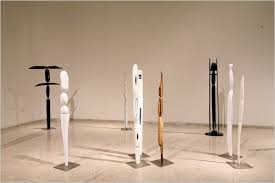
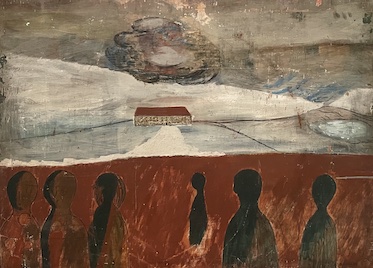
She was also, for much of this period, making work that the New York art world largely ignored. Her early paintings and engravings — produced in the late 1930s and 1940s, showing figures in domestic spaces that feel simultaneously real and dreamlike, spaces in which the architecture seems to be performing the emotional states of its inhabitants — were shown in small group exhibitions and received with polite indifference. Her turn to sculpture in the late 1940s produced a series of wooden totemic figures that she called the Personages — tall, thin, anthropomorphic presences that she installed in configurations on the floor of her studio, working through the relationships between them as a way of working through the relationships — with the family she had left in France, with the country itself, with the self she had been before the emigration — that she could not otherwise access.
The Surrealists were the obvious point of comparison, and the comparison was made, and it was not entirely wrong — there are affinities of imagery and of psychological ambition. But Bourgeois was not a Surrealist, and the distinction matters. The Surrealist project, in its orthodox form, was concerned with the unconscious as a source of imagery — with the dream, the automatic, the eruption of the repressed into conscious form. Bourgeois was interested in something more specific and more difficult: not the unconscious as image-generating machine but the unconscious as structural principle, as the organiser of spatial and relational experience. She was not mining her dreams. She was mapping her psyche, which is a different operation requiring different tools.
The map took decades to draw, and for most of those decades she drew it in relative obscurity. Robert Goldwater died in 1973, and the loss — she has spoken of it in terms that make clear it was not simply grief but a structural disorientation, the removal of a presence that had organised her daily life for thirty-five years — preceded by only a few years the period of increasing recognition. The MoMA retrospective in 1982 was the turning point, but the turn had been prepared by years of growing attention from younger artists and critics who had found in her work something that the dominant art historical narratives of the postwar period — the grand arc from Abstract Expressionism through Minimalism to Conceptualism — had not provided: an art that took the body, and the emotional life of the body, seriously as a subject.
The Cells: Architecture as Psychology
The series of works for which Bourgeois is, after the Maman spiders, most consistently celebrated — the Cells, which she began making in the late 1980s and continued until her death — are enclosures: small rooms, cages, architectural fragments, built from found industrial materials (old doors, metal grilles, wire mesh, glass panels) and filled with arrangements of objects — mirrors, perfume bottles, hands made of marble or glass, beds and chairs and clothing and the other furniture of intimate life — that create environments in which the viewer is invited to look but not to enter, to witness but not to participate.
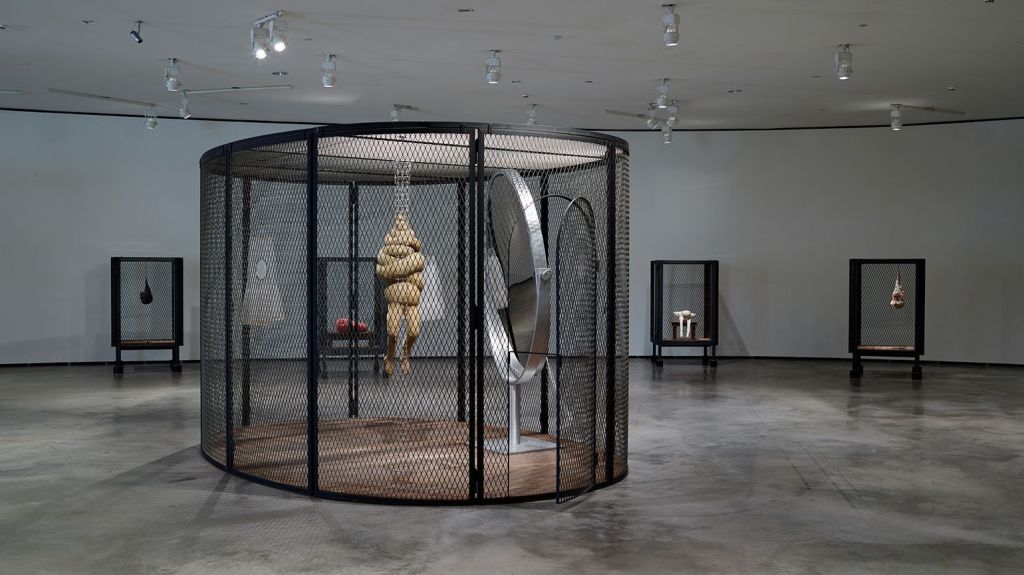
The title is deliberate in its ambiguity. A cell is a prison cell — a space of confinement, of punishment, of the restriction of freedom. A cell is also a biological cell — the fundamental unit of living matter, the enclosed space within which the chemistry of life takes place. It is also a monk’s cell — a space of chosen withdrawal, of contemplation, of the cultivation of an interior life in conditions of deliberate austerity. All three meanings are present simultaneously in Bourgeois’s Cells, and the simultaneous presence of all three is part of the work’s argument: the argument that the enclosed spaces of our psychological lives are at once prisons and workshops and sanctuaries, that the damage and the creativity are not separable, that the cell of childhood experience is also the cell in which the self is constituted.
Cell (Eyes and Mirrors) (1989-93) is one of the most fully realised of the series: a circular enclosure of metal doors, within which two large marble spheres — eyes — are surrounded by fragments of mirror that multiply and fragment the image, reflecting the viewer back at themselves in pieces. The experience of looking into the work is the experience of being looked at — of finding your own gaze returned, fractured, multiplied, made strange. This is a formal enactment of what Bourgeois understood to be the phenomenology of psychological experience: we think we are looking outward, at the world, at others; we are always also looking inward, at the mirrors within us that reflect and distort the images we have absorbed.
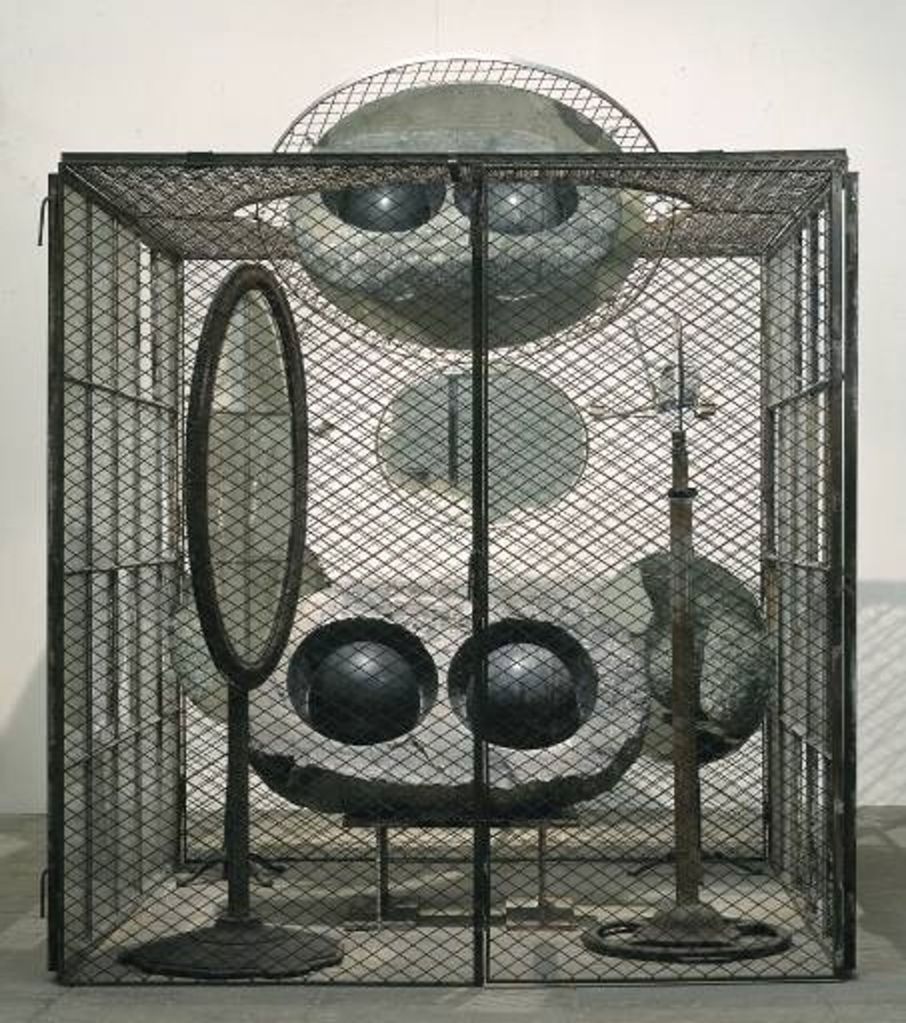
The materials matter, as they always do in Bourgeois’s work. She was drawn, throughout her career, to materials that were themselves charged — that carried associations and histories that preceded their use in the artwork. The old doors in the Cells are real old doors, salvaged from demolished buildings, and they bring with them the specific texture of industrial age and use. The marble hands and body parts are carved by Bourgeois herself, with a craft skill that is easy to underestimate because it is so thoroughly in service of the emotional content — you do not think, first, about the carving; you think about the hand. But the carving is extraordinary, and the extraordinariness of it is part of what makes the emotional impact possible: the precision of the craft is the form taken by the seriousness of the attention.
The Spider and the Mother
Of all the images in Bourgeois’s vocabulary — and the vocabulary is large, built over eight decades, including the biomorphic latex forms, the spiral staircases, the figures in bondage, the severed limbs, the architectural fragments — none has achieved the cultural visibility or the psychological reach of the spider. The Maman sculptures, of which there are six large-scale bronze versions installed at institutions around the world (the Tate Modern, the Guggenheim Bilbao, the National Gallery of Canada, the Mori Art Museum in Tokyo, among others), stand between nine and thirty feet high, their skeletal steel legs spanning extraordinary distances above the ground, their egg sac of marble spheres suspended beneath the body with an almost aggressive maternal purposefulness. They are terrifying and they are beautiful and the terror and the beauty are not in tension but in the same gesture, the same form, the same presence.
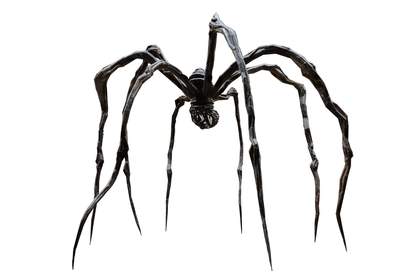
Bourgeois identified the spider with her mother explicitly, repeatedly, and with a consistency that makes the identification feel less like an interpretive frame imposed after the fact and more like the literal content of the image. Her mother, Joséphine, was a weaver and restorer — someone whose work was the patient reconstruction of damaged fabric, the knitting together of what had been torn. She was also, in her daughter’s account, the psychological organiser of the household: the figure who contained the chaos, who managed the emotional weather, who provided the stability that her husband’s inconstancy regularly threatened. “The spider is an ode to my mother,” Bourgeois wrote. “She was my best friend. Like a spider, my mother was a weaver. My father would tell stories and spin his web to get what he wanted. My mother on the other hand would quietly and patiently mend the weaving.”
The identification is loving, but the image is not, or not only, a loving image. A spider is also a predator. A spider’s web is also a trap. The Maman sculptures do not look, when you stand beneath them, like benign maternal presences. They look like something you might not survive an encounter with. The sac of eggs is not comforting; it is faintly horrifying. The legs, which rise to a height that makes the human body feel very small and very vulnerable, are not welcoming. The sculpture gives you the mother — warm, protective, web-spinning, patient — and also the mother as experience: enormous, encompassing, inescapable, over you like a sky.
This is the quality in Bourgeois’s work that most distinguishes it from the work of artists whose emotional ambitions are comparable but whose formal solutions are simpler. She does not resolve the ambivalence. She does not choose between the loving mother and the overwhelming one, between the protector and the predator, between the grief of loss and the relief of it. She holds both, in the same form, with the same material, at the same scale, and she forces the viewer to hold both as well — to stand beneath the spider and feel whatever it is the spider makes them feel, without the guidance of a fixed interpretation.
The Body, Sexuality, and the Refusal of Shame
Among the more remarkable aspects of Bourgeois’s career — remarkable in the context of the art world in which she made it, which was not, for most of its history, a notably body-positive or sexually direct environment — is the consistency with which she represented the body: the human body in its full range of conditions, undisguised and unidealized, without the conventional euphemisms that art has traditionally deployed when confronting the physical reality of human existence.
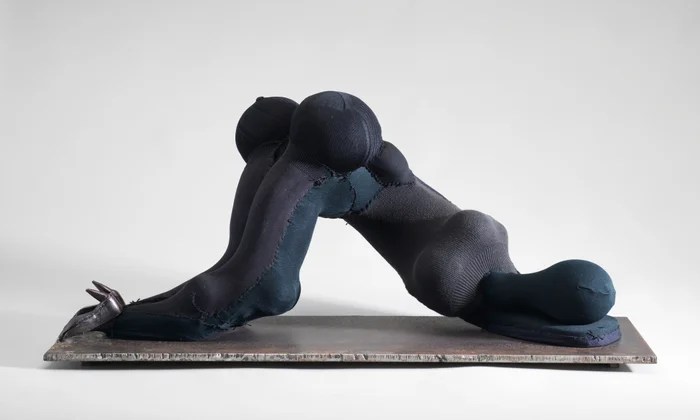
The latex and rubber sculptures of the 1960s — soft, bulging, unmistakably corporeal, occupying the difficult territory between the comic and the visceral that very few artists have successfully navigated — were radical acts in their moment. They were not, or not primarily, about sexuality in the narrowly erotic sense; they were about the body as a site of experience, as the place where psychological and physical reality cannot be disentangled. The forms are simultaneously internal organs and external surfaces, simultaneously threatening and absurd, simultaneously about desire and about something more fundamental than desire — about the basic fact of being embodied, of having a body that digests and secretes and distends and is subject to forces both internal and external that it cannot entirely control.
She made penises and vaginas and breasts and internal organs with the same matter-of-fact directness that she brought to everything else. She was not being deliberately provocative in the way of artists who deploy sexual imagery as a form of institutional critique. She was being honest — representing the body as the body is, as a fact rather than a symbol, as the site of experience rather than the object of desire. This distinction is harder to maintain than it sounds, and the difficulty of maintaining it is one of the reasons that so much art that claims to deal with the body honestly ends up dealing with it as spectacle, as provocation, as the occasion for a statement that is really about something other than the body.
The Destruction of the Father (1974) is the most extreme and the most theatrically charged of her works about family violence and the dynamics of power within the family. It is a large-scale installation — a cave-like interior, dim and reddish, filled with biomorphic protrusions from the walls and ceiling and a large table-like form on which shapes that might be body parts, or might be food, are arranged in configurations that suggest both a feast and something more disturbing than a feast. The title refers to a fantasy Bourgeois described explicitly: of killing and eating her father, of the children around the dinner table rising up against the paternal authority that had dominated and humiliated them, of a violence that is also a consumption, a taking back of what had been taken.
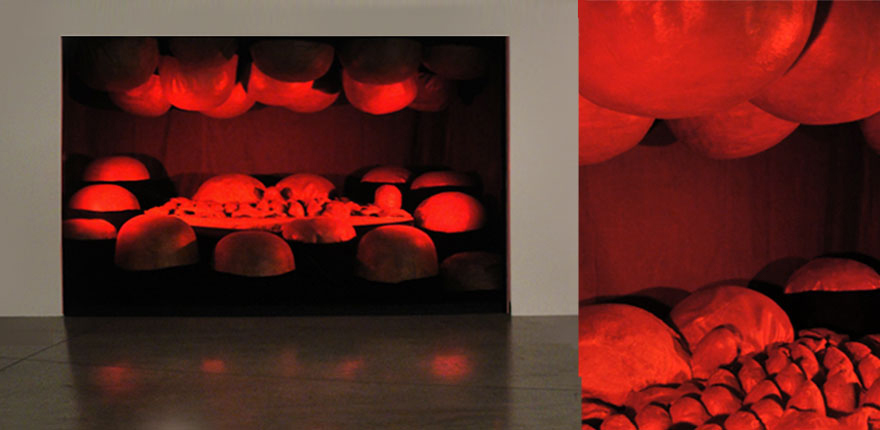
The work is not easy. It is not supposed to be easy. It is a monument to a feeling that most people have and most people suppress, and the act of making the feeling visible — of giving it scale and material form and placing it in a gallery where it must be encountered — is an act of considerable courage. The courage is not the courage of transgression, of the artist who says the unsayable to shock or to provoke. It is the courage of honesty: the refusal to pretend that the family is simply a site of warmth and protection, the insistence that it is also a site of power and violence and the formation of damages that persist across a lifetime.
Fabric, Sewing, and the Late Work
In the last decade of her life — she continued to work in her Chelsea townhouse in Manhattan until very close to the end, holding the Sunday salons that were her primary form of professional sociality, receiving younger artists and writers and critics with the same intensity and the same demand for complete honesty that had characterised all her encounters — Bourgeois returned to fabric. She had always worked with textiles — they were, after all, the material of her childhood, the material of her mother’s trade — but in the very late work, from approximately 2000 onward, fabric became the dominant medium: clothes, particularly, old clothes with histories, which she cut and stuffed and stitched into figures and installations that carried the weight of personal history more directly than even the sculptures.
The Fabric Works — the series of wall-hung panels and free-standing figures made from found textiles, old clothing, and handmade additions — have a quality that is unique in her output: intimate in a way that the large-scale sculptures cannot quite be, domestic in the most precise sense, concerned with the small texture of daily life rather than the large architecture of psychological experience. They are made with a technique that is explicitly referential to the amateur — to the sewing and embroidery of women who make things at home, outside the institutional structures of art, for purposes that are use-related rather than aesthetic. The choice is not nostalgic. It is political, in the way that Bourgeois’s aesthetic choices were always political: a statement about whose labour counts and what counts as art and the relationship between the domestic and the significant.
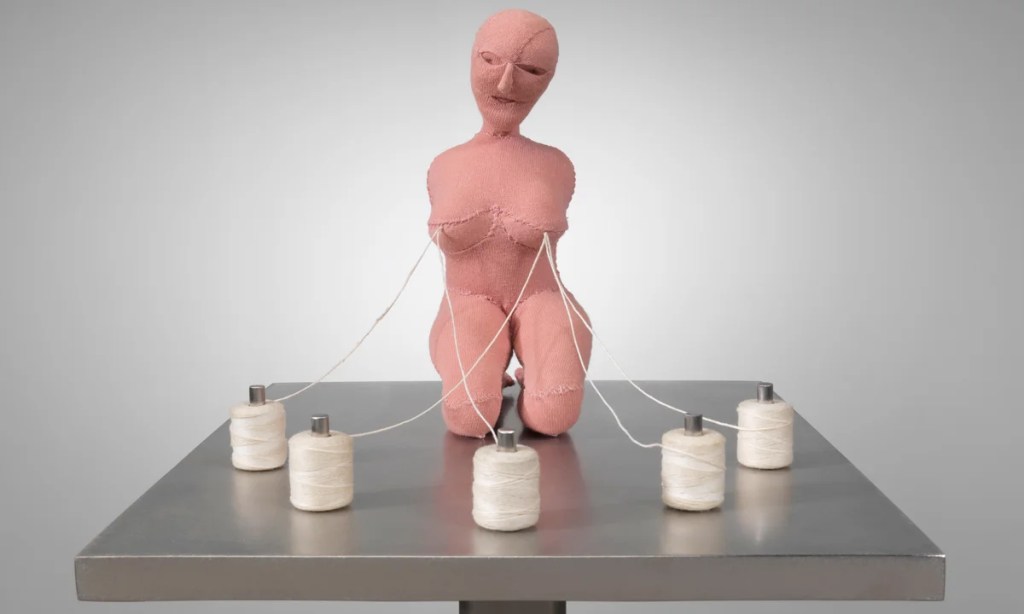
The text installations that accompanied the late work — phrases and sentences stitched into fabric, printed on banners, embroidered into cushions and clothing — are among the most direct statements she made. “I have been to hell and back. And let me tell you, it was wonderful.” “I am not what I am. I am what I do with my hands.” “Do not abandon me.” “You are observation. I am the subject.” The sentences are not explanations of the visual work; they are parallel to it, doing in language what the sculpture does in form — making the internal external, making the private legible, insisting on the right to be known.
The Sunday Salons
Jerry Gorovoy came to work as Bourgeois’s studio assistant in 1980 and stayed for thirty years, becoming, in time, not merely an assistant but a collaborator, a keeper of the archive, and a presence of considerable psychological importance in the life of an artist whose psychological life was, by all accounts, never simple. The relationship between them — professional, deeply personal, not sexual, conducted with a loyalty that Bourgeois expressed in works dedicated to him and in statements of a directness that embarrassed some of those who witnessed them — is one of the less-examined but more significant relationships in the history of late twentieth-century art.
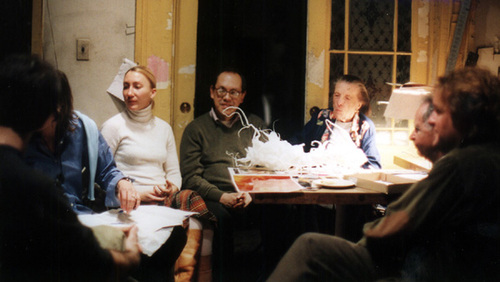
The Sunday salons that Bourgeois held at her Chelsea house from the 1980s until very close to the end of her life were, for the young artists and writers who were invited, an experience unlike any other available in the New York art world. The format was loose — people arrived, there was food, there was conversation — but Bourgeois herself was the organising principle, and her presence organised everything around it. She asked questions. She expected honest answers. She had no interest in the social performances by which the art world usually conducted its business — the careful self-presentation, the strategic modesty, the maintenance of position. She wanted to know what you actually thought, what you were actually afraid of, what you were actually making and why.
The artists who attended those salons describe an experience that was simultaneously frightening and liberating: the freedom of being in the presence of someone who required nothing except honesty, and the fear of being unable to meet that requirement. Bourgeois had spent her entire career being honest at a cost, and she had no patience for those who were not. She was not cruel — the accounts of her generosity, particularly toward younger artists who were struggling, are consistent and convincing. But she was direct in a way that the art world, which is a world of considerable social complexity and considerable career anxiety, does not usually accommodate, and the directness had an effect that outlasted the encounter.
The Question of Feminism
Louise Bourgeois’s relationship to the feminist art movement — which gathered momentum through the 1970s and 1980s, producing artists and critics and institutional practices that transformed the conditions of women’s participation in the art world — was complicated in ways that resisted easy summary. She was, by every structural measure, a feminist: she was a woman who made art about the female body and the female experience, who had spent decades being ignored by institutions that were organised around the promotion of male artists, who understood from the inside what it cost to be a woman trying to work in conditions not designed for women.
She was also resistant to being defined primarily by her gender, resistant to the reduction of the work to its feminist content, resistant to the idea that the personal and political dimensions of the art were its most important dimensions. “I am not a feminist,” she said, at various points in her career, in ways that were deliberately provocative and that need to be read carefully — not as a rejection of the feminist project but as a resistance to the categorisation, to the idea that the work could be adequately understood through the lens of any single argument, however valid.
The feminist critics and curators who championed her work in the 1970s and 1980s — Lucy Lippard’s early essays on Bourgeois were among the first serious critical engagements with the work — were not wrong in the feminist reading. The work is feminist, in the sense that it takes the female experience seriously as a subject, that it represents the body without the male gaze’s organising authority, that it refuses the conventional hierarchies that had kept women’s art marginal for centuries. But it is also more than feminist, in the sense that the psychological territory it occupies — the terrain of fear, of desire, of the damaged and the creative, of the family as the site of wound and formation — is not gendered in any simple way. The father and the mother are both in the work. The damage done by love and the love that persists through damage are not experiences unique to women. They are human experiences, which Bourgeois rendered in forms that spoke to everyone who had them.
What Remains
Louise Bourgeois died on the first of May 2010, at the age of ninety-eight, in the New York Presbyterian Hospital, having worked until the previous year with a sustained productivity that would have been remarkable at half the age. She had made art for seven decades. She had spent thirty years in relative obscurity and thirty years in the kind of recognition that brought retrospectives at the Tate and the Guggenheim and the Centre Pompidou and the highest prices at auction that sculpture by a woman had ever achieved. She had outlived her husband by thirty-seven years, outlived her three sons’ childhood and most of their adult lives, outlived most of the friends and colleagues and antagonists of her New York years. She had been in psychoanalysis for nearly fifty years — she began in 1952 and continued, by her account, until very close to the end, which is either a testament to the depth of the material she was working through or to the degree of seriousness with which she took the examined life, and is probably both.
The work she left behind is of a scale and a variety that takes time to fully apprehend. The early paintings and engravings, still underestimated. The Personages, those strange wooden sentinels. The latex and rubber sculptures of the 1960s. The Destruction of the Father. The Cells series, spanning a decade and a half. The marble and bronze body parts — the hands, the eyes, the couple locked in their eternal embrace. The Maman spiders on their various continents. The late fabric works. The text installations. The drawings, which she made throughout her life and which are, at their best, as extraordinary as the sculpture: the spirals, the figures, the anatomical forms rendered with a line that is simultaneously scientific and completely personal.
What holds it together — what makes it, despite the variety of media and the span of decades and the shifts in scale and material and formal approach, a single coherent body of work — is the consistency of the subject. Not the consistency of the imagery, though certain images recur; not the consistency of the formal approach, though certain formal principles persist; but the consistency of the inquiry. She was always asking the same question, in different forms, at different scales, with different materials. The question was: what does it mean to have been a child, and to carry that childhood forever afterward, and to make something out of the carrying? What does it mean to have been frightened and to have survived the fear? What does it mean to love people who have hurt you, and to be hurt by people you love, and to go on making and living in the knowledge that the hurt and the love are not separable?
The answer she gave was not in words — she was not a thinker in the way that Sontag was a thinker, not a writer who could articulate the argument in prose. The answer was the work itself. The accumulated, varied, enormous, precise, brutal, beautiful body of work that she made over seventy years, in studios and bedrooms and the various spaces that a life of sustained creativity occupies, was the only answer she had and the only answer she needed. It is also, as answers go, sufficient. It is more than sufficient. To stand beneath a Maman, or inside a Cell, or in front of one of the late fabric works with their stitched declarations, is to be in the presence of an answer given at full scale and full cost — at the cost of a life, of everything a life has available to spend.
She was afraid all her life. She made art all her life. The art was what she did with the fear. And the fear, transformed — given form, given scale, given the patience and the craft and the absolute refusal to look away that characterised everything she made — became something that hundreds of thousands of people, standing beneath the spiders or inside the cells or in the presence of the carved hands, have recognised as their own.
That is what art is for, when it is doing what only art can do. That is the guaranty.
The primary catalogue for Louise Bourgeois’s work is the Phaidon monograph by Frances Morris and Marie-Laure Bernadac. Mignon Nixon’s study Fantastic Reality: Louise Bourgeois and a Story of Modern Art is published by MIT Press. The Louise Bourgeois Studio maintains an extensive online archive. Major permanent Maman installations can be seen at Tate Modern, London; the Guggenheim Bilbao; the National Gallery of Canada, Ottawa; and the Mori Art Museum, Tokyo.
Discover more from My World of Interiors
Subscribe to get the latest posts sent to your email.

