
Across Gaza, the West Bank and a scattered diaspora, the past five years have produced an unusually intense body of work — made, in large part, out of catastrophe
A note on scope before anything else: “Palestinian culture” today is made across more places than any single capital could hold — Gaza, the West Bank and East Jerusalem, Palestinian citizens of present-day Israel, and a diaspora stretching from Amman and Beirut to London, Paris and Chicago. This dispatch follows the culture, not the map; it makes no claim about where any future border should sit, and where the ongoing war and occupation appear below, they are described as reported by the institutions and witnesses cited, including where Israeli officials and Palestinian institutions offer starkly different accounts of the same events.
What follows, then, is not a portrait of a place so much as a portrait of a people’s cultural output under five years that included a pandemic, a war that has killed tens of thousands of Palestinians in Gaza since October 2023, the near-total destruction of Gaza’s built environment, and a West Bank in which entire refugee camps have been emptied by military operations. It would be reasonable to expect all of that to silence a culture. Instead — and this is the thing that keeps surprising festival juries, prize committees and museum directors who did not expect to be confronted with it so often — the past five years have produced Palestine’s first Academy Award, a Pulitzer Prize, a Grand Jury Prize at Venice, a wave of translated poetry unlike anything the language has seen in a generation, and a fashion and textile revival now showing in major museums from London to Kuala Lumpur. None of this erases the losses described below. It exists alongside them, and often because of them.
Cinema: from Masafer Yatta to the Academy Awards
Palestinian cinema’s defining moment of the past five years has been, by any measure, No Other Land, a documentary made by the Palestinian-Israeli collective of Basel Adra, Hamdan Ballal, Rachel Szor and Yuval Abraham, which follows the years-long demolition of the Palestinian herding community of Masafer Yatta in the occupied West Bank as Israeli authorities cleared land for a declared military firing zone. Filmed between 2019 and 2023, it premiered at the Berlinale, where it won the Panorama Audience Award, and went on to win the Academy Award for Best Documentary Feature in March 2025 — the first Oscar ever won by a Palestinian film. Despite the award, the film could not secure U.S. theatrical distribution, a situation some critics likened to soft censorship; the filmmakers eventually self-released it on streaming platforms rather than accept a deal tied to an investor they objected to. The film’s reception has itself become a small case study in how contested this cultural terrain is: the Palestinian Campaign for the Academic and Cultural Boycott of Israel criticized the film’s win for what it called insufficient acknowledgment of Israeli responsibility, while Israel’s culture minister at the time condemned the documentary as distorting Israel’s image; co-director Basel Adra was later assaulted by settlers and briefly detained by Israeli forces in the West Bank, an incident that drew international attention.
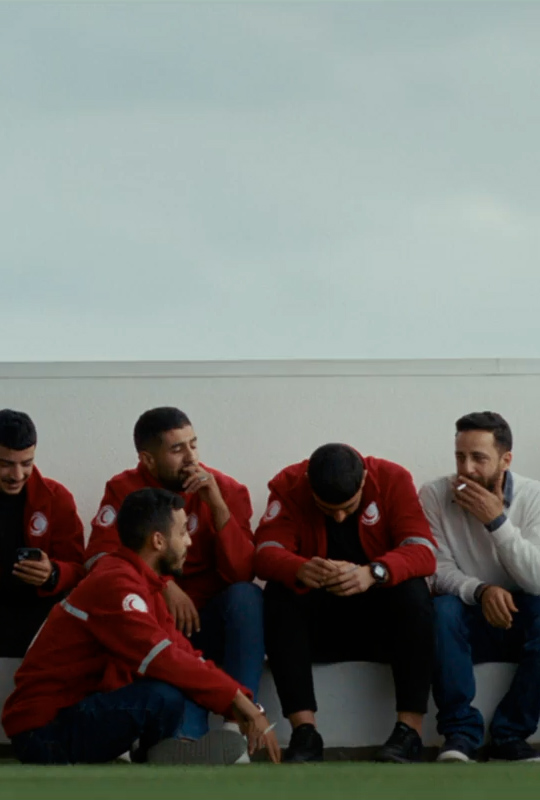
If No Other Land was the decade’s most argued-over film, The Voice of Hind Rajab has been its most acclaimed. Directed by Tunisian filmmaker Kaouther Ben Hania and cast entirely with Palestinian actors, the docudrama reconstructs the real emergency calls made by a five-year-old girl trapped in a car in Gaza in January 2024, using the actual audio recordings of her voice interwoven with dramatized reenactments of the Red Crescent responders who tried, and failed, to reach her in time. It premiered at Venice in September 2025 to a reported 23-minute standing ovation, won the festival’s Grand Jury Prize, and went on to an Oscar nomination for Best International Feature — one of three films concerning Palestinian history submitted to the Academy that year, alongside All That’s Left of You and Palestine 36. Its reception has not been uniformly celebratory: some critics have raised questions about the ethics of dramatizing a real child’s death using her actual voice, while the film’s India theatrical release was reportedly blocked amid concerns about diplomatic fallout.
Institutions built specifically to sustain Palestinian filmmaking under these conditions have grown alongside the films themselves. The Freedom Theatre in Jenin refugee camp, founded in 2006 as a youth theatre and film training center, has produced a generation of actors and filmmakers, including Motaz Malhees, who trained there before starring in The Voice of Hind Rajab. The theatre’s own story has been one of repeated destruction and rebuilding: its predecessor, the Stone Theatre, was bulldozed by the Israeli army in 2002; its founder Juliano Mer-Khamis was assassinated in 2011 by an unidentified gunman; and the theatre itself was raided and vandalized by Israeli forces in December 2023, before large-scale Israeli military operations in Jenin refugee camp in 2025 displaced the camp’s roughly 42,000 residents entirely, forcing the theatre to relocate to temporary quarters in central Jenin. That it has continued to operate at all, training a new cohort of young actors even as the camp around it emptied out, is treated by its own staff less as resilience than as a continuation of what they call cultural resistance — a term the theatre uses of itself, explicitly, rather than one applied to it from outside.
Literature: an anthology built from loss
No discipline has registered the human cost of the past five years more directly, or more literally, than poetry. Refaat Alareer, a professor of English literature at the Islamic University of Gaza and co-founder of the mentorship project We Are Not Numbers, was killed in an Israeli airstrike in December 2023 alongside his brother, sister and four nephews; his final poem, “If I Must Die,” was read aloud by the actor Brian Cox in a video that circulated globally, and gives its title to You Must Live, a 2025 anthology gathering thirty-four Palestinian poets, most of them still living in Gaza or the West Bank. His former student Mosab Abu Toha, who fled Gaza after being detained by Israeli forces in late 2023, has become the movement’s most internationally recognized living voice: his second collection, Forest of Noise, was published by Knopf in 2024, and in 2025 he won the Pulitzer Prize for Commentary for a series of New Yorker essays on daily life and loss in Gaza — the first time the prize has gone to a Palestinian writer for work specifically about the war. Alareer’s collected writing was itself published posthumously as If I Must Die: Poetry and Prose, with a foreword by novelist Susan Abulhawa.
That wave of literary attention has not been limited to poets writing from inside the war. A steady stream of Arabic fiction in translation has continued to reach English-language readers through the period, part of a longer tradition of Palestinian storytelling that predates the current war by decades — Ghassan Kanafani’s mid-century fiction, still taught and reissued, remains a touchstone for younger writers, several of whom got their start through the same Gaza Writes Back anthology project Alareer edited in 2014. Editors compiling year-end reading lists have noted the anthology form itself becoming unusually dominant in Palestinian publishing of the past five years — a structural response, several editors and translators have suggested, to a moment in which individual literary careers are frequently interrupted by displacement, and in which a chorus of voices can carry testimony that no single narrator’s account could sustain alone.
Visual art and heritage: what survives, what is verified lost
Visual culture is where the human and material costs of the war have been most exhaustively documented — and also where the documentation itself has become contested territory. By UNESCO’s own verified count, based on satellite monitoring and on-site assessment conducted after the October 2025 ceasefire, at least 164 cultural sites in Gaza sustained damage between October 2023 and March 2026: religious sites, museums, archaeological sites, monuments and repositories of movable cultural property. Among the confirmed losses are the seventh-century Great Omari Mosque, Gaza’s oldest mosque; the Church of Saint Porphyrius, among the world’s oldest churches; the Ottoman-era Hamam al-Sammara bathhouse; and the Qasr al-Basha, a thirteenth-century Mamluk palace that had been converted into an archaeology museum and whose roughly 17,000-artifact collection was, according to the museum’s own restoration team, reduced to fewer than twenty recovered pieces. Palestinian cultural officials and independent researchers, including a University of Oxford heritage-documentation project, have offered higher damage estimates than UNESCO’s own confirmed figures, citing access restrictions on independent verification.
How to characterize this destruction is itself a matter of open dispute. UN human rights investigators have concluded that Israeli forces damaged more than half of Gaza’s religious and cultural sites and found the destruction, in specific instances, to have exceeded any identifiable military necessity, constituting war crimes; Amnesty International and South Africa’s case before the International Court of Justice have gone further, characterizing the pattern of destruction as evidence of intent to erase Palestinian cultural memory. Israeli officials have consistently maintained that military operations target Hamas infrastructure embedded within civilian and cultural sites, with an IDF spokesperson telling the BBC that Hamas and other armed groups conceal military assets in densely populated civilian areas; the Israeli legal team at The Hague has argued the campaign constitutes lawful self-defense rather than a campaign against Palestinian civilians or their heritage as such. UNESCO itself, notably, has been criticized by some heritage scholars for declining to name Israel directly as a responsible party in its own statements, a marked departure from its practice in prior conflicts such as the destruction of Palmyra.
Amid the loss, individual acts of rescue have taken on outsized symbolic weight. In September 2025, Première Urgence Internationale, working with the Latin Patriarchate of Jerusalem, evacuated an eighty-cubic-metre archive of antiquities — ceramics, mosaics, coins, human remains spanning twenty-five years of excavation, including material from the Byzantine monastery of Saint Hilarion — from a Gaza City storage facility just ahead of a strike the Israeli military had warned was imminent. Contemporary artists have registered smaller, more personal versions of the same loss: the Gazan painter Shareef Sarhan, now living in exile in Madrid, has described losing thousands of his own works along with the nearly one thousand pieces held by Shababeek, the contemporary art gallery he ran in Gaza City before an October 2023 airstrike destroyed the building. For architects, the response has sometimes taken the form of a rescue mounted at a distance: the Bethlehem- and Paris-based practice AAU Anastas designed the Paris exhibition that displayed a separate cache of ancient Gazan artefacts — already evacuated from Gaza years before the current war and unable to return — using storage-crate aesthetics deliberately, so that the display itself would communicate the objects’ provisional, unresolved status.
Fashion and textile: embroidery as archive
If any single Palestinian art form has moved furthest into global visibility over the past five years, it is tatreez, the traditional cross-stitch embroidery historically worked into the thobe, or dress, worn by Palestinian women, with motifs that vary distinctly from village to village. Recognized by UNESCO in 2021 as Intangible Cultural Heritage, tatreez has a documented history as a form of coded resistance stretching back to the first intifada, when the Israeli authorities banned public display of the Palestinian flag and women began stitching its colors into their embroidery instead. That history has given the craft an unusual dual life: it functions simultaneously as heritage object, income source for displaced women, and — increasingly, over the past five years — as high fashion.
Major museums have taken notice. The Islamic Arts Museum Malaysia opened Tatreez: Reclaiming Palestine Through Embroidery, built from a collection assembled over fifteen years partly through the Beirut-based Inaash Association, which has employed Palestinian refugee women in Lebanon as embroiderers for decades. Antwerp’s MoMu fashion museum has shown contemporary designers working the tradition into runway-ready silhouettes, including London- and West Bank-based designer Ayham Hassan, whose 2025 Central Saint Martins graduate collection, titled after a shade of magenta he described as symbolizing erasure and survival, drew directly on visual references to Gaza. At the Golden Globes in January 2026, actor Saja Kilani — who starred in The Voice of Hind Rajab — wore a custom gown by Jordanian designer Reema Dahbour with tatreez embroidery worked into the neckline, a red-carpet moment that traveled well beyond the fashion press specifically because of what it referenced. Grassroots transmission has kept pace with the institutional recognition: stitching circles have proliferated from Bethlehem cafés to diaspora living rooms in New York and Beirut, with practitioners describing the communal act of embroidering together as inseparable from what they preserve.
Music: dabke goes electronic, protest goes pop
Contemporary Palestinian music has spent the past five years pulling in two directions simultaneously: toward the specifically Palestinian folk tradition of dabke, and toward international pop, hip-hop and electronic production, often within the same song. 47Soul, the Palestinian-Jordanian band credited with pioneering the “shamstep” genre, fuses dabke rhythms and the reed instrument mijwez with electronic synths; East Jerusalem-based singer-songwriter Bashar Murad, who first gained wider attention through a 2019 collaboration with Icelandic band Hatari after their Eurovision performance, has built a career addressing occupation and gender politics directly in his lyrics. Jerusalem-born, Gaza-raised artist Saint Levant became one of the period’s most visible new pop exports, his concerts drawing crowds who perform dabke en masse in the audience — a practice that has itself become a recognizable feature of Palestinian diaspora concerts more broadly, documented widely on social platforms as younger fans learn steps from parents and grandparents specifically at these shows. Amman-based singer Zeyne, who grew up in a family that ran a dabke troupe, released her debut album in October 2025 with production drawing on Arabic music, jazz and R&B; a planned 2026 European tour was postponed following the outbreak of the broader regional war that began with strikes on Iran that February, a small but telling reminder of how directly regional escalation continues to interrupt Palestinian cultural production even at some geographic remove from Gaza itself.
The music’s political register runs deep and long before the current war: the pioneering hip-hop group DAM, formed in the city of Lod in the late 1990s, has spent a quarter-century rapping in Arabic, Hebrew and English about the specific position of Palestinian citizens of Israel, while the earlier generation’s Sabreen collective, active from the 1980s, set Palestinian poetry to music in ways that still shape how younger songwriters approach the form. In October 2023, in the war’s opening weeks, twenty-five musicians from across the Middle East and North Africa released the charity single “Rajieen” (“We Are Returning”) in direct response to events in Gaza — a fast, collective act of solidarity that has become almost a genre convention of its own during the past five years, with new benefit singles and compilations continuing to appear as the war has ground on.
Architecture and design: conservation as practice
Palestinian architecture over the past five years has operated at two entirely different scales simultaneously: the catastrophic, ongoing loss of Gaza’s built environment, and a smaller but genuinely internationally recognized body of contemporary design and heritage conservation work concentrated in the West Bank.
The most honored example of the latter is AAU Anastas, a Bethlehem- and Paris-based practice run by brothers Elias and Yousef Anastas, whose Wonder Cabinet project — conceived as a haven for culture and creativity bridging design and local production — won a 2025 Aga Khan Award for Architecture, one of the field’s most significant international prizes. The same award cycle recognized RIWAQ, the Centre for Architectural Conservation, for its Qalandiya restoration project, which rehabilitated a historic Jerusalem-area village center using traditional stone masonry and local materials, winning the Grand Prize at the 2025 Holcim Foundation Awards for what jurors called a sensitive, contextual approach to heritage conservation under conditions of political fragmentation. AAU Anastas’s practice draws heavily on Palestinian stone-construction traditions, exhibited at the Venice Architecture Biennale, and extends into museum design: the studio designed the Paris exhibition of rescued Gazan antiquities described above, treating the display cases themselves — built to look like mobile storage crates — as a statement about the objects’ unresolved, provisional exile from home.
Set against that recognition is the scale of what has been lost in Gaza specifically. Independent researchers and the World Bank have estimated damage to Gaza’s cultural heritage alone in the hundreds of millions of dollars, part of a far larger figure — tens of billions of dollars in destroyed built infrastructure overall, with independent assessments suggesting the large majority of all buildings in the Gaza Strip have been damaged or destroyed since October 2023. Restoring the built environment to anything resembling its prior state has been estimated, even under optimistic assumptions about funding and access, to take the better part of a decade. For a discipline that elsewhere in the region — as in Lebanon’s ongoing port reconstruction, or Iran’s postwar rebuilding after the 1980s — has learned to treat catastrophe as an unwelcome but recurring condition of practice, Gaza represents something categorically larger: not a single, bounded reconstruction project, but the material erasure of an entire built environment that a small, celebrated cohort of Palestinian architects is only now beginning to imagine how to answer.
The pattern underneath
Set beside the other cultures surveyed in this series, Palestinian cultural production of the past five years is harder to describe through a single organizing logic, because it has been made under so many different kinds of pressure at once: military occupation in the West Bank, sustained blockade and war in Gaza, and a diaspora large enough, and connected enough by shared language and grief, to function as something like a distributed second homeland. What holds across all of it is a recurring structural choice, visible in nearly every discipline surveyed here: Palestinian artists have overwhelmingly chosen documentation and testimony over allegory. No Other Land is not a fable about occupation; it names the village, the family, the specific court ruling. The Voice of Hind Rajab uses an actual child’s actual recorded voice rather than an invented composite. Refaat Alareer’s poem is titled, unambiguously, after the possibility of his own death, which arrived days later. UNESCO’s own damage assessments list buildings by name and construction date rather than describing loss in the abstract. Even tatreez, the most seemingly decorative art form discussed here, is read by nearly everyone who practices it as a form of documentary record — a village’s specific patterns, stitched, are treated as evidence that a specific place and its people existed.
That insistence on specificity, on naming names and giving dates, is not incidental to the political argument several of these works make; it is very often the argument itself, put forward by artists across a genuinely wide range of individual political views, from PACBI’s insistence on unambiguous responsibility to individual Gazan artists focused simply on getting their own names and their own work recorded before it disappears. Whether or not any given viewer, reader or listener agrees with the political claims embedded in that specificity, the cultural fact is not really contestable: an unusually large amount of what has been made under these conditions over the past five years has been designed, quite deliberately, to survive as a record — on the theory, stated outright by more than one artist quoted above, that a story that is told in enough detail is harder to erase than the place it describes.
Sources
Cinema
- No Other Land — Wikipedia
- No Other Land Wins Oscar for Best Documentary Film — Arab Film and Media Institute
- Palestinian Documentary “No Other Land” Wins Oscar, PACBI Declares Film Violates BDS Guidelines — Institute for Palestine Studies
- The Voice of Hind Rajab — Wikipedia
- What happened to the Jenin Freedom Theater? — Mondoweiss
- The Freedom Theatre — Wikipedia
Literature
- Palestine Is a Story Away: A Tribute to Refaat Alareer — Los Angeles Review of Books
- Mosab Abu Toha — Wikipedia
- Palestinian author Mosab Abu Toha wins Pulitzer Prize for commentary — Al Jazeera
- Forthcoming 2026: Arabic Literature in Translation — ArabLit
Visual art and heritage
- Impact on cultural heritage — UNESCO
- Destruction of cultural heritage during the Israeli invasion of the Gaza Strip — Wikipedia
- Artists hope to preserve and rebuild Gaza’s cultural heritage — PBS News
- Israeli actions in Palestinian territories constitute war crimes, Human Rights Council hears — UN News
- Israel/OPT: Israel’s systematic destruction of high-rise buildings must be investigated as war crimes — Amnesty International
- Gaza’s Archaeological Heritage at Risk of Destruction — Première Urgence Internationale
- AAU Anastas creates exhibition design for show of Palestinian antiquities — Dezeen
Fashion and textile
- Tatreez explained: Why Palestinian women are preserving this embroidery — CNN
- Tatreez — Wikipedia
- Tatreez: Reclaiming Palestine Through Embroidery — A Deep Dive into IAMM’s New Exhibition
Music
- 9 Palestinian Music Artists you Need to Check out Before the End of The Year — Visionary Magazine
- Tracing History: Identity in Palestinian Music — Arab America
- Zeyne (singer) — Wikipedia
Architecture and design
Discover more from My World of Interiors
Subscribe to get the latest posts sent to your email.

