
Essay · Film & Lives
The Face That the New Wave Built Its Cathedral Around
Anna Karina arrived in Paris from Copenhagen at seventeen with almost nothing, and became, within a decade, the most filmed face of the French New Wave — a presence so fully itself on screen that the camera, which usually mediates between a person and the world, seemed in her case merely to be getting out of the way.
By Bergotte · Paris · Film & Lives
There is a scene in Vivre sa vie — Jean-Luc Godard’s 1962 film, twelve episodes in the life of a young Parisian woman who drifts into prostitution — in which Anna Karina, playing Nana, sits alone in a cinema and watches Carl Theodor Dreyer’s La Passion de Jeanne d’Arc. On screen, Renée Falconetti weeps. In the audience, Karina weeps. The camera moves between them — between the woman on the old screen and the woman watching her — and something extraordinary happens: the two faces, separated by thirty-four years of cinema history, become a single meditation on what it means to be a woman in the hands of forces larger than herself, forces that are simultaneously brutal and indifferent and somehow, in Dreyer’s rendering and in Godard’s, transfigured into art. It is one of the great moments in cinema, and it is great precisely because Karina is not performing. She is watching a film and crying, as anyone might, and Godard has understood that the camera does not need to do anything more than be present for the moment to become eternal.
This was Anna Karina’s particular gift, and it was also her particular condition: to be looked at with an intensity that transformed the looking into something larger than either the looker or the looked-at. She did not always choose the looking. In the case of the most consequential gaze of her life — Jean-Luc Godard’s — the choice was complicated by love and by power and by the strange, asymmetrical dynamic of a muse and her artist, a dynamic that the films they made together are partly about and that the life they led together was entirely defined by. She was, in those years, the most important person in French cinema. She was also, in those same years, in a marriage that left marks that did not fade.
Copenhagen to Paris: The Escape and the Arrival
She was born Hanne Karin Blarke Bayer in Copenhagen on September 22, 1940, into circumstances that were, by her own account, difficult from the beginning. Her parents separated when she was very young; she was raised by her grandmother, then by a series of foster families, then briefly by her mother before leaving Denmark altogether at seventeen. The childhood she described in later interviews was marked by the particular instability of a child who has been passed between adults and has learned, as such children do, to read a room very quickly and to present whatever version of herself the room requires. This is not a bad preparation for acting. It is, in fact, almost precisely what acting requires.
She arrived in Paris in 1956 — seventeen, Danish, barely speaking French, beautiful in the specific and slightly unconventional way that would photograph so well: the dark eyes set wide, the face open and grave and capable of a sudden, transforming smile that was so unguarded it looked like an accident. She worked as a model, appeared in advertisements, caught the attention of Coco Chanel, who offered her work and gave her a kind of informal sponsorship that stabilised the early years. She took the name Anna Karina — chosen, she said, almost arbitrarily, from a magazine, though the name’s clean, pan-European sound suited perfectly the borderless creature she was becoming, neither fully Danish nor fully French but something that belonged to both and was contained by neither.
“I am Danish by birth, French by adoption, and a citizen of cinema by vocation. The cinema was the only country that ever felt entirely like home.”Anna Karina, in interview, 1965
Godard saw her first in a soap commercial — she was washing a window, or a floor, some domestic surface, and there was something in the way she moved, in the combination of physical grace and absolute unselfconsciousness, that stopped him. He offered her a role in À bout de souffle — Breathless, 1960, the film that announced the New Wave to the world — and she turned it down, reportedly because the role required nudity and she was not willing. He cast Jean Seberg instead. Then he cast Karina in Le Petit Soldat (1960), which the French government immediately banned for its depiction of the Algerian war, so that her first Godard film was not seen publicly until 1963. By that time she had made three more with him, he had asked her to marry him, and she had said yes.
Godard and the Films That Were Also a Marriage
They married in 1961 and divorced in 1965, and in the four years between those dates they made seven films together — Une femme est une femme, Vivre sa vie, Les Carabiniers, Le Mépris (in which Karina did not appear but whose emotional climate she inhabited), Bande à part, Une femme mariée, Alphaville, and Pierrot le Fou — that constitute one of the most remarkable bodies of collaborative work in the history of cinema and one of the more complicated partnerships in the history of art. The films used Karina’s face, her body, her voice, her laugh, her particular quality of presence, as their primary material, and they were made by a man who was simultaneously her husband and her director, which are roles whose power dynamics point in the same direction and whose combination is not always healthy for the person who is both wife and subject.
Karina has spoken, in various interviews across the years, about the difficulties of the marriage — Godard’s coldness, his remoteness, the way his intellectual intensity could become a form of absence, the miscarriage she suffered that he did not respond to in the way she needed. She has also spoken about the films with a love that is clearly genuine — about what it meant to be trusted with that material, to be the person through whom Godard’s ideas about cinema and women and the modern world were made visible, to inhabit characters who were simultaneously fictional constructions and investigations of herself. The duality was productive and it was painful and it produced work that is indelible.
In Bande à part (1964) — the film in which Karina and her two co-stars run through the Louvre in record time, the sequence that has been referenced and quoted and replicated across fifty years of world cinema — she dances in a café with a spontaneity that seems to exist entirely outside the film, outside the fiction, as though the camera has caught something that was not arranged. The dance is one of the most joyful minutes in the New Wave, and its joy is Karina’s — her specific, unrepeatable, wholly personal quality of delight in her own body in space. Godard filmed it. He did not invent it. That distinction matters.
Nana, the Twelve Episodes, and What the Camera Saw
Vivre sa vie — released in 1962, the year after their marriage, and widely regarded as the finest film they made together and one of the finest films of its decade — is structured as twelve tableaux in the life of Nana Kleinfrankenheim, a young Parisian woman who, unable to pay her rent, unable to get the acting career she wants, enters prostitution and dies, at the film’s end, in a botched deal between her pimp and a buyer. The plot is as stark as that summary makes it sound. The film is not.
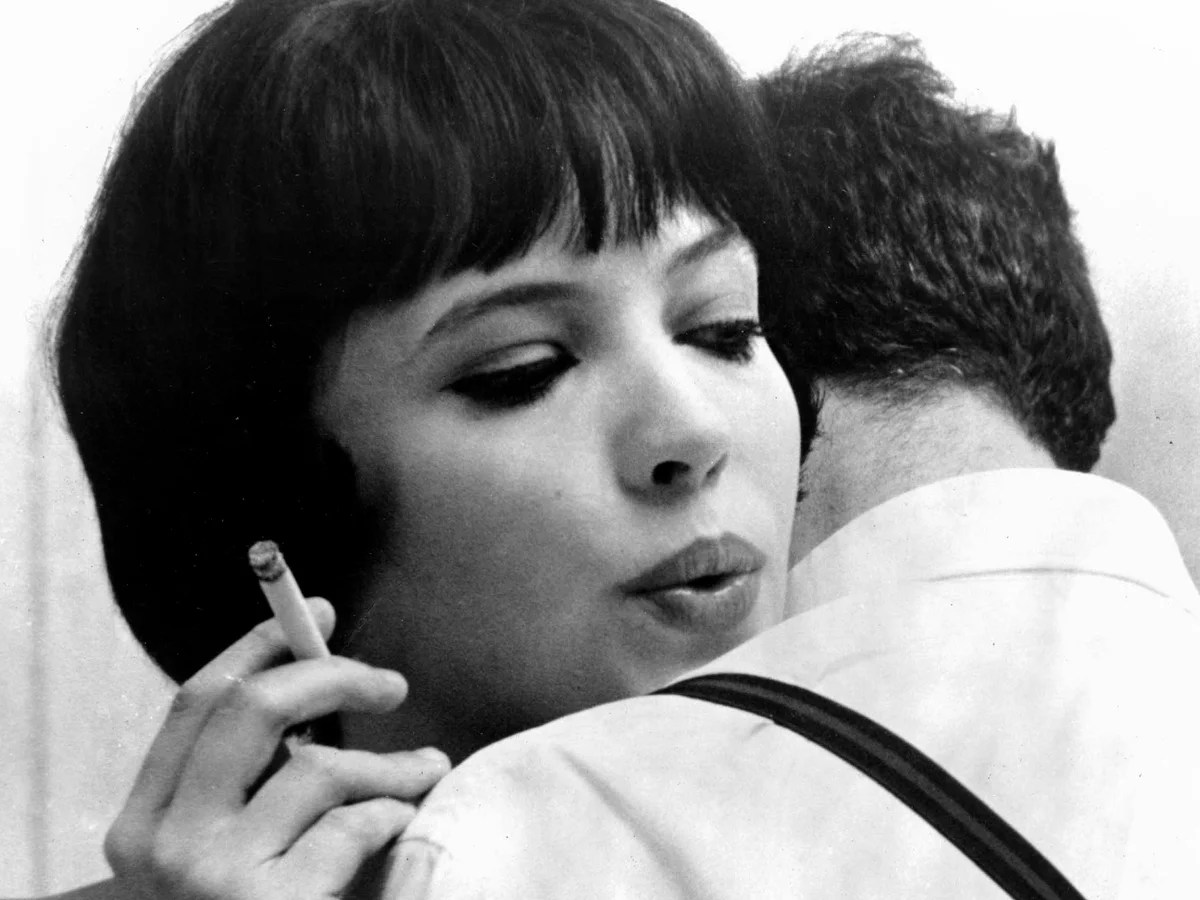
Godard shoots Karina’s face in extended close-up, in profile, from behind, in motion and in stillness, with a sustained and sometimes uncomfortable intensity that is — it is important to say this clearly — both an act of genuine cinematic intelligence and an act of possession. The face is the film’s primary text. Everything that Nana thinks and feels and fails to say passes across it, or fails to pass, and the camera is there for both the passage and the failure. What Karina does with this — how she inhabits the exposure, how she finds within the close-up not vulnerability but a kind of sovereign privacy, a self that the camera can approach but not entirely enter — is the performance. It is one of the great performances in cinema, and it is great in a way that is inseparable from the fact that the actress giving it was also, at the time, living with the man pointing the camera.
“He filmed me as if I were an object. But when I watched the films, I understood that the object had a soul, and that he had found it. I am not sure he knew what to do with it once he had.”Anna Karina, in interview with Cahiers du Cinéma, 1968
Pierrot le Fou and the End of Something
Pierrot le Fou, released in September 1965, was the last film they made together during their marriage, and it reads, in retrospect, as its elegy — a film about a man and a woman on the run from everything, from bourgeois life, from narrative convention, from each other, and from the fact that the thing between them is ending. Ferdinand — Jean-Paul Belmondo — covers his face in blue paint and blows himself up at the end, on a clifftop in the Var, overlooking the Mediterranean, because the only available response to the situation is an act so extreme it converts despair into spectacle. It is, among other things, a very Godardian solution to a very Godardian problem.
Karina plays Marianne, who is either a free spirit or a manipulative fantasist or both simultaneously, and who dies before Ferdinand, shot in a plot that the film handles with the deliberate carelessness of someone who has lost interest in plot. She is incandescent throughout — funny and dangerous and heartbreaking and never quite where you expect her to be, which is the quality that made her irreplaceable in these films and that made her so difficult to replicate in the films she made without Godard. The films without Godard were many, and several of them were good, and none of them were quite this.
After Godard: The Career That Was Also a Self
The divorce was finalised in 1965, and Karina went on working — with Jacques Rivette, with Luchino Visconti, with George Cukor, with Tony Richardson — and the work was consistently interesting and intermittently remarkable, but the cultural narrative had already been written, and the cultural narrative said that Anna Karina was Godard’s muse, which is a designation that simultaneously elevates and diminishes, that acknowledges the centrality of a person’s contribution while relocating the authorship elsewhere. She was not, it should be said, entirely unhappy with the association — she loved those films, she said so often, she understood their importance. But she was also a person, an actress, a writer — she published novels, she directed a film, she sang, she continued to make work — whose existence outside the Godard years was real and various and not entirely captured by the frame the film histories provided.
She married three more times. She lived between Paris and Los Angeles and various other cities, with the mobility of someone for whom no single place had ever been entirely home. She gave interviews with a combination of candour and discretion that is its own form of intelligence — telling enough to be honest, withholding enough to remain herself. She spoke about Godard without bitterness and without sentimentality, which is a difficult thing to achieve about a person who used you so completely and loved you so inadequately, and the achievement of it speaks to a character of considerable resilience and considerable grace.
The Face, the Dancing, and What It Meant
Anna Karina died in Paris on December 14, 2019, at seventy-nine. The tributes that followed were warm and numerous and occasionally reductive — she was described, again, as a muse, as the face of the New Wave, as Godard’s great love, as though these were the primary facts rather than contingent ones. The primary fact is simpler and more durable: she was an actress of extraordinary gifts who brought to the screen a quality of presence that no director, however gifted, can manufacture in a performer who does not already have it, and that Godard, whatever else he was to her, was wise enough to film rather than direct.
The dance in the café in Bande à part is still there. The weeping face in the cinema in Vivre sa vie is still there. Nana’s profile in close-up, thinking something the film will not tell us, is still there. These are among the indelible images of twentieth-century cinema, and they belong to Anna Karina — not to Godard, not to the New Wave, not to the history of film in the abstract, but to a girl from Copenhagen who arrived in Paris at seventeen with almost nothing and found, in front of a camera, the country she had always been looking for.
This essay draws on published interviews with Anna Karina across five decades, Richard Brody’s biography of Jean-Luc Godard Everything Is Cinema (2008), and the critical literature on the French New Wave including writings from Cahiers du Cinéma. The films referenced are: Le Petit Soldat (Godard, 1960/63), Une femme est une femme (Godard, 1961), Vivre sa vie (Godard, 1962), Bande à part (Godard, 1964), Alphaville (Godard, 1965), and Pierrot le Fou (Godard, 1965). Carl Theodor Dreyer’s La Passion de Jeanne d’Arc was released in 1928. Anna Karina was born Hanne Karin Blarke Bayer on September 22, 1940, in Copenhagen, and died December 14, 2019, in Paris.
Discover more from My World of Interiors
Subscribe to get the latest posts sent to your email.

