
America has always been a country obsessed with images of itself. It is not enough for America to exist; it must be seen existing. It must be staged, framed, printed, reproduced, circulated, believed. From the battlefield photograph to the fashion spread, from the Depression migrant to the moonlit desert, from the civil-rights witness to the imperial atrocity, American photography has done something more serious than preserve appearances. It has argued with the national myth.
A photograph is often mistaken for evidence. But the greatest photographs are more complicated than evidence. They are acts of selection, arrangement, accident, exposure and power. They show the world and also the position from which the world is being seen. In America, where the national story has so often been built on competing fantasies of innocence, freedom, conquest, abundance and reinvention, photography has been one of the great instruments of interruption.
To choose ten photographs that capture the soul of America is not to choose the ten “best” photographs, nor the most beautiful, nor even the most famous. It is to choose images that reveal something essential about the American condition: war, race, labour, land, migration, poverty, empire, spectacle, loneliness, dignity and the unresolved question of who is allowed to be visible.
The American soul is not one soul. It is a battlefield, a reservation, a ship deck, a factory floor, a migrant camp, a government office, a mountain horizon, a segregated streetcar, a flag on foreign soil, an execution on a city street. Photography has been there, not always innocently, to make the argument visible.
1. Alexander Gardner, Home of a Rebel Sharpshooter, 1863
One of the earliest great photographs of America is also one of the most troubling. Alexander Gardner’s Home of a Rebel Sharpshooter shows a dead Confederate soldier lying behind a stone barricade at Gettysburg. For generations, the image stood as a haunting document of the Civil War. Later scholarship revealed that Gardner probably moved the body and rifle to create a more dramatic composition.
That fact does not make the photograph less American. It makes it more so. The image exists between evidence and theatre, death and arrangement, truth and staging. The Civil War itself occupies a similar space in national memory: real bodies, real blood, real emancipation, real terror, later transformed into myth, romance, reunion and selective forgetting.
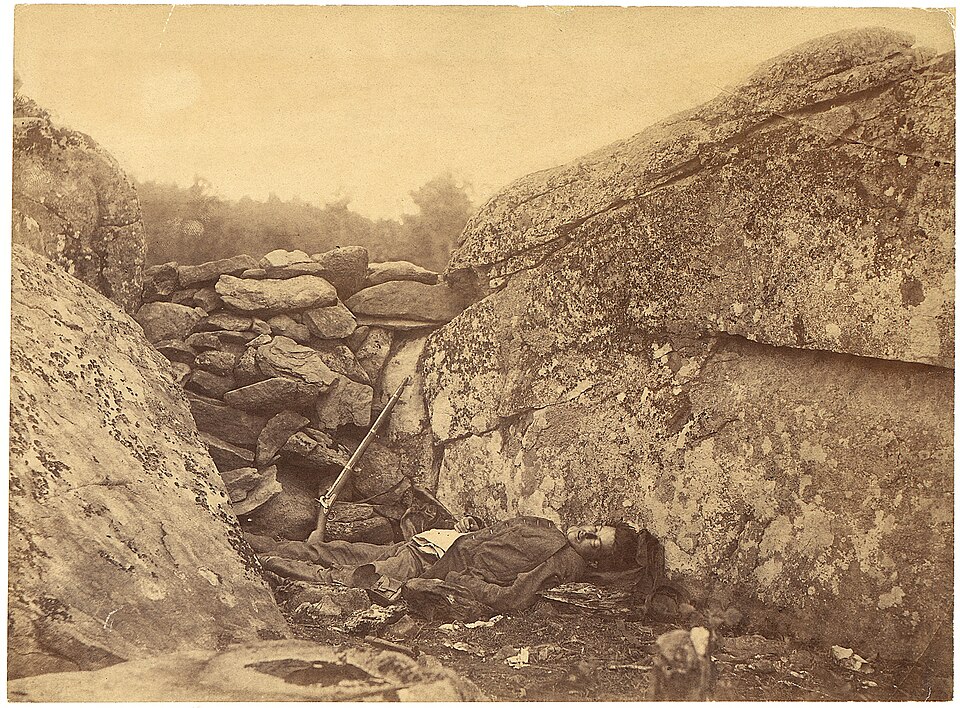
The photograph captures America because it shows the republic at war with itself, but also because it shows how quickly war becomes image. Death is made legible through composition. The corpse becomes symbol. The battlefield becomes national memory.
America’s soul begins here in fracture: brother against brother, union against slavery, sacrifice against ideology, the dead body turned into historical argument.
2. Edward S. Curtis, The Vanishing Race, 1904
Edward S. Curtis’s The Vanishing Race is one of the most famous and morally complicated photographs in the history of American image-making. It shows a group of Navajo riders moving away from the camera into shadow, under a title that implies disappearance. As an image, it is beautiful. As an idea, it is dangerous.
Curtis’s work helped shape the visual mythology of Native Americans for generations: noble, melancholy, aestheticised, associated with loss rather than political continuity. His photographs are technically powerful, but they often participated in the settler fantasy that Indigenous peoples belonged to the past. The phrase “vanishing race” is not neutral. It turns conquest into elegy. It makes disappearance seem natural rather than enforced.
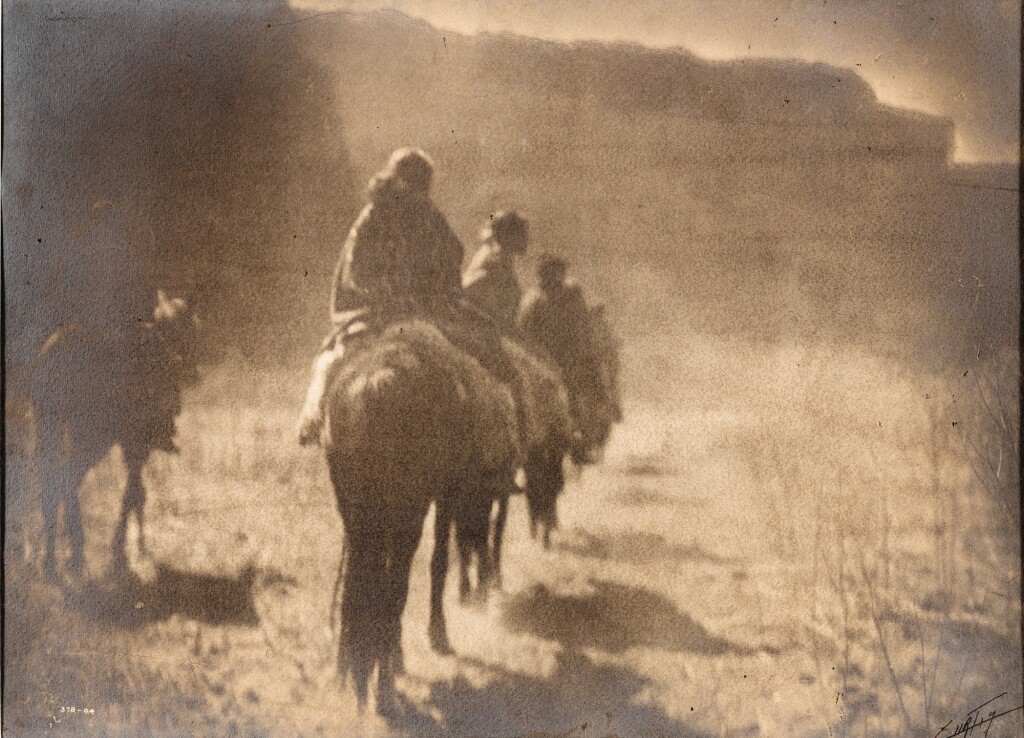
This photograph captures the soul of America because it reveals the country’s deep habit of romanticising what it has injured. America has often preferred Indigenous people as image rather than as sovereign nations, neighbours, critics, artists, citizens and living communities.
Yet the photograph can also be read against itself. The riders are not gone. The people did not vanish. The camera’s fantasy failed. The image therefore holds one of America’s oldest contradictions: the desire to turn Indigenous presence into memory, and the reality of Indigenous survival.
3. Alfred Stieglitz, The Steerage, 1907
Alfred Stieglitz’s The Steerage is one of the great photographs of modernity. Taken aboard a ship travelling from New York to Europe, it shows passengers divided by class across decks, gangways, hats, railings, bodies and geometric forms. It is often praised as a landmark of modernist photography, but its power is not merely formal. It is social.
The photograph captures America as structure. Upper deck and lower deck, privilege and crowding, movement and confinement: the image turns the ship into a diagram of the modern world. The people in steerage are not abstract masses; they are migrants, travellers, workers, returnees, human beings caught inside the architecture of class.
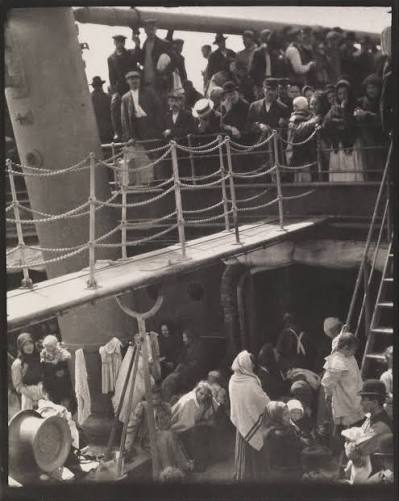
America has always imagined itself through migration. But The Steerage refuses the sentimental version of that story. It does not show arrival as redemption. It shows mobility as stratified. Even on the way to somewhere else, hierarchy remains.
The photograph captures the American soul because it makes visible one of the country’s great truths: the dream of movement has always been shaped by unequal decks.
4. Lewis Hine, Power House Mechanic Working on Steam Pump, 1920
Lewis Hine’s Power House Mechanic Working on Steam Pump is one of the great images of American labour. A muscular worker leans into a machine, his body echoing the curve and force of industrial metal. The photograph is beautiful in the way machinery can be beautiful, but its beauty is uneasy.
Hine was one of America’s most important social photographers, known for his work documenting child labour and industrial conditions. In this image, the worker is neither victim nor ornament. He is powerful, skilled, concentrated. Yet he is also nearly absorbed into the machine. The human body appears heroic and endangered at the same time.
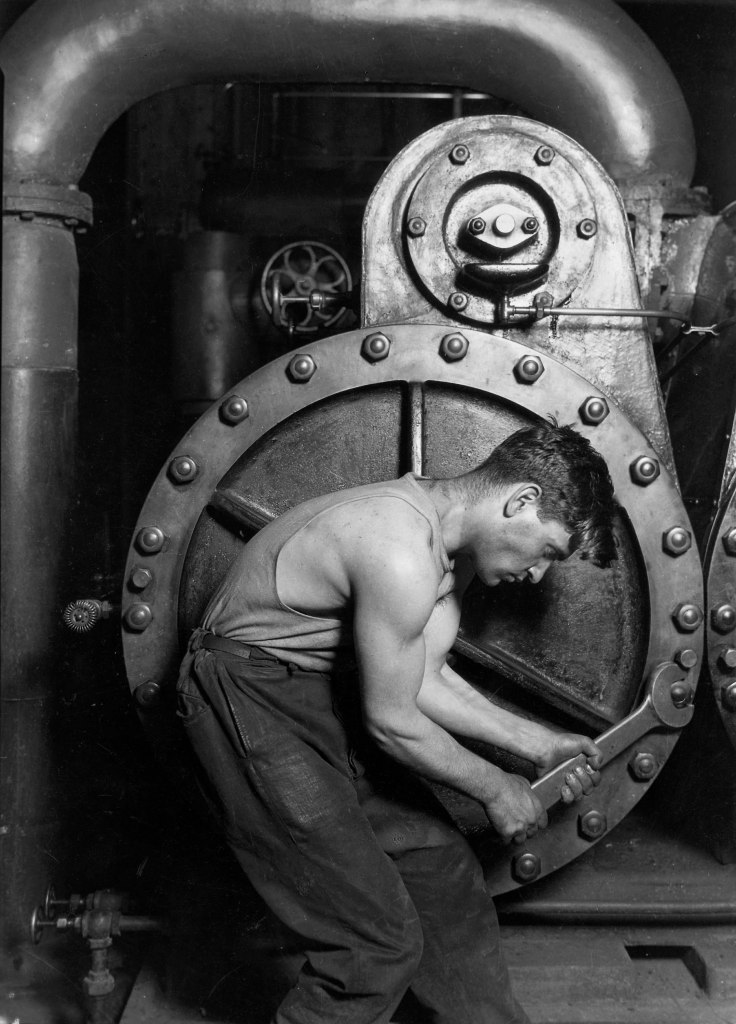
The photograph captures America because the country has so often worshipped industry while forgetting the worker. It loves bridges, skyscrapers, railways, factories, engines, infrastructure and growth; it is less eager to remember the hands, backs, lungs and lives that built them.
Hine’s image restores the worker to the centre of modernity. It says that progress is not made by machines. It is made by bodies in relation to machines. The soul of America here is labour: disciplined, exploited, magnificent and too often unnamed.
5. Dorothea Lange, Migrant Mother, 1936
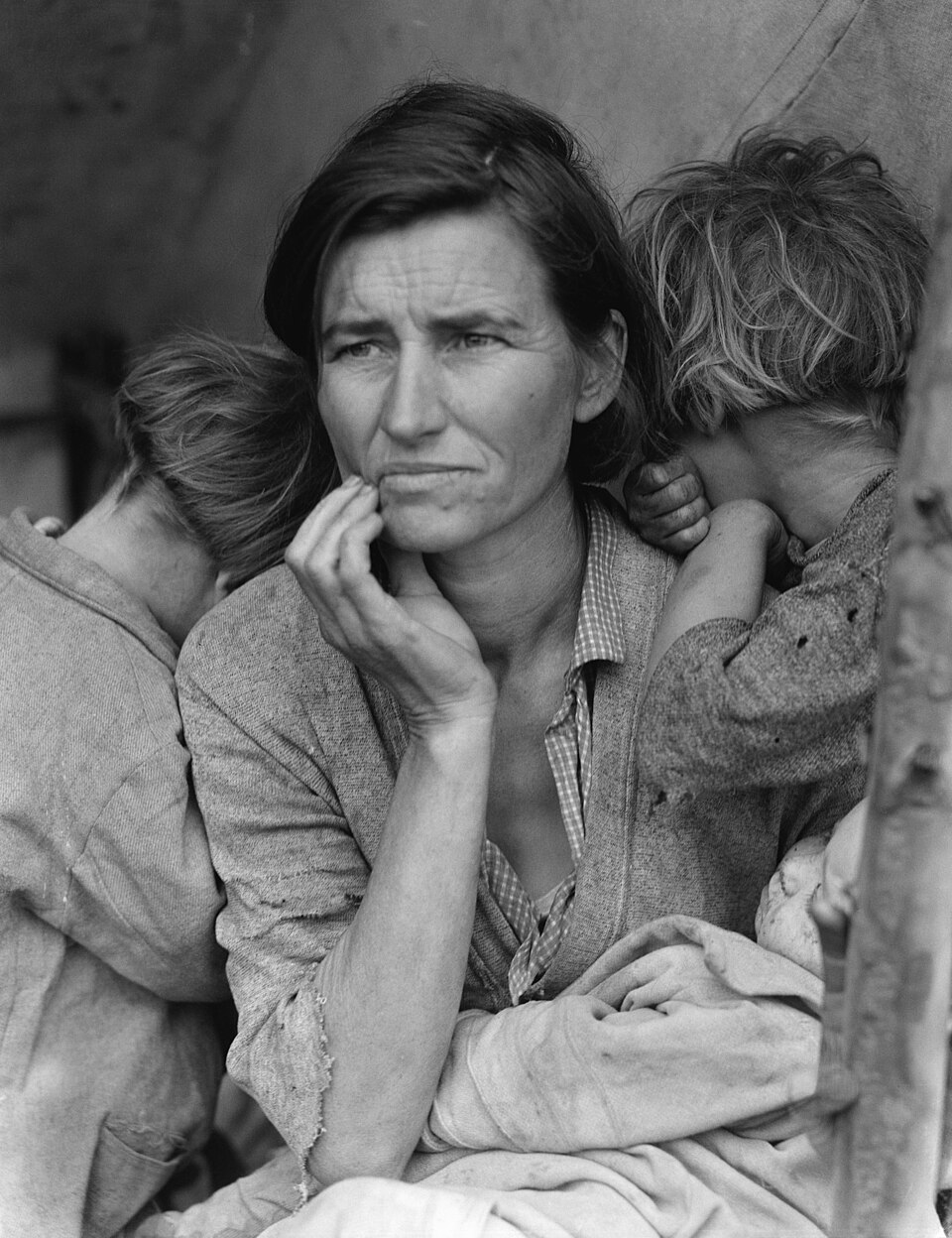
Few American photographs are more famous than Dorothea Lange’s Migrant Mother. Florence Owens Thompson sits surrounded by her children, her hand at her face, her gaze turned beyond the frame. The image became the emblem of Depression-era suffering, but its power exceeds the historical moment.
The photograph captures poverty without theatrical excess. There are no ruins, no dramatic gesture, no sentimental collapse. The mother’s face carries anxiety, endurance, calculation and fatigue. The children turn away from the camera, making her both individual and archetype. She is a particular woman and also an image of maternal survival under economic catastrophe.
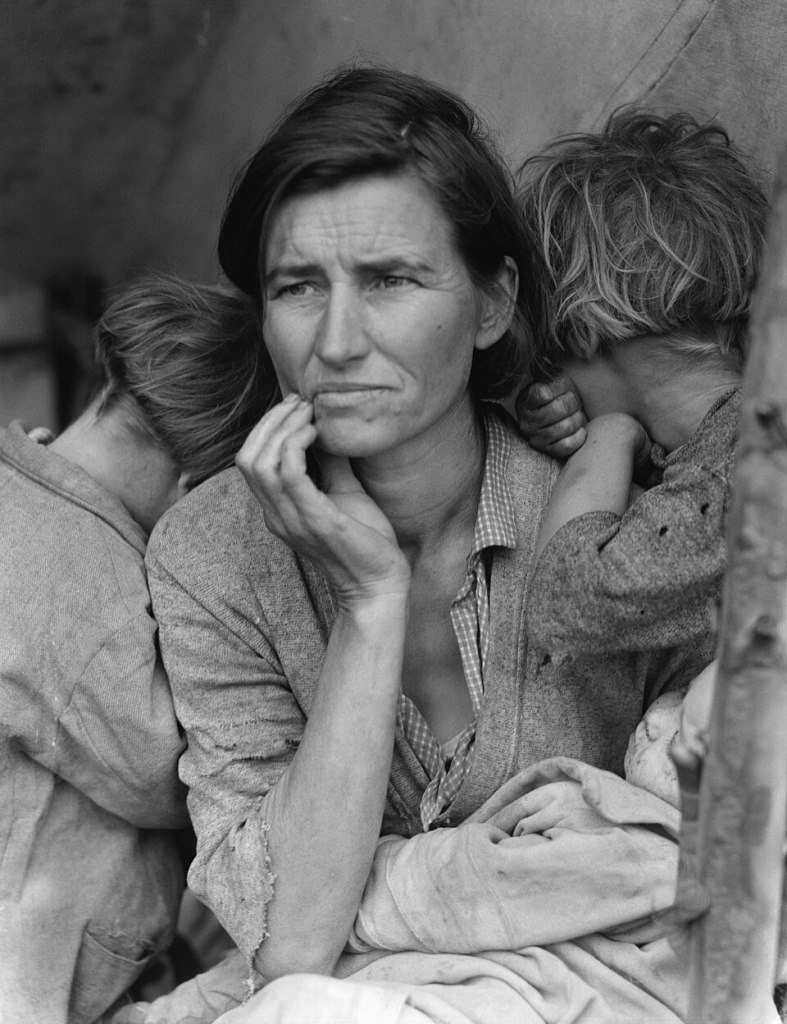
America has often preferred to imagine poverty as failure of character. Lange’s photograph makes that evasion impossible. The suffering here is structural: drought, labour markets, agricultural capitalism, migration, the inadequacy of relief. Yet the image does not turn its subject into a symbol alone. Its dignity lies in restraint.
Migrant Mother captures America because it shows the cost of a country that promises abundance while allowing millions to live on the edge of hunger. It is not an image of defeat. It is an image of endurance when the national promise has failed.
6. Ansel Adams, Moonrise, Hernandez, New Mexico, 1941
Ansel Adams’s Moonrise, Hernandez, New Mexico gives America one of its most enduring images of landscape as transcendence. A moon hangs over a small settlement, crosses in a cemetery catch the last light, and the sky opens above the land with almost religious force.
Adams is often associated with wilderness and national parks, but Moonrise is not simply a nature photograph. It is a photograph of land, settlement, death and sky held in perfect tension. The human presence is small, but not absent. The cemetery matters. The houses matter. The land is not empty spectacle; it is inhabited, remembered, mortal.
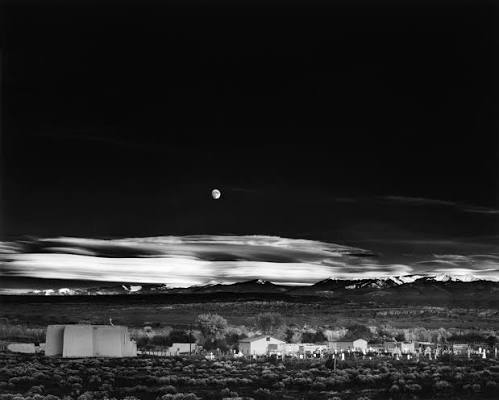
This photograph captures America’s longing for vastness. The country has repeatedly imagined land as moral cure: the West, the horizon, the desert, the mountain, the open sky. That longing has produced sublime art and terrible politics. It has given Americans a language of freedom while also justifying conquest and erasure.
Adams’s photograph is powerful because it does not need to shout. It understands that America’s grandeur is real, but also haunted. The moon rises over beauty, settlement and graves.
7. Gordon Parks, American Gothic, Washington, D.C., 1942
Gordon Parks’s American Gothic, Washington, D.C. is one of the sharpest visual critiques of American democracy. It shows Ella Watson, a Black government cleaning woman, standing with a mop and broom before an American flag. The title refers to Grant Wood’s painting, but Parks replaces rural white severity with Black labour inside the nation’s capital.
The photograph’s genius lies in its precision. Watson stands upright, dignified and unsmiling. The flag behind her is not merely patriotic background; it becomes an accusation. What does the flag mean to a woman whose labour maintains the institutions that do not fully honour her citizenship?
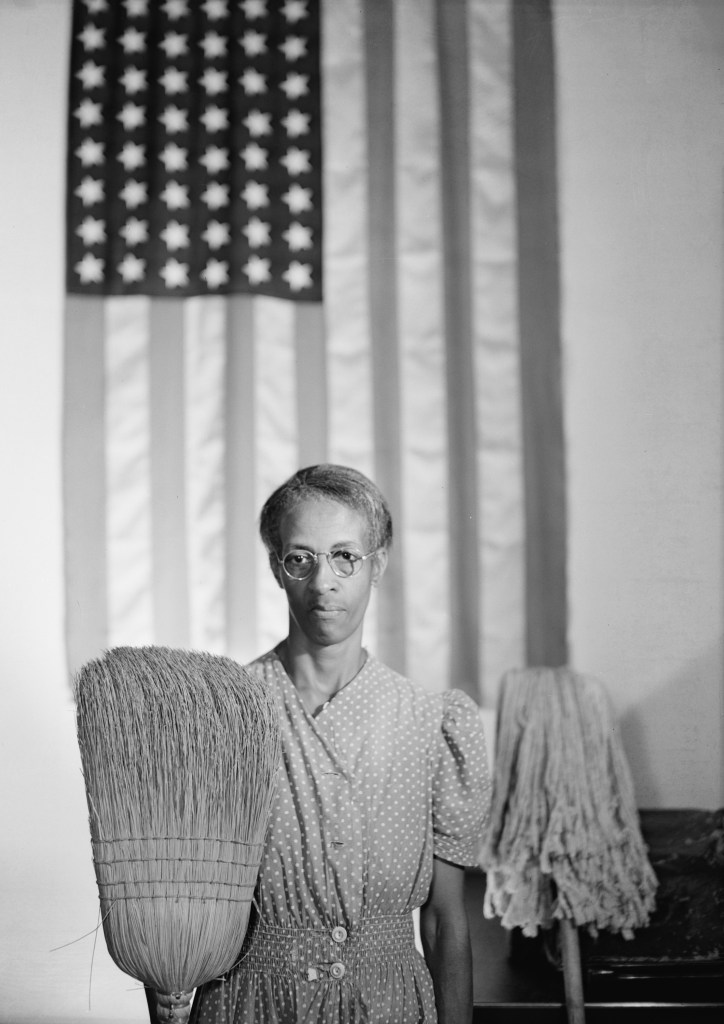
Parks captures America because he understands that democracy is maintained by people whom democracy often ignores. The photograph exposes the contradiction between national symbol and lived inequality. It does not burn the flag; it makes the flag answerable.
This is one of the great American images of dignity under hypocrisy. Watson’s presence does not ask for pity. It demands recognition. The soul of America here is the worker in the shadow of the symbol.
8. Joe Rosenthal, Raising the Flag on Iwo Jima, 1945
Joe Rosenthal’s Raising the Flag on Iwo Jima is perhaps the most iconic American war photograph. Marines raise the flag on Mount Suribachi, their bodies forming a diagonal of collective effort. The image became an instant national symbol: sacrifice, victory, unity, military courage.
Its power is formal as much as patriotic. The composition is almost classical. The individual faces are obscured, which allows the figures to become collective. It is not one hero but a group body. The flag seems to emerge from struggle, pushed upward by physical force.
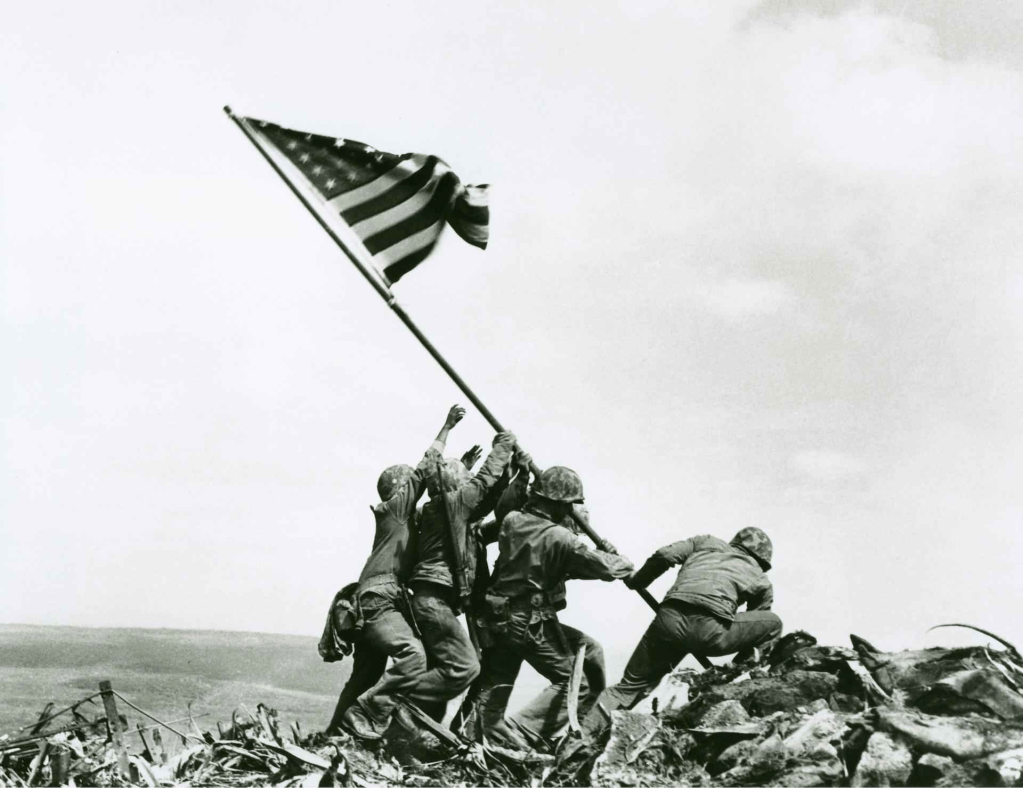
But the photograph also reveals the danger of military iconography. It can turn war into purity. It can make violence appear clean, noble, inevitable. The actual battle of Iwo Jima was brutal, terrifying and costly. No image of a flag can contain that reality.
The photograph captures America because the country has often understood itself through war: revolutionary war, civil war, world war, cold war, wars abroad. It shows American courage, but also the seductive power of martial myth. The flag rises; the dead remain outside the frame.
9. Robert Frank, Trolley—New Orleans, 1955
Robert Frank’s Trolley—New Orleans is one of the defining images of postwar America. Shot from the street, it shows passengers framed in the windows of a segregated trolley: white passengers in front, Black passengers behind. The photograph is quiet, but devastating.
Frank, born in Switzerland, saw America with an outsider’s eye. In The Americans, he photographed diners, roads, jukeboxes, cars, parades, flags, funerals and ordinary streets with a melancholy that stripped away triumphalism. Trolley—New Orleans captures the social order not through dramatic violence, but through seating arrangement.
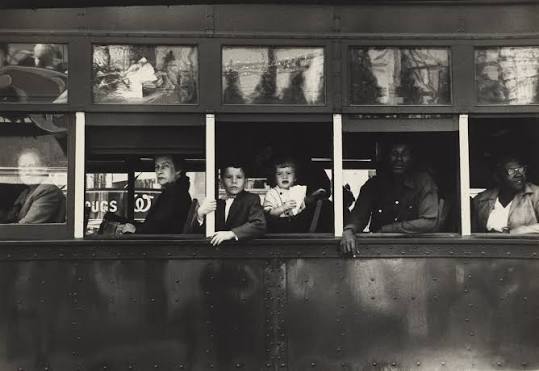
That is what makes it so powerful. Segregation appears as everyday composition. Racism is not only a mob, a law, a slur or an attack. It is design. It is space. It is who sits where, who is seen first, who is framed behind whom.
The photograph captures America because it shows inequality not as exception, but as structure. The trolley becomes the nation in miniature: moving forward, divided inside.
10. Eddie Adams, Saigon Execution, 1968
Eddie Adams’s photograph of South Vietnamese police chief Nguyễn Ngọc Loan executing a Viet Cong prisoner in Saigon is one of the most famous images of the Vietnam War. Although the man pulling the trigger was not American, the photograph belongs to America’s visual conscience because it entered American living rooms as evidence of what the war had become.
The image is almost unbearable because it captures the instant before death. The body has not yet fallen. The face registers terror, shock, compression. The gun is close. The street is ordinary. History has become intimate and obscene.
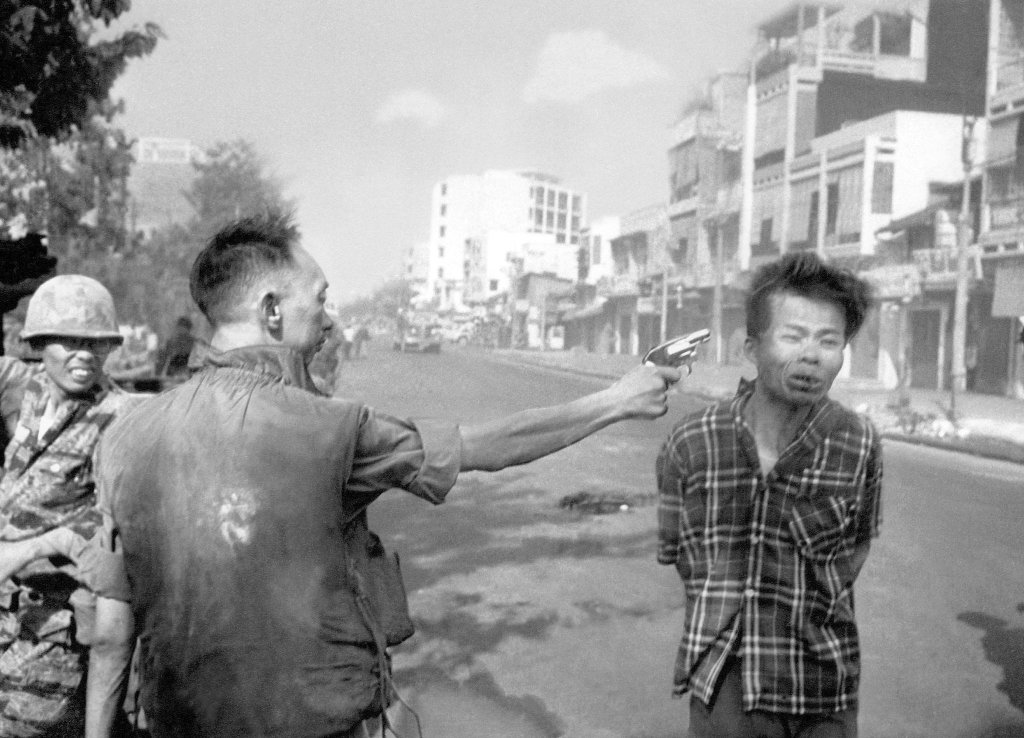
The photograph captures America because Vietnam was one of the great ruptures in the nation’s moral self-image. The United States had imagined itself as defender of freedom; the war revealed imperial arrogance, anti-communist obsession, racialised violence, political lying and civilian devastation. Images from Vietnam changed public consciousness partly because they punctured official language.
Adams later spoke with complexity about the photograph and its consequences, reminding us that even iconic images can simplify human realities. But the image’s historical force remains. It showed Americans that war was not an abstraction occurring somewhere else. It was an act, a body, a second, a trigger.
America through the lens
These ten photographs do not produce one America. They produce a nation seen in fragments.
Gardner gives us civil war and the staging of death. Curtis gives us the settler gaze and Indigenous survival. Stieglitz gives us migration and class. Hine gives us labour and machinery. Lange gives us poverty and endurance. Adams gives us land as grandeur and haunting. Parks gives us race, dignity and national hypocrisy. Rosenthal gives us war myth and collective sacrifice. Frank gives us segregation as everyday structure. Eddie Adams gives us empire stripped of rhetoric.
Together, they suggest that America’s photographic soul lies in the tension between symbol and evidence. The camera has repeatedly shown what the country wished to celebrate, and what it wished to hide. It has made myths, but it has also broken them.
The greatest American photographs do not merely say, this happened. They ask: what kind of country allows this to be seen — and what kind of country tries not to look?
Discover more from My World of Interiors
Subscribe to get the latest posts sent to your email.

