
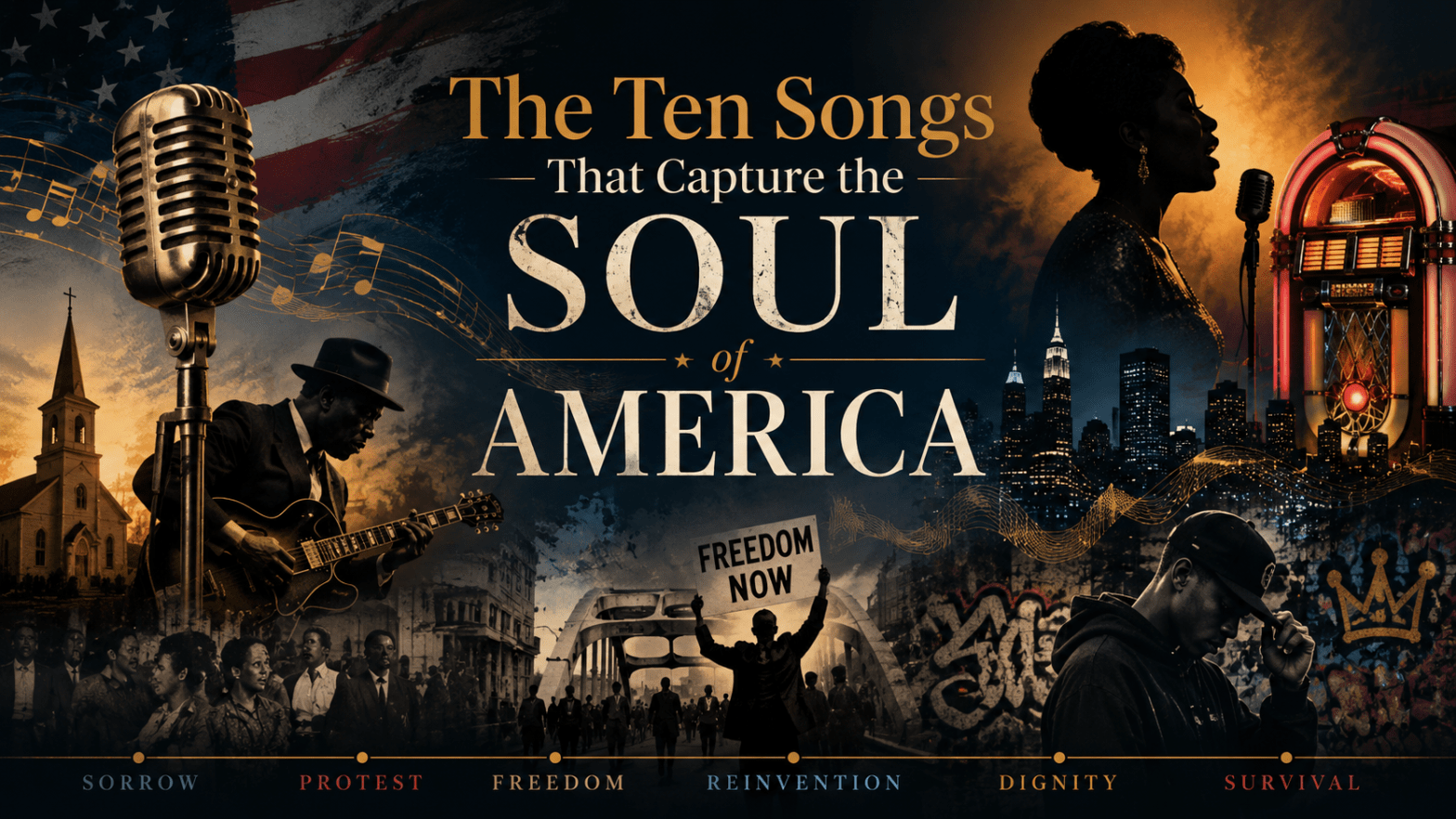
America has often sung what it could not admit in speech. Its songs have carried grief before the law recognised suffering, desire before society permitted freedom, rage before politics found language, and longing before the country had earned the ideals it claimed for itself. If the American novel is a courtroom of conscience, and American film a dream machine, then American music is something more bodily: breath, rhythm, lament, seduction, testimony, refusal.
To choose ten songs that capture the soul of America is not to choose the ten “best” American songs, nor the most technically innovative, nor the most popular. It is to choose songs that reveal the country’s deepest contradictions: enslavement and liberation, land and dispossession, loneliness and reinvention, race and appropriation, labour and poverty, protest and pleasure, democracy and abandonment, the private wound and the public cry.
American music is not one tradition. It is spiritual, blues, jazz, country, gospel, folk, rock’n’roll, soul, funk, hip-hop, protest song, Broadway, punk, disco, pop and noise. It is Indigenous rhythm, African survival, European hymnody, Appalachian balladry, Caribbean pulse, Mexican border sound, church, field, porch, club, radio, studio, street corner and stadium. Its genius has always come from contact — sometimes loving, sometimes violent, often exploitative, always transformative.
The American soul is not pure. Neither is American music. Its greatest songs often emerge from theft, pain, commerce, invention and resistance at once. That is why they matter. They are not monuments. They are arguments with melody.
1. “Swing Low, Sweet Chariot” — African American spiritual, nineteenth century
Before America sang itself as popular entertainment, it sang itself through bondage. “Swing Low, Sweet Chariot” belongs to the tradition of African American spirituals: songs created by enslaved people from biblical imagery, African musical memory, Christian theology, coded hope and unbearable historical pressure. Its surface is religious. Its depths are political, existential and collective.
The song imagines deliverance in language that could move between heaven and earth. That doubleness is central to the spiritual. The promised land may be the afterlife, but it may also be freedom. The chariot may be divine, but it may also be escape. In a society that attempted to deny enslaved people literacy, legal personhood and bodily autonomy, song became memory, map, theology and resistance.
It captures the soul of America because it begins where America most wants to avert its eyes: slavery. But it does not leave enslaved people as mute victims of history. It reveals them as creators of one of the world’s most profound musical languages. The spiritual is the sound of human beings making transcendence under conditions designed to destroy the human.
America’s first great music of freedom was made by the unfree.
2. “St. Louis Blues” — W.C. Handy, 1914
“St. Louis Blues” is one of the decisive moments when the blues entered national and international circulation. W.C. Handy did not invent the blues; no single person could have done so. The blues came from Black Southern experience: work songs, field hollers, spirituals, minstrelsy’s distortions, ragtime, sorrow, wit, sexuality, endurance and the daily negotiation between pain and style. But Handy helped translate that world into published song and modern performance culture.
The genius of “St. Louis Blues” lies in its hybridity. It moves between blues feeling, popular song structure and cosmopolitan arrangement. It is local and portable, mournful and elegant, wounded and theatrical. The song helped make Black American melancholy into a world language — but not as passive sadness. The blues is not surrender. It is form imposed on suffering. It is grief with rhythm, irony and dignity.
It captures America because it understands that pain in this country has often had to become marketable before it could be heard. The blues travelled through commerce, race records, vaudeville, sheet music, clubs and later recordings. That history is morally complicated. Yet the form itself remains one of America’s supreme contributions to civilisation: the art of saying, I suffer, therefore I transform.
3. “Strange Fruit” — Billie Holiday, 1939
There are protest songs, and then there is “Strange Fruit.” Sung by Billie Holiday with devastating restraint, the song is one of the most important moral documents in American music. It confronts lynching not through argument, but through image. It turns pastoral Southern beauty into horror. Trees, air, fruit, landscape — the traditional materials of lyric beauty — become evidence of racial terror.
Its power depends on refusal. Holiday does not sentimentalise. She does not console. The arrangement leaves space around her voice, and that space becomes accusation. The song does not ask the listener to feel virtuous for opposing violence. It asks the listener to inhabit the obscenity of a nation that allowed racial murder to become public ritual.
“Strange Fruit” captures the soul of America because it exposes the terror beneath the national landscape. The song says that beauty itself is compromised when it grows around unacknowledged death. It also shows the moral authority of Black performance: a nightclub singer, standing before an audience, forcing America to hear what law, newspapers and politicians had too often softened, denied or ignored.
It is not merely a song. It is a witness stand.
4. “This Land Is Your Land” — Woody Guthrie, 1940
Woody Guthrie’s “This Land Is Your Land” is often treated as a gentle patriotic folk song. That is one of the great misunderstandings in American music. Properly understood, it is both hymn and critique, a song of landscape and inequality, belonging and exclusion. Guthrie wrote it partly in response to the complacent patriotism of “God Bless America,” and its fuller versions include verses about private property, hunger and relief lines.
The song captures the American contradiction of land. America has always imagined land as promise: open, vast, democratic, renewing. Yet land is also the site of conquest, enclosure, eviction, speculation and dispossession. Guthrie’s genius was to make the landscape sing while asking who was actually allowed to inhabit it.
Its simplicity is deceptive. “This Land Is Your Land” sounds communal, but it contains a political demand. If the land belongs to all, then poverty is not natural. If the country is shared, then exclusion is theft. The song turns the American landscape from scenery into obligation.
It captures America because it asks the most radical patriotic question: what would it mean if the country actually belonged to the people?
5. “Heartbreak Hotel” — Elvis Presley, 1956
Elvis Presley did not invent rock’n’roll. Rock’n’roll came from Black rhythm and blues, gospel, country, jump blues, boogie-woogie, Pentecostal ecstasy, teenage desire and the commercial machinery of postwar America. But in 1956, with “Heartbreak Hotel,” Elvis became the figure through whom rock’n’roll entered mass global consciousness as image, body, sound and scandal.
“Heartbreak Hotel” is not one of his wildest recordings, but it may be one of his most revealing. It is a song about loneliness turned into atmosphere. Its hotel is not just a place; it is a national interior. The voice is sensual, wounded, theatrical, intimate and strange. It made teenage grief feel glamorous and dangerous. It made alienation marketable. It made the singer’s body part of the song’s meaning.
The American soul here is not innocence, but transmission. Black musical sources move through a white performer and become global commodity. The result is thrilling and compromised. Elvis’s greatness cannot be separated from America’s racial order, which could more easily export Black-derived music through a white body.
That contradiction is not a footnote. It is the historical condition of rock’n’roll’s world conquest.
6. “A Change Is Gonna Come” — Sam Cooke, 1964
Sam Cooke’s “A Change Is Gonna Come” is one of the great songs of American moral longing. Written in the atmosphere of the civil-rights movement, it carries the weight of spirituals, gospel, soul and political prophecy. Its power lies in the tension between weariness and faith. The singer is tired, frightened, wounded, but not defeated.
The song captures a particular kind of American hope: not optimism, not cheerfulness, not naïve belief in progress, but hope as endurance under historical pressure. It is the hope of people who have been given every reason not to hope, yet continue to insist that history can move.
Cooke’s voice is crucial. It does not shout. It pleads, rises, trembles, gathers dignity. The orchestration gives the song grandeur, but the grandeur is intimate. America’s democratic promise, so often written in legal documents and public speeches, becomes here a human voice asking whether the future can be different.
It captures America because the country’s finest moral achievements have so often come from those forced to sing toward rights they had not yet received.
7. “Respect” — Aretha Franklin, 1967
Otis Redding wrote “Respect,” but Aretha Franklin transformed it. In her hands, the song became one of the great declarations of modern American selfhood. It is soul, feminism, Black power, sexual negotiation, labour demand and personal command compressed into a few minutes of electrifying performance.
Franklin’s version matters because it shifts authority. The singer is not asking politely to be recognised. She is spelling out the terms of recognition. The song is joyous, but its joy has force. It understands that dignity is not abstract. It enters the home, the workplace, the bedroom, the stage, the street. It is about how one human being is treated by another, and therefore about politics at its most intimate.
“Respect” captures America because it turns a private demand into a public anthem. It belongs to the era of civil rights and women’s liberation, but it exceeds both as a statement of human sovereignty. Franklin’s voice does not merely perform freedom. It commands the room in which freedom must be acknowledged.
It is democracy as sound: embodied, rhythmic, non-negotiable.
8. “What’s Going On” — Marvin Gaye, 1971
Marvin Gaye’s “What’s Going On” is one of the great American songs of sorrowful intelligence. It emerged from the Vietnam era, police violence, social unrest, ecological anxiety and generational fracture. Yet it does not sound like a manifesto. It sounds like a conversation overheard in the soul.
The song’s genius is its softness. In a moment of rage, Gaye chose tenderness. He asks rather than commands. He mourns rather than condemns outright. The result is not weakness, but moral depth. The arrangement — layered voices, supple bass, floating melody — creates a civic atmosphere in which grief becomes inquiry.
It captures America because it recognises that violence abroad and violence at home are connected. War, poverty, racism, policing, family rupture and environmental damage are not separate crises. They belong to the same disorder of values.
“What’s Going On” is the sound of a citizen refusing numbness. It asks the most basic political question not as slogan, but as lament: what has happened to us?
9. “The Message” — Grandmaster Flash and the Furious Five, 1982
“The Message” changed hip-hop by making social reportage central to the form’s mainstream consciousness. Earlier hip-hop had already been inventive, communal, playful, technically radical and rooted in Bronx block-party culture. But “The Message” brought urban abandonment, poverty, psychic pressure and systemic neglect into sharp narrative focus.
The song is cinematic. It moves through broken infrastructure, claustrophobic apartments, public failure, pressure, danger and despair. Its famous refrain is not simply about individual stress. It is about social conditions pressing the mind toward collapse. The city becomes both setting and system.
“The Message” captures America because it refuses the myth that the inner city is a problem separate from the nation. It reveals the metropolis as evidence: of policy, neglect, racism, capital flight, policing, austerity and survival. Hip-hop here becomes journalism, poetry, sociology and warning.
It also marks one of the great shifts in American music: the rapper as witness, analyst and narrator of structural truth. After “The Message,” popular music could not pretend that the party was the whole story.
10. “Alright” — Kendrick Lamar, 2015
Kendrick Lamar’s “Alright” became one of the defining American songs of the Black Lives Matter era. Its refrain was taken up in protests because it held together two things that are often falsely separated: rage and survival. The song does not deny brutality. It moves through it, names it, absorbs it and still insists on communal endurance.
Its power lies in doubleness. Musically, it is buoyant, almost ecstatic; lyrically and historically, it is shadowed by police violence, racism, trauma and spiritual crisis. That contradiction is precisely what makes it American. Joy in Black music has never meant the absence of suffering. It has often meant the refusal to let suffering have the final word.
“Alright” captures America because it shows that the protest song did not disappear after the 1960s. It changed form. It moved through hip-hop, video, chant, street protest, digital circulation and collective memory. Kendrick Lamar inherited spirituals, blues, jazz, funk, soul, West Coast rap and prophetic Black speech — and made them speak to the twenty-first century.
The song is not naïve hope. It is survival as chorus.
America in ten songs
These ten songs do not produce a single America. They produce a nation in conflict with its own sound.
“Swing Low, Sweet Chariot” gives us enslavement and deliverance. “St. Louis Blues” gives us Black sorrow as world form. “Strange Fruit” gives us racial terror as moral indictment. “This Land Is Your Land” gives us landscape as democratic demand. “Heartbreak Hotel” gives us loneliness, youth and the racial contradictions of rock’n’roll. “A Change Is Gonna Come” gives us civil-rights hope under pressure. “Respect” gives us dignity as command. “What’s Going On” gives us grief as civic inquiry. “The Message” gives us urban abandonment as testimony. “Alright” gives us survival as protest.
Together, they show that America’s soul has often been most truthful when sung by those who had reason to distrust its promises. The greatest American songs are not merely beautiful. They are forms of evidence. They prove that a country can fail its people and still be answered by voices powerful enough to change the world.
Discover more from My World of Interiors
Subscribe to get the latest posts sent to your email.

