
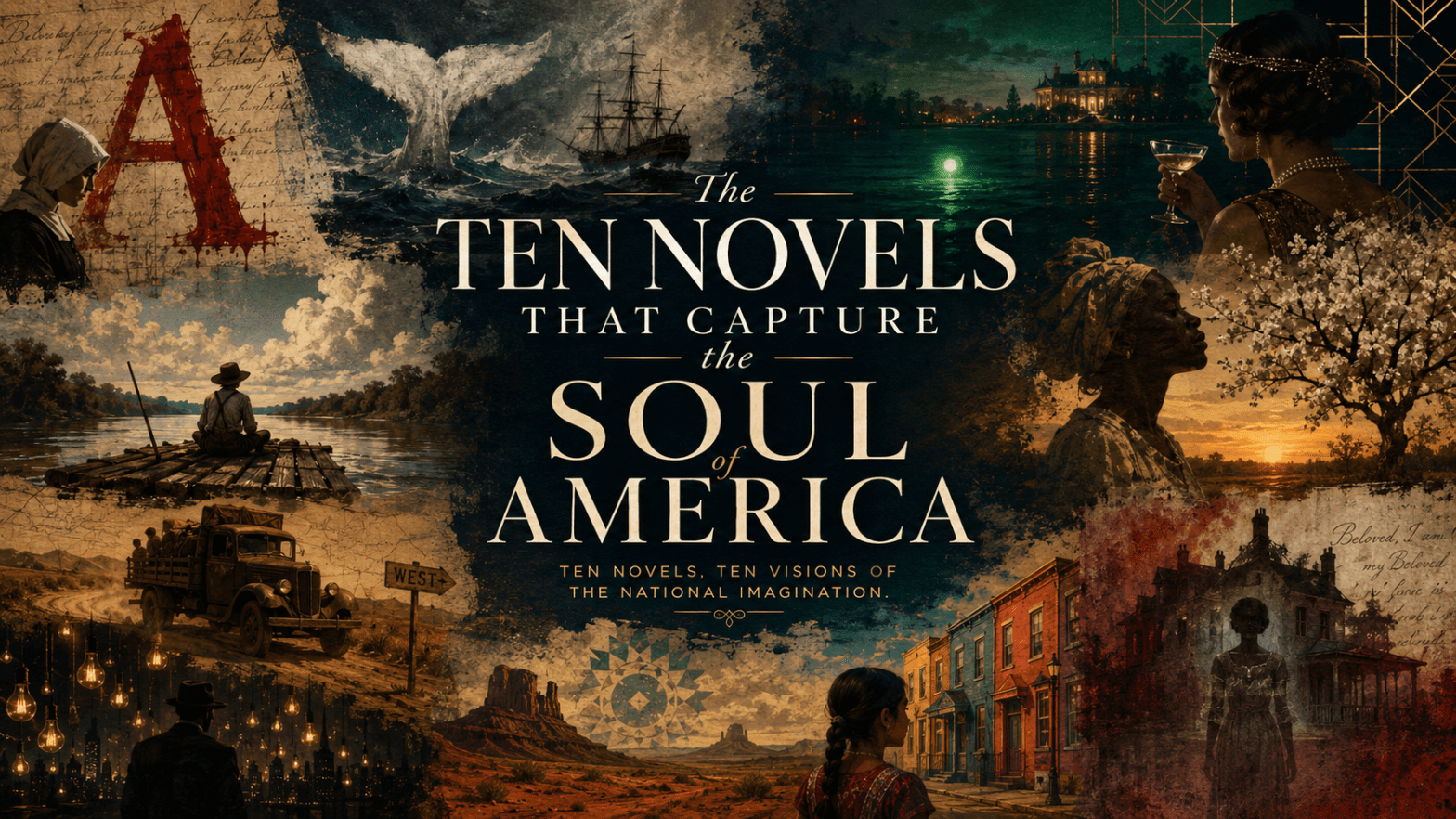
America has always been a country unusually dependent on story. Before it became a superpower, before it became a marketplace, before it became a screen onto which the rest of the world projected desire and dread, it was already narrating itself: as wilderness, covenant, republic, frontier, refuge, opportunity, innocence, exception, destiny. No nation has been more skilled at mythologising itself, and few have produced a literature more committed to interrupting those myths.
The American novel is therefore not simply a literary form. It is a national argument. It tests the country’s favourite fictions against the lives of those damaged by them. It asks what liberty means in a slave society, what innocence means in a culture of punishment, what success means in a country organised around money, what home means on stolen land, what selfhood means inside race, gender, migration, poverty and violence.
To choose ten novels that capture the soul of America is not to choose the ten “best” American novels, nor the most formally perfect, nor even the most beloved. It is to choose works that disclose something essential about the American condition: shame, movement, race, money, wilderness, labour, voice, dispossession, reinvention, memory and the unresolved question of who belongs. Many of these books appear in the Library of Congress’s Books That Shaped America project, a useful reminder that literary influence is not merely aesthetic, but civic. (loc.gov)
The American soul, if such a thing exists, is not one soul. It is a courtroom, a river, a whale-ship, a mansion, a migrant road, a porch, an underground room, a reservation, a Chicago street, a haunted house. It is a country speaking against itself in the voices of those it tried not to hear.
1. Nathaniel Hawthorne, The Scarlet Letter, 1850
The American novel begins, in one sense, with shame. Hawthorne’s The Scarlet Letter gives us a Puritan colony organised around surveillance, punishment and symbolic violence. Hester Prynne’s red “A” is not merely a mark of adultery; it is an early American logo of social control. A woman’s body becomes public text. A community reads her, judges her and depends on her humiliation to confirm its own righteousness.
The Library of Congress includes The Scarlet Letter in its Books That Shaped America, noting Hawthorne among the nineteenth-century writers whose work entered the national literary imagination. But the novel’s importance is not only historical. It remains one of the great anatomies of moral hypocrisy. America has repeatedly imagined itself as a nation of freedom while maintaining deep appetites for punishment, purity and public disgrace.
Hester is neither simply victim nor rebel. She becomes morally larger than the society that brands her. That is why the book still feels American. It understands that this country’s most radical figures are often those whom respectable society first tries to shame into silence.
2. Herman Melville, Moby-Dick, 1851
Moby-Dick may be the great American novel because it refuses to behave like a novel. It is sea story, sermon, encyclopedia, tragedy, comedy, cetology, metaphysics, labour narrative and democratic experiment. The Library of Congress includes Melville’s Moby-Dick; or, The Whale in its list of books that shaped America.
The Pequod is America before it understands itself: multiethnic, commercial, violent, religious, masculine, global and doomed by charismatic authority. Ahab is not merely a mad captain. He is a figure of leadership when leadership becomes obsession. He turns collective labour into private vengeance and persuades others to follow his wound into catastrophe.
Melville’s genius lies in making the whale both everything and nothing: nature, God, capitalism, whiteness, terror, mystery, projection. America has always pursued meanings too large for its instruments, and Moby-Dick captures that fatal grandeur. It is a book about the danger of confusing will with truth.
3. Mark Twain, Adventures of Huckleberry Finn, 1884
Twain’s Adventures of Huckleberry Finn brought American vernacular speech into the centre of literary greatness. The Library of Congress’s discussion of its Books That Shaped America famously cites Hemingway’s claim that modern American literature comes from Twain’s book.
Its subject is childhood, but not innocence. Huck floats down the Mississippi with Jim, an enslaved man seeking freedom, through a landscape of frauds, feuds, violence, sentimentality and moral confusion. The river offers movement, but not escape. America’s original sin travels with them.
The book captures America because it understands that moral awakening may require disobedience to the morality one has been taught. Huck’s famous decision to help Jim, even if he believes it condemns him, is one of American literature’s central moments: conscience against social law. Yet the novel is also deeply troubled, especially in its racial comedy and ending. It remains essential because it is not pure. It is a national masterpiece built around a national wound.
4. F. Scott Fitzgerald, The Great Gatsby, 1925
No novel has more elegantly exposed the emptiness inside the American dream than The Great Gatsby. The Library of Congress describes Fitzgerald’s novel as a portrait of the Jazz Age in its decadence and excess, and notes its connection to powerful myths about American success.
Gatsby is not merely a man in love. He is the American imagination in a white suit: self-created, theatrical, sentimental, fraudulent, hopeful and doomed. He believes that money can repair time, that desire can remake class, that the past can be summoned through enough light, enough music, enough performance.
The novel captures America because it understands the cruelty of aspiration in a class society that denies it has classes. Gatsby reaches toward the green light, but the light is not promise; it is distance. Fitzgerald’s genius is to make longing beautiful and then show how easily beauty becomes delusion. America’s dream is not that anyone can become anything. It is that the dream itself can survive the evidence against it.
5. Zora Neale Hurston, Their Eyes Were Watching God, 1937
Zora Neale Hurston’s Their Eyes Were Watching God is one of the great American novels of voice. The National Endowment for the Arts describes it as the story of Janie Crawford’s movement from a vibrant but voiceless teenage girl into a woman with “her finger on the trigger of her own destiny.”
The novel’s radicalism lies partly in its refusal to make Black life legible only through white oppression. Racism is present, but so are porch talk, humour, desire, weather, work, gossip, marriage, sexuality and self-making. Hurston gives Black vernacular speech not as sociological material, but as music, philosophy and social form.
Janie’s quest is not for respectability, nor for assimilation, nor even simply for love. It is for the authority to narrate her own life. In a national tradition so often organised around male wandering, Hurston gives us female becoming: the horizon not as conquest, but as interior expansion. America’s soul here is oral, Southern, Black, female and alive.
6. John Steinbeck, The Grapes of Wrath, 1939
Steinbeck’s The Grapes of Wrath is the great American novel of dispossession. The Library of Congress notes that few novels can claim that their message led to actual legislation, but that Steinbeck’s account of Oklahoma migrants during the Great Depression helped ignite congressional action benefiting farm workers.
The Joads travel west not as adventurers, but as the expelled. The road, one of America’s central symbols of freedom, becomes here a corridor of hunger. California is not paradise, but another system of exploitation. The dream of land ownership collapses under banks, drought, machinery and corporate agriculture.
The novel captures America because it rejects the lie that poverty is personal failure. Steinbeck turns suffering into collective vision. “I” becomes “we.” The American soul here is not the lone hero, but the migrant family, the labour camp, the shared meal, the rage against systems too large for one body to fight alone.
7. Ralph Ellison, Invisible Man, 1952
Ralph Ellison’s Invisible Man is one of the great novels of American perception. The Library of Congress describes it as the story of an unnamed narrator who regards himself as someone society does not see, and notes that Ellison addresses what it means to be African American in a world hostile to minority rights on the cusp of the civil-rights era.
Invisibility, in Ellison, is not literal absence. It is the violence of being misrecognised. The narrator is seen through stereotypes, ideologies, institutions and projections, but rarely as himself. The novel moves through school, city, politics, labour, performance, riot and underground retreat with a surreal intensity that makes American reality itself seem hallucinatory.
Its greatness lies in formal restlessness. Ellison fuses jazz, oratory, satire, nightmare, folklore and modernism. The result is a novel about democracy’s failure to perceive the people it claims to include. America’s soul here is not invisible because it is hidden. It is invisible because the country has learned not to look.
8. Leslie Marmon Silko, Ceremony, 1977
Leslie Marmon Silko’s Ceremony is essential because it refuses the settler assumption that American history begins with America. The novel follows Tayo, a mixed Laguna Pueblo and white World War II veteran, as he returns from war into trauma, drought, memory and the need for healing. A casebook on the novel describes Ceremony as one of the most important novels of the Native American Renaissance and among the most widely studied works in higher education.
The novel’s form is part of its argument. Prose, poetry, myth, ceremony, landscape and memory interweave. Healing is not psychological in a narrow Western sense; it is ecological, historical and communal. Tayo’s trauma is not only personal. It belongs to war, colonial violence, land theft, environmental damage and cultural fragmentation.
Ceremony captures America by decentring America. It makes the nation appear as one historical layer within older Indigenous worlds. The soul of America here is not frontier triumph, but damaged relation — to land, story, ancestry and survival.
9. Sandra Cisneros, The House on Mango Street, 1984
Sandra Cisneros’s The House on Mango Street is a small book with immense cultural force. The National Endowment for the Arts describes it as a greatly admired novel of a Latina girl growing up in Chicago, told in a series of eloquent vignettes, translated worldwide and taught from schools to universities.
Its formal beauty lies in compression. Esperanza Cordero’s world arrives in fragments: houses, names, shoes, windows, hair, streets, mothers, girls, danger, shame, laughter, aspiration. The novel understands that childhood is not small simply because children are. A street can contain gender, class, migration, violence, language and the first stirrings of artistic selfhood.
The American soul in The House on Mango Street is urban, Chicana, female, poor, observant and self-authoring. Esperanza’s desire for “a house all my own” is not only domestic. It is aesthetic and existential: a space from which to speak. In a country obsessed with property, Cisneros turns the dream of a house into a dream of voice.
10. Toni Morrison, Beloved, 1987
Toni Morrison’s Beloved may be the most morally necessary American novel of the late twentieth century. The National Endowment for the Arts describes it as a work that weaves ghost story, romance, domestic drama and a chronicle of enslavement into a reading experience that humanises the historical record through specific lives.
The novel’s force lies in its refusal to leave slavery in the past. Slavery returns as ghost, memory, flesh, milk, scar, mother-love, house, voice. Morrison does not write history as information. She writes it as haunting. The dead are not gone because the nation has not learned how to remember them truthfully.
In Beloved, America’s soul is a haunted house. The violence of slavery is not background to the national story; it is architecture. Morrison’s genius is to make the reader feel that historical forgetting is itself a form of violence. A country cannot be free while its dead remain unburied in language.
The American novel as witness
These ten novels do not produce one America. They produce a country in argument with itself.
The Scarlet Letter gives us shame and public punishment. Moby-Dick gives us obsession, labour and charismatic doom. Huckleberry Finn gives us vernacular conscience and the wound of slavery. The Great Gatsby gives us money, longing and illusion. Their Eyes Were Watching God gives us Black female voice and self-possession. The Grapes of Wrath gives us dispossession and collective endurance. Invisible Man gives us misrecognition and democratic blindness. Ceremony gives us Indigenous memory and healing. The House on Mango Street gives us Chicana girlhood and urban self-authorship. Beloved gives us slavery as haunting and memory as moral necessity.
Together, they suggest that America’s literary soul is not found in triumph, but in exposure. The greatest American novels do not merely tell stories about America. They make America answerable to the stories it has told about itself.
Discover more from My World of Interiors
Subscribe to get the latest posts sent to your email.

