
America did not merely invent Hollywood. It invented one of the most persuasive dream machines in human history. More than any other modern art form, cinema allowed America to export itself: its landscapes, faces, appetites, terrors, fantasies, violence, tenderness, vulgarity, idealism and loneliness. The American film is not simply entertainment. At its most revealing, it is national psychoanalysis with lighting.
To choose ten films that capture the soul of America is not to choose the ten “best” American films, nor the most technically perfect, nor the most beloved. It is to choose films that disclose something essential about the American condition: race, land, money, home, exile, violence, spectacle, reinvention, loneliness, myth, democracy, migration, memory and the question of who is allowed to belong.
The Library of Congress’s National Film Registry preserves films deemed culturally, historically or aesthetically significant, and almost all the films below belong to that national canon. But significance does not always mean virtue. Some films reveal America by embodying its ideals. Others reveal America by exposing its crimes. The American soul, if there is such a thing, is not pure. It is an argument in motion.
1. The Birth of a Nation, 1915
It is impossible to begin an essay on American cinema’s soul without confronting one of its original sins. D.W. Griffith’s The Birth of a Nation is technically foundational and morally obscene. The Library of Congress essay on the film notes that it was based on Thomas Dixon Jr’s novels and stage work, including The Clansman, a romance of the Ku Klux Klan.
The film’s importance lies in the terrifying conjunction of formal innovation and racist mythology. Griffith expanded the grammar of cinema — cross-cutting, scale, close-ups, battle scenes, emotional montage — while placing those tools in the service of white supremacist fantasy. It is a film about the power of images to organise public feeling, and about what happens when that power is married to racial terror.
To call it one of the films that captures America is not to honour it. It is to recognise that American cinema was born, in part, from the same contradiction as America itself: dazzling formal promise entangled with the violent preservation of racial hierarchy. The film reveals the danger of national myth when myth is allowed to call itself history. It shows cinema not as innocent dream, but as political weapon.
2. The Wizard of Oz, 1939
If The Birth of a Nation is cinema as poisoned national mythology, The Wizard of Oz is cinema as American dream-work. The Library of Congress describes the 1939 MGM film as the best-known dramatization of L. Frank Baum’s Oz story.
Its structure is among the most American in popular art: a child leaves home, enters colour, travels through spectacle, discovers fraud behind authority, and learns that the deepest longing was always for return. The film’s movement from sepia Kansas to Technicolor Oz is not merely a technical wonder. It is a national psychology. America imagines itself as the place where drab reality can become radiant self-invention.
And yet the film is more melancholic than its reputation suggests. Dorothy’s dream is born from loneliness, threat, misunderstanding and flight. The farm is home, but it is also limitation. Oz is freedom, but it is also illusion. The Wizard is power revealed as performance. The American soul here is not simply optimistic. It is homesick for a home it must first escape in order to love.
3. The Grapes of Wrath, 1940
John Ford’s The Grapes of Wrath, adapted from John Steinbeck’s novel, gives American cinema one of its great images of economic dispossession. The film follows the Joad family, Oklahoma sharecroppers pushed from their land during the Depression and drawn westward toward California in search of work. It was among the first 25 films selected for the National Film Registry in 1989.
This is America without the romance of upward mobility. The road is not liberation; it is necessity. The family does not travel because it is free, but because it has been expelled by forces too large to see clearly: banks, machines, drought, ownership, hunger, law.
Ford turns the American landscape into a moral test. Wide roads, camps, fields and faces become part of a social epic. The film’s greatness lies in its refusal to isolate poverty as personal failure. The Joads are not weak. They are structurally defeated and spiritually undefeated. The American soul here is collective endurance: the insistence that dignity may survive even when property, security and justice have failed.
4. Citizen Kane, 1941
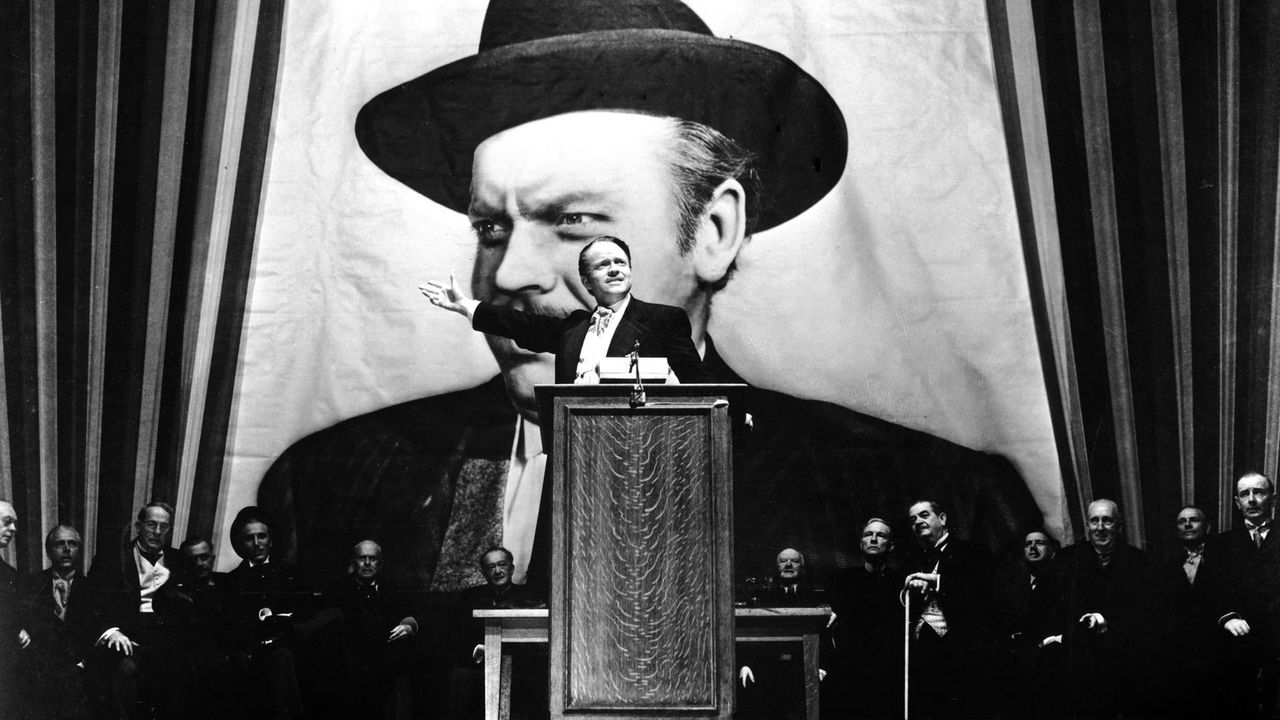
Orson Welles’s Citizen Kane may be the greatest American film about power because it understands power as emptiness. The Library of Congress essay on the film notes its dual existence: the film released by RKO in 1941, and the later reputation that made it “the greatest film ever made.”
Kane is wealth, media, architecture, appetite and loneliness organised into one man. The film’s famous search for the meaning of “Rosebud” is a search for the lost origin of a life buried beneath accumulation. A child is taken from poverty into wealth, and the rest of the film asks whether that transfer was ascent or wound.
The American soul in Citizen Kane is the tragedy of possession. Kane can acquire newspapers, statues, lovers, elections, rooms, audiences and art, but not intimacy. He can build Xanadu, but not a home. Welles makes American success gothic: the mansion as mausoleum, the public man as private ruin, the empire of communication as an elaborate failure to be understood.
5. The Searchers, 1956
John Ford’s The Searchers is perhaps the most important western because it begins to expose the sickness inside the western myth. The Library of Congress essay notes that the film was adapted from Alan LeMay’s novel about a revenge-driven quest after a Comanche attack and abduction.
The film contains some of the most beautiful images in American cinema: Monument Valley, doorways, riders against horizon, domestic interiors threatened by wilderness. But its beauty is not innocent. John Wayne’s Ethan Edwards is not simply a hero. He is the frontier as obsession, racism, vengeance and exclusion.
The genius of The Searchers is that it understands the American home as both sanctuary and ideological fortress. Who may enter? Who must be rescued? Who is contaminated by contact with the other? Ethan’s search is not merely for a lost girl; it is for the restoration of a racial and domestic order that the film itself begins to find terrifying. America’s soul here is the frontier myth looking into its own abyss.
6. The Godfather, 1972
Francis Ford Coppola’s The Godfather is one of the great films about America because it understands capitalism as family romance. The Library of Congress essay describes the film as a breakthrough crime movie because its gangsters are not simply propelled by bloodlust and greed, but by choices, strategy and position within a social order.
The Corleones are criminals, but the film’s deepest provocation is that their world resembles legitimate power: hierarchy, loyalty, patriarchy, secrecy, negotiation, violence, succession. Coppola gives organised crime the visual gravity of church, marriage, opera and classical tragedy. The family becomes both shelter and trap.
As an American film, The Godfather is not merely about the Mafia. It is about assimilation, inheritance and the moral cost of becoming powerful. Michael Corleone’s tragedy is not that he fails to become American, but that he becomes American too completely: strategic, ruthless, managerial, enclosed. The American dream here is not upward mobility. It is the conversion of injury into empire.
7. Nashville, 1975
Robert Altman’s Nashville may be the great American ensemble film: a nation overheard rather than explained. Set in the country-music capital, it gathers singers, politicians, drifters, fans, journalists, hustlers and dreamers into a sprawling mosaic of performance and desire. The film was selected for preservation in the National Film Registry in 1992.
Altman’s method is democratic and merciless. Voices overlap. Stories interrupt one another. No single character owns the meaning of the film. America appears not as a coherent narrative, but as a soundscape: patriotic songs, campaign slogans, backstage gossip, applause, confession, commerce.
Nashville captures America as performance culture before performance culture became total. Everyone is trying to be seen, heard, loved, elected, recorded or consumed. Politics and entertainment blur into one another. The country sings itself into existence, but the music does not heal the fracture. It merely gives fracture a chorus.
8. Do the Right Thing, 1989
Spike Lee’s Do the Right Thing is one of the essential American films because it understands race not as a “theme” but as atmosphere. The Library of Congress notes that Lee’s film entered the National Film Registry in its first year of eligibility; a Registry essay calls it “urban and American down to its bones.”
Set over one boiling day in Brooklyn, the film turns heat into structure. The block is alive with humour, music, argument, flirtation, exhaustion, territorial pride and historical pressure. No one is merely symbolic. Everyone is particular. That is why the film’s explosion feels not like a plot device, but like an accumulation.
Lee’s genius is moral refusal. He refuses the comfort of a single lesson. He refuses to make racial conflict polite. He refuses to resolve anger into civic uplift. The American soul here is not the fantasy of harmony, but the reality of proximity without justice. People live together, talk together, eat together, joke together — and still the structures of power remain lethal.
9. Daughters of the Dust, 1991
Julie Dash’s Daughters of the Dust is one of the most important American films about memory, migration and Black female interiority. The Library of Congress described it, when adding it to the National Film Registry in 2004, as the first feature-length film by an African American woman to receive a wide theatrical release.
Set among Gullah Geechee people in the Sea Islands in 1902, the film is not structured like conventional American historical drama. It moves through voice, image, ritual, landscape, food, fabric, memory and ancestral presence. Its form resists the forward momentum of assimilation. Migration is not simply progress; it is also rupture.
The American soul in Daughters of the Dust is matrilineal, diasporic and oceanic. It insists that Black history is not reducible to trauma alone, though trauma is present. It contains beauty, cosmology, argument, sensuality, language and the living dead. Dash gives America an image of memory as inheritance rather than burden — a history carried by women who know that leaving is never only departure.
10. Smoke Signals, 1998
Chris Eyre’s Smoke Signals, written by Sherman Alexie, belongs here because it breaks the old Hollywood habit of treating Native people as figures in someone else’s frontier story. The American Film Institute notes that Smoke Signals was inducted into the National Film Registry in 2018 as culturally, historically or aesthetically significant. Yale’s film notes describe it as marketed as the first film written, directed, acted and co-produced by Native Americans to receive a major distribution deal.
Its radicalism lies partly in its ordinariness. It is funny, wounded, intimate, contemporary. It is not about vanishing Indians, noble savages or cinematic enemies of the settler hero. It is about fathers and sons, storytelling, anger, reservation life, friendship, memory and the difficulty of forgiveness.
If The Searchers shows Native people through the haunted gaze of white frontier mythology, Smoke Signals turns the camera around. The American soul here is not only the settler’s dream or guilt. It is Indigenous survival as humour, intelligence, grief and narrative authority. The film says: we were never only your symbol. We were always speaking.
America as cinema
These ten films do not produce one America. They produce a country in conflict with its own images.
The Birth of a Nation reveals the violence of racial myth. The Wizard of Oz gives us dream, home and illusion. The Grapes of Wrath gives us dispossession and collective endurance. Citizen Kane gives us wealth as loneliness. The Searchers gives us the frontier as wound. The Godfather gives us power as family and corruption. Nashville gives us politics as performance. Do the Right Thing gives us race as lived atmosphere. Daughters of the Dust gives us ancestral memory. Smoke Signals gives us Indigenous voice after a century of cinematic distortion.
Together, they suggest that America’s soul is not found in innocence, nor even in greatness, but in the images through which it reveals what it cannot say plainly. American cinema has always been a machine for dreaming. Its greatest films are the ones that make the dream answerable to history.
Discover more from My World of Interiors
Subscribe to get the latest posts sent to your email.

