
America has often explained itself through words: declarations, amendments, sermons, speeches, songs, campaign slogans, courtroom arguments, advertising copy. But its deeper truths have often appeared first as images. Paintings, unlike political speeches, do not have to pretend to resolve contradiction. They can hold opposites in the same frame: liberty and violence, innocence and denial, loneliness and abundance, myth and machinery, private tenderness and public cruelty.
To choose ten paintings that capture the soul of America is not to choose the “best” American paintings, nor the most beautiful, nor the most expensive, nor even the most formally radical. It is to choose works that seem to disclose something essential about the American condition: the dream of founding, the violence of land, the severity of labour, the invention of self, the loneliness of modernity, the wound of race, the mythology of the ordinary, the spectacle of power, the unresolved question of who belongs.
America’s soul, if such a thing exists, is not singular. It is an argument. It is a chorus in conflict. These ten paintings do not flatter America. They reveal it.
1. Emanuel Leutze, Washington Crossing the Delaware, 1851
Emanuel Leutze’s Washington Crossing the Delaware may be the great American painting of national self-invention. It does not show America as it was. It shows America as it wanted to imagine itself: heroic, cold, endangered, providential, moving through darkness toward dawn. The Metropolitan Museum of Art describes the painting as honouring a critical turning point in the war against Britain, and notes that it was a great success in Leutze’s native Germany as well as in the United States.
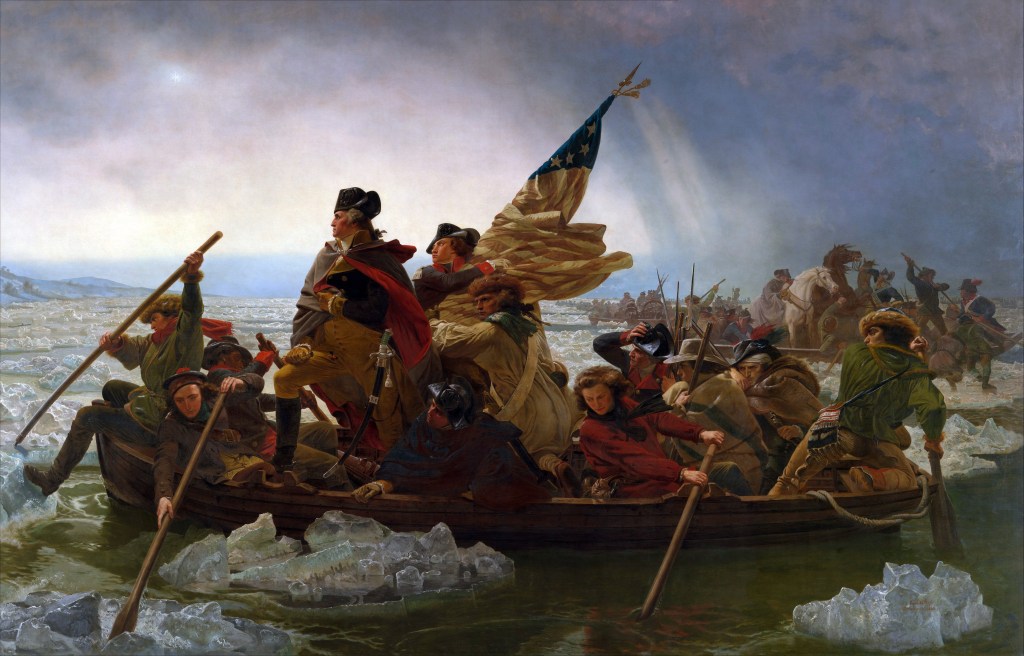
Its historical inaccuracies are famous. The boat is improbable, the flag premature, the posture theatrical. But that is precisely why the painting matters. It is not documentary realism; it is republican theatre. Washington stands like a secular saint, surrounded by a crew meant to symbolise the diversity of the new nation. The Delaware becomes not merely a river, but a baptismal passage from colonial dependency into national destiny.
Yet the painting’s grandeur also reveals the American problem. The founding image is heroic because it omits so much: slavery, Indigenous dispossession, women’s exclusion, class hierarchy, the coming violence of expansion. America’s first great self-image is already selective. It captures the soul of America because it captures both the beauty of its aspiration and the danger of its myth-making. The republic begins by staging itself.
2. Thomas Eakins, The Gross Clinic, 1875
If Leutze gives us America as founding myth, Thomas Eakins gives us America as modern body. The Gross Clinic shows the surgeon Dr Samuel D. Gross lecturing in an operating amphitheatre, his bloodied hand and dark coat commanding the composition. The Philadelphia Museum of Art calls it “acclaimed as the greatest American painting of the nineteenth century” and notes that Eakins painted it for Philadelphia’s 1876 Centennial Exhibition.
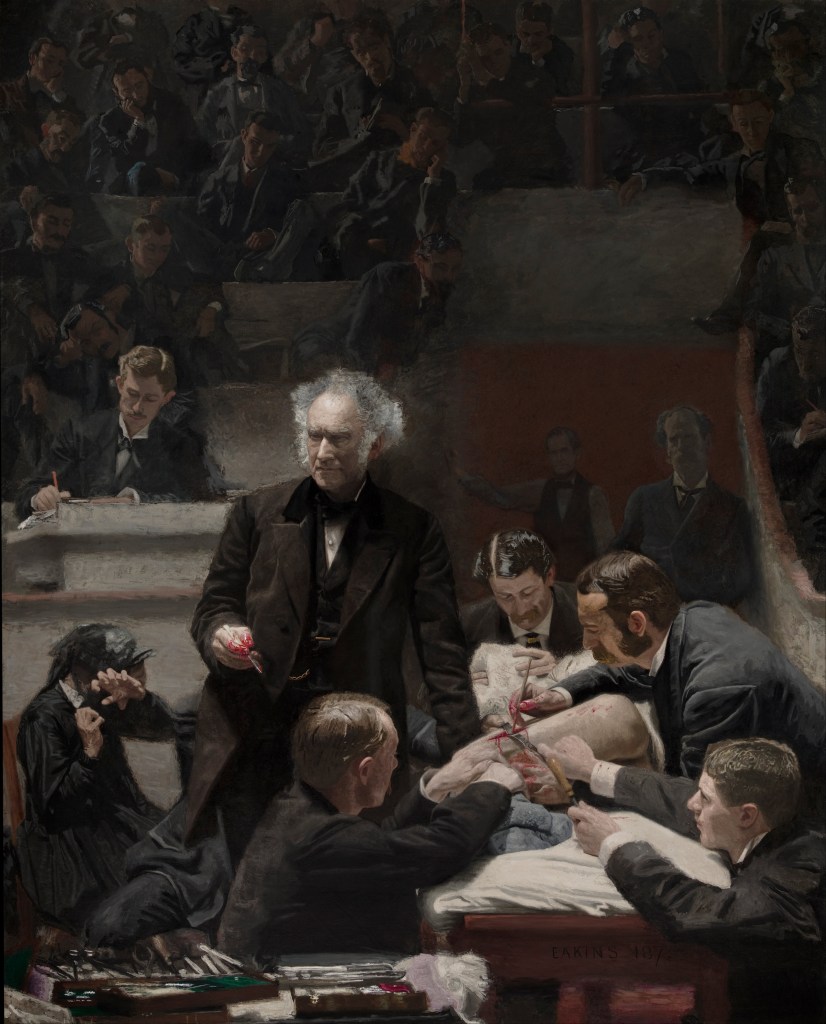
This is America after the romance of founding has entered the age of institutions: medicine, education, science, professionalism, spectatorship. It is a painting of knowledge, but also of violence. The body on the operating table is both patient and object. Around it, students watch, record, learn. Modern America is born not only in congresses and battlefields, but in clinics, laboratories, universities and theatres of expertise.
What makes the painting so American is its refusal of gentility. It is ambitious, harsh, empirical, unsentimental. It believes in progress, but progress appears with blood on its hands. This is one of the central American tensions: the worship of improvement alongside a persistent inability to ask who pays the human cost of improvement.
3. Georgia O’Keeffe, Sky above Clouds IV, 1965
Georgia O’Keeffe’s Sky above Clouds IV is a late, monumental American vision. Painted when O’Keeffe was seventy-seven, the work stretches across a vast horizontal format, turning cloud forms into a field of repetition and transcendence. The Art Institute of Chicago notes that it was painted in the summer of 1965 and culminates a series inspired by O’Keeffe’s experiences of air travel.
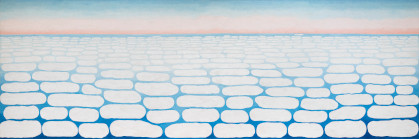
O’Keeffe is essential because she reimagines America not as territory to be conquered, but as perception to be transformed. Her America is not the flag, the city, the battlefield, or the farm. It is the immense abstraction of space itself: desert, bone, flower, sky, cloud, horizon. In her work, the American landscape becomes interior and metaphysical.
Sky above Clouds IV belongs to the jet age, but it does not celebrate technology in any simple way. It is a painting of flight stripped of machinery. The airplane disappears; what remains is the altered human gaze. America’s soul here is not possession, but expansion — the strange, almost religious desire to see beyond the ordinary scale of the self.
4. Grant Wood, American Gothic, 1930
Grant Wood’s American Gothic is perhaps the most parodied American painting ever made, which is one reason it remains so powerful. The Art Institute of Chicago notes that the work debuted at the museum in 1930 and won Wood a $300 prize. Its endurance lies in its ambiguity. Are we looking at dignity or repression? Rural virtue or provincial severity? Satire or tribute? A couple, or a father and daughter? A national type, or a national joke?
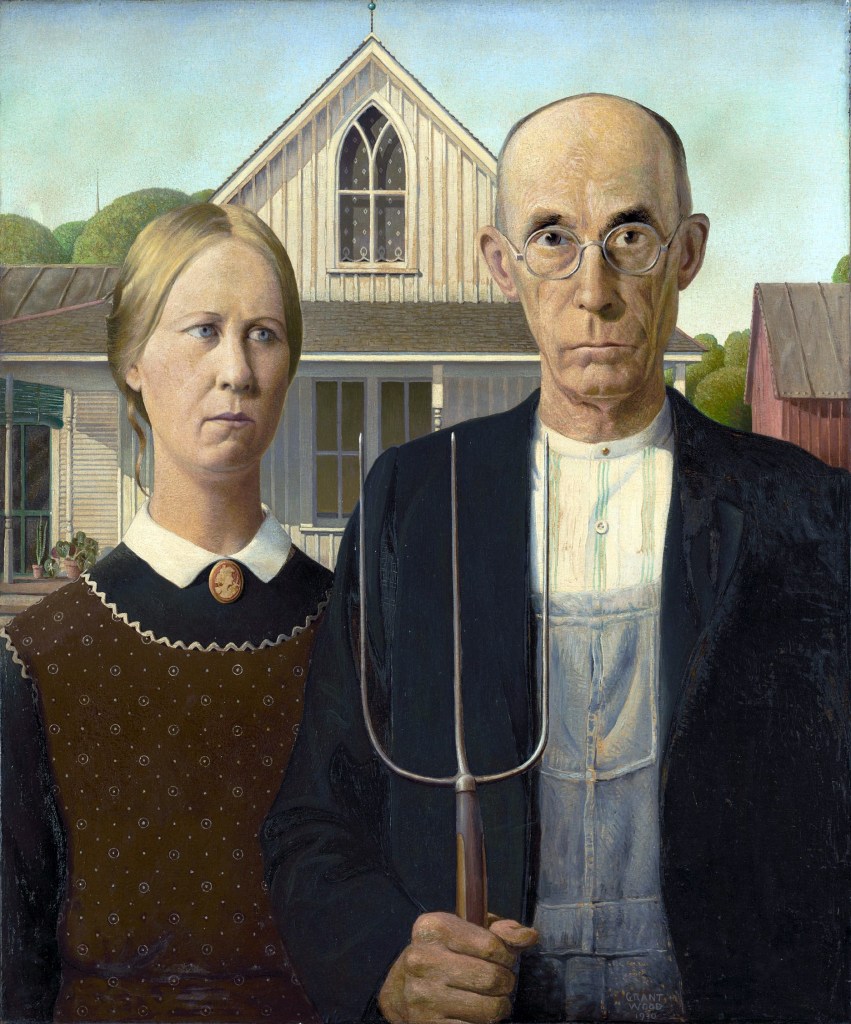
The painting’s genius is its stillness. The figures do not explain themselves. The pitchfork, the Gothic window, the tight mouths, the straight bodies: everything is composed into an emblem of moral discipline. It is funny, but not merely comic. It is stern, but not merely admiring.
American Gothic captures America because it understands the country’s self-seriousness. The painting is about the performance of virtue: thrift, labour, restraint, suspicion, piety, endurance. It also understands that behind such virtues there may be fear, repression, pride and theatricality. The American soul often appears in costume, and here the costume is overalls, apron and architecture.
5. Jacob Lawrence, The Migration Series, 1940–41
Strictly speaking, Jacob Lawrence’s The Migration Series is not one painting but a sixty-panel cycle. Yet to omit it from a list of paintings that capture America would be absurd. MoMA describes the work as an epic series depicting the post–World War I migration of African Americans from the rural South to the industrial North.
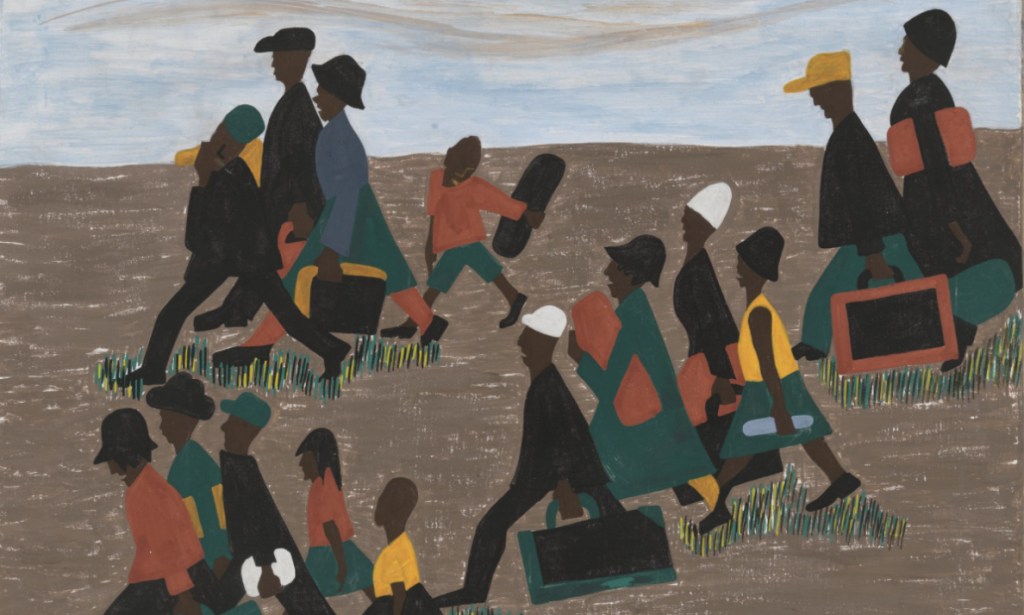
Lawrence understood America as movement under pressure. His figures travel not because of romance, but because of terror, poverty, labour demand and hope. The Great Migration transformed American cities, music, politics, literature and consciousness. Lawrence made that transformation visible with compressed forms, flat colour, sharp diagonals and narrative clarity.
The soul of America here is not the lonely individual, but the historical collective. These are people pushed by violence and pulled by possibility. The work is both documentary and modernist, social history and formal invention. It refuses the idea that Black life is peripheral to American modernity. In Lawrence, Black movement is American movement. Black history is national structure.
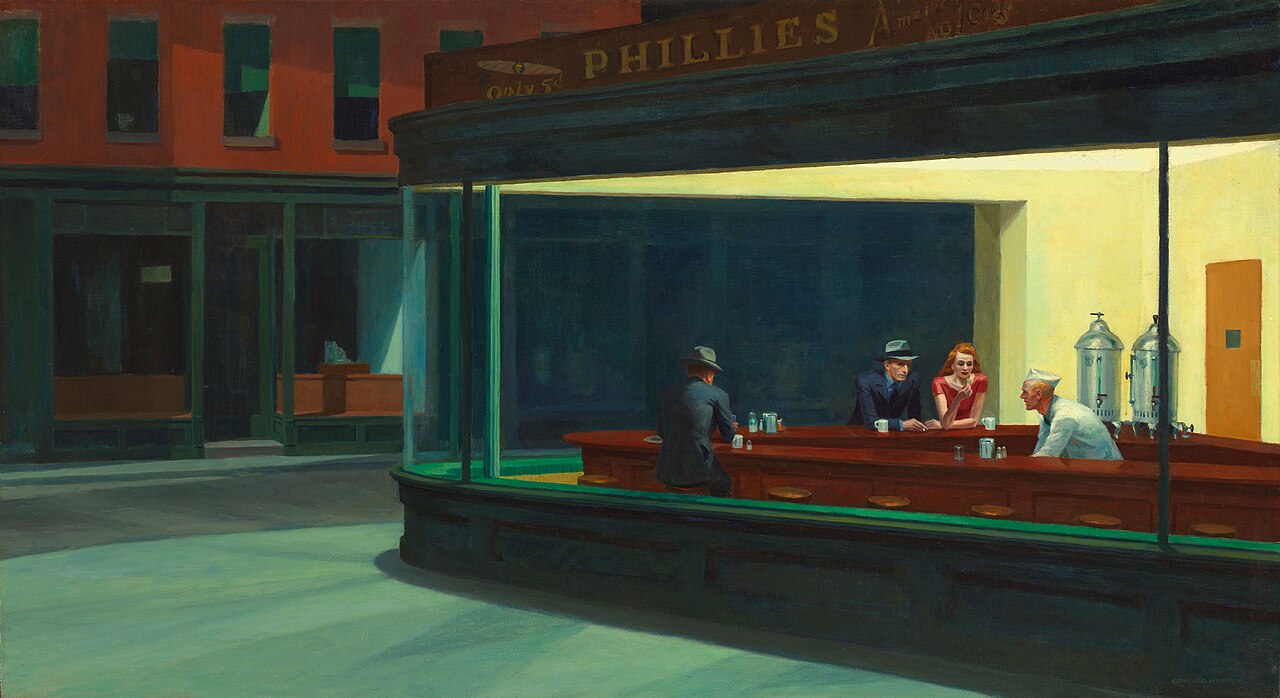
6. Edward Hopper, Nighthawks, 1942
Edward Hopper’s Nighthawks is one of the great images of modern loneliness. The Art Institute of Chicago has described the painting as long positioned as an icon of loneliness and alienation, with a spare composition and ambiguous narrative.
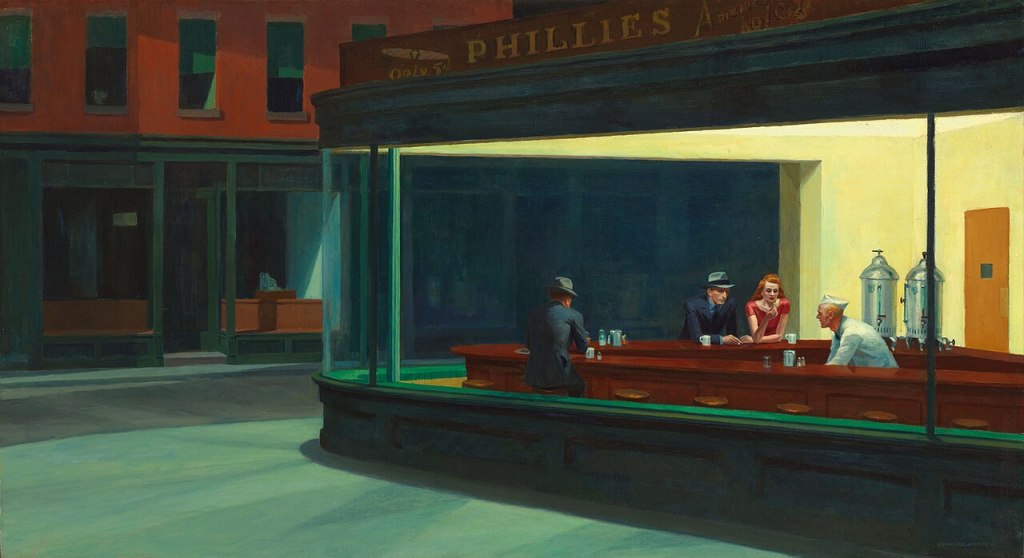
The painting is often treated as a scene of urban isolation, but its deeper power lies in how beautifully it lights that isolation. The diner glows like an aquarium in the dark city. Four figures are visible, yet no intimacy seems possible. There is no visible door. The viewer is outside, looking in, implicated in the act of observation but denied entry.
Nighthawks captures a modern American soul: awake, lit, commercial, solitary. It is the loneliness of a country that has built endless spaces for consumption and too few for communion. The diner is public, but not communal; illuminated, but not warm; occupied, but not inhabited. Hopper’s America is not empty because no one is there. It is empty because no one can reach anyone else.
7. Andrew Wyeth, Christina’s World, 1948
Andrew Wyeth’s Christina’s World is one of the most recognisable American paintings of the twentieth century. MoMA describes it as depicting a young woman seen from behind in a dry field, staring toward a distant farmhouse and outbuildings in coastal Maine; although she appears at rest, her body is tense and strangely alert.
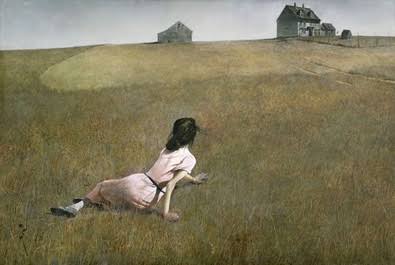
The painting’s force lies in distance. Christina is near to us, yet facing away. The house is visible, yet far. The field is open, yet impassable. Wyeth transforms rural America into a psychological condition: desire without easy arrival.
The painting is often read sentimentally, but it is not sentimental. It is about longing, limitation, endurance and the cruelty of space. America has often imagined itself as a land of movement, but Christina’s World asks what happens when movement is difficult, denied or impossible. The soul of America here is not the triumphant road, but the body in the field measuring the distance between aspiration and reality.
8. Jackson Pollock, Number 1, 1950 (Lavender Mist), 1950
Jackson Pollock’s Lavender Mist marks the moment when American painting stopped looking toward Europe for permission and began to export its own heroic modernism. The National Gallery of Art describes the painting as a dense field of black, white, pale salmon pink, teal and steel-gray lines and splatters crossing a cream-coloured canvas, with ghostly white handprints visible near the upper corners.
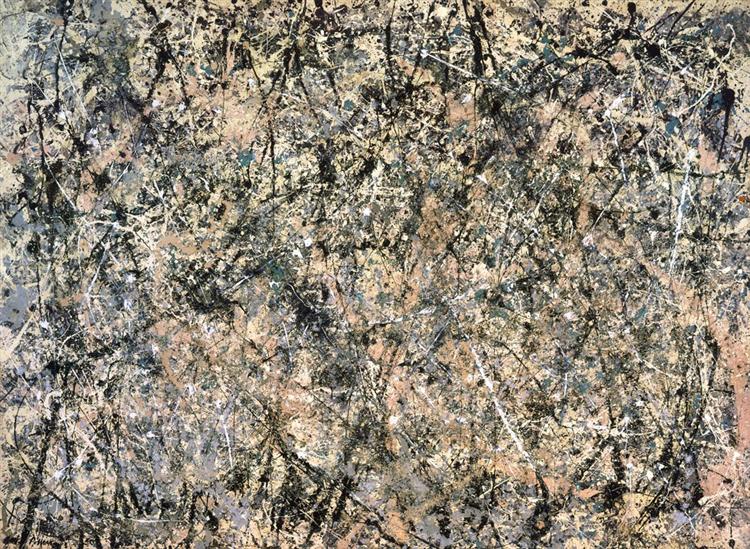
Pollock’s greatness was not simply that he dripped paint. It was that he made the act of painting visible as event, movement, trace and risk. The canvas became not a window onto the world, but a record of bodily action. Painting became performance before performance art had fully named itself.
As an image of America, Lavender Mist is both liberating and mythic. It suggests freedom, energy, scale, violence, improvisation, excess. It is the jazz of paint, the frontier myth internalised into gesture, the Cold War avant-garde recast as existential drama. The painting captures America’s postwar ambition: to be unbounded, original, physical, immense. It also captures its appetite for heroic individualism — the artist as cowboy, genius, storm.
9. Norman Rockwell, The Problem We All Live With, 1964
Norman Rockwell’s The Problem We All Live With is the painting in which American innocence is forced to walk past American hatred. The Smithsonian identifies the painting as a 1964 work by Rockwell related to Look magazine and the civil-rights movement. The Kennedy Center describes it as an image of Ruby Bridges, the Black child who integrated an all-white school in New Orleans, escorted by federal marshals.
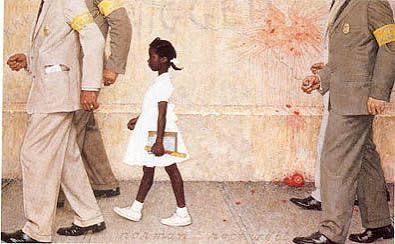
Rockwell’s earlier reputation rested on scenes of small-town decency and sentimental everyday life. Here he uses that illustrative clarity against America itself. The child is small, immaculate, composed. The adults are cropped into anonymity. The wall bears the marks of racial terror. The tomato stain becomes a secular wound.
The painting captures America because it understands that moral courage is sometimes carried by a child while institutions merely accompany her. It also understands that innocence is not the absence of politics. Ruby Bridges is innocent precisely because the world around her is not. Rockwell’s genius here is to make the viewer confront the obscenity of white rage against Black childhood.
10. Jaune Quick-to-See Smith, Trade (Gifts for Trading Land with White People), 1992
Jaune Quick-to-See Smith’s Trade (Gifts for Trading Land with White People) is one of the essential American paintings of the late twentieth century. SmartHistory identifies the work as a 1992 oil and mixed-media collage with objects on canvas. The Whitney has described it as exemplary of Smith’s use of pop-culture imagery to indict the celebration of a republic built on stolen land.
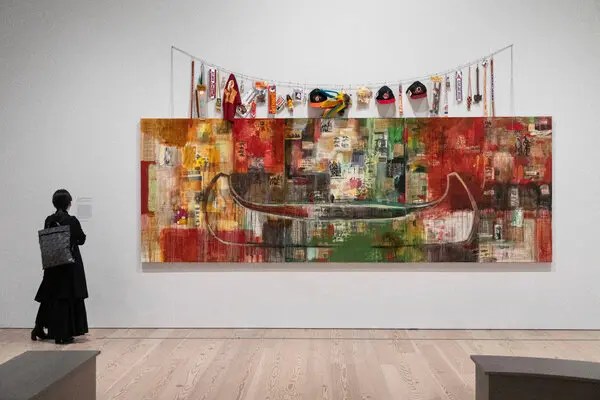
If Leutze gives us America’s founding myth, Smith gives us the bill. The work stages the absurdity and violence of “trade” as a colonial euphemism. A painted canoe is overlaid with images, clippings and found objects, turning the surface into an archive of conquest, commodity, kitsch and memory.
Its importance lies in refusal. Smith refuses the decorative assimilation of Native imagery into American style. She refuses the innocent museum viewer. She refuses the national story in which land simply becomes property and Indigenous presence becomes past tense. The painting captures the soul of America because it insists that the soul has a prior occupant. Before the republic, before the flag, before the frontier, before the myth of discovery, there was land already known, named, inhabited and loved.
The American soul as contradiction
These ten paintings do not produce a single America. They produce a field of tensions.
Leutze gives us the founding myth. Eakins gives us the modern institution. O’Keeffe gives us vastness and perception. Wood gives us rural severity. Lawrence gives us movement and racial history. Hopper gives us loneliness. Wyeth gives us longing and limitation. Pollock gives us energy and excess. Rockwell gives us moral confrontation. Smith gives us the original wound of land.
Together, they suggest that America is not best understood as a nation with one soul, but as a nation whose soul is permanently contested. Its paintings know what its slogans often conceal: that America is both promise and performance, shelter and violence, loneliness and invention, open space and stolen land, abstraction and blood, myth and witness.
The greatest American paintings do not ask us to admire America simply. They ask us to look at it until admiration becomes more difficult, more truthful, and more humane.
Discover more from My World of Interiors
Subscribe to get the latest posts sent to your email.

