
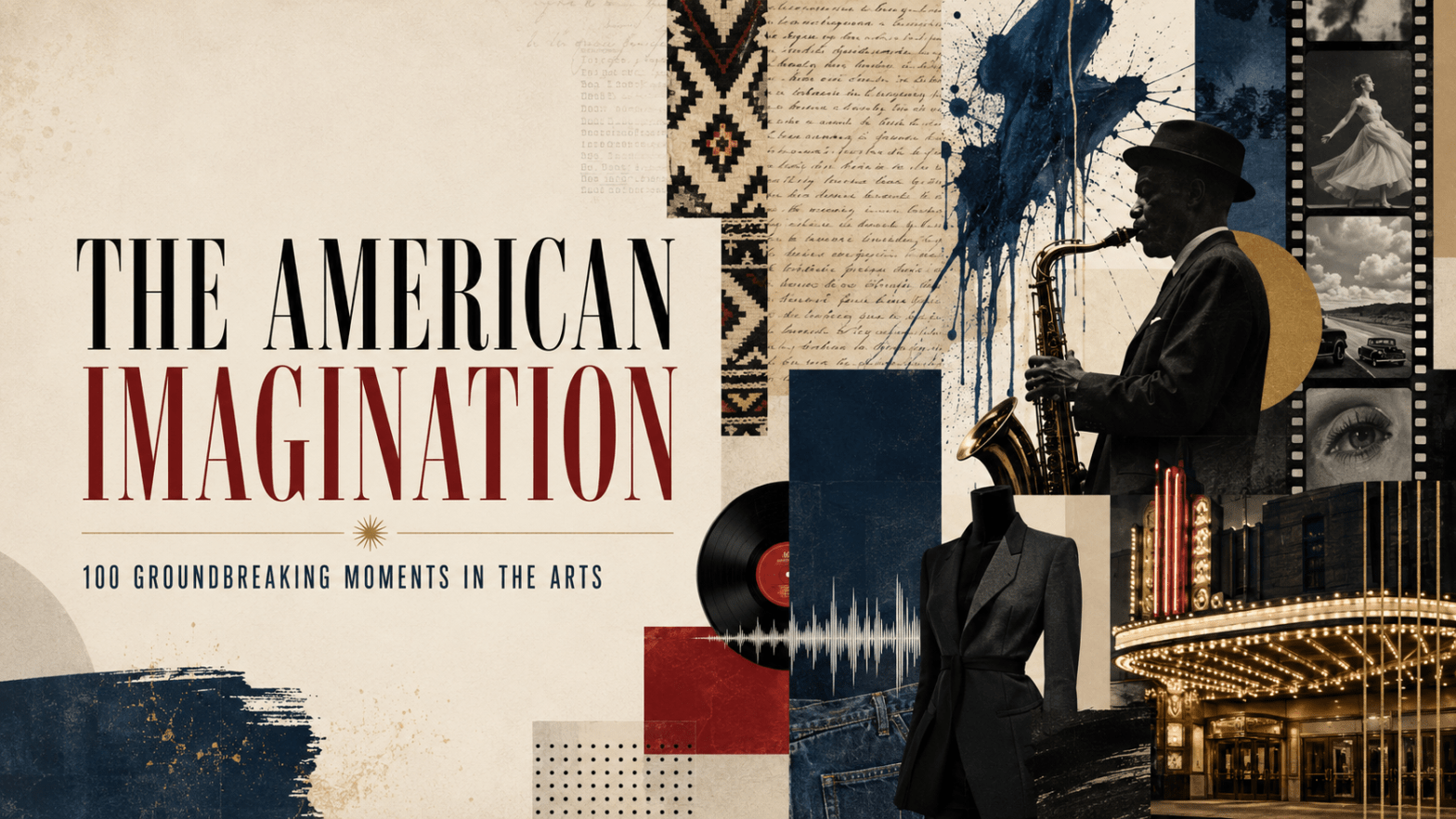
American art has never been a single tradition. It is not one style, one canon, one language, one race, one city, one market, one mythology, or one moral direction. It is a field of struggle: Indigenous geometry and settler expansion, enslaved song and constitutional rhetoric, Puritan severity and surrealist nightmare, Black rhythm and white appropriation, democratic promise and commercial spectacle, frontier myth and urban alienation, mass entertainment and avant-garde refusal. Its power lies not in purity, but in collision.
To speak of “American art” is therefore not merely to speak of painting, literature, music, film, theatre, fashion or design. It is to speak of forms through which America has imagined itself — and through which the rest of the world has imagined America. From earthworks to jazz, denim to cinema, rock’n’roll to Abstract Expressionism, hip-hop to Indigenous television, American culture has repeatedly produced artistic languages that travelled beyond their original circumstances and entered global consciousness.
This list is chronological rather than ranked. It treats “moment” broadly: a publication, a building, a performance, a recording, a garment, a film, a painting, a magazine, a television series, a conceptual shift. Some moments are beautiful. Some are ethically compromised. Some are both. The criterion is not moral innocence, but world-historical influence: did this moment alter form, perception, style, narrative, sound, image, embodiment or cultural possibility?
The Library of Congress’s National Recording Registry and National Film Registry preserve works judged culturally, historically or aesthetically significant, while its “Books That Shaped America” project offers one institutional map of literary influence. But no list can be final. A canon is not a monument; it is an argument.
1. c. 100 BCE–400 CE — The Hopewell ceremonial earthworks
Long before the United States existed, Indigenous artists and builders were shaping North America through geometry, cosmology, ceremony and landscape. The Hopewell ceremonial earthworks in present-day Ohio were not merely constructions; they were spatial thought. Their vast circles, squares, octagons and alignments transformed land into architecture, ritual and celestial relation. UNESCO describes the Hopewell Ceremonial Earthworks as monumental Indigenous enclosure complexes built between 2,000 and 1,600 years ago, remarkable for geometric precision and alignments with solar and lunar cycles.
They remind us that American art begins not with European easel painting or republican print culture, but with earth, sky, communal labour and sacred measurement. The first great American abstraction was not painted on canvas. It was made in land.
2. c. 850–1250 — Chaco Canyon and Ancestral Puebloan architecture
Chaco Canyon, in present-day New Mexico, was one of the most extraordinary architectural and ceremonial complexes in pre-colonial North America. Its great houses, roads, kivas and astronomical alignments reveal a culture of immense spatial sophistication. UNESCO identifies Chaco Culture as preserving outstanding elements of a vast pre-Columbian cultural complex in northwestern New Mexico.
Chaco matters because it overturns the colonial fiction of an empty continent. It demonstrates that North America possessed monumental architecture, engineering, ritual design and long-distance cultural networks long before European settlement. In Chaco, architecture was not simply shelter. It was social order, astronomy, authority and memory.
3. c. 1050–1350 — Cahokia and the Mississippian city
Cahokia, near present-day St Louis, was the largest pre-Columbian settlement north of Mexico. UNESCO describes it as covering nearly 1,600 hectares at its height, with around 120 mounds and a peak population possibly between 10,000 and 20,000 people.
Its importance is not only archaeological. Cahokia demands a rethinking of American urban history. The city, the monument, the plaza, the mound, the ceremonial centre — these are not exclusively European inheritances. Cahokia places Indigenous urbanism at the beginning of any serious account of American cultural form.
4. Pre-colonial era onward — Wampum belts as art, law and memory
Wampum belts, used by Haudenosaunee and other northeastern Native nations, collapse the false distinction between art object and political instrument. They are visual design, mnemonic system, treaty record, diplomatic protocol and sacred history. Smithsonian Magazine notes that wampum strings and belts were central diplomatic tools for negotiating and recording treaties among northeastern Native Nations.
This is an art of relation rather than possession. In wampum, pattern is not decoration. It is obligation. The belt holds memory so that words may be renewed. It is one of the great American examples of art as law.
5. 18th century onward — Diné/Navajo weaving
Diné weaving is among the great textile traditions of North America. Its forms are mathematical, spiritual, material and territorial. Blankets and later rugs carry knowledge of land, colour, kinship, trade, ceremony and adaptation. The National Museum of the American Indian’s exhibition Woven by the Grandmothers foregrounded nineteenth-century Navajo textiles as a major artistic tradition with deep cultural continuity.
Its influence on American design has been enormous, though often appropriated and commodified by non-Native markets. To include Diné weaving is not to insert Indigenous art into American culture as ornament. It is to recognise that American design has always been indebted to Indigenous pattern, material intelligence and aesthetic sovereignty.
6. 1773 — Phillis Wheatley publishes Poems on Various Subjects
Phillis Wheatley, an enslaved African-born woman in colonial America, became one of the first published Black poets in the Atlantic world. Her work is foundational not only because it exists against impossible odds, but because it exposes the contradiction at the birth of American literary culture.
A society that enslaved her also needed to confront the fact of her intellect. Wheatley’s poetry therefore performs a double labour: it participates in neoclassical literary form while making visible the racial hypocrisy of a civilisation that claimed reason, Christianity and liberty while holding human beings as property.
7. 1776 — Thomas Paine’s Common Sense
Thomas Paine’s Common Sense turned political argument into mass prose. Its revolution was not only ideological, but stylistic. Paine wrote in a language intended to move ordinary readers, not merely elites. He made political abstraction portable.
This is one of the founding moments of American public rhetoric: direct, urgent, impatient with inherited authority. Paine helped establish a tradition in which writing does not merely reflect politics, but creates political possibility.
8. 1787–1788 — The Federalist Papers
Written by Alexander Hamilton, James Madison and John Jay, The Federalist Papers made constitutional theory into an American literary form. Their importance lies less in beauty of style than in the intellectual seriousness with which they imagined institutional design.
These essays belong in a history of the arts because they demonstrate that political architecture is also an act of imagination. The American republic was argued into being through prose: faction, sovereignty, representation, power, balance, ambition and fear turned into sentences.
9. 1820 — Washington Irving’s “The Legend of Sleepy Hollow”
Washington Irving helped give the young nation a mythology of its own. “The Legend of Sleepy Hollow” is not yet the great American novel, but it is an early American dreamscape: haunted villages, unstable identities, rural superstition, comic terror and historical unease.
American gothic begins not in medieval castles, but in settlements, roads, schoolhouses and rumours. Irving understood that the new country was already haunted — not despite its youth, but because of it.
10. 1836 — Thomas Cole’s The Oxbow and the Hudson River School
Thomas Cole and the Hudson River School made American landscape painting into a moral theatre. Wilderness, settlement, weather, providence and conquest all enter the same frame. The Oxbow is often read as a meditation on nature and civilisation, but it also participates in the visual ideology of expansion.
The Hudson River School gave the United States a sublime landscape tradition. Yet its beauty cannot be separated from the politics of land. These paintings helped teach Americans how to see the continent as destiny.
11. 1841 — Edgar Allan Poe and the invention of detective fiction
With “The Murders in the Rue Morgue,” Edgar Allan Poe effectively created the modern detective story. The genre’s future is almost unimaginable without him: Sherlock Holmes, noir, crime fiction, police procedurals, psychological thrillers and true crime all inherit something from Poe’s fusion of rational method and morbidity.
Poe’s deeper importance lies in making analysis dramatic. Modernity would increasingly become a world of clues, systems, hidden motives and forensic reading. Poe gave that world a form.
12. 1851 — Herman Melville’s Moby-Dick
Moby-Dick is one of the great impossible books: epic, comic, metaphysical, encyclopedic, democratic, theatrical, obsessive and strange. It turns the whaling ship into a floating civilisation and the whale into an object of knowledge, terror, projection and unknowability.
Its influence lies in its refusal of proportion. Melville made the American novel oceanic: able to contain labour, capitalism, race, masculinity, theology, imperial extraction, madness and the limits of human interpretation.
13. 1852 — Harriet Beecher Stowe’s Uncle Tom’s Cabin
Uncle Tom’s Cabin was abolitionist fiction as political force. Its racial imagination is deeply complicated and often troubling to modern readers, but its influence on nineteenth-century public consciousness was enormous.
The novel demonstrated that sentimental narrative could become a weapon against slavery. It also revealed the power and danger of moral feeling in mass culture: sympathy could mobilise, but it could also simplify. Stowe’s achievement belongs to both literature and political history.
14. 1855 — Walt Whitman’s Leaves of Grass
Whitman transformed the poetic line and the poetic self. In Leaves of Grass, the “I” becomes body, crowd, continent, labourer, lover, prophet and democratic instrument. The poem expands outward, rejecting the inherited compression of European lyric form.
Whitman’s free verse gave American poetry a new amplitude. He made poetry sound like breath, speech, catalogue, sermon and embrace. His influence is everywhere in modern poetry’s understanding of the self as plural.
15. 1860s–1920s — Plains ledger art
Plains ledger art emerged as Indigenous artists used paper ledger books to record battle, ceremony, dress, memory and changing worlds. The form arose partly from violent historical disruption, including confinement and forced assimilation, but it also carried forward older pictorial traditions into new materials.
Its significance lies in adaptation without surrender. Ledger art is neither ethnographic residue nor folk curiosity. It is modern Indigenous narrative art: mobile, graphic, historical and politically charged.
16. 1868 — Louisa May Alcott’s Little Women
Little Women made domestic life intellectually and emotionally consequential. Alcott’s novel changed the cultural meaning of girlhood by treating ambition, authorship, sisterhood, anger, sacrifice and moral development as serious subjects.
Jo March is one of American literature’s great figures of female creative restlessness. The novel’s power lies in understanding the home not as an escape from history, but as a site where gender, labour, love and selfhood are formed.
17. 1871 — The Fisk Jubilee Singers take spirituals to the world
The Fisk Jubilee Singers brought African American spirituals to national and international audiences. Their performances helped transform sacred songs born out of slavery into world culture while raising funds for Black education.
The historical importance is immense. Spirituals carried coded survival, sorrow, theology and collective endurance. Through the Fisk Jubilee Singers, an art form forged under bondage entered concert culture and changed the global understanding of American music.
18. 1873 — Blue jeans are patented
When Levi Strauss and Jacob Davis patented riveted denim trousers, they could not have known they were creating one of the most global garments in modern history. Jeans began as workwear and became labour uniform, youth symbol, erotic object, rebel costume, fashion staple and democratic myth.
Denim is one of America’s most powerful aesthetic exports because it carries contradiction so efficiently. It suggests labour and leisure, poverty and luxury, authenticity and branding, the cowboy and the rock star, the worker and the supermodel.
19. 1884 — Mark Twain’s Adventures of Huckleberry Finn
Twain brought vernacular American speech into literary greatness. Huckleberry Finn changed prose by making dialect, childhood perception, satire and moral crisis central to national literature. The Library of Congress cites Hemingway’s famous claim that modern American literature comes from Twain’s book.
The novel remains foundational and contested because it sits at the wound of race. Its greatness lies not in innocence, but in its exposure of a society where a child must unlearn the morality of slavery in order to become human.
20. 1890 — Emily Dickinson’s poems are published
Emily Dickinson’s poems, published after her death, altered the future of lyric poetry. Her compression, slant rhyme, dashes, metaphysical intensity and radical interiority made the poem feel less like public utterance than private lightning.
Dickinson’s modernity lies in scale. She made the smallest poem capable of holding death, God, desire, nature, consciousness and terror. American poetry after Dickinson could no longer assume that vastness required length.
21. 1891 — Louis Sullivan and the modern skyscraper
With buildings such as the Wainwright Building, Louis Sullivan helped articulate the skyscraper as a new architectural form. The tall commercial building was not merely an engineering solution; it was a new urban aesthetic.
The skyscraper became America’s vertical signature: capitalism, ambition, density, technology and spectacle translated into height. Sullivan’s famous principle that form follows function would echo through modern architecture and design far beyond America.
22. 1899 — Scott Joplin’s “Maple Leaf Rag”
Ragtime was the first great American popular music to conquer the world through syncopation. Scott Joplin’s “Maple Leaf Rag” made rhythm feel modern: elegant, propulsive, Black, urban and mechanically reproducible through sheet music and piano rolls.
Its importance lies in the shifting of the musical centre. European harmonic respectability gives way to American rhythmic surprise. Ragtime prepared the ground for jazz, popular song and the global twentieth century.
23. 1903 — The Great Train Robbery
Edwin S. Porter’s The Great Train Robbery helped establish cinematic action, editing and narrative momentum. Its famous direct-to-camera gunshot announced something primal about American cinema: spectacle, violence, pursuit and frontier mythology compressed into moving images.
The film is short, but its implications are vast. American cinema would repeatedly return to the same ingredients: speed, crime, landscape, technology, masculinity and the shock of being looked at.
24. 1909 — Frank Lloyd Wright’s Robie House and the Prairie Style
Frank Lloyd Wright’s Prairie architecture reimagined the American house as horizontal, spatially fluid and organically related to its environment. The Robie House in Chicago is one of the great expressions of this idea.
Wright’s importance lies in refusing European historical revival as the default language of architecture. He sought an American modernism rooted in land, movement, domestic life and spatial continuity. The house became not a box of rooms, but an unfolding experience.
25. 1906 — Upton Sinclair’s The Jungle
Sinclair intended to expose the exploitation of immigrant labour, and instead made an entire nation nauseous about meat. The Jungle is muckraking literature as bodily horror: capitalism enters the stomach.
Its artistic significance lies in making industrial systems visible through narrative. The novel insists that food, labour, immigration, poverty and corporate power are not separate subjects. They are one machine.
26. 1908 — The Ashcan School and The Eight
The Ashcan painters turned away from genteel polish toward tenements, streets, crowds, boxers, bars, theatres and urban grime. They gave American painting a city body.
Their work made modern life artistically legitimate not because it was ideal, but because it was alive. American realism became less pastoral and more metropolitan. Beauty could be found in dirt, speed, working bodies and public life.
27. 1912 — W.C. Handy publishes “Memphis Blues”
W.C. Handy did not invent the blues. The blues came from Black Southern experience, oral tradition, field hollers, spirituals, work songs, sorrow and survival. But Handy’s publication helped move the blues into national commercial circulation.
The significance is historical transmission. A regional Black expressive form entered the machinery of modern music publishing and began its transformation into one of the foundational languages of twentieth-century sound.
28. 1913 — The Armory Show
The Armory Show brought European modernism to American audiences and scandalised many of them. Cubism, Fauvism and abstraction arrived not as gradual evolution, but as shock.
Its importance was not simply that Americans saw modernism. It was that American artists could no longer pretend that art must obey nineteenth-century realism. The Armory Show introduced a crisis of perception, and that crisis became productive.
29. 1915 — The Birth of a Nation
D.W. Griffith’s The Birth of a Nation is one of the most troubling works in American cultural history: technically revolutionary and morally poisonous. Its innovations in scale, editing, cross-cutting and narrative force cannot be separated from its white supremacist mythology.
It must be included because influence is not innocence. The film demonstrated cinema’s ability to organise emotion at mass scale — and to place that power in the service of racial terror. It remains a warning about art’s capacity to enchant and deform public consciousness.
30. 1917 — Charlie Chaplin’s Tramp becomes a global figure
Chaplin’s Tramp was not purely American in origin, but Hollywood made him a world icon. The figure turned poverty, slapstick, melancholy, grace and resilience into a universal cinematic language.
The Tramp matters because he is modernity’s little man: crushed by machines, bosses, police and hunger, yet still moving. Through Chaplin, American cinema exported not only glamour, but pathos.
31. 1921 — Shuffle Along and the Harlem Renaissance
Shuffle Along helped bring Black musical theatre to Broadway with new force, and its success belongs to the broader flowering of the Harlem Renaissance. In Harlem, literature, music, theatre, nightlife, visual art and political thought converged.
The Renaissance was not merely a period style. It was a declaration that Black modernity would not be peripheral to American culture. It would be one of its engines.
32. 1924 — George Gershwin’s Rhapsody in Blue
Gershwin made a concerto out of the city. Rhapsody in Blue fused classical ambition with jazz inflection, traffic, glamour and nervous metropolitan energy. It is one of the earliest great sound-images of New York modernity.
Its global influence lies in synthesis. Gershwin did not resolve the tension between high art and popular form. He staged it, orchestrated it and made it seductive.
33. 1925 — F. Scott Fitzgerald’s The Great Gatsby
Fitzgerald wrote the American dream as a ghost story in a dinner jacket. The Great Gatsby turns wealth, reinvention, desire and moral emptiness into a glittering tragedy.
Its influence endures because Gatsby is less a man than a national method: self-invention through illusion. America recognises itself in him not because he succeeds, but because he believes so beautifully in the lie that destroys him.
34. 1926 — Ernest Hemingway’s The Sun Also Rises
Hemingway changed the surface temperature of prose. The Sun Also Rises made omission, restraint, repetition and emotional compression into a new literary method. The trauma of the First World War does not announce itself theatrically in the novel; it circulates under the sentence.
Hemingway’s influence on world literature is almost impossible to overstate. He exported an American prose style of hardness, understatement and wounded masculinity. Even writers who reject him often write in the wake of his discipline.
35. 1925–1928 — Louis Armstrong’s Hot Five and Hot Seven recordings
Louis Armstrong changed the history of music by altering the role of the individual voice inside collective form. His Hot Five and Hot Seven recordings transformed jazz improvisation, phrasing, swing, trumpet language and the very idea of the soloist.
Armstrong’s genius was formal and bodily at once. He made time elastic. He made melody speak. He gave modern music a new grammar of freedom.
36. 1920s — Georgia O’Keeffe and American modernist vision
Georgia O’Keeffe’s flowers, bones, skyscrapers and desert forms changed the visual language of American modernism. She made scale intimate and intimacy monumental. Her work refuses the old hierarchy between landscape, body, abstraction and object.
O’Keeffe’s importance lies in her control of looking. She did not merely paint flowers larger. She made perception itself strange, erotic, architectural and sovereign.
37. 1926 — Martha Graham and modern dance
Martha Graham gave American dance a body of contraction, grief, myth and psychological force. Breaking from ballet’s European codes, she made movement feel primal, modern, female and interior.
Graham’s body was not decorative. It was an instrument of conflict. She helped invent an American modern dance language in which the torso could think, mourn and revolt.
38. 1927 — The Jazz Singer and sound cinema
The arrival of synchronised sound transformed film from visual dream to audiovisual spectacle. The Jazz Singer helped inaugurate the sound era, changing acting, editing, performance, exhibition and the economics of cinema.
Its use of blackface also places the birth of sound cinema inside America’s racial wound. Technological progress arrived wearing an old mask. The moment is therefore both artistic revolution and moral indictment.
39. 1928 — Disney’s Steamboat Willie
Steamboat Willie helped establish synchronised sound animation and introduced Mickey Mouse as a global figure. Disney would become one of the most powerful myth-making institutions in modern culture.
The significance is not simply charm. Animation became industrialised fantasy: repeatable, marketable, musical, emotionally precise. American drawing learned to move through the world as corporate folklore.
40. 1929 — William Faulkner’s The Sound and the Fury
Faulkner fractured time, voice and consciousness. The American South became not a setting but a psychic ruin, where race, memory, family, class and decay move through language like fever.
His influence lies in narrative difficulty. Faulkner made American modernism dense, recursive and haunted. He understood that history does not pass. It mutates inside syntax.
41. 1930 — Grant Wood’s American Gothic
Few paintings have been reproduced, parodied and misread more often. American Gothic made rural American severity iconic: stern, comic, anxious, pious and uncanny.
Its genius lies in ambiguity. Is it satire, tribute, nightmare or mask? Like much American art, it endures because it refuses to say whether the national face is dignified or absurd.
42. 1931 — The Empire State Building
The Empire State Building became architecture as vertical confidence. Built during the Depression, it rose as though height itself could answer economic despair.
The skyscraper is one of America’s great contributions to world architecture: a form born of steel, capital, density, speculation and technological optimism. The Empire State Building turned that form into an icon.
43. 1935 — The Federal Art Project
The New Deal’s Federal Art Project made an extraordinary claim: artists were workers, and culture was a public good. It supported murals, posters, photography, community art and public visual culture.
Its importance lies in the relationship between democracy and art. The project refused the idea that culture should belong only to private wealth. It imagined the artist as part of the public body.
44. 1936 — Dorothea Lange’s Migrant Mother
Lange’s photograph became the face of Depression-era suffering. Its power lies in the mother’s gaze: exhausted, monumental, unsentimental.
American photography learned through Lange how to make poverty visible without reducing dignity to pity. The image is documentary, but it is also iconographic. It transforms social crisis into moral confrontation.
45. 1939 — The Wizard of Oz
Kansas turns to Technicolor and American childhood enters the dream factory. The Wizard of Oz became a global fable about home, escape, performance, fear and self-discovery.
Its deeper importance lies in its structure of transformation. The ordinary world becomes colour. The child becomes pilgrim. Fantasy becomes a way of thinking about loneliness, courage and return.
46. 1939 — John Steinbeck’s The Grapes of Wrath
Steinbeck made dispossession epic. The Joads are not only a family but a collective American body: driven from land, exploited by capital, held together by anger, hunger and stubborn compassion.
The novel’s influence lies in its moral collectivism. It refuses to treat poverty as personal failure. It understands migration, labour and hunger as political conditions.
47. 1941 — Orson Welles’s Citizen Kane
Citizen Kane made cinema intellectually modern: deep focus, fractured chronology, unreliable memory, media power and the loneliness of wealth. The Library of Congress’s National Film Registry includes it among films preserved for their cultural, historical or aesthetic significance.
The film’s central question — what explains a life? — remains unanswerable. Its form is investigative, but its truth is absence. American cinema became more adult because Welles made biography unstable.
48. 1942 — Edward Hopper’s Nighthawks
Hopper painted urban loneliness as national atmosphere. Nighthawks is America after hours: lit, exposed, silent, cinematic.
Its influence on film noir, photography, advertising and visual storytelling is enormous. Hopper made loneliness architectural. The diner becomes a stage on which nothing happens and everything is felt.
49. 1943 — Oklahoma! and the integrated musical
Rodgers and Hammerstein helped reinvent Broadway by integrating song, dance and narrative into a psychologically coherent whole. The American musical became not revue but drama.
Oklahoma! is also a myth-making machine, turning territory, courtship, violence and settlement into song. Like many American forms, it is formally brilliant and ideologically uneasy.
50. Mid-1940s — Bebop
Charlie Parker, Dizzy Gillespie, Thelonious Monk and others turned jazz into high-speed modernism. Bebop was not polite entertainment. It was harmonic density, virtuosity, irony, Black intellectual force and rhythmic rebellion.
Its significance is partly social. Bebop refused the easy consumption of Black music as dance entertainment alone. It demanded listening as thought.
51. 1947 — Jackson Pollock’s drip paintings
In 1947, Jackson Pollock began using his drip technique, placing canvas on the floor and extending marks across the whole surface. MoMA describes Full Fathom Five as one of the first paintings in which Pollock used this method and developed an “allover” composition.
Pollock changed painting by making process visible. The canvas became an event, an arena, a record of movement. American painting, for the first time, seemed to seize the centre of the international avant-garde.
52. 1947 — Tennessee Williams’s A Streetcar Named Desire
Williams made American theatre humid, sexual, wounded and psychologically dangerous. With Blanche DuBois and Stanley Kowalski, the stage became a battlefield of gender, class, violence, fantasy and desire.
The play’s influence lies in emotional weather. Williams understood that realism could be lyrical, and that domestic rooms could contain catastrophe.
53. 1949 — Arthur Miller’s Death of a Salesman
Miller turned capitalism into tragedy. Willy Loman is not a king, yet his collapse has tragic force because America has taught him to confuse worth with success, love with performance and identity with salesmanship.
The play remains one of the great indictments of the American dream. Its subject is not failure alone, but the cruelty of a culture that sells failure back to the failed as personal inadequacy.
54. 1949 — The Eames House
Charles and Ray Eames made modern design warm, playful and livable. Their house and furniture translated industrial materials into domestic intelligence.
Their contribution was not simply style. They imagined design as a democratic language of usefulness, elegance, experiment and delight. Postwar American modernism became less severe through them.
55. 1951 — J.D. Salinger’s The Catcher in the Rye
Holden Caulfield gave adolescence a modern voice: wounded, suspicious, funny, alienated and morally hypersensitive. The novel changed how youth, authenticity and phoniness could be written.
Its influence lies in intimacy. Salinger made the adolescent voice not a subject to be described from outside, but a consciousness capable of organising the novel itself.
56. 1952 — Ralph Ellison’s Invisible Man
Ellison wrote invisibility as a political and existential condition. The novel fuses jazz structure, surrealism, Black history, philosophy and American violence into one of the central works of twentieth-century literature.
Its power lies in the instability of recognition. To be unseen is not to be absent. Ellison made invisibility a diagnosis of the nation.
57. 1956 — Elvis Presley becomes the first global body of rock’n’roll
Elvis Presley did not invent rock’n’roll. Rock’n’roll came from Black rhythm and blues, gospel, country, jump blues, boogie-woogie, Pentecostal ecstasy, teenage desire and the commercial machinery of postwar America. What Elvis did in 1956 was historically different: he became the medium through which rock’n’roll entered mass global consciousness as image, sound, body and scandal.
The Sun recordings of 1954 are the origin myth, but 1956 is the rupture. “Heartbreak Hotel” became his first major No 1 single, his debut album made him a national recording force, and his television appearances turned his body into a cultural crisis. Graceland’s account of Elvis’s 1956 emphasises the extraordinary concentration of recordings, hits and public attention in that year, while the Ed Sullivan archive notes the January 1956 release of “Heartbreak Hotel” and his subsequent television breakthrough.
Elvis became the king of rock’n’roll because America’s racial order could more easily export Black-derived sound through a white body. That contradiction is not a footnote. It is the historical condition of his world domination.
58. 1957 — Noam Chomsky’s Syntactic Structures
Noam Chomsky’s Syntactic Structures belongs in a history of American arts because it altered the intellectual conditions under which language, mind and creativity could be understood. It was not an artwork, but it changed the theory of the human capacity that makes artworks possible. The original study described itself as an attempt to construct a formalised general theory of linguistic structure.
Against behaviourist models that treated language largely as habit and response, Chomsky proposed grammar as generative: finite rules capable of producing infinite utterances. Its influence travelled into linguistics, philosophy, cognitive science, literary theory, anthropology, artificial intelligence and political thought. In cultural terms, Chomsky helped make language itself visible as an architecture of freedom and constraint.
59. 1957 — West Side Story
West Side Story brought Shakespeare, ballet, jazz, Latin rhythm and urban violence into the American musical. It is formally thrilling and representationally complicated, a landmark in the musical’s ambition to address the city.
Its importance lies in synthesis and tension. The dance is beautiful; the politics are uneasy. The work remains influential because it shows the musical trying to grow up without fully escaping the limits of its imagination.
60. 1959 — Miles Davis’s Kind of Blue
Kind of Blue is one of the great recordings of modernity: spacious, elegant, searching and endlessly influential. Modal jazz gave musicians a new relationship to time, atmosphere and improvisational freedom.
The album’s global afterlife is immense because it is both intellectually advanced and sensuously immediate. It feels like thought taking breath.
61. 1962 — Andy Warhol’s Campbell’s Soup Cans
Warhol made mass production look back at itself. With soup cans, celebrities and repetition, he turned American consumer culture into art and prophecy.
His importance lies in surface. Warhol understood that modern life was increasingly mediated by images, packaging, fame and reproduction. Pop Art did not merely represent capitalism. It adopted its methods and made them uncanny.
62. 1963 — Bob Dylan and the modern protest song
With songs such as “Blowin’ in the Wind,” Dylan transformed folk into moral weather. The protest song became not only music, but public question.
His early work matters because it gave political uncertainty a memorable form. The song does not lecture; it asks. In doing so, it made ambiguity singable.
63. 1964 — Motown goes global
Motown created a polished, disciplined, irresistible sound that carried Black American music into living rooms across the world. The Supremes, Marvin Gaye, Stevie Wonder, The Temptations and others made pop elegant, rhythmic and globally legible.
Its achievement was aesthetic and infrastructural. Motown understood arrangement, choreography, grooming, songwriting, production and distribution as one system. It was Black modernity with a backbeat and a business plan.
64. 1965 — The Autobiography of Malcolm X
As told to Alex Haley, Malcolm X’s life became one of the most influential political-spiritual narratives of the twentieth century. It changed global understandings of race, Islam, self-education, anger, transformation and liberation.
Its literary significance lies in conversion as structure. The self is not stable; it is revised through knowledge, prison, faith, travel and political awakening. The book made autobiography revolutionary.
65. 1966 — The Velvet Underground and Warhol’s Factory
The Velvet Underground sold few records at first but altered the future. Their mixture of art, noise, drugs, sexuality, literary darkness and downtown cool became the seedbed for punk, alternative music and the idea of the band as avant-garde object.
The Factory context matters. Music, film, fashion, celebrity, boredom and deviance converged into a new cultural system. The underground became a method.
66. 1967 — Ralph Lauren and the invention of aspirational Americana
Ralph Lauren transformed American style into a total narrative world: polo fields, denim, tweed, Western myth, Ivy League, Gatsby, ranch, country house, old money and democratic fantasy. His genius was not merely garment design, but atmosphere.
Lauren understood that American fashion could be built from imagined memory. He made aspiration wearable and exported an idea of America that was less a place than a wardrobe. Vogue recently pointed to Ralph Lauren as an example of American identity narratives that continue to resonate globally.
67. 1967 — Jimi Hendrix at Monterey Pop
Hendrix at Monterey was not merely a performance; it was an electrical event. He made the guitar theatrical, cosmic, erotic, violent and painterly.
His influence lies in amplification as authorship. The guitar was no longer simply an instrument. It became fire, feedback, scream, body and atmosphere. Hendrix changed the sound of freedom and danger.
68. 1968 — Stanley Kubrick’s 2001: A Space Odyssey
Kubrick made science fiction metaphysical. 2001 expanded what popular cinema could contemplate: evolution, technology, artificial intelligence, infinity and human smallness.
Its form remains radical. Long silences, abstraction, design precision and cosmic scale turned the film into a philosophical object. It made the future feel ancient.
69. 1969 — Woodstock
Woodstock became the mythic image of the counterculture: music as gathering, youth as nation, mud as sacrament. Its mythology is larger than its reality, but that too is American.
The event matters because it staged music as temporary society. For a moment, sound, style, anti-war politics, communal fantasy and generational identity seemed to occupy one field.
70. 1969 — Sesame Street
Sesame Street made educational television artful, urban, musical and inclusive. It turned public pedagogy into pop culture and treated children as intelligent citizens of media.
Its global influence is profound. The show demonstrated that television could teach without condescension, and that design, humour, repetition and song could become instruments of public care.
71. 1969 — Maya Angelou’s I Know Why the Caged Bird Sings
Angelou’s memoir changed the possibilities of autobiographical writing. Childhood, racism, sexual violence, voice, silence and self-making enter the narrative with literary discipline and moral authority.
Its importance lies in testimony as art. Angelou did not merely tell what happened. She transformed survival into structure, music and speech.
72. 1972 — Gloria Steinem, Ms. magazine and feminism as cultural criticism
The first standalone issue of Ms. magazine appeared in July 1972, featuring Wonder Woman on its cover. The Smithsonian identifies the issue as founded by activists including Gloria Steinem and Dorothy Pitman Hughes.
Its significance was not merely journalistic. Ms. helped transform feminism into a mass cultural language. Domestic labour, abortion, sexual violence, marriage, work, beauty standards, childcare, anger, ambition and representation became subjects of public analysis. Steinem and her collaborators helped teach America how to read its own surfaces: the advertisement, the office, the kitchen, the magazine cover, the joke, the law, the silence.
73. 1972 — The Godfather
Coppola made the gangster film operatic, familial and tragic. The Godfather is about crime, but also capitalism, immigration, patriarchy, loyalty, corruption and the American dream as dynastic rot.
Its influence lies in grandeur without innocence. The film made violence beautiful and then forced us to question the beauty. It is one of American cinema’s great studies of power as family romance.
74. 1973 — The Bronx block party and the birth of hip-hop
On 11 August 1973, a back-to-school party at 1520 Sedgwick Avenue in the Bronx became a foundational origin story for hip-hop, with DJ Kool Herc central to the event. Smithsonian Magazine identifies this party as a crucial point in hip-hop’s origins.
Hip-hop would become one of the most influential global art forms ever created: music, poetry, dance, fashion, visual style, technology, entrepreneurship and political speech. It began as local innovation and became planetary language.
75. 1975 — Jaws and the blockbuster
Spielberg’s Jaws changed the economics and rhythm of Hollywood. The summer blockbuster was born: cinema as event, marketing machine, communal fear and mass-release phenomenon.
Its artistic significance is sometimes obscured by its commercial afterlife. Jaws is also a masterpiece of suspense, absence and editing. It taught Hollywood that anticipation could be industrialised.
76. 1977 — David Lynch’s Eraserhead
With Eraserhead, David Lynch gave American cinema one of its most radical inner landscapes. Released in 1977, the film does not simply tell a story; it constructs a psychic environment. Industrial noise, sexual dread, deformed domesticity, reproductive anxiety, black humour and dream logic converge into a vision of America as nightmare architecture.
Lynch’s achievement was to reveal that surrealism did not have to be imported from Europe. It could be found in factories, suburbs, diners, bedrooms, curtains, electricity, small towns and family dread. His influence would extend through film, television, music video, photography, fashion and contemporary art.
77. 1977 — Star Wars
George Lucas created a new mythology from serials, samurai films, westerns, fairy tales and science fiction. Star Wars changed cinema, merchandising, fandom and the global relationship between story and franchise.
Its importance lies in industrial myth. The film made narrative expandable: toys, sequels, prequels, costumes, games, conventions, identities. Story became universe.
78. 1977 — Disco and Saturday Night Fever
Disco was queer, Black, Latino, urban, ecstatic and communal before it was packaged into mainstream fantasy. Saturday Night Fever helped export the image, but the deeper art was the dance floor.
Disco’s significance lies in collective embodiment. It turned the club into a temporary utopia: rhythm, lights, sexuality, anonymity and style arranged against ordinary social constraint.
79. 1978 — Cindy Sherman’s Untitled Film Stills
Cindy Sherman photographed herself as women who seemed to belong to films that did not exist. The series changed photography, feminism and postmodern art.
Sherman’s breakthrough was conceptual. She exposed femininity as image, genre, pose and expectation. The self in her work is not revealed; it is constructed, costumed and questioned.
80. 1981 — MTV
MTV made music visual in a new way. It did not invent the music video, but it transformed image, youth identity, fashion, celebrity and pop sound into one continuous cultural language.
Its influence lies in the acceleration of style. After MTV, music increasingly had to be seen. Sound acquired a wardrobe, a face, a cut, a gesture.
81. 1982 — Jean-Michel Basquiat breaks through
Basquiat brought graffiti, poetry, anatomy, jazz, Black history, colonial critique and raw pictorial intelligence into the centre of the art market. His work remains a wound and a crown: beautiful, furious, exploited, prophetic.
His importance lies in inscription. Basquiat painted as if the wall, the notebook, the body and the museum were all contested surfaces. He made the history of Blackness flash, fracture and accuse.
82. 1982 — Blade Runner
Ridley Scott’s Los Angeles of neon, rain, advertising and artificial life became the blueprint for cyberpunk visual culture. The film’s American future is really a global city of loneliness, corporate power and uncertain humanity.
Its influence lies in atmosphere. Blade Runner made the future feel used, crowded, polluted and melancholy. It replaced clean futurism with noir decay.
83. 1983 — Michael Jackson’s Thriller
Thriller made the pop album a global multimedia event. Music, dance, video, horror, fashion, celebrity and MTV fused into one planetary language.
Jackson’s body became one of the most recognisable instruments in modern culture. The moonwalk, the red jacket, the choreographic precision — these were not accessories to the music. They were part of the composition.
84. 1984 — Madonna and the pop persona as art
Madonna’s Like a Virgin era made self-invention explicit. She treated image, sexuality, Catholic iconography, fashion and scandal as materials.
Her importance lies in authorship through persona. Madonna understood that pop could be a theatre of control: over the body, over desire, over outrage, over reinvention itself.
85. 1985 — Air Jordan and sneaker culture
The Air Jordan turned athletic footwear into myth, design object, status symbol and global fashion language. It fused basketball, Black excellence, branding, youth desire and commodity culture.
Sneaker culture matters because it changed how fashion circulates. The shoe became archive, identity, investment, memory and tribal marker. American sport became wearable mythology.
86. 1986 — Run-DMC’s Raising Hell
Run-DMC made hip-hop stadium-sized without surrendering its edge. Raising Hell helped move rap into the mainstream while preserving its force as rhythm, speech, style and attitude.
The Adidas connection also proved that music, fashion, branding and street identity had become inseparable. Hip-hop was no longer a subculture to be observed. It was a cultural economy.
87. 1987 — Toni Morrison’s Beloved
Beloved made the ghost story carry the weight of slavery. Morrison wrote memory as haunting, motherhood as terror and love as both salvation and wound.
It is one of America’s greatest acts of literary reckoning. Morrison did not write slavery as historical background. She wrote it as an active presence inside language, body and kinship.
88. 1989 — Spike Lee’s Do the Right Thing
Lee made heat political. The film’s colour, music, humour, rage and moral ambiguity created a cinematic language for racial tension that refuses easy comfort.
Do the Right Thing remains essential because it does not offer the viewer moral escape. It makes atmosphere accountable. The block becomes America in miniature: alive, comic, beautiful, volatile and structurally doomed.
89. 1990 — Paris Is Burning
Jennie Livingston’s documentary brought New York ballroom culture to a wider audience, while also raising lasting questions about gaze, authorship and extraction.
Its influence on fashion, gender performance, queer language, pop music and visual culture is enormous. Ballroom understood identity as labour, fantasy, survival and performance long before mainstream culture learned to quote it.
90. 1991 — Nirvana’s Nevermind
Grunge moved alienation into the mainstream. Nevermind changed rock fashion, sound and attitude: thrift-store clothes, distortion, vulnerability, rage and anti-glamour became global youth grammar.
Its contradiction is central. Anti-commercial feeling became a commercial phenomenon. That tension — refusal sold back as product — defines much of late twentieth-century culture.
91. 1992 — Dr Dre’s The Chronic
The Chronic gave West Coast hip-hop a cinematic, bass-heavy, sun-drenched menace and smoothness. G-funk changed production, flow, regional identity and the global sound of rap.
The album’s influence is formal, but also political and commercial. It helped make hip-hop the dominant narrative music of late modern America: local, violent, stylish, entrepreneurial and globally exportable.
92. 1993 — Tony Kushner’s Angels in America
Kushner turned the AIDS crisis, Mormonism, Reaganism, queerness, prophecy and American history into epic theatre. Angels in America proved that political theatre could be intellectually vast, emotionally devastating and formally extravagant.
Its achievement lies in scale. Private illness becomes national revelation. The play insists that America’s spiritual life cannot be separated from its policies, exclusions and abandoned bodies.
93. 1994 — Kara Walker and the violent silhouette
Kara Walker’s cut-paper silhouettes transformed a polite eighteenth- and nineteenth-century form into a theatre of racial, sexual and historical violence. Her work uses beauty, delicacy and grotesque exaggeration to expose the fantasies that structure American racism.
Walker’s importance lies in making history look decorative and then unbearable. The silhouette becomes a trap: at first elegant, then obscene, then impossible to escape.
94. 1995 — Pixar’s Toy Story
The first fully computer-animated feature changed animation permanently. Toy Story made digital technique emotionally persuasive.
Its importance lies not only in technology, but in ontology. Plastic toys became vessels for abandonment, friendship, obsolescence and love. The digital image learned to move the human heart.
95. 1999 — The Sopranos
Television became novelistic. The Sopranos turned the crime boss into a therapy patient and made long-form television a serious artistic medium: psychologically dense, morally ambiguous, domestic and violent.
Its influence lies in duration. Character could now unfold across years with the complexity once associated with the novel. Television stopped being the lesser form.
96. 2002 — The Wire
The Wire treated the city as system: police, schools, unions, politics, media, drugs, childhood, bureaucracy. It is less a crime show than a social novel in television form.
Its greatness lies in institutional vision. It refuses the fantasy that corruption belongs only to bad individuals. The system is the protagonist, and everyone lives inside its grammar.
97. 2016 — Beyoncé’s Lemonade
Lemonade made the visual album into a monumental form: music, film, poetry, fashion, Black Southern womanhood, marital grief, political anger and ancestral memory. Critics and scholars quickly recognised its cultural force, particularly in relation to Black women’s experience and the politics of memory.
Its achievement lies in total composition. Song, costume, landscape, choreography, spoken word and image become one ritual structure. Pop becomes archive.
98. 2018 — Black Panther and mainstream Afrofuturism
Ryan Coogler’s Black Panther brought Afrofuturist design, politics and myth to the centre of global blockbuster cinema. Wakanda became an image of Africa uncolonised by Western fantasy: technologically advanced, aesthetically sovereign, internally conflicted and visually magnificent.
The film did not invent Afrofuturism; that tradition long predates it in music, literature, art and theory. But it made Afrofuturist imagination globally mainstream, joining costume, architecture, language, ritual, science fiction and Black political desire in one mass-cultural object.
99. 2018 — Kendrick Lamar wins the Pulitzer Prize for DAMN.
Kendrick Lamar’s Pulitzer Prize for Music marked a major institutional recognition of hip-hop as one of America’s central compositional forms. The Pulitzer citation described DAMN. as a “virtuosic song collection” marked by vernacular authenticity and rhythmic dynamism, capturing the complexity of modern African American life.
The significance is not that hip-hop needed validation from the Pulitzer. It is that the Pulitzer had to expand to meet hip-hop. The canon moved because the form was too important to ignore.
100. 2021 — Reservation Dogs and Indigenous contemporary television
Created by Sterlin Harjo and Taika Waititi, Reservation Dogs marked a breakthrough for Indigenous storytelling on American television. PBS described it as a breakthrough hit for Indigenous representation, following four Indigenous teenagers in Oklahoma.
Its importance lies in refusing the museumification of Native life. The show is funny, grieving, ordinary, surreal, local and contemporary. It does not treat Indigenous people as symbols of the past. It allows them the fullness of the present: boredom, jokes, friendship, death, style, stupidity, tenderness, community and future.
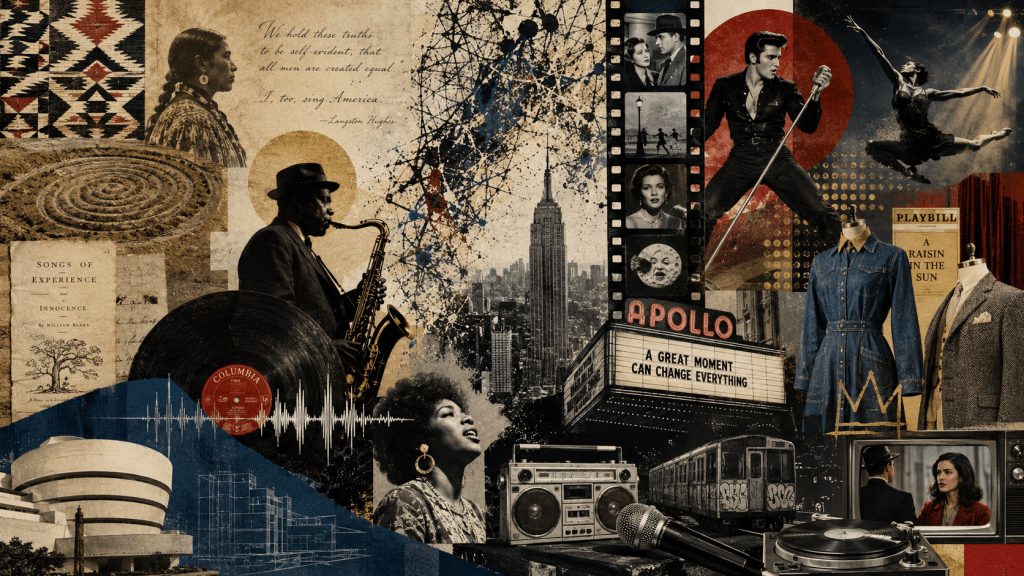
Together, these 100 moments do not form a simple celebration. They form a map of cultural force. American art has given the world Indigenous spatial intelligence, Black musical modernity, the skyscraper, the detective story, denim, jazz, Hollywood, the Broadway musical, Abstract Expressionism, rock’n’roll, feminist journalism, hip-hop, sneaker culture, long-form television, Afrofuturist cinema and new forms of Indigenous authorship.
But its greatness has rarely been innocent. Again and again, the most influential American forms emerge from contradiction: slavery and freedom, market and rebellion, appropriation and invention, violence and beauty, self-creation and historical wound. The American imagination is not great because it is pure. It is great because it has repeatedly turned conflict into form — and because those forms have travelled far enough to change the world.
Discover more from My World of Interiors
Subscribe to get the latest posts sent to your email.

