
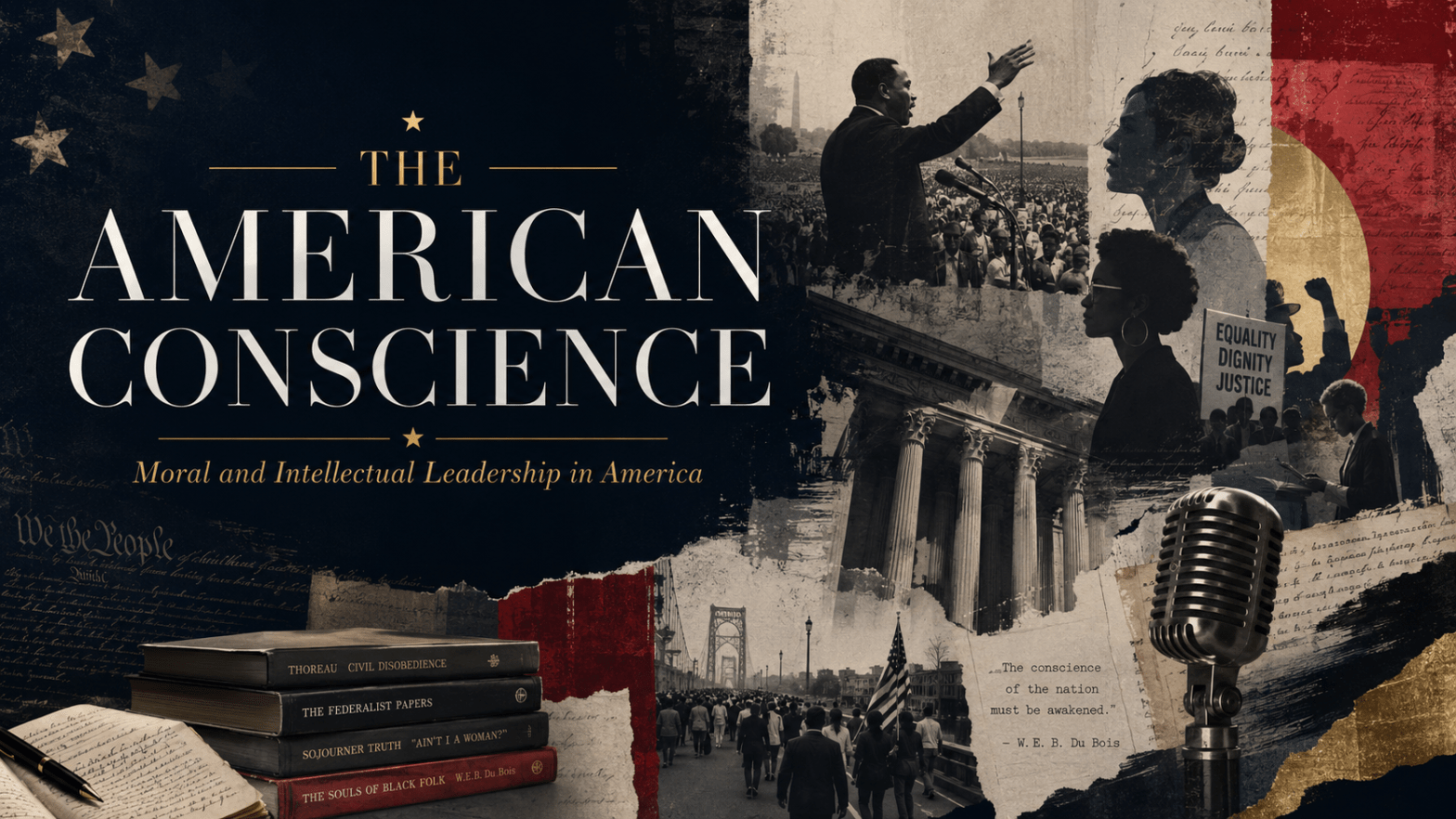
America’s finest leadership has not always come from the White House.
Sometimes it has. There have been moments when presidents restrained themselves, widened the law, rebuilt former enemies, defended constitutional order or placed human dignity above immediate popularity. But more often, the moral leadership of America has come from those outside formal power: abolitionists, fugitives, writers, singers, feminists, civil-rights organisers, environmental scientists, athletes, novelists, dissidents and citizens who refused the comfort of silence.
This is one of the more beautiful facts about America. The country’s conscience has never belonged entirely to its government. It has lived in pulpits, prison cells, newsrooms, songs, novels, marches, courtrooms, kitchen tables, union halls, classrooms, theatres and microphones. It has lived in those willing to tell America the truth before America was ready to hear it.
The worst of American leadership has usually been the opposite: not merely bad policy, but moral smallness. Power treated as property. Law treated as weapon. War treated as theatre. Women treated as disposable. Black suffering treated as inconvenience. Poverty treated as failure. Dissent treated as disloyalty. Truth treated as something to be negotiated, branded or buried.
The history of American leadership is therefore not a procession of heroes and villains. It is an argument between enlargement and domination.
At its best, America has been led by people who made the word “we” larger. At its worst, it has been led by people who made it smaller.
George Washington and the morality of giving power back
The first great act of American presidential leadership was not conquest, but relinquishment. George Washington’s most important legacy may not be that he became president, but that he stopped being president. By stepping away after two terms, he helped establish the idea that power in a republic must be temporary, conditional and larger than the person who holds it. The Library of Congress describes Washington’s withdrawal from power after two terms as a model of modest retirement rather than the accumulation of personal rule.
This matters because democratic leadership begins with the acceptance that office is not ownership. The presidency is not a throne. The state is not the emotional property of the man elected to administer it.
The shadow is obvious: Donald Trump’s refusal to accept defeat in 2020 and the violence of January 6. The House committee investigating the attack released its final report in December 2022, documenting one of the most serious assaults on American constitutional order in modern history.
The contrast is almost allegorical. Washington made the republic more real by leaving power. Trump degraded the republic by treating power as something stolen from him personally.
Frederick Douglass and the courage to expose hypocrisy
Frederick Douglass represents one of the highest forms of American moral leadership: the witness who refuses to allow a nation to hide behind its own language. Having escaped slavery, Douglass became one of the nineteenth century’s great abolitionist orators and writers. The National Park Service describes him as a national leader of the abolitionist movement, renowned for his oratory and antislavery writing.
His genius was not only rhetorical. It was diagnostic. Douglass understood that America’s problem was not that it had no ideals, but that it betrayed the ideals it most loudly celebrated. His famous question — what, to the enslaved person, is the Fourth of July? — remains one of the most devastating moral interrogations in American history.
The shadow is patriotic evasion: every form of nationalism that loves the flag more than the person excluded from its promise. The worst America has always wanted celebration without accounting. Douglass demanded accounting before celebration.
He did not reject the American promise. He forced America to hear what the promise sounded like from outside the gates.
Harriet Tubman and the leadership of rescue
Harriet Tubman’s leadership was not institutional, literary or electoral. It was physical. She placed her own body between slavery and freedom. The National Park Service describes Tubman as the Underground Railroad’s best-known conductor and notes that before the Civil War she repeatedly risked her life to guide around 70 enslaved people to freedom.
Tubman is a rebuke to every polite theory of justice that asks the oppressed to wait until power becomes reasonable. She did not wait. She acted. Her morality was practical, dangerous and embodied.
The shadow is the long American tradition of making law serve cruelty: the Fugitive Slave Acts, Jim Crow, family separations, migrant detention, voter suppression, policing without accountability. In each case, legality tries to disguise itself as morality.
Tubman understood the opposite. An unjust law does not become sacred because it is enforced. Sometimes moral leadership means helping people escape what the law protects.
Abraham Lincoln and the enlargement of purpose
Lincoln’s Emancipation Proclamation did not end slavery everywhere at once, and its limitations matter. But it transformed the Civil War from a war only to preserve the Union into a war also against slavery. The National Archives states that the proclamation declared enslaved people in rebellious states “are, and henceforward shall be free.”
Lincoln’s greatness here lies partly in moral movement. He did not begin as the pure emancipator of national myth. He was pressured, challenged, educated and enlarged by abolitionists, Black soldiers, enslaved people fleeing to Union lines and the reality of war itself. His leadership became great because it changed.
The shadow is every American leader who refuses to grow beyond the limits of his own ambition. Nixon’s Watergate abuses, for example, exposed a president using state power for private political survival; the National Archives notes that the investigation reached the highest levels of the Nixon administration and ultimately Nixon himself, who resigned under threat of impeachment.
Lincoln allowed history to make him larger. Nixon allowed fear to make him smaller.
Ida B. Wells and the moral force of evidence
Ida B. Wells understood that truth could be a weapon. As a journalist, anti-lynching activist, suffragist and civil-rights leader, she investigated racial terror when many white institutions preferred euphemism, silence or complicity. The National Women’s History Museum describes Wells-Barnett as a journalist, anti-lynching activist, women’s suffragist and early civil-rights leader.
Her greatness lies in combining moral outrage with documentation. She did not merely denounce lynching; she investigated it, counted it, named it, exposed its lies. In doing so, she made journalism into a form of moral leadership.
The shadow is official denial: governments, newspapers and institutions that minimise violence when the victims are politically inconvenient. America’s worst leadership has often depended on making suffering statistically invisible, rhetorically vague or socially acceptable.
Wells insisted that a nation cannot be innocent while its crimes are documented.
Eleanor Roosevelt and the internationalisation of dignity
Eleanor Roosevelt’s leadership after the second world war helped carry American moral language beyond national self-congratulation and into universal human rights. The United Nations records that Roosevelt was part of the group that began drafting the International Bill of Human Rights.
This matters because the Universal Declaration of Human Rights was not simply a diplomatic document. It was an attempt, after fascism and genocide, to say that dignity cannot depend entirely on citizenship, nation, race, class, gender or state permission.
The shadow is America’s repeated violation of the universal principles it claims to defend: Hiroshima and Nagasaki, Vietnam, CIA-backed coups, Iraq, Guantánamo, drone warfare, and today the moral catastrophe of supporting Israel through the destruction of Gaza. The contradiction is not minor. It is central. A country cannot credibly speak the language of human rights only when its allies are not implicated.
Roosevelt’s contribution remains a standard against which later American power must be judged. The question is not whether America says “human rights.” The question is whether it means human beings.
Harry Truman and the decision to desegregate the armed forces
In 1948, President Harry Truman signed Executive Order 9981, banning segregation in the US armed forces. The National Archives notes that the order declared equality of treatment and opportunity in the armed services without regard to race, colour, religion or national origin.
This was not full racial justice. But it was a meaningful federal act against segregation at a time when white supremacy still structured American life. Truman’s decision belongs to the history of moral leadership because it used executive authority to force an institution toward equality before the country as a whole was prepared to accept it.
The shadow is Woodrow Wilson’s segregationist administration, Jim Crow, and every later politician who found advantage in racial grievance. America’s worst leaders have often discovered that racial resentment is politically profitable.
Truman’s better instinct was the opposite: the state must sometimes move before public morality catches up.
Martin Luther King Jr and the discipline of civil disobedience
Martin Luther King Jr’s leadership was moral, intellectual, theological and strategic. He understood nonviolence not as passivity, but as disciplined confrontation. His “Letter from Birmingham Jail,” written in April 1963 while confined in jail, responded to those who called civil-rights protest untimely and disruptive. The National Park Service notes that the letter was written while King was jailed during the Birmingham Campaign against segregation.
King’s genius was to make moderation itself appear morally extreme when it asked the oppressed to wait. He revealed that “order” without justice is merely the tranquillity of domination.
The shadow is every politician who praises King once he is safely dead while opposing the movements that continue his work. The worst American leadership turns prophets into statues and then uses the statue to silence the living.
King’s leadership teaches that peace is not the absence of conflict. Peace is the presence of justice.
Lyndon Johnson, civil rights — and the tragedy of divided moral vision
Lyndon Johnson belongs in any serious account of moral leadership because of the Civil Rights Act of 1964 and the Voting Rights Act of 1965. The National Archives describes the Civil Rights Act as prohibiting discrimination in public places, integrating public facilities and making employment discrimination illegal; it describes the Voting Rights Act as legislation to enforce the Fifteenth Amendment.
Johnson understood, at least in this realm, that federal power had to confront state-sanctioned injustice. He did not create the civil-rights movement; Black Americans did. But he used presidential power to translate movement pressure into law.
The shadow is Vietnam. Johnson’s presidency contains one of the most intellectually important moral contradictions in American history: the same administration that enlarged democracy at home deepened catastrophe abroad. This does not erase the civil-rights achievement, but it forbids simplification.
Leadership can be morally great in one register and disastrous in another. Johnson is a warning against the fantasy that history gives us pure vessels.
Fannie Lou Hamer and the right to be heard
Fannie Lou Hamer’s leadership was the leadership of testimony. At the 1964 Democratic National Convention, she spoke for the Mississippi Freedom Democratic Party and forced national attention onto the violence and disenfranchisement faced by Black voters in Mississippi. The American Yawp notes that civil-rights activists in Mississippi struggled against a repressive racial regime, and that the state’s Democratic Party continued to disfranchise African American voters.
Hamer’s power was not institutional. It was existential. She spoke as someone the system had tried to erase, and in speaking, she made erasure impossible.
The shadow is voter suppression, then and now. Every attempt to narrow access to the ballot is a confession that some people fear democracy when it includes the wrong voters.
Hamer made the moral question brutally simple: is this America?
Rachel Carson and the ethics of warning
Rachel Carson’s Silent Spring is one of the great acts of American intellectual leadership. She forced the public to confront the ecological consequences of chemical modernity and helped launch modern environmental consciousness. The EPA’s own historical account says Silent Spring played a role in environmentalism roughly comparable to Uncle Tom’s Cabin in abolitionism, and that the EPA could be called the “extended shadow” of Rachel Carson.
Carson’s leadership was quiet, scientific and literary. She did not shout. She accumulated evidence. She changed the moral status of nature in public life.
The shadow is corporate denial: tobacco, pesticides, fossil fuels, climate disinformation, every industry that discovers profit in doubt. Bad leadership does not always appear as cruelty. Sometimes it appears as delay.
Carson teaches that moral courage can be the willingness to tell a technologically intoxicated society that its miracles are poisoning the world.
Muhammad Ali and the courage to refuse
Muhammad Ali’s refusal to be drafted into the Vietnam War remains one of the great acts of moral leadership by an athlete. He lost his title, his licence to box and years of his career. His stand was not symbolic in the cheap sense. It cost him materially.
Ali’s greatness here lies in refusing to separate conscience from body. He would not allow the state to use his body for a war he considered unjust while Black Americans were denied dignity at home.
The shadow is the entire machinery of imperial certainty: Vietnam, Iraq, Afghanistan, and every moment when dissenters are called unpatriotic for seeing earlier what power admits later.
Ali reminds us that moral leadership is not always eloquent in the approved language of institutions. Sometimes it is one man saying: no.
Eartha Kitt and the refusal to flatter power
In January 1968, Eartha Kitt attended a White House luncheon hosted by Lady Bird Johnson and confronted the administration over Vietnam and its effect on young Americans. White House History records that Kitt attended the luncheon and questioned President Lyndon Johnson during the event.
This is a remarkable moment because Kitt did what artists are so often punished for doing: she broke the decorative contract. She had been invited as a celebrated performer, but she refused to perform politeness in the presence of war.
The shadow is the punishment of dissent. Kitt paid a professional price. America often celebrates artists when they entertain and disciplines them when they accuse.
Her moral leadership lies in understanding that elegance without conscience is only manners.
James Baldwin and the destruction of white innocence
James Baldwin’s leadership was intellectual and spiritual. He did not command armies, sign bills or hold office. He did something harder: he forced America to look at itself without the narcotic of innocence. The Smithsonian’s National Museum of African American History and Culture frames Baldwin as a witness who understood civil rights as a moral struggle rather than merely a sectional, partisan or legal issue.
Baldwin’s greatness lies in the precision of his diagnosis. He understood that racism damaged the victim first and most brutally, but also corrupted the soul of the person who needed the lie of superiority. He treated America’s racial crisis not as a problem of manners, but as a spiritual emergency.
The shadow is every leader who sells white innocence back to white people as patriotism. Nixon’s law-and-order politics, Reagan’s racial coding, Trump’s open grievance politics — all depend in some way on the refusal Baldwin exposed.
Baldwin’s leadership was not comforting. That was its mercy.
Gloria Steinem and feminism as public intelligence
Gloria Steinem’s leadership helped make feminism legible as cultural criticism. With Ms. magazine and broader feminist organising, she helped bring questions of domestic labour, abortion, sexual violence, representation, marriage, work, beauty and power into public language. The Smithsonian identifies the first issue of Ms. as founded by activists including Steinem and Dorothy Pitman Hughes.
Steinem’s significance is not that she invented feminism. She did not. Her importance lies in helping translate feminist thought into a mass cultural grammar. She helped show that the private was political because power had always hidden inside the private.
The shadow is the long male habit of treating women’s bodies, reputations and labour as collateral. This is where Bill Clinton’s Monica Lewinsky scandal belongs. It was not one of America’s greatest geopolitical crimes, but it was a revealing moral failure: a president abusing an asymmetry of power, lying publicly, and allowing a young woman to be devoured by the machinery of humiliation. The Miller Center notes that news broke in January 1998 that Clinton had engaged in an affair with White House intern Monica Lewinsky, a scandal with serious legal and political implications.
The lesson is not prudery. The lesson is power.
Noam Chomsky and the critique of manufactured consent
Noam Chomsky represents another form of American intellectual leadership: the relentless critique of power’s language. His work in linguistics transformed the study of language; his political writings helped generations understand propaganda, empire, media consent and the ways democracies can be managed through narrative rather than open coercion.
Chomsky’s importance is not that he was always right, nor that he was easy to read politically. It is that he insisted citizens must examine the premises of their own state with the same suspicion they apply to official enemies.
The shadow is the Bush administration and the Iraq War: a catastrophic demonstration of how fear, intelligence failure, media repetition and imperial confidence can carry a country into disaster. The official WMD Commission report examined the intelligence failures surrounding Iraq’s alleged weapons programmes; even where it rejected simple claims of politicisation, the larger historical fact remains that the war was sold through certainties that collapsed.
Chomsky’s moral function was to make obedience intellectually embarrassing.
Toni Morrison and the authority of memory
Toni Morrison’s leadership was literary, but also moral. She changed the meaning of American reality by insisting that Black life, Black memory, Black language, Black motherhood, Black haunting and Black interiority were not marginal to the American story but central to it. The Nobel Prize committee awarded her the 1993 Nobel Prize in Literature for novels that, with “visionary force and poetic import,” give life to an essential aspect of American reality.
Morrison’s art is leadership because it alters the reader’s moral architecture. She does not merely represent history. She makes history intimate. In Beloved, slavery is not past. It returns, speaks, demands, wounds, loves and refuses burial.
The shadow is historical erasure: every school board, politician, movement or law that tries to make American history harmless by removing its victims. Morrison understood that forgetting is not neutrality. Forgetting is a continuation of violence by other means.
She led by remembering what power wanted smoothed away.
Disability-rights activists and the Americans with Disabilities Act
The Americans with Disabilities Act of 1990 belongs among America’s great moral achievements. The National Archives describes it as the world’s first comprehensive civil-rights law for people with disabilities.
But the law did not descend from kindness. It was forced into being by disabled activists who rejected pity and demanded access, autonomy and equal citizenship. Their leadership redefined public space itself: stairs, buses, schools, workplaces, bathrooms, pavements, language, employment and architecture all became moral questions.
The shadow is every ideology that treats dependence as shame and accessibility as burden. The worst leadership flatters strength while abandoning the vulnerable. Disability justice teaches the opposite: a society is judged by whether people can enter it.
The better America is not the innocent America
What unites these figures is not purity. Washington owned enslaved people. Lincoln was constrained by political calculation and racial assumptions. Johnson gave America civil-rights law and Vietnam. Truman desegregated the military and authorised atomic warfare before that. Even the greatest moral leaders are historical beings, not saints.
But moral leadership does not require innocence. It requires enlargement. It requires the capacity to move the boundary of concern outward.
The worst American leadership moves in the opposite direction. Nixon narrowed the republic to his own paranoia. Clinton narrowed accountability to denial and legalism. George W. Bush narrowed the world into friends, enemies and targets. Trump narrowed democracy to personal loyalty and grievance. At their worst, American leaders have confused power with virtue, punishment with order, wealth with worth, masculinity with domination, and patriotism with obedience.
The better tradition is older, deeper and more difficult.
It is Douglass asking what freedom means to the enslaved. Tubman walking people through danger. Wells counting the dead. Roosevelt helping articulate universal rights. King writing from jail. Hamer asking whether this is America. Carson warning that progress can poison the earth. Kitt refusing to flatter war. Baldwin destroying innocence. Steinem naming the politics of private life. Chomsky interrogating consent. Morrison restoring memory. Disabled activists remaking the built world. Ali saying no.
This is the American conscience: not a single voice, but a chorus of interruption.
It interrupts power when power lies.
It interrupts patriotism when patriotism becomes amnesia.
It interrupts politeness when politeness protects violence.
It interrupts despair by proving that history is not only what rulers do, but what witnesses, organisers, artists and citizens force into being.
So perhaps the moral of America is not that it has been good. It has not, not reliably, not consistently, not without pressure. The moral is that within America there has always been another America, one that appears whenever someone expands the circle of dignity against the wishes of those guarding the gate.
That is the America worth defending.
Not the America of empire, spectacle, punishment, nostalgia and domination.
The America of the larger “we.”
Discover more from My World of Interiors
Subscribe to get the latest posts sent to your email.

