
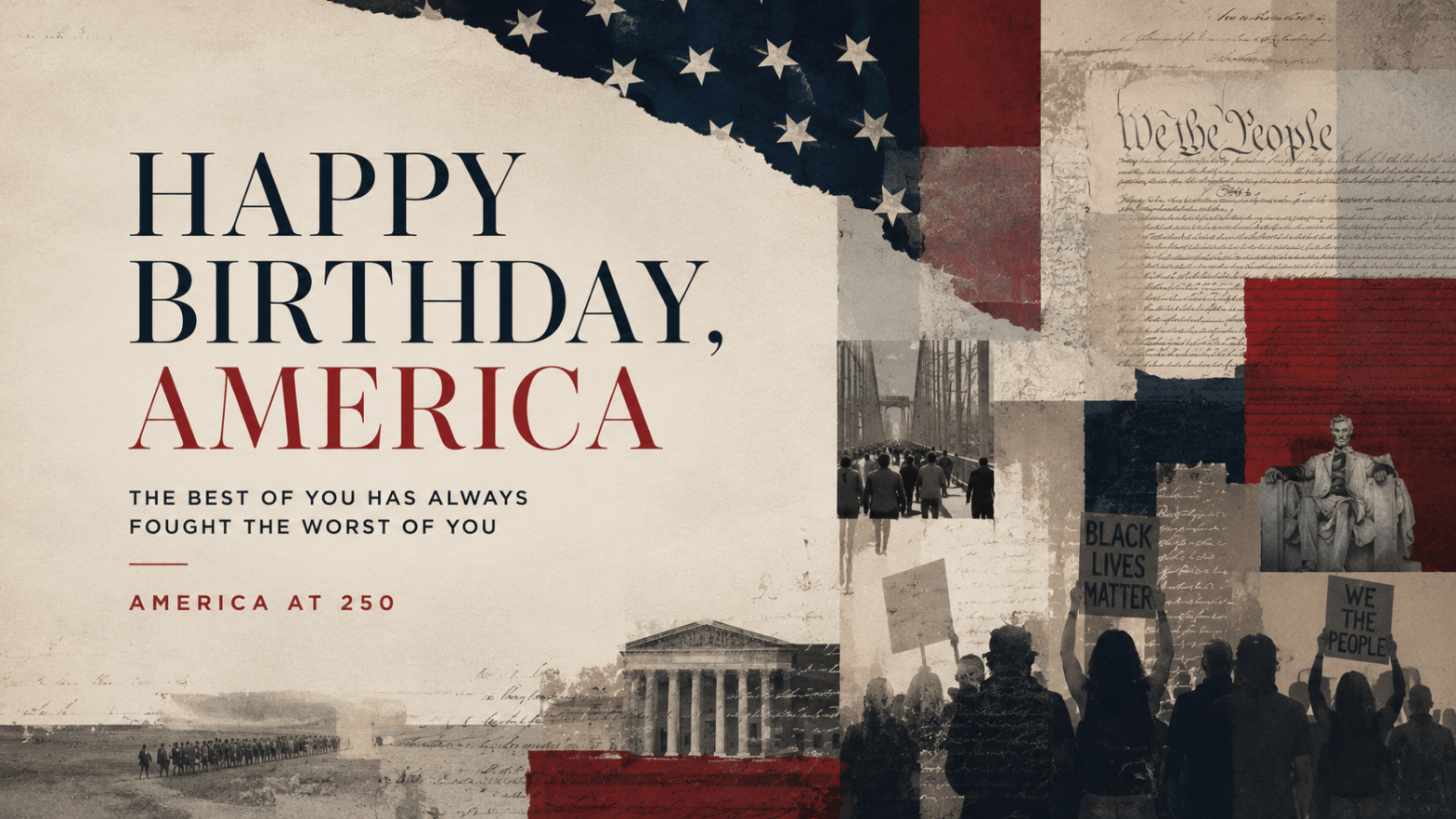
Happy birthday, America — though the words do not come easily this year.
On 4 July 2026, the United States marks 250 years since the signing of the Declaration of Independence. Officially, it is a commemoration of the birth of the republic, the semiquincentennial of the moment when thirteen colonies declared themselves no longer subjects of empire, but authors of their own political destiny. Yet an anniversary is never only a celebration. It is also a summons. It asks what has been done with time. It asks what survived. It asks what was betrayed. It asks whether a promise, repeated for two and a half centuries, has become truth, ritual, myth, or alibi.
America arrives at 250 not as the radiant young republic of its own imagination, nor even as the bruised but self-confident superpower of the 20th century. It arrives diminished, mistrusted, adored by some, feared by many, and watched by the world with an exhaustion that borders on dread. Gallup found in March 2026 that 59% of Americans themselves believed the US was viewed unfavourably around the world — essentially tied with the worst reading in its trend, from the Iraq war era. Pew’s 2026 global survey across 36 countries likewise found declining ratings for the United States amid rising concerns over American foreign policy and the health of its democracy.
This is not simply a matter of image, branding, diplomacy, or failed public relations. It is a moral consequence. The world has watched America speak of democracy while electing Donald Trump not once, but twice. It has watched the attack on the Capitol on 6 January 2021 become not a permanent civic warning, but a prelude to return. The House committee that investigated the attack released its final report in December 2022; two years later, the official Electoral College results recorded Trump’s 2024 victory with 312 electoral votes to Kamala Harris’s 226.
The world has also watched America’s continuing military, diplomatic and financial support for Israel through the devastation of Gaza. Whatever careful language diplomats prefer, the moral reality is unbearable. OCHA reported in June 2026 that most people in Gaza remained displaced, confined to shrinking and overcrowded spaces, and lacking adequate access to essential services or minimum standards of living. The International Court of Justice ordered Israel in 2024 to halt its Rafah offensive and open the Rafah crossing for aid, while a Costs of War/Quincy Institute report estimated that the US government spent $21.7bn on military aid to Israel in the two years after the 7 October 2023 Hamas attack. To many outside America — and increasingly to many within it — this has made US invocations of human rights sound less like principle than choreography. Pew found in 2026 that 60% of US adults held an unfavourable view of Israel, and a separate 36-country survey found a median of 67% with unfavourable views of Israel.
And yet, to say “happy birthday, America” should not be impossible. It should only be difficult.
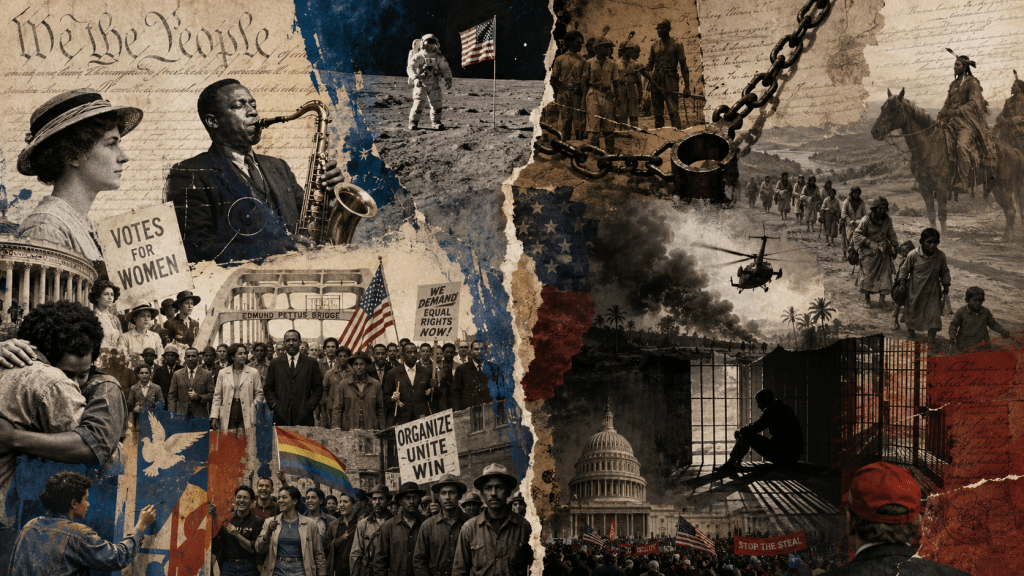
For the United States has always been both more and less than its government. More and less than its presidents. More and less than its wars, its wealth, its billionaires, its prisons, its myths, its markets, its flags. America has been a country of conquest and emancipation, enslavement and abolition, Jim Crow and civil rights, imperial arrogance and democratic dissent, Hollywood fantasy and radical literature, military violence and anti-war conscience, brutal capitalism and astonishing public imagination. It has been slave auction and freedom song, Hiroshima and jazz, Vietnam and the March on Washington, Wall Street and the New Deal, Guantánamo and James Baldwin, the Trail of Tears and Standing Rock, the prison-industrial complex and the abolitionist imagination.
The great error is to pretend that only one of these Americas is real.
The sentimental patriot says only the good is America. The cynic says only the evil is America. History, being more intelligent than either, says: all of it is America. And the struggle between these Americas is the American story.
The United States was born in language of almost unbearable beauty. “We hold these truths to be self-evident,” says the Declaration, “that all men are created equal,” endowed with rights to “Life, Liberty and the pursuit of Happiness.” The Constitution would later open with an even more dangerous phrase: “We the People.” It promised a more perfect union, justice, domestic tranquillity, common defence, general welfare and the blessings of liberty. These are not small words. They are not administrative words. They are not the vocabulary of mere statecraft. They are civilisational words.
But from the beginning, the words were larger than the men who wrote them.
That may be America’s first and finest paradox. Its founding promise was hypocritical, compromised, exclusionary, and yet it created a language that could be turned against the hypocrisies of the founding itself. The Declaration did not free the enslaved. The Constitution did not include everyone inside its “we.” But the words were there, blazing beyond the intentions of their authors, waiting to be seized by those who had been excluded from them.
America’s finest moments have rarely come from power behaving generously. They have come from human beings forcing power to enlarge the word “we.”
The abolition of slavery was one such moment. The 13th Amendment, passed by Congress in January 1865 and ratified in December of that year, abolished slavery in the United States. But even that sentence, dignified by legal clarity, risks making emancipation sound like a gift issued from marble rooms. It was not. It was won through revolt, resistance, fugitivity, abolitionist agitation, Black intellect, enslaved courage, civil war and death on an almost incomprehensible scale. The enslaved were not passive recipients of freedom. They were among its authors.
Then came Reconstruction: perhaps the most beautiful road America did not take. For a brief and fragile period after the Civil War, the United States glimpsed the possibility of interracial democracy. Black men voted, held office, wrote constitutions, built schools, imagined citizenship not as a white inheritance but as a democratic right. That vision was not simply “unfinished”; it was violently overthrown. White supremacy did not win because Reconstruction failed in some natural, inevitable way. It won because terror, compromise and Northern fatigue allowed democracy to be strangled.
This, too, is America: not only the birth of freedom, but the betrayal of it.
The women’s suffrage movement belongs among America’s finest hours, though not because the story is clean. The 19th Amendment, passed by Congress in 1919 and ratified in 1920, granted women the right to vote. But many Black women, Native women, Asian American women and Latina women continued to face racist exclusion and suppression. The victory was real; so was the incompleteness of the victory. That is often how progress comes in America: as an opening, not a deliverance. As a door forced ajar, then guarded, then forced wider by those still left outside.
The New Deal was another moment when America briefly understood that freedom without material security is a cruel abstraction. The Social Security Act of 1935 created a system of federal old-age benefits and provisions for unemployment compensation, dependent children, maternal and child welfare, public health and support for vulnerable groups. It did not abolish capitalism. It did not end poverty. It excluded many, especially domestic and agricultural workers, with racist consequences. But it stood against the barbarous idea that citizens should be abandoned to market forces and then blamed for drowning. It said, however imperfectly: the state has obligations. The elderly are not waste. The unemployed are not moral failures. The poor are not disposable.
The defeat of fascism in the second world war also belongs to America’s moral ledger, though it cannot be romanticised without dishonesty. America helped defeat Nazism and fascism, and the Marshall Plan later helped rebuild Western Europe after the war. But the same America incarcerated Japanese Americans under Executive Order 9066, which authorised mass removal from the West Coast to inland “relocation centers” and resulted in the incarceration of Japanese Americans. The same war that allowed America to imagine itself as liberator also exposed its capacity to treat its own citizens as a suspect race.
This is the recurring pattern: light, shadow, light, shadow. America liberates and imprisons. It proclaims universal rights and violates them. It defeats fascism abroad and tolerates racial caste at home. It speaks in the language of the human and acts in the logic of empire.
And still, there are moments when the better America becomes impossible to deny.
The civil rights movement was one of them. Not the sanitised version of schoolroom memory, but the real movement: disciplined, radical, strategic, brave, despised in its time by many who would later quote it. The Civil Rights Act of 1964 outlawed segregation in businesses such as theatres, restaurants and hotels, banned discriminatory employment practices, and ended segregation in public places such as libraries, swimming pools and public schools. The Voting Rights Act of 1965 sought to enforce the right to vote against racial discrimination.
This was America at its best: not because America suddenly became innocent, but because Black Americans forced the republic to confront its lies. They took the founding words seriously when the nation itself did not. They understood that democracy is not what a country claims in documents; it is what people can safely do with their bodies in public. Sit at a counter. Walk across a bridge. Register to vote. Attend a school. Enter a library. Live.
One might add the moon landing, not as nationalist pageantry, but as proof that public ambition can still do something magnificent. Apollo 11 launched in July 1969, landed on the moon, and placed human beings on another world. At its worst, the space race was Cold War theatre. At its best, it was a revelation of collective possibility: engineers, mathematicians, factory workers, astronauts, public money, public science, public imagination. It suggested that human beings, organised around a task larger than profit, could still astonish themselves.
America’s finest moments include these legal and political milestones, but they are not exhausted by them. They include jazz, which turned suffering, improvisation and genius into one of the great art forms of modernity. They include the literature of Melville, Dickinson, Whitman, Morrison, Baldwin, Didion, Faulkner, Hurston, Sontag, Ellison, Steinbeck, Plath, Audre Lorde. They include Hollywood when it made the dream-world visible; the blues when it made grief musical; the labour movement when it insisted that the worker’s body was not a machine; ACT UP when it transformed mourning into political fury; the feminist movement when it made the private wound public; the queer movement when it insisted that love need not apologise to law; the anti-war movement when it said that patriotism without conscience is obedience.
In 2015, Obergefell v Hodges made same-sex marriage legal across the United States, the culmination of decades of queer activism, legal struggle and cultural courage. It was not the end of queer liberation, and its gains remain politically contested. But it was one of those American moments when the circle widened, when a country became less cruel, when love stopped asking permission from prejudice.
If one wanted to wish America a happy birthday honestly, one would begin there: with the wideners of the circle.
Happy birthday to the abolitionist, the suffragist, the striker, the marcher, the whistleblower, the teacher, the nurse, the librarian, the dissident, the drag queen, the Black mother, the undocumented worker, the poet, the union organiser, the public defender, the student protester, the person who says no when everyone else has learned to say nothing.
Happy birthday to the America that fights America.
But no adult birthday tribute can omit the dead.
The worst of America begins before the republic itself, in slavery and Indigenous dispossession. The American story cannot be told as liberty interrupted by occasional crimes. It must be told as liberty born beside crime, speaking the language of human equality while building wealth through the ownership of human beings and the theft of land.
The Trail of Tears remains one of the great moral indictments of the American project. The National Archives notes that during the forced removal of the Cherokee in 1838-39, approximately 4,000 of 16,000 Cherokees died along the way. The American dream of land, space and westward possibility was, for Indigenous peoples, often a nightmare of removal, hunger, disease, broken treaties and sacred places renamed by conquerors.
Then came Jim Crow: not an afterthought to slavery, but its afterlife. Segregation, disenfranchisement, lynching, racial terror, redlining, convict leasing, school inequality, police violence — these were not deviations from America. They were systems. They were law, custom, economy and theology. They made white supremacy ordinary. They made humiliation administrative.
America’s worst moments abroad are similarly inseparable from its self-image. The Vietnam War belongs among the central catastrophes of the 20th-century American imagination. The National Archives records 58,220 US military fatal casualties in the Vietnam War, but the American dead are only one part of the moral accounting. Vietnam, Laos and Cambodia bore devastation on a scale that cannot be contained by American grief alone. Vietnam was what happened when anti-communist certainty became mass death; when geopolitical abstraction consumed villages; when a superpower mistook its fear of losing face for a moral right to destroy.
Nor was Vietnam an aberration. The darker history of US foreign policy includes the destabilisation and overthrow of governments abroad, especially when democracy produced results Washington disliked. Declassified US government records describe planning and implementation of the 1953 covert operation in Iran against Mohammad Mosaddegh’s government. National Security Archive documents on Chile include records of covert operations to undermine Salvador Allende’s government before the 1973 coup. The pattern is difficult to evade: America preached democracy as a universal good, then feared it when foreign voters chose the wrong people.
The Iraq War stands in this same imperial tradition. It was a catastrophe of arrogance, falsehood and force, a war sold through claims that collapsed under scrutiny and paid for by lives far from the rooms in which the arguments were made. Brown University’s Costs of War project estimated that from 2003 to 2023, between 550,000 and 580,000 people were killed in Iraq and Syria in the context of the US war in Iraq and subsequent operations, with millions displaced. Iraq is what happens when power mistakes itself for truth.
At home, mass incarceration is one of modern America’s most devastating moral failures. The Sentencing Project notes that War on Drugs policies beginning in the early 1970s, later intensified by mandatory minimums and three-strikes laws, produced dramatic growth in incarceration for drug offences, especially at the federal level. A country cannot call itself free while caging so many of its poor, Black, brown, addicted, mentally ill and abandoned people. The prison is the shadow constitution of the United States: the place where every abandoned social question is eventually sent.
And then there is Trumpism.
It is important not to exaggerate Trump into the origin of America’s darkness. He did not invent racism, misogyny, xenophobia, corruption, anti-intellectualism, Christian nationalism, billionaire impunity, authoritarian desire or contempt for the poor. He inherited them. He marketed them. He gave them permission to speak without embarrassment. He transformed cruelty into theatre and grievance into governance. He understood something terrible and true: that many people would rather be flattered in their resentment than challenged in their humanity.
To elect him once was a rupture. To elect him twice was a revelation.
And so America turns 250 with democracy itself in question. A June 2026 Reuters/Ipsos poll found that two-thirds of Americans believed US democracy was in danger of failing, while 77% expected political violence to rise in the next five years. These are not the numbers of a healthy republic arguing with itself. They are the numbers of a country unsure whether it still inhabits a shared moral world.
Yet the answer cannot be despair. Despair is too easy, and in the end it is too private. The people most endangered by politics rarely have the luxury of declaring politics hopeless. They need rent, medicine, asylum, abortion access, clean water, schools, disability rights, labour protections, trans safety, racial justice, demilitarised police, public libraries, truthful history, and enough money to live without terror. They do not need aesthetic hopelessness. They need material hope.
The question, then, is how to love America without lying about it.
One answer is to reject the childish forms of patriotism now being offered: the flag as narcotic, the anthem as anaesthetic, the military flyover as moral argument, the founding father as saint, the billionaire as proof of freedom, the border as sacred object. Patriotism of this kind is not love. It is avoidance. It loves America as symbol because it cannot bear America as fact.
Another answer is to reject the idea that America is irredeemable in some metaphysical sense. Nations do not have souls. They have histories, institutions, economies, violences, memories, habits, laws and possibilities. They can be made worse. They can also be forced to become less cruel. The fact that progress is reversible does not mean it is false. The fact that victories are incomplete does not mean they were meaningless. The fact that rights can be taken away is precisely why they must be defended as living things, not framed as monuments.
The best America has always been unfinished. That is not an excuse; it is a demand.
The greatness of America, where it exists, is not in innocence. Innocence was never available. Its greatness lies in the recurring revolt against its own exclusions. It lies in the enslaved person who runs. The woman who demands the vote. The worker who strikes. The student who sits in. The Black child who enters the school under guard. The gay man who kisses openly after a lifetime of hiding. The Indigenous activist who refuses disappearance. The journalist who publishes the truth. The soldier who refuses an illegal order. The citizen who will not confuse the president with the republic.
At 250, America should not be congratulated like a monarch, flattered like a celebrity, or marketed like a product. It should be spoken to like an old and dangerous republic with blood on its hands and beauty still within reach.
Happy birthday, America — for the words you gave the world, even when you betrayed them.
Happy birthday for the abolitionists, the suffragists, the civil rights marchers, the labour organisers, the artists, the public school teachers, the nurses, the farmworkers, the librarians, the dissenters, the queers, the radicals, the immigrants, the people who made your democracy more real than your founders intended.
Happy birthday for jazz, for Baldwin, for Morrison, for Nina Simone, for Muhammad Ali, for Martin Luther King Jr and Malcolm X, for Rosa Parks and Fannie Lou Hamer, for Woody Guthrie and James Brown, for ACT UP and Stonewall, for the women who refused silence, for every person who widened the “we.”
And shame, too — because love without shame is only propaganda.
Shame for slavery. Shame for the Trail of Tears. Shame for Jim Crow. Shame for Hiroshima and Nagasaki. Shame for Vietnam. Shame for Chile, Iran, Guatemala and every country where the language of freedom was used to conceal the fear of someone else’s democracy. Shame for Iraq. Shame for Gaza. Shame for mass incarceration. Shame for every child sacrificed to guns, every woman stripped of bodily autonomy, every migrant hunted for political theatre, every poor person told their suffering is their own fault.
This is not hatred of America. It is the only form of respect worth having.
For to wish America a serious happy birthday is not to say: you are good. It is to say: you have been better than this, and worse than this, and you are still responsible for what comes next.
The flag is not the people. The anthem is not the people. The army is not the people. The market is not the people. The president is not the people. The billionaire is not the people.
The people are the test.
After 250 years, the question remains the same as it was at the beginning, though now the whole world knows enough to ask it with suspicion: who is included in “we”?
If the answer is only the citizen, it is too small. If the answer is only the legal, the white, the wealthy, the obedient, the useful, the Christian, the native-born, the respectable, the insured, the employed, the untroublesome, it is too small. If the answer stops at the border, it is too small. If it excludes the Palestinian child, the undocumented worker, the prisoner, the trans teenager, the poor mother, the addict, the disabled veteran, the homeless man, the frightened woman, the bombed family, it is too small.
Every authoritarian politics begins by shrinking the “we.” Every emancipatory politics begins by enlarging it.
So happy birthday, America. Not because you are innocent. Not because you are exceptional. Not because history owes you admiration. But because the best of you has always fought the worst of you, and because the world still needs the better America to win.
Not the America of empire, punishment, spectacle and revenge.
The America of the larger “we.”
Discover more from My World of Interiors
Subscribe to get the latest posts sent to your email.
 My World of Interiors