
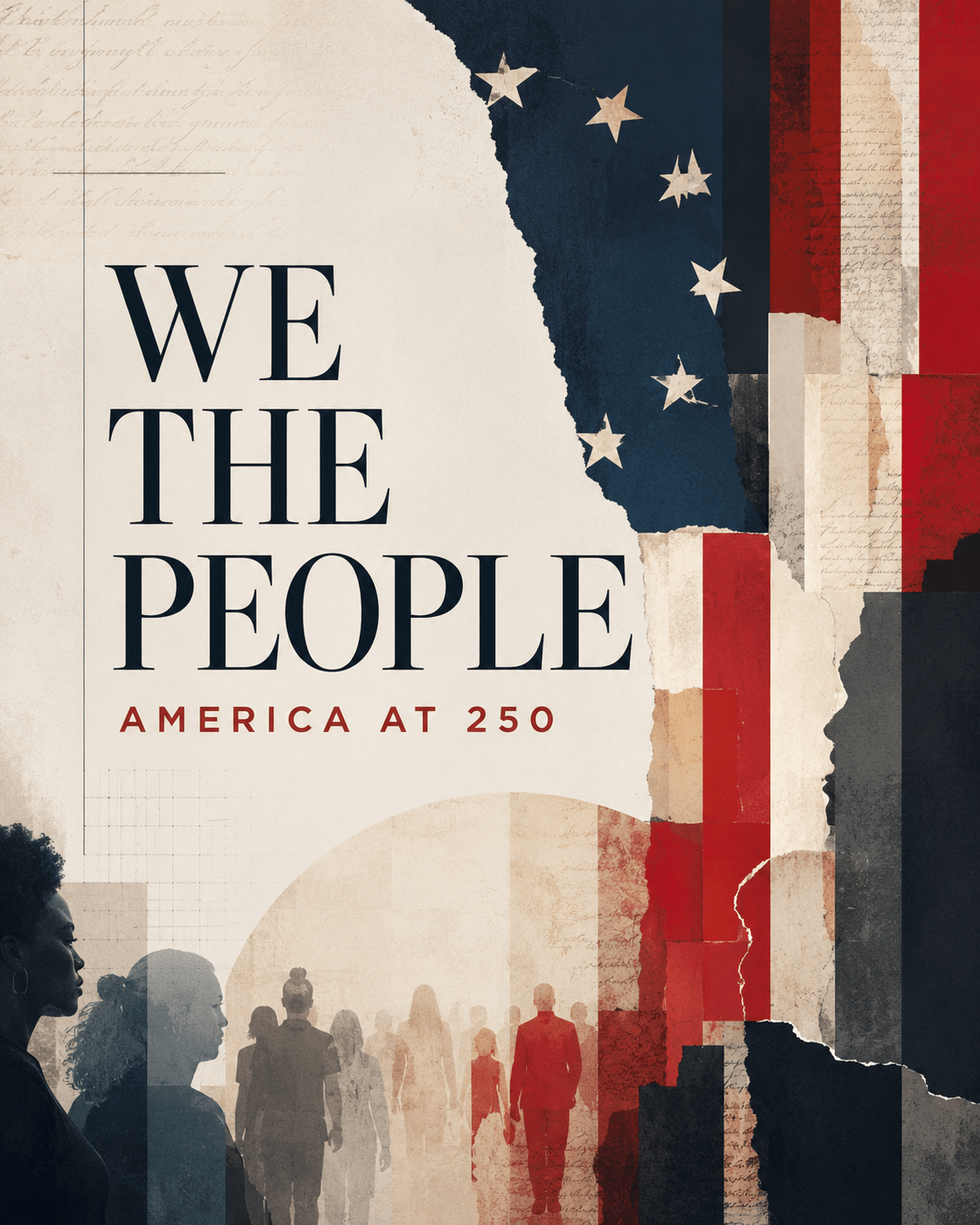
The Unfinished We
Today, the United States turns 250 years old. Officially, the occasion marks the semiquincentennial of the signing of the Declaration of Independence, the founding document by which thirteen colonies announced themselves as a nation. But an anniversary is never only a celebration. It is also an interrogation. It asks not merely what began, but what became of what began; not only what was promised, but who was excluded from the promise; not only what a nation says about itself, but what it permits to happen to human beings in its name.
The United States was born, in part, as a sentence. “We hold these truths to be self-evident,” the Declaration begins, before arriving at its great and wounded claim: that all men are created equal, endowed with unalienable rights to life, liberty and the pursuit of happiness. The Constitution would later open with another phrase of almost liturgical power: “We the People.” Few political formulations have carried so much hope, so much contradiction, and so much blood. Few have been quoted so reverently by those who believed in emancipation, and so cynically by those who wished to deny it.
For the central question was always there, hidden in the first word. Who is “we”?
“We” is the most beautiful and dangerous word in politics. It can mean solidarity, kinship, democracy, mutual obligation, the making of a common world. It can also mean purity, exclusion, obedience, race, border, tribe, mob. It can shelter the vulnerable, or it can gather the crowd outside the vulnerable person’s door. Every emancipatory movement in history has enlarged the “we”. Every authoritarian movement has shrunk it.
At 250, America is not simply being asked to remember its founding. It is being asked to account for the size of its moral imagination.
The question is not whether the United States has been great. Greatness is an imperial word, too easily confused with scale, violence, wealth, spectacle, and victory. The more serious question is whether America has been good to the people it asked to believe in it. To the enslaved and their descendants. To Indigenous nations whose sovereignty was broken beneath the march of settlement. To women whose citizenship was partial, conditional, domestic. To workers whose bodies built the wealth of men who would never learn their names. To migrants welcomed as labour and hated as people. To the poor, the imprisoned, the queer, the disabled, the dissident, the grieving, the inconvenient. To every person for whom the flag was raised while the door remained closed.
The genius of the American promise was that it spoke in universals. The crime of the American reality was that it rationed them.
This is not a uniquely American hypocrisy. It is the wound at the centre of modern politics. The West has often spoken in the language of humanity while arranging humanity into hierarchies. It has declared rights while building empires, praised liberty while policing borders, spoken of civilisation while practising abandonment. The phrase “the people” has always been unstable because power is forever trying to decide which people count.
But there is something especially revealing about America at 250, because America has never been merely a country. It has been a theatre of political imagination. It has projected itself as promise, warning, empire, refuge, experiment, marketplace, arsenal, dream, nightmare. The world has watched America not only because of its power, but because America insisted that its power had a moral meaning. It did not only want to be strong. It wanted to be exemplary.
That is why the degradation of the American “we” matters beyond America. When a republic built on the language of popular sovereignty begins to doubt the people, fear the people, divide the people, surveil the people, punish the people, or replace the people with donors, algorithms, militias, corporations and courts, something larger than one national story is at stake. The democratic imagination itself is weakened.
And in 2026, that weakening is no longer subtle. A Reuters/Ipsos poll published ahead of the anniversary found that two-thirds of Americans believe their democracy is in danger of failing, while 77% expect political violence to increase in the next five years. These are not the numbers of a country merely disagreeing with itself. They are the numbers of a people unsure whether they still inhabit a shared reality.
It is tempting, at such a moment, to retreat into nostalgia. Nostalgia offers the comfort of a simpler past, which is usually a past edited by power. It removes the body from history. It gives us the farmhouse without the dispossession, the town square without the exclusion, the family without the woman’s unpaid labour, the flag without the body bag, the constitution without the slave plantation, the parade without the prison. Nostalgia is not memory. It is memory with the victims removed.
The humanist task is different. It is to remember without worship. To love without lying. To criticise without surrendering the possibility of repair.
For the left, at its best, is not an aesthetic of rebellion, nor a performance of superiority, nor a catalogue of correct opinions. It is the insistence that no human being is disposable. That poverty is not a character flaw. That cruelty is not realism. That borders do not erase moral obligation. That the market is not a soul. That the state must not be permitted to turn fear into policy and policy into punishment. That freedom without bread, shelter, healthcare, bodily autonomy, education, safety and dignity is not freedom, but theatre.
This is why “We the People” cannot be left to nationalists. They make the “we” smaller. They guard it with suspicion. They turn citizenship into inheritance, belonging into blood, history into property, and politics into revenge. Their “people” are never the people as they actually exist: mixed, wounded, plural, dependent, desiring, ageing, changing, contradictory. Their people are imaginary, purified after the fact, arranged beneath a flag like figures in a propaganda mural.
But nor can “We the People” be abandoned to liberal ceremony, where the right words are spoken over intolerable conditions. A democracy cannot survive as a museum of its own ideals. It cannot invoke justice while tolerating mass poverty. It cannot praise liberty while denying women authority over their own bodies. It cannot speak of the rule of law while allowing the law to become a weapon of faction. It cannot honour immigrants in sentimental retrospect while humiliating the living migrant at the border. It cannot celebrate civil rights as heritage while treating racial equality as a threat. It cannot mourn political violence while manufacturing the conditions that make violence feel inevitable.
A republic is not measured by its anthem. It is measured by the life of the person who cannot afford to be sentimental about it.
In that sense, 2026 is not simply an anniversary. It is a stress test. Around the world, democratic forms remain visible while democratic substance erodes. Elections still happen. Courts still issue decisions. Legislatures still meet. Newspapers still publish. But democracy can die inside its own architecture. It can retain the appearance of procedure after the spirit of equality has departed. The V-Dem Institute’s 2026 Democracy Report places particular focus on autocratisation in the United States and argues that American democracy has fallen back to a level comparable to 1965. International IDEA’s most recent global democracy report similarly warns that representation, rights, rule of law and participation are all under strain, with declines in judicial independence, press freedom and electoral integrity.
The lesson is brutal and simple: democracy is not self-executing. It is not preserved by old paper, marble buildings, military flyovers, or children waving flags at parades. It survives only when enough people are willing to defend the humanity of people they do not know.
That is the part often missing from official patriotism. Patriotism tends to love the country as symbol. Humanism loves the people as bodies. Bodies that hunger, bleed, labour, miscarry, migrate, age, freeze, sweat, panic, grieve. Bodies that sleep in cars, cross deserts, wait outside hospitals, clean hotel rooms, harvest food, bury children, study under debt, stand in court, stand in line, stand at borders, stand alone.
The people are not an abstraction. The people are not a demographic. The people are not a polling category, a consumer segment, a security threat, a campaign asset, a television audience, or a data set. The people are the poor mother choosing between medicine and rent. The trans teenager listening to adults debate whether their life is a problem. The undocumented worker who knows the country through its kitchens, fields and construction sites, but not through its protections. The Black citizen who has inherited both the promise of equal citizenship and the memory of its violation. The Indigenous community still living with the afterlife of conquest. The exhausted nurse. The evicted family. The prisoner no one writes to. The veteran used as symbol and neglected as person. The child learning active-shooter drills before multiplication. The old person dying in loneliness in a nation rich enough to invent almost anything except tenderness.
If America at 250 means anything, it must mean them.
And yet the modern world has become exceptionally skilled at making people disappear while keeping them visible. We see suffering constantly, but often as spectacle. We scroll past famine, bombardment, police violence, climate disaster, homelessness, detention, grief. We are saturated with images and starved of responsibility. The wound appears, the outrage flares, the algorithm moves on. A political order built on permanent stimulation does not create solidarity. It creates nervous exhaustion.
This is one of the great changes between 1776 and 2026. The people are now addressed not only by governments, newspapers, churches and parties, but by machines designed to know them more intimately than any constitution ever could. In the algorithmic age, the citizen is broken into preferences, fears, purchases, resentments, probabilities. Democracy becomes vulnerable not only to censorship, but to manipulation; not only to propaganda from above, but to personalised unreality from every direction. Recent scholarship on democracy and artificial intelligence warns of systems that can intrude on privacy, reproduce bias, spread misinformation, manipulate citizens and influence electoral outcomes.
What happens to “We the People” when the people are no longer primarily addressed as citizens, but targeted as data?
The danger is not simply that people will believe false things. The deeper danger is that they will lose the habit of believing in a common world at all. A democracy requires disagreement, but it also requires some shared ground on which disagreement can take place. When every fact is tribal, every institution suspect, every stranger a potential enemy, the citizen becomes first anxious, then cynical, then obedient. Authoritarianism does not always begin with devotion to a strongman. Sometimes it begins with fatigue. With the exhausted wish for someone else to make the chaos stop.
This is why cruelty so often presents itself as order. It promises clarity in place of complexity. It tells people that their pain has an enemy and their enemy has a face. The migrant. The feminist. The intellectual. The queer child. The foreigner. The protester. The journalist. The teacher. The poor person accused of taking too much, the refugee accused of arriving too late, the minority accused of asking too loudly to be free.
A politics of cruelty is always a politics of misdirection. It trains people to look downward and sideways, never upward. It asks the precarious worker to hate the poorer worker. It asks the citizen without healthcare to fear the asylum seeker. It asks the lonely man to blame the liberated woman. It asks the indebted student to resent the racial minority. It asks the exhausted majority to identify not with one another, but with the powerful people who despise them all.
Against this, the left-humanist answer must be morally plain: a society is not made safer by making vulnerable people more afraid. A nation is not made freer by giving the state more power to punish. A people is not made greater by narrowing the definition of who belongs.
The true opposite of authoritarianism is not individualism. It is not the lonely “I” against the corrupted state. The opposite of authoritarianism is a larger, braver, more truthful “we”.
This larger “we” cannot be sentimental. It cannot pretend that all wounds are equal, all histories interchangeable, all conflicts misunderstandings. Humanism is not politeness. It is not the avoidance of anger. There are things worth being angry about: children under rubble, women forced into childbirth, workers discarded, refugees drowned, books banned, histories falsified, bodies imprisoned, votes suppressed, truth degraded, wealth hoarded, cruelty applauded. There is no moral seriousness without anger. But anger must be made answerable to love, or it becomes merely another appetite for domination.
The left must say, clearly, that compassion is not weakness. Care is not softness. Equality is not envy. Solidarity is not naivety. Public goods are not theft. Human rights are not luxuries. The measure of civilisation is not how efficiently it rewards winners, but how faithfully it refuses to abandon those whom winning has crushed.
Here, the American anniversary becomes global. For what is at stake in 2026 is not only the future of one republic, but the fate of the human “we” in an age of multiplying abandonment. By the end of 2025, UNHCR estimated that 117.8 million people were forcibly displaced worldwide. As 2026 began, OCHA reported that just over 239 million people were in urgent need of humanitarian assistance and protection. These figures are almost impossible to hold in the mind. Their very scale becomes a form of concealment. But each number is a person removed from ordinary expectation: the bed, the school, the street, the neighbour, the cup, the photograph, the grave, the familiar tree, the door that used to open.
No serious essay on “We the People” in 2026 can stop at the American border. The American phrase has always exceeded America’s custody of it. “The people” are not only citizens. They are not only voters. They are not only those with documents, property, safety, language, broadband, representation. They are the living claim that politics exists for human beings, not the other way around.
To say this is not to dissolve all nations into abstraction. People live in places. They need homes, laws, schools, hospitals, histories, languages, rituals, solidarities. But love of place becomes morally obscene when it requires hatred of the person outside it. A border may organise legal responsibility; it cannot abolish human kinship. No passport has ever made a child less hungry. No national anthem has ever made a bomb more humane.
At 250, then, America faces the question that every democracy eventually faces: will it become more frightened than free? Will it mistake domination for strength, nostalgia for memory, obedience for unity, punishment for justice? Will it continue to confuse the wealth of billionaires with the welfare of the people? Will it measure itself by the splendour of its ceremonies, or by the condition of those who clean up after the ceremonies are over?
The answer is not predetermined. Nations are not souls. They are arrangements of power, memory and will. They can be degraded. They can also be remade. That, too, is part of the American inheritance: not innocence, but struggle. The abolitionists were America. The enslavers were America. The suffragists were America. The men who denied women the vote were America. The civil rights marchers were America. So were the police who beat them. The labour organisers, the strikebreakers, the poets, the censors, the sanctuary churches, the detention centres, the freedom schools, the segregated classrooms, the mutual aid networks, the billionaires buying influence, the mothers marching after murdered children — all of it is America. The country has never been one thing. It has been a battlefield over the meaning of “we”.
This is why despair, however understandable, is insufficient. Despair can become another form of privilege when it allows the comfortable to withdraw from the unfinished work of the world. The people who are most endangered by politics rarely have the luxury of declaring politics hopeless. They need rent control, asylum law, abortion access, clean water, disability rights, labour protections, public schools, demilitarised police, truthful history, liveable wages, breathable air. They need not an abstract hope, but a material one.
The task is not to believe that history bends automatically toward justice. It does not. History bends when people bend it, and sometimes it snaps back. The task is to refuse the lie that cruelty is inevitable. To refuse the lie that the powerful are more realistic than the compassionate. To refuse the lie that the human being at the edge of the frame is not part of the picture.
Perhaps that is what should be said on America’s 250th birthday: not happy birthday, not shame on you, not God bless, not burn it down, but something harder and more adult.
Tell the truth.
Tell the truth about the beauty of the promise and the violence of its betrayal. Tell the truth about the people who were not meant to be included and the people who forced the circle wider. Tell the truth about the present danger. Tell the truth about the money, the prisons, the borders, the courts, the guns, the loneliness, the lies. Tell the truth about the fact that democracy cannot be defended by nostalgia, only by courage. Tell the truth that the country belongs not to those who flatter it, but to those who insist it become more humane.
The flag is not the people. The anthem is not the people. The military is not the people. The market is not the people. The billionaire is not the people. The president is not the people. The border is not the people.
The people are the test.
They always were.
And after 250 years, the word “we” remains unfinished. It is still being fought over, still being narrowed by fear and widened by struggle, still used as a weapon and offered as a shelter. It can still become a lie. It can still become a promise.
The moral question of 2026 is whether we are willing to make it large enough to hold the human being we have been taught not to see.
Because a republic does not fail only when its institutions fall. It fails when its imagination becomes too small for the people who live inside it.
Discover more from My World of Interiors
Subscribe to get the latest posts sent to your email.

