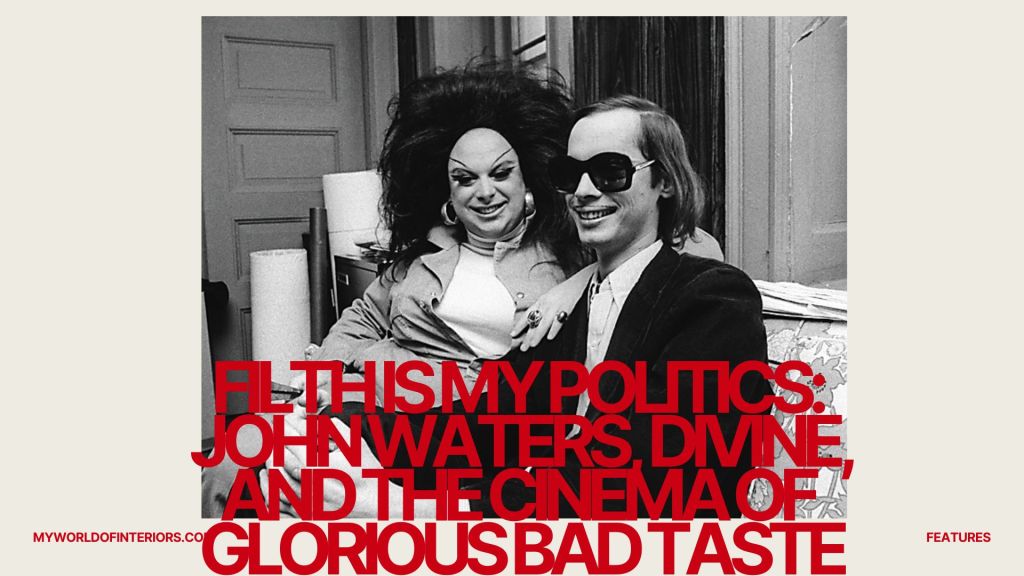
For six decades, the Pope of Trash has been making films that Baltimore’s respectable classes would prefer not to exist. In doing so, he and his muse created something that outlasted respectability entirely — a body of work that is simultaneously the most offensive and the most loving in American cinema.
By Bergotte
There is a scene near the end of Pink Flamingos — the 1972 film that established John Waters as either the most important underground filmmaker in America or the most dangerous man in cinema, depending on your tolerance for what he was offering — in which Divine, playing a character who has just been crowned the filthiest person alive, bends down on a Baltimore street and eats the freshly deposited excrement of a small poodle. The act is not simulated. The excrement is not synthetic. The poodle is real, the street is real, the act is real, and the camera, held by Waters himself, records it with the unflinching equanimity of a nature documentary. Divine then turns to the camera, grinning, with evidence of what she has just done still visible on her teeth, and the film ends.
This is where any account of John Waters has to begin, because to begin anywhere else would be a form of dishonesty — the kind of dishonest, good-taste euphemism that Waters has spent his entire career opposing. The shit-eating scene is the film’s final statement, its punch line, its manifesto. It says: we will go further than you thought possible. We will go to the place where your disgust resides and we will find it funny. We will make you laugh at the thing you most did not want to laugh at, and in making you laugh, we will have done something to you that cannot easily be undone.
Whether you consider this a public service or an assault depends, to a considerable degree, on who you are and what you brought to the experience. For the young, gay, odd, outcast, differently assembled people who found their way to Waters’s films in the 1970s and 1980s — often in circumstances of some difficulty, in repertory cinemas and late-night screenings and on bootleg VHS tapes passed between people who needed them — the experience was not primarily of disgust but of recognition. Here, finally, was a cinema that did not ask them to pretend. Here was a filmmaker who loved freaks and outcasts and the aesthetically transgressive not as objects of pity or comic relief but as protagonists, as heroes, as the most interesting people in any room. Here was a world in which the respectable were ridiculous and the disreputable were magnificent. That world was, for a great many people, the first version of the world they had ever seen that felt true.
Baltimore as Vocation
John Waters was born in Baltimore in 1946, and Baltimore — its specific atmosphere, its rowhouse streets and Formstone facades and the particular quality of its provincial Catholic respectability — is so thoroughly the subject of his work that it is almost impossible to imagine the films existing anywhere else. He grew up in the Lutherville suburb, in a family of comfortable middle-class aspiration, and from a very early age he was drawn, with the compulsive specificity of the true obsessive, to everything that the suburb was designed to exclude: exploitation films and carnivals and true crime and the garish end of popular entertainment, the things that respectable people found vulgar or disturbing or simply in poor taste.
He has described his childhood sensibility, in the memoirs and essay collections that are among the most entertaining and under-celebrated prose works of the late twentieth century, as one of pure aesthetic contrarianism: the worse a thing was considered, by the standards of his community, the more attractive he found it. This is not quite the same as saying he had bad taste; it is closer to saying that he found in the disreputable and the excessive a vitality and an honesty that the respectable and the restrained could not match. The exploitation films he sneaked into as a teenager — the William Castle gimmick pictures, the Herschell Gordon Lewis gore films, the nudie-cuties — were, he understood even then, engaged in something that the prestige cinema of the period was not: they were trying, with a kind of shameless, commercially motivated sincerity, to produce a direct physical effect on the audience. They wanted to make you scream or laugh or squirm. They were not interested in your intellectual engagement. They were interested in your body.
This is a more sophisticated aesthetic position than it sounds, and Waters arrived at it instinctively rather than through any theoretical detour. The great formalist critics were, at the same moment, producing arguments about the relationship between cinematic form and the viewer’s perceptual and psychological experience. Waters, without the benefit of film school or critical theory — he was briefly enrolled at New York University’s film programme and was expelled for smoking marijuana, an expulsion he has always regarded as the best thing that happened to him — arrived at a related position by a more direct route: by watching films that were made to produce effects and thinking about how they did it and what the implications of the doing were.
He began making films in his early teens, with a group of friends from the neighbourhood who shared his sensibilities or were willing to participate in his enthusiasms. The early films — Hag in a Black Leather Jacket (1964), Roman Candles (1966), Eat Your Makeup (1968) — are juvenilia in the most generous sense: they show a filmmaker learning by doing, experimenting with the possibilities of the medium, finding his obsessions. They are not, by any conventional standard, good films. They are, however, already distinctly themselves: already concerned with the performers rather than the script, already interested in the gap between the respectable and the outrageous, already in love with excess as a formal and a moral principle.
Divine: The Creation of a Star
Harris Glenn Milstead was born in Baltimore in 1945, the year before Waters, and grew up in a family of similar middle-class aspiration and similar suburban geography. He was overweight and effeminate and miserable in the way that overweight and effeminate boys in mid-century American suburbs were miserable: systematically, comprehensively, with few resources and no models. He and Waters met at school, became friends with the ease of people who recognise in each other a shared alienation, and remained friends — became, in fact, the most significant creative relationship of each other’s lives — until Milstead’s death in 1988.
Waters gave Milstead a persona. The persona he gave him was Divine — not a drag character in the conventional sense, not a female impersonator in the mode of those who performed in gay bars, but something that did not yet have a name: a character who was simultaneously a woman and not a woman, who used feminine presentation as a vehicle for something that transcended gender entirely, who was so much larger than any category that the categories ceased to apply. Divine was not pretending to be a woman. Divine was performing femininity at a volume so extreme that the performance became its own thing — a third category, beyond masculine and feminine, that the culture did not previously have.
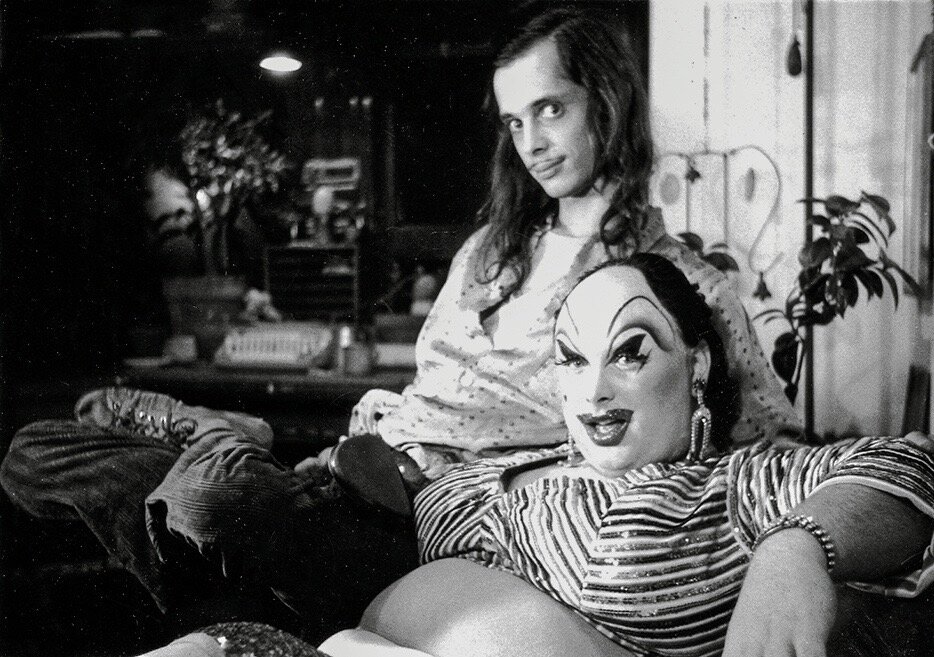
The physical transformation was extreme and was partly the point. Divine’s makeup — the shaved hairline, the drawn-on brows positioned halfway up the forehead, the exaggerated lips, the false eyelashes of cartoonish length — was not designed to create an illusion of femininity. It was designed to create an image that was simultaneously grotesque and glamorous, that borrowed from the iconography of Hollywood femininity and pushed it to a point of deliberate distortion. The references were explicit: Jean Harlow, Jayne Mansfield, the most excessive versions of female glamour that American popular culture had produced, inflated to a scale and a pitch that made the original’s constructedness visible. Divine was femininity as theatre, and the theatre was so transparent that watching it was an education in how the original worked.
The body was essential and was never hidden or apologised for. Divine was a large person — very large, in the years of the early films — and Waters filmed that largeness without the euphemism or the strategic framing that mainstream cinema uses to minimise or conceal the bodies of people who do not conform to its beauty standards. The largeness was part of the aesthetic, part of the argument. There is a way in which Divine, on screen, is simply more present than almost any other performer in American cinema: more physically there, more impossible to overlook, more demanding of the eye’s attention. The films exploit this without quite being able to explain it, which is one of the marks of a genuine star quality.
By all accounts, Milstead was, offscreen, a shy and gentle and somewhat insecure man — warm, loyal, funny in a quiet way quite different from the operatic outrage of Divine. The gap between the performer and the role was large enough that people who knew him in both registers report the experience of two almost separate people. This is not unusual for performers — the distance between the public self and the private is familiar — but in Milstead’s case the distance was of an unusual kind, because the public self was, deliberately and structurally, everything that the culture had told the private self he was not allowed to be: large and loud and magnificent and without shame. Divine was not Milstead’s revenge on his tormentors. It was more interesting than that. It was his answer to the question of what a person might become if they took everything the world considered a defect and treated it as a gift.
Pink Flamingos and the Aesthetics of Transgression
The film was made in 1972 for approximately ten thousand dollars, shot on locations in and around Baltimore over a period of several weekends, using a cast of Waters’s friends and regular collaborators — the extended family he called the Dreamlanders, after the name of the production company — and a 16mm camera that Waters operated himself. It was not made with any expectation of conventional distribution or mainstream exhibition. It was made as an act of pure, concentrated aesthetic intention: Waters wanted to make the most disgusting film ever made, and he succeeded well enough that the claim, half a century later, retains a degree of literal accuracy.
To describe the plot of Pink Flamingos is to produce a sentence that requires some adjustment of one’s relationship to the concept of plot. Divine lives in a pink trailer outside Baltimore with her mentally deficient son Crackers, her mother Edie (who spends the entire film in a crib, eating eggs), and a woman named Cotton. A couple named the Marbles — who run a scheme in which they kidnap women, impregnate them, and sell the babies to lesbian couples — have declared themselves the filthiest people alive and are challenging Divine’s claim to the title. Various acts of spectacular depravity follow. A talking asshole appears. A man performs an act with a chicken that led to the film being banned in several countries. Divine eats excrement. The filthiest person alive is confirmed in her title.
What is remarkable about Pink Flamingos — what separates it from simple provocation and makes it, genuinely and in the face of considerable resistance from one’s own aesthetic categories, a work of art — is the consistency and the conviction of its comic vision. The film is funny. Not funny in spite of its extremity but because of it: the extremity is so complete, so utterly without the hedging and qualification that most offensive comedy deploys to maintain its distance from its own outrageousness, that it crosses a line and becomes something else. The something else is absurdism of a very pure kind — the recognition that the boundaries between the acceptable and the unacceptable, the clean and the dirty, the normal and the deviant, are not natural but constructed, and that one way of making that constructedness visible is to violate the boundaries so comprehensively that the violation becomes funny.
The casting of Divine as the hero — as the character whose triumph the film demands the audience invest in, whose dignity (if that is the word, and it is, in fact, the word) must be maintained against the pretensions of the Marbles — is the film’s crucial moral and aesthetic decision. Divine is not a figure of pathos. She is not an underdog in the conventional sense, someone who is suffering and requires the audience’s sympathy. She is, rather, a figure of absolute self-confidence — a person who has located herself so securely in her own values, however alien those values might be to the viewer, that no external judgment can reach her. This quality is, in the context of the early 1970s gay underground, politically significant: it models a form of self-possession that the culture denied to the people who most needed it.
The Dreamlanders: A Family Portrait
No account of Waters’s work can proceed without attention to the extended repertory company — the Dreamlanders — whose participation gave the films their particular texture. Mink Stole, who appeared in almost every Waters film from Multiple Maniacs (1970) to Serial Mom (1994), brought a quality of controlled viciousness to every role she played — an ability to be simultaneously ridiculous and terrifying that is rarer than it sounds. David Lochary, beautiful and otherworldly, a hairdresser by profession, appeared as the male lead in the early films with a kind of ethereal weirdness that could not be taught or directed. Edith Massey — “Edie,” the egg lady of Pink Flamingos — was a real Baltimore woman, a barmaid at a bar Waters frequented, who appeared in the films with a complete absence of conventional acting technique that somehow produced performances of an almost surreal effectiveness. She could not act. She was, nonetheless, utterly riveting.
The Dreamlanders were not a troupe in the formal sense. They were a community — a chosen family, as the phrase has it, though in this case the family had been chosen by shared aesthetic sensibility rather than shared sexual identity, though the two overlapped considerably. They lived near each other, socialised constantly, supported each other in the way that people who have collectively decided to be outside the mainstream support each other: with the particular solidarity of those who have no expectation of approval from the wider culture and have therefore developed their own economy of recognition.
Waters has written about this community, and about what the act of making films within it required and produced, with a warmth that is uncharacteristic of his public persona — his public persona being that of the genial, cheerfully monstrous provocateur, the man who has made a brand of his own outrageousness. Beneath the brand, and present in the films themselves, is something that is not monstrous at all: a genuine, sustained, carefully maintained love for the people he made films with. The films are, among other things, portraits of this community — documents of a specific time and place and group of people who found each other and made something together that none of them could have made separately.
Lochary died of a drug overdose in 1977, at thirty-three. Massey died in 1984. Divine died in 1988, at forty-two, of an enlarged heart — the night before he was due to begin filming a television sitcom, Married with Children, in a role that would have brought his gifts to a mainstream American audience at a scale previously unimaginable. The deaths came too quickly and too young, as deaths in that community always did, and the community they left behind carried the losses with the particular grief of people who have learned not to be surprised by early death and who have not, for that reason, been made less capable of grief.
Female Trouble and the Star as Subject
The 1974 film Female Trouble is, by some distance, the most fully realised and the most thematically ambitious of the early Waters films. It is also the one that most directly engages with the question of stardom — with what it means to want to be famous, to be looked at, to be the centre of attention — in ways that feel, fifty years later, not like period pieces but like prophecy.
The film follows Dawn Davenport from her teenage Christmas morning when she doesn’t receive the cha-cha heels she has demanded (“Don’t you know me? Don’t you know what I want?”), through a life of escalating crime and transgression, to her execution in the electric chair — an execution that she experiences as the culmination of her career, the ultimate performance. Divine plays Dawn across her entire life, from adolescence to middle age, and the performance is the most sustained and most complex of the collaboration: Dawn is simultaneously ridiculous and, in the film’s terms, genuinely heroic, a person whose desire to be seen is so extreme that she will do anything to satisfy it, including the things that will destroy her.
The film’s argument — developed with the kind of internal consistency that distinguishes genuine satire from simple outrageousness — is that the desire for fame is itself a form of violence, and that the culture that produces and sustains that desire is complicit in the violence it generates. Dawn is not a monster produced by her own defects. She is a monster produced by a culture that teaches its members that to be seen is the highest form of being, and that offers very limited legitimate routes to visibility to people like her. The crime she commits — the atrocities she performs in a nightclub act, marketed explicitly as glamorous transgression — are what happens when someone takes seriously the culture’s promises about fame and success and acts on those promises without the resources to achieve them by conventional means.
This is, in 2026, an analysis that has become commonplace: we have all read the thinkpieces about social media and the performance of self and the violence of the attention economy. Waters made the argument in 1974, in a film featuring Divine smearing egg yolk on her face and committing murder, with a cast of Baltimore eccentrics and a budget that would not have covered the catering on a mainstream production. He made it with greater clarity and greater honesty, because greater honesty was the only option available to him, than most subsequent versions of the argument have managed.
Hairspray and the Question of Mainstreaming
The 1988 film Hairspray is the work that performed the most unlikely transformation in Waters’s career: it is a film that is simultaneously the most mainstream thing he ever made and, in certain respects, the most politically serious. Set in Baltimore in 1962, it follows Tracy Turnblad — a chubby, exuberant teenager with a passion for dancing — as she breaks into the television dance programme that is, in the Baltimore of the film, the closest thing to a genuine public sphere, and in doing so confronts and begins to dismantle its policy of racial segregation.
The film is a musical — Waters’s first — and it has the energy and the formal pleasure of the best musicals: the dancing is joyful, the music (a mixture of period-accurate early 1960s pop and Waters originals) is genuinely good, and the performances, including Divine in a double role as Tracy’s mother Edna and as the white segregationist television station manager Arvin Hodgepile, are the most accessible and the most conventionally enjoyable the two had produced together. Ricki Lake, as Tracy, gave a performance of such warmth and physical confidence that it made her a star; the supporting cast, including Jerry Stiller and Debbie Harry and Pia Zadora and Sonny Bono, is a Waters casting extravaganza that manages to be both a collection of eccentrics and a functional ensemble.
But the film’s politics are not incidental decoration. They are the subject. Hairspray is, at its core, a film about who is allowed to be seen — who is allowed on television, who is allowed in the public sphere, whose presence is considered legitimate and whose is considered transgressive. The connection between this question and the broader project of Waters’s career — which has always been about the visibility of people whom the mainstream culture would prefer to render invisible — is not subtle. Tracy, who is fat and working-class and enthusiastic and completely without self-consciousness about any of these things, is a Divine figure without the extremity: a person who refuses to accept the culture’s judgment of her worthiness, who insists on being present in a space that has been constructed to exclude her.
The racial politics of the film are handled with a directness unusual for a mainstream American comedy of the period. The Black characters — and there are many of them, given full humanity and full dignity and some of the best musical numbers — are not the object of the film’s sympathy in a condescending sense. They are its allies, the people with whom Tracy makes common cause, the community that teaches her something about what it means to fight for the right to be seen. The integration storyline is not a metaphor for gay liberation or any other liberation: it is about racial justice in a specific historical moment, and it treats that subject with more seriousness and more accuracy than many films that would have considered themselves more seriously engaged with civil rights.
Hairspray was a hit. It crossed over. It played in cinemas that would never have considered showing Pink Flamingos, to audiences who had no idea who John Waters was and who did not need to know. And then, in 2002, it became a Broadway musical, and then, in 2007, it became a film version of the Broadway musical, with John Travolta playing Edna Turnblad and a budget that could have financed every Waters film ever made with money to spare. The transformation of Hairspray from underground provocation to Broadway blockbuster is one of the most remarkable arcs in the history of American popular culture — a story about what happens when subversion is really good, and the culture eventually catches up.
The Prose Waters and the Auteur as Persona
Waters has always been, alongside the filmmaking, a writer — and the writing is, at this point in his career, arguably the medium in which he is working most freely and most productively. The essay collections — Shock Value (1981), Crackpot (1986), Art: A Sex Book (written with Bruce Hainley, 2003), Role Models (2010), Carsick (2014), and Mr. Know-It-All (2019) — constitute a body of prose that is among the most distinctive in American letters: funny and precise and genuinely knowledgeable about an extraordinary range of subjects, written in a voice so fully achieved that it requires no effort from the reader to maintain the sense of a specific human being behind the sentences.
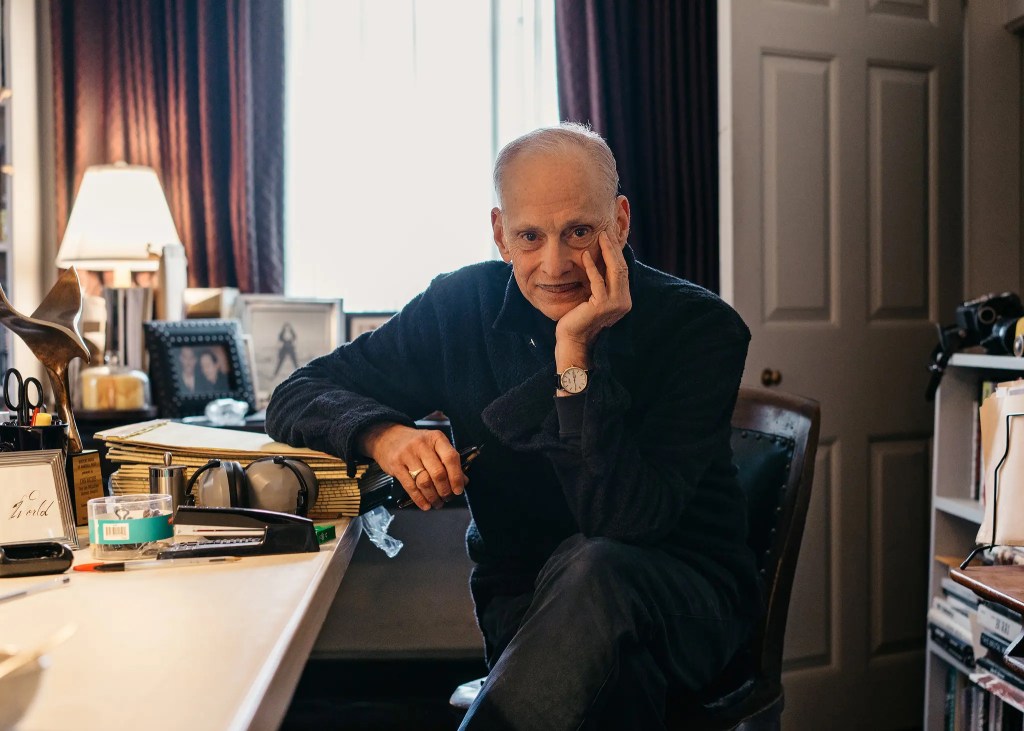
Role Models is probably the finest of the books — a collection of essays each devoted to a person who has influenced or fascinated Waters, ranging from the obscure (a convicted murderer named Leslie Van Houten, a member of the Manson Family whose case Waters followed for decades with the combination of genuine concern and aesthetic fascination that characterises his best engagements) to the canonical (Tennessee Williams, Little Richard) to the sublimely unexpected (the hardcore pornographic novelist and Waters hero Johnny Wadd; the fashion designer Rei Kawakubo). What holds the essays together is not a theme but a sensibility: the specific quality of Waters’s attention, which is simultaneously respectful and anarchic, deeply interested and completely without reverence, always looking for what is genuinely extraordinary in the subject rather than what is conventionally celebrated.
The persona that Waters has constructed and maintained across six decades of public life is itself a kind of performance — as deliberate and as carefully maintained as Divine’s. The thin pencil moustache (which he grows and then describes in detail, noting that it looks most like the moustache of a corrupt Mexican police official, which is, he has explained, exactly what he was going for). The impeccable wardrobe, always precisely wrong in a way that requires tremendous effort. The forensic knowledge of true crime and underground culture and art film and the most obscure corners of American popular entertainment. The Christmas cards he sends — genuinely, by post, to a list of hundreds — with images he has found or created that hover precisely on the line between charming and disturbing.
The persona is not a mask in the sense of concealing a different, more private self. It is an extension of the self — the public manifestation of a sensibility that is, in private, exactly as it appears in public. People who have spent time with Waters in social settings report the experience of encountering someone who is genuinely as he seems: curious, warm, funny, without malice, enthusiastic about culture in all its manifestations from the highest to the lowest, committed to the proposition that bad taste is a legitimate aesthetic position and that the people who enforce the boundaries of good taste are the people most worth subverting.
After Divine: The Collaborations and the Late Films
The death of Divine in March 1988 — two weeks after the premiere of Hairspray, the night before the beginning of the Married with Children shoot — was a loss from which Waters’s filmmaking did not entirely recover, not because he stopped making films but because the specific creative chemistry that had produced the best of the early work was unrepeatable. The late films — Cry-Baby (1990), Serial Mom (1994), Pecker (1998), Cecil B. Demented (2000), A Dirty Shame (2004) — are intermittently wonderful and consistently interesting and none of them are Female Trouble or Desperate Living or Polyester.
This is not a criticism of the late films, exactly. It is an observation about what Divine brought to the work that could not be replaced. The specific combination of physical presence and performative commitment that made Divine extraordinary was not a technique that could be transferred to another performer; it was the product of a specific person in a specific creative relationship over a specific period of time. The late films find other pleasures: Kathleen Turner in Serial Mom gives a performance that is one of the most sustained comic achievements in 1990s American cinema, a portrait of suburban respectability curdling into violence that is both hilarious and genuinely unnerving. Johnny Depp in Cry-Baby — playing a greaser named Wade “Cry-Baby” Walker with a single tear permanently balanced on his cheek — brings a quality of committed absurdism that suggests what it might have been like to work with the young Brando if the young Brando had been funny.
But something in the centre of the work had changed. The early films had the quality of necessity — the feeling that they were being made because they had to be made, that the alternative to making them was some kind of suffocation. The late films have the quality of pleasure — they are made by a man who is good at making films and enjoys it and has the resources and the goodwill to do it, and the slight relaxation of pressure that this represents is visible in the work. They are not as hungry. They could not be as hungry. The hunger of the early work was produced by conditions — of exclusion, of poverty, of the absence of institutional support or mainstream acceptance — that no longer applied.
The Legacy: What Waters Made Possible
The question of influence is always difficult to answer precisely, and in Waters’s case it is particularly difficult because his influence has operated through several different channels simultaneously. There is the direct influence on filmmakers who cite him explicitly — Pedro Almodóvar, who arrived at a somewhat similar aesthetic position by a different route (Catholic Spain rather than Protestant Baltimore, but with a comparable commitment to excess and a comparable love for female performers of a very specific kind); Gus Van Sant, who has spoken of Pink Flamingos as a liberating experience; Todd Solondz, whose darkness owes something to Waters’s permission to go where the discomfort is. There is the influence on drag culture and queer performance more broadly, which is immense and largely unquantifiable: Divine’s model of drag as total transformation rather than female impersonation, as the creation of an entity rather than the performance of a gender, is one of the founding documents of the aesthetic that would eventually produce RuPaul’s Drag Race and the mainstream visibility of drag as a cultural form.
And there is the influence that is hardest to document but perhaps most pervasive: the influence on the general culture’s tolerance for transgression, for the proposition that bad taste is a legitimate aesthetic category, for the idea that the things the culture considers most shameful and most outrageous are not necessarily the things most worth avoiding. Waters did not create this tolerance single-handedly, and he would be the first to resist any claim to have done so. But he contributed to it substantially, over six decades, by making work that insisted on its own right to exist and that was good enough, and funny enough, and — underneath the filth, and not separate from it — loving enough, to earn that right.
What he gave to the people who needed him most — the queer teenagers in the suburbs, the freaks in the small cities, the people who had been told that what they were was wrong and ugly and shameful — was something that sounds simple and was not: the image of a person, or a community of people, who had taken exactly that judgment and refused it. Not argued with it. Not explained why it was incorrect. Refused it, with style, with humour, with an absolutely unapologetic commitment to their own way of being in the world. Divine, on screen, in the pink trailer, in the filth and the sequins and the absurd improbable magnificence, was the refusal made visible. And the refusal, it turned out, was what a great many people needed to see.
Harris Glenn Milstead is buried at Prospect Hill Park Cemetery in Towson, Maryland. His gravestone reads: “Divine — June 19, 1945 – March 7, 1988. Son, Brother, Friend.” The simplicity of it is striking. After everything — after the cha-cha heels and the pink trailer and the dog’s excrement and the electric chair and the nightclub act and the Broadway adaptation and the fifty years of being the most outrageous, the most excessive, the most impossible-to-ignore person on any screen he occupied — the gravestone names him as what he most privately was: a son, a brother, a friend. John Waters has said that he visits the grave regularly. He brings fresh flowers. He stands there for a while. Then he gets in the car and drives back to Baltimore.
The films remain. They will remain. They are, in their way — in the way that only things made with genuine conviction and genuine love can be — permanent.
John Waters’s essay collections, including Role Models, Crackpot, and Mr. Know-It-All, are published by Farrar, Straus and Giroux. His memoir Shock Value is published by Running Press. The Criterion Collection has released editions of Pink Flamingos, Female Trouble, Desperate Living, Polyester, and Hairspray. Michael Lange’s documentary I Am Divine (2013) provides the fullest available portrait of Harris Glenn Milstead.
