
The boy calls me often this term; he wants to tell me all about the fun he’s having. He says he has to be humble with everyone else, and I’m the only person he can brag to, the one he can tell everything. His little girlfriend would be upset by some of it, and Mrs P would kill him if she knew what really went on out on the road. But he sounds upbeat, and he says the band is getting better all the time. He makes me laugh.
“One of my favourite things about you,” I say, “is when you’re lit up, full of impulsive fun.”
He chuckles. “You just like me when I’m a fool.”
“It makes me feel good, knowing you’re in high spirits,” I protest, and as I do, I realise it’s true.
“I miss you,” he says, his voice suddenly serious.
Then I hear voices calling him, and he hangs up without saying goodbye. I shake my head and look out at the autumn landscape of Pennsylvania.
“Shall we drive into Philly for dinner?” Topper asks.
“Sure,” I say, peeking up at him.
He’s here for the weekend. I haven’t told the boy; he hasn’t asked, and he’s busy anyway. I wonder if he’d mind. He doesn’t need to know, I tell myself.
***
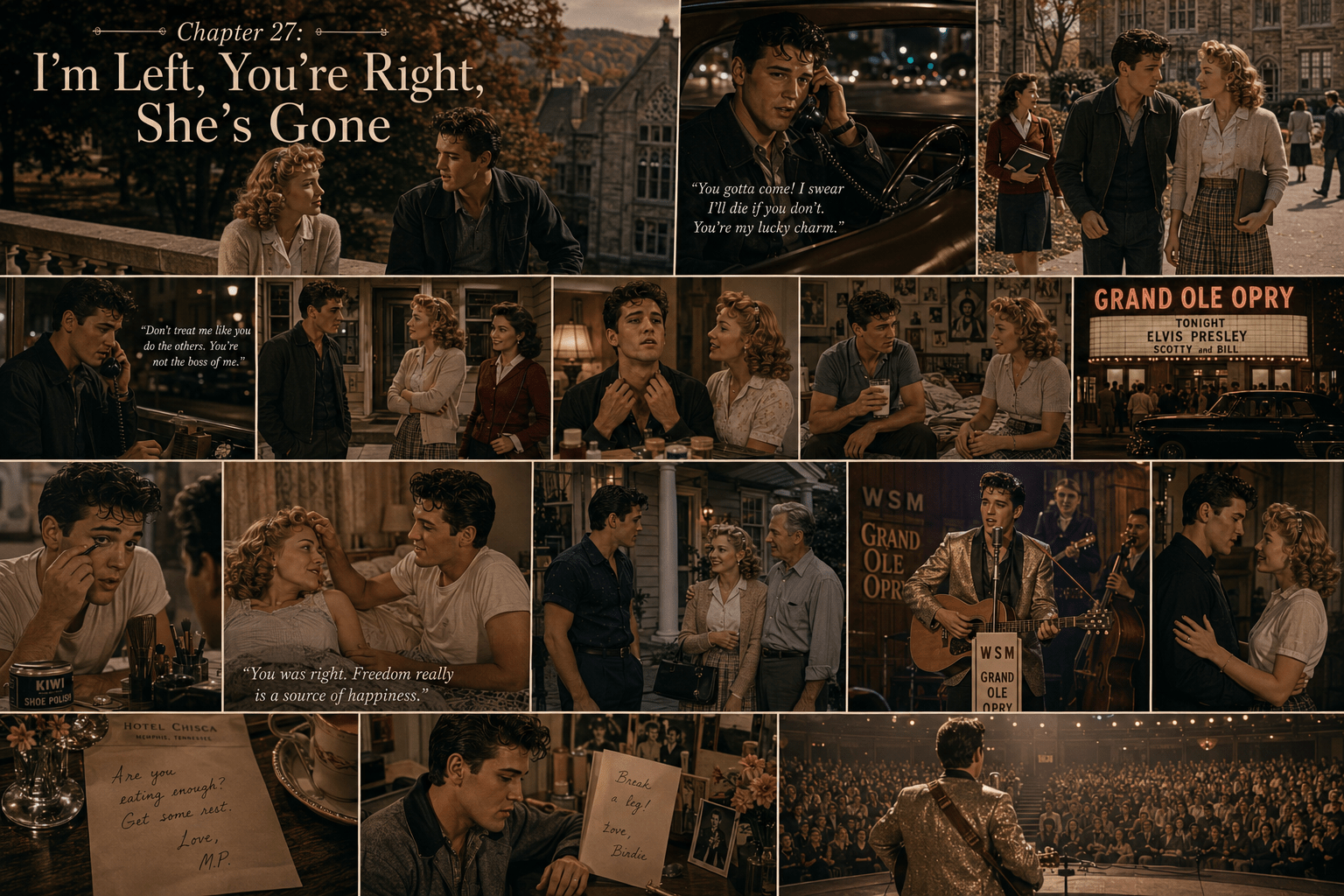
“You have to come back!” It’s the boy on the line, urgent.
“Why? I’m in the middle of term.” I question.
“Sam’s booked us to play the Grand Ole Opry in Nashville. You gotta come! I swear I’ll die if you don’t. You’re my lucky charm.” His voice trembles between pleading and panic.
“Again, baby, it’s all about you.” I roll my eyes. “I have a life too, you know.”
“I’m beggin’ you,” he says, voice cracking.
I sigh. “You can’t manipulate me.”
“What d’you mean?” he snaps, instantly defensive.
“Don’t treat me like you do the others. I know you too well.”
“I don’t know what you’re talkin’ about,” he mutters. Then, louder: “You don’t care about me. I think about you all the time. I’ve only ever loved you!”
“That’s just not true,” I say, my patience thinning.
“It is!” he cries, either sobbing for effect or with real desperation.
“Hey.” My tone sharpens. “If you want to speak to me, if you want any kind of relationship with me, you need to use a tone I can actually tolerate. Don’t scream at me like a child.”
Silence.
“You can’t just barge into my life and throw demands around,” I continue, calmer now. “You’re not the boss of me, and I’m not the boss of you. You’re important to me, and I’ll always treat you with respect. I’m asking for the same in return.”
He doesn’t answer.
“Goodbye,” I say undramatically, and hang up.
***
Two days later, the boy is standing outside the apartment.
He looks a mess, but somehow, he’s never looked more handsome. There’s a newfound confidence in him, a bit of swagger.
He’s come all the way up to Bryn Mawr to see me.
“What on earth?” I ask, glancing outside to see if he’s with anyone. “What are you doing here?”
Tilly appears, drawn by the noise. “As I live and breathe,” she sniggers, “if it isn’t Li’l Abner in person.” She gives him a slow once-over. “Why is your neck so dirty?”
“It ain’t,” he says, frowning. “And why you callin’ me Li’l Abner?”
“Let me see,” I say, pulling him into the hallway. He checks the mirror.
“Ah,” he says. “Yeah, alright.”
I raise an eyebrow. “Are you wearing makeup?”
“Stop it,” he groans, but I can’t help laughing.
“I don’t mind if you are, you look great. But are you?”
Later, I find out he’s been using shoe polish to darken his hair, which explains the dirty neck, and eye makeup to “make his eyes pop.”
“I probably oughta stop doin’ that,” he says after his shower, sitting on my bed and eating a sandwich.
“I’m sorry,” he adds quietly. “I just had to see you.”
I hand him a glass of buttermilk. “What’s up?”
“I just felt like seein’ you,” he says, pouting, trying to channel Marlon Brando but guffawing too much to pull it off.
Tilly passes by my open door, sees him, and pokes her head in.
“Why are all Southerners so dramatic?” she asks, genuinely curious. “You’re all so full of melodrama.”
I smile. “Goodnight, Tilly. Your geographical stereotyping is, once again, not welcome here.”
“Night-night, Daisy Mae,” she says, looking at me. Then to the boy: “Li’l Abner.” She closes the door behind her.
“I wanted to reassure you that I love you,” he says, caressing my face.”I love only you. All the others are just time-fillers.”
I blink. “All the others? I thought there was only the little girlfriend?”
He clears his throat. “Ah, about that,” he grins. “Anyway, I’m so glad to see you.” He pulls me closer.
Multiple girls. Not just Dixie. I should feel something, jealousy, anger, hurt. But I don’t. Or maybe I already did, and those feelings have long since settled into my system. I’m thinking about Topper, and whether or not to tell him about today. I decide I’ll tell him, if he asks.
***
Lying in bed, the boy strokes my hair and says, “You was right. Freedom really is a source of happiness.”
“Bein’ on the road, Birdie… it’s somethin’ else.”
“I wish I could bring you,” he goes on, “but then again, it’s probably best not to.”
We both chuckle.
A moment later, he adds, “Thanks for puttin’ me in my place. I needed that.”
“You’re welcome,” I say, “but I don’t want to be the one who always has to do this.”
Everything feels back to normal, as if no time has passed, and we’ve slipped right back into our old, familiar ways.
“I don’t know why I can’t get enough of you,” he says. “I usually get bored real quick, but with you, somethin’ always shifts. You’re all new to me again.”
He edges closer. “Or you run off, to school, holidays with your little gang. You always gotta slip through my fingers like that.”
***
I’m back home to accompany the boy to the Opry, even if I really don’t have the time to babysit him. I tell myself it will be the last time I do this.
It’s good to be back with Miss Mary and to see the house again. It’s also lovely to visit with the boy’s parents, though Mrs P looks tired and fraught.
“Are you looking after your mother?” I ask him.
He waves an irritated hand. “Course I am. But I can’t be her little boy forever. I’m a man now. Things gotta change.”
I am noticing the ways the boy is adjusting. He’s still sweet with me, attentive and fun to be around, but he’s grown more self-centred. I catch flashes of casual cruelty in the way he treats others. He isn’t as kind to his little girlfriend as he used to be. He ‘pretends’ when he’s around her now.
And I wonder, does he pretend with me, too? Tears fill his eyes when I ask.
“No,” he says. “Can’t you tell? D’you know how much heartache you’ve brought me in my nineteen years? If I had to pretend around you, it’d be easier to just let you go. It’s a pain in the ass that I love you so much.”
He goes quiet. Then: “Tell me about you,” he says, for the first time in a long while. “I genuinely wanna hear what you’ve experienced, what you’ve learned since we last talked like that.”
I don’t know if he’s manipulating me, like he does with everyone else, or if he really means it, but I decide to believe him, for now.
So I tell him everything: the books I’m reading, Camus, Graham Greene, Virginia Woolf, Hemingway, and the films I’ve seen. I tell him what I’ve been thinking about: what makes someone good, what freedom really is, how memory works, how I might want to tell stories with images. I mention the political conversations, though I don’t say they’re with Topper, about America’s contradictions, how people look away when something doesn’t touch them directly.
He laughs. I can tell he’s both interested and not interested at all, mostly surprised by how many thoughts I’m having. He says he never knew girls thought about anything other than getting married and having children. I can’t tell if he’s being serious or if he’s having me on.
Then he winks at me.
He kisses me and puts his arm around me. I feel him drawing closer. I feel us becoming one again, more than we’ve been in a long while.
And I love him as always.
A pain in the arse, this little up-tempo, always-moving, running-at-full-tilt, leg-shaking nuisance of a boy.
When I picture him, as he is this autumn, I see him striding through a venue, his long legs taking him everywhere at once, one eyebrow raised, laughter behind his eyes. It’s as if he’s saying: I’m going that way, one arm stretched toward the future, a pointed finger and a wink, Catch me if you can.
I can see why it’s hard for Mrs P to keep up. I can see how his own mind struggles to keep pace. And I can see this is why he needs me here: someone to witness it, someone who knew him before, someone to keep him from veering off-course. Whether I can actually do that is another question.
***
Turns out the Grand Ole Opry in early October 1954 is not yet ready for the boy and his band. Instead of applauding this energetic new trio, delivering old songs with a new beat, the old guard sit in confused silence. They don’t get the energy, the rhythm, the pulse behind their version of Blue Moon of Kentucky. Someone even tells him to go back to truck-driving.
I’m ready to deal with this crowd, just like I dealt with the boys who took his school bag back at Humes in junior high. But I’m an adult now, and this isn’t junior high. I can’t sock anyone on the nose. All I can do is sit with him afterward and try to make it all better.
“They weren’t ready, is all,” I tell him gently as we drive back. Not everyone will understand what he brings. But I do, and maybe that’s reason enough for him to want me here, after all.
***
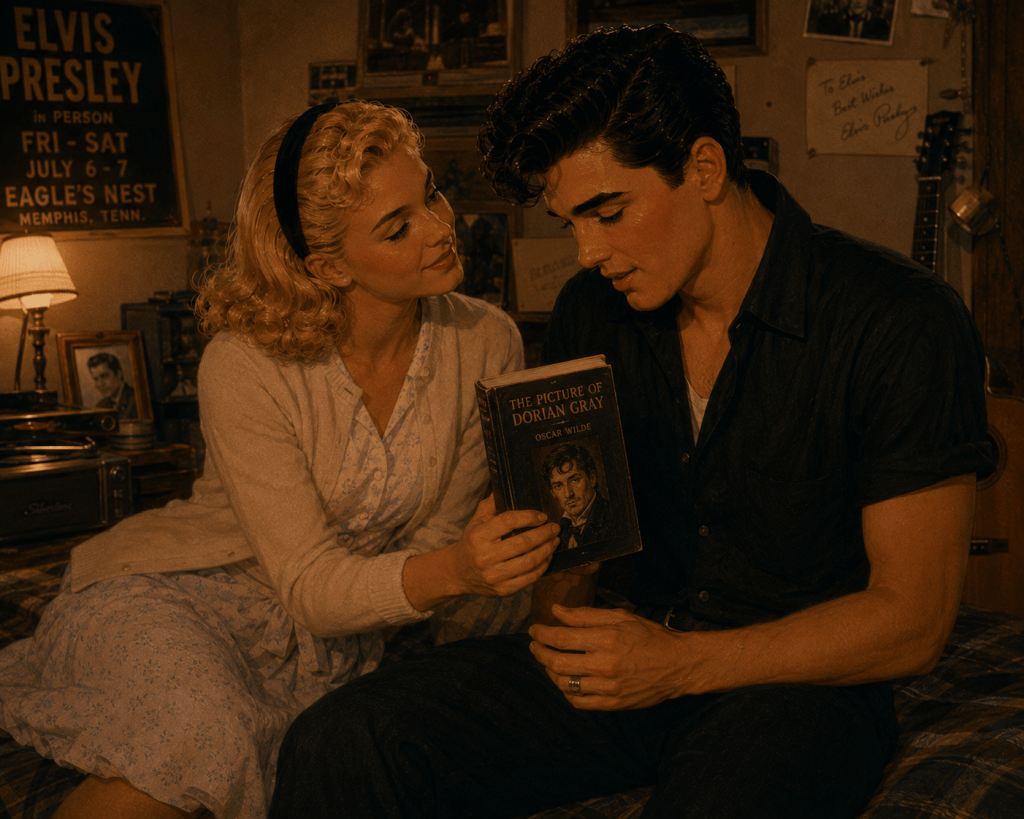
Before I go back to college, I give him a copy of The Picture of Dorian Gray. I don’t know why exactly, I just feel like he should read it at some point.
“Please try not to stumble and fall,” I say as I kiss him goodbye.
He grins and winks at me. “Don’t you worry. I won’t, long as I got you.”
And I know Mrs P’s instincts shouldn’t be ignored. Things are moving too fast for any of us to really know how to deal with it.
Discover more from My World of Interiors
Subscribe to get the latest posts sent to your email.
 My World of Interiors