
Essay · Art & Lives
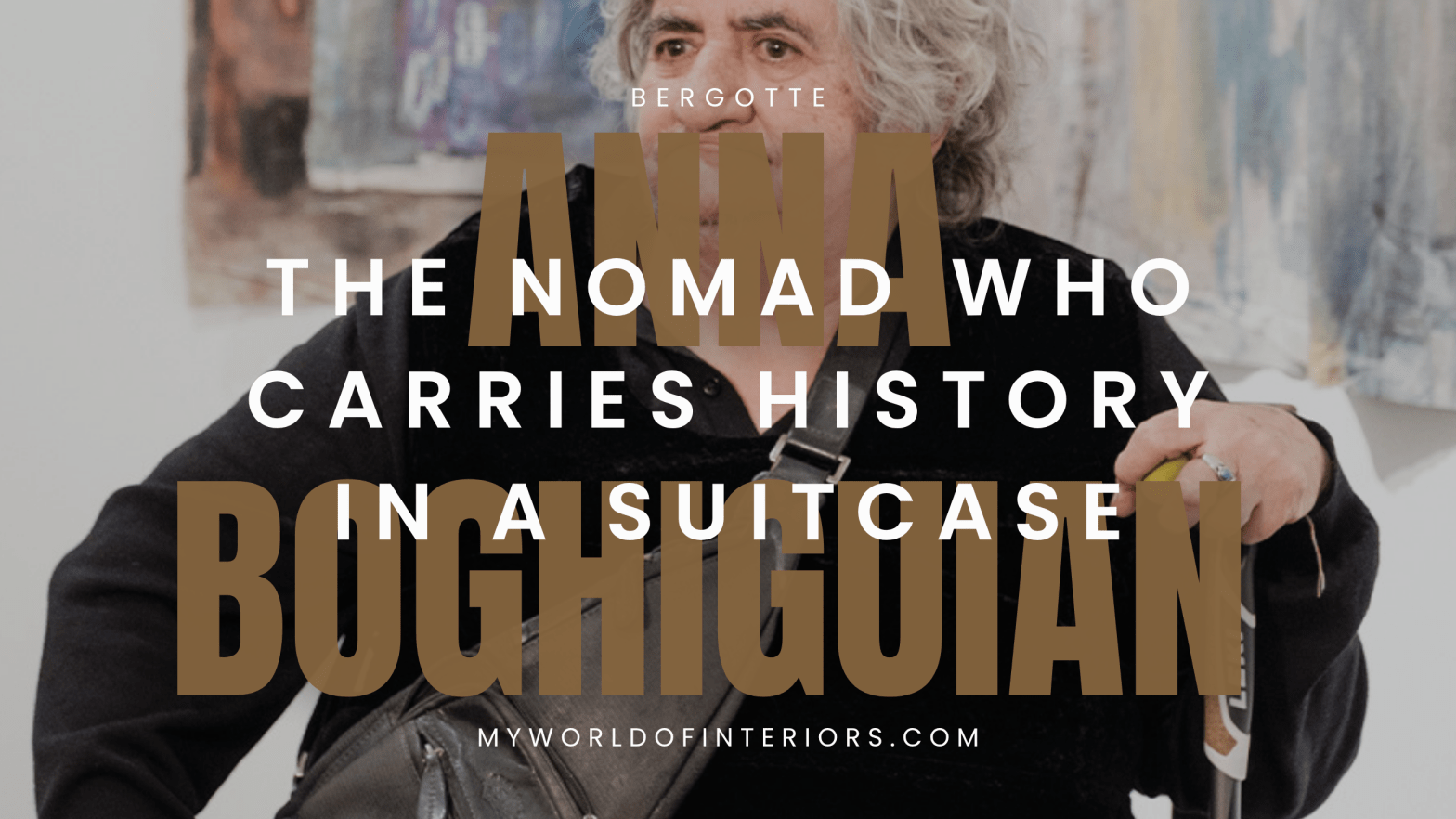
The Nomad Who Carries History in a Suitcase
Anna Boghiguian has no fixed address and no fixed medium. What she has, instead, is an inexhaustible appetite for the world’s buried histories — of trade, of empire, of displacement, of the bodies that paid the price for other people’s prosperity — and a way of rendering them on paper that is unlike anything else being made today.
By Bergotte · Cairo · Art & Lives
She arrives in a city with a suitcase, a roll of paper, some paint, and a head so full of history that the problem is never what to put in the work but what, given the constraints of any single wall or floor or gallery, to leave out. She may stay for weeks or months. She works on the floor, kneeling, cutting figures from paper with scissors, pinning them to surfaces with a directness that looks provisional until you stand in front of the result and feel its total authority. Then she leaves. Anna Boghiguian, born in Cairo in 1946 to an Armenian family, has been making this kind of art — nomadic, urgent, politically alive, saturated with reading — for more than half a century, and the world, with its customary tardiness in these matters, is only now beginning to catch up with what she has been saying.
She is, by any useful definition, one of the most important artists alive. She is also one of the least categorisable — a fact that has made her career trajectory unusual, marked by long periods of relative obscurity punctuated by the kind of recognition that arrives when an institution finally finds the language for something that has been exceeding its available vocabularies for decades. The language, when it came, was simple enough: here is an artist who has spent her life thinking seriously about where the modern world came from, and who has found a visual form for that thinking that is as rigorous as it is strange.
Cairo, Armenia, and the Education of a Wanderer
To be born Armenian in Cairo in 1946 is to be born into a doubled dispossession. The Armenians of Egypt were a community formed largely by the survivors of the genocide of 1915 — people who had fled one catastrophe and settled in a country that was itself, in the decades that followed, undergoing the turbulent process of decolonisation, revolution, and the expulsion of its own minorities. When Nasser’s nationalisations and the political upheavals of the 1950s and 1960s drove most of Egypt’s cosmopolitan communities — Greeks, Jews, Italians, Armenians — into a fresh diaspora, the Boghiguians, like many others, found themselves once again between places.
Boghiguian studied political science at the American University in Cairo, then fine arts, then music at McGill University in Montreal — an itinerary that tells you something essential about the kind of mind she has: restless, omnivorous, refusing the specialisation that might have made her more legible to the market but would have cost her the breadth that makes her work what it is. She returned to Cairo, left, returned again. She has been leaving and returning ever since — to Cairo, to India, to Greece, to Germany, to wherever the work takes her — and the condition of perpetual transit is not, for her, a hardship to be managed but the very substance of what she is investigating.
“I am always a stranger. But being a stranger means you see things that people who belong cannot see.”Anna Boghiguian, in interview, Documenta 14, 2017
Her work is steeped in literature in a way that is rare among visual artists and rarer still among those who manage to translate the steeped-ness into form rather than illustration. She is a devoted reader of Constantine Cavafy, the great Alexandrian Greek poet of diaspora and desire, whose sensibility — elegiac, ironic, attentive to the cost of empire in individual lives — echoes through her imagery. She has read the historians of the ancient world and the theorists of the modern one. She quotes Walter Benjamin in conversation the way other artists quote colleagues. The work emerges from all of this, not as illustrated argument but as something more ambiguous and more powerful: felt thought, intellect made physical by the labour of cutting and painting and pinning.
The Work: Paper, Bodies, the Weight of Trade
The signature element of Boghiguian’s mature practice is the cut-paper figure: silhouettes and near-silhouettes, rendered in paint and ink on paper, then cut out and deployed in space — hung from ceilings, pinned to walls, arranged on floors — in formations that suggest crowds, processions, caravans, the movement of peoples across distances too large for any single image to contain. They are not illustrations of historical events. They are something more like concentrations of historical pressure, points at which the accumulated weight of what human beings have done to one another in the name of commerce and empire becomes briefly, unbearably visible.
Her figures carry the slight awkwardness of bodies under duress — they lean, they strain, they reach toward one another across distances the installation makes palpable. They are not heroic. They are not victims, in the flattening sense that word has acquired in activist art. They are people, doing what people do: moving, carrying, suffering, occasionally, against the odds, connecting.
The recurring preoccupations of her work are the great systems of extraction that built the modern world: the spice trade, the cotton trade, the slave trade, the sugar trade. These are not chosen for their contemporary political valence — though they have it — but because they are genuinely the hinge on which modernity turns. Follow the pepper from Malabar to Lisbon to Amsterdam and you have followed the logic of capitalism to its source. Follow the cotton from the American South or the Egyptian Delta to the mills of Lancashire and you have followed the thread that connects plantation slavery to industrial revolution to the clothes on your back. Boghiguian follows these threads with the patience of a historian and the eye of a poet, and what she finds at the end of them is always the same thing: a body, bearing weight.
Her installation The Salt Traders, shown in various iterations across Europe, is among the most sustained explorations of this territory — an immersive environment of figures and text and painted surfaces in which the ancient economy of salt becomes a lens for the entire history of commodity extraction. Salt is so old a medium of exchange that to think seriously about it is to think about the foundations of civilisation itself: its preservation of food, its role in religious ritual, its use as currency (the word salary derives from it), its extraction from the bodies of those who mined it. Boghiguian holds all of this simultaneously, and asks you to do the same.
Documenta and the Arrival of Recognition
Boghiguian had been exhibiting internationally for decades before the recognition arrived in force. The turning point, for many observers, was documenta 14 in 2017 — the quinquennial exhibition of contemporary art that, under the directorship of Adam Szymczyk, made the unusual decision to split itself between Kassel and Athens, the latter choice a pointed commentary on the European economic crisis and the treatment of Greece by its creditors. In this context, Boghiguian’s work — historically dense, politically undeceived, made by an artist who had spent her entire career occupying the margins of multiple worlds — found its ideal frame.
“She makes you feel that history is not behind us. It is the floor we are standing on.”Adam Szymczyk, artistic director, Documenta 14, 2017
Her installations in both Athens and Kassel drew some of the most serious critical attention of that edition — no small thing in a show that included a great deal of serious work. What distinguished them was not novelty of form but depth of thought: the sense that every element in the room had been considered, that the figures on the walls and the text woven through them and the colours — raw, often abraded, applied with an urgency that reads as handwriting reads, as evidence of a particular consciousness at a particular moment — were all in conversation with one another and with the viewer in ways that revealed themselves gradually, over time, to those willing to stand still long enough to listen.
Subsequent exhibitions at the Tate Modern in London and in major institutions across Europe confirmed what documenta had suggested: that Boghiguian was not an emerging artist who had finally been discovered but a fully formed one who had been making important work, quietly and without institutional support, for longer than many of her newly enthusiastic champions had been paying attention to art at all. The recognition, when it came, had the quality of all belated recognitions: slightly embarrassing in its lateness, genuinely welcome, and somewhat beside the point from the perspective of the artist herself, who continued, during the period of her greatest visibility, to arrive in cities with a suitcase and work on the floor.
The Armenian Question
The genocide is always present in Boghiguian’s work, rarely named, never absent. It is present in the figures that move through her installations as through a landscape of enforced transit. It is present in her sustained attention to what it means to be a people — a word, a culture, a cuisine, a memory — dispersed across the indifferent surface of the world. It is present in her refusal to sentimentalise displacement, which is the characteristic move of artists who treat their own marginality as a kind of credential. For Boghiguian, the fact of dispossession is not a position to occupy but a condition to think from — a vantage point from which certain things are visible that are not visible from the centre, and from which the obligation is not to mourn but to look.
There is a recurring image in her work that is worth dwelling on: a figure in motion, carrying something — a bundle, a child, an object whose nature is unclear — across a space that offers no clear destination. The figure is not despairing. It is not triumphant. It is simply moving, with the particular determination of someone who has understood that the movement itself is what there is, that the destination is not the point, that what matters is the quality of attention brought to the crossing.
This is, one comes to feel, a self-portrait of sorts. Boghiguian has been crossing — between Cairo and the world, between the Armenian past and the Egyptian present, between the visual and the literary, between the historical and the urgently contemporary — for her entire working life. The crossings have produced a body of work that is, in aggregate, one of the more remarkable achievements in contemporary art: not because it resolves the questions it raises, but because it raises them with such precision, such formal intelligence, and such evident, unfashionable moral seriousness.
What She Is Owed
Art history has a long tradition of discovering, in the final decades of a career, artists who have been making essential work without adequate recognition, and congratulating itself on the discovery. The congratulation is generally premature: recognition of this kind, arriving late, rarely comes with the material conditions — the institutional support, the critical infrastructure, the simple fact of being seen in time — that might have made the work different, or the life easier, or the practice more sustainable.
Boghiguian has survived the long obscurity with her practice and her curiosity intact, which is itself a kind of achievement, and the work she is making now — in her late seventies, still travelling, still kneeling on floors, still cutting figures from paper with the concentration of someone for whom the act of making is identical with the act of thinking — is as alive as anything she has made. She is owed, at minimum, the kind of sustained and serious attention that her work has always rewarded. She is owed, more broadly, the acknowledgment that the history she has spent her career examining — of trade, of bodies, of the price paid by the many for the comfort of the few — is not a marginal history. It is the history of the world we are currently living in, and she has been drawing its portrait, with paper and scissors and a tireless, uncomfortable eye, for longer than most of us have been looking.
This essay draws on Anna Boghiguian’s published interviews and artist statements, the catalogue of Documenta 14 (2017), and exhibition texts from the Tate Modern, London, and the Museum Ludwig, Cologne. The Wotruba Foundation, Vienna, holds related archival material on postwar Central European art contexts.
Discover more from My World of Interiors
Subscribe to get the latest posts sent to your email.

