
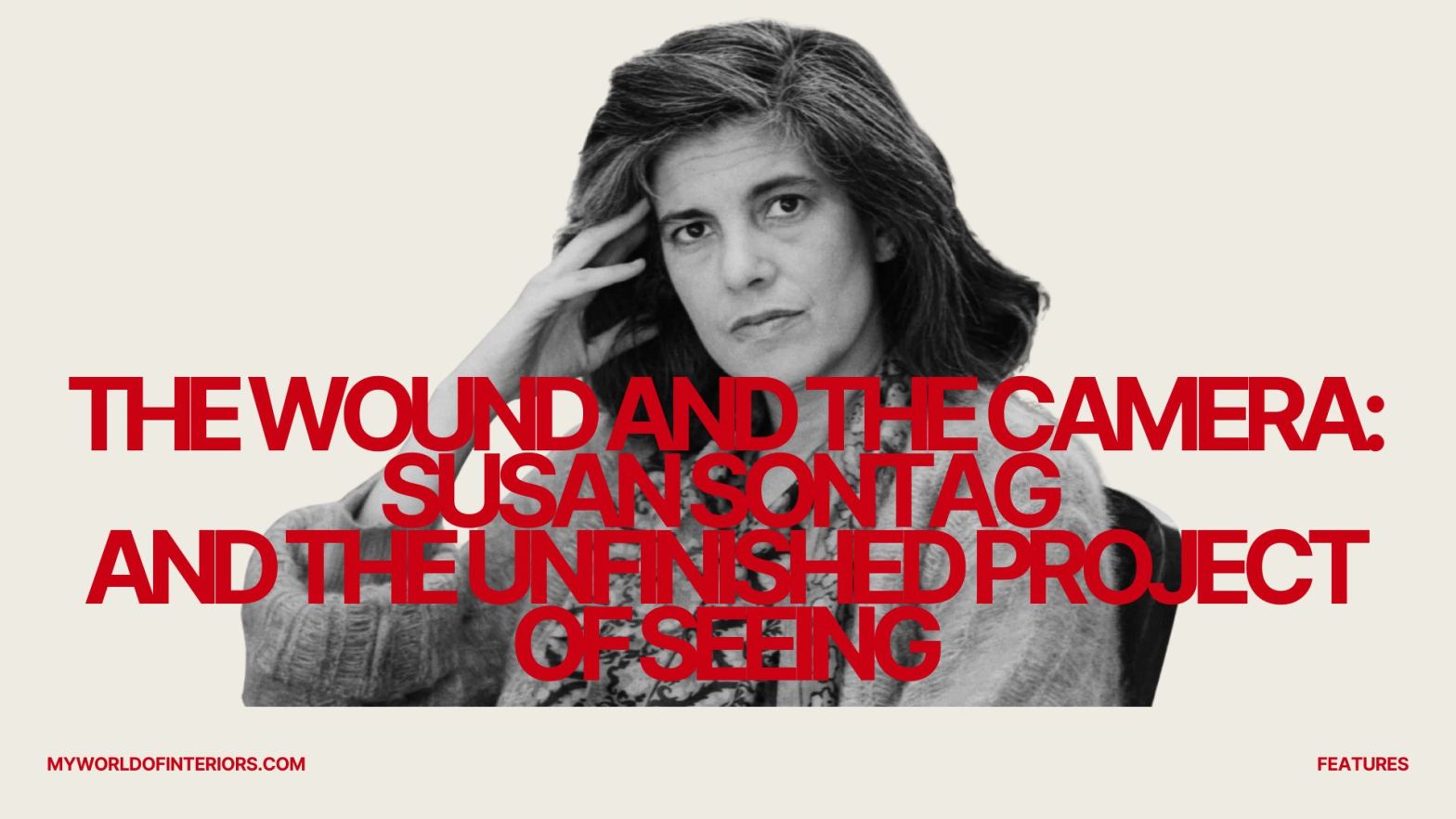
Twenty years after her death, the great critic’s ideas about images, suffering, and the moral life feel less like history than like prophecy.
By Bergotte
There is a photograph that Susan Sontag never saw — or rather, she could not have seen it in the form we now encounter it, scrolling past it on a phone screen in the blue light of a bedroom, between a friend’s holiday snapshot and an advertisement for trainers. It shows a child’s body on a beach. Or it shows a woman holding her face in her hands outside a hospital. Or it shows a soldier grinning beside something unspeakable. The specific image hardly matters; what matters is the context — the infinite horizontal scroll of it all, the way catastrophe and commerce and sentiment sit in adjacency so complete that the eye can barely distinguish between them. This is the world Sontag was trying to think through. This is the world that, in some sense, she predicted.
Susan Sontag died in December 2004, at the age of seventy-one, of a rare form of myelodysplastic syndrome. She had fought, with characteristic ferocity and a refusal that bordered on the theological, three separate cancers over the course of her life. She died in New York, which was the city that had claimed her and which she had, in turn, claimed — arriving as a young woman from the provinces, from Tucson and Los Angeles and the respectable middlebrow misery of a mid-century American childhood, and remaking herself, through sheer intellectual will, into someone else entirely: a figure of European seriousness transplanted into American soil, a woman who wanted to think and would not be told that this was not what women did. Twenty years on, her work sits on the shelf in that particular way that certain books occupy space — not merely as objects but as ongoing provocations, conversations that have not ended, arguments that keep finding new interlocutors.
To speak of Sontag’s “legacy” is already to risk the kind of museification she would have despised. She was profoundly allergic to the posthumous — to the way culture tends to neutralise its most discomfiting minds by making them monuments. And yet the concept of legacy is unavoidable, because what Sontag left behind is not merely a body of work but a set of methodological habits, a posture toward the world, a particular quality of attention that has shaped how several generations of writers, critics, and artists understand their own practice. The question is not whether she matters. The question is how — and the answer is considerably more complicated than either her admirers or her detractors tend to allow.
The Career of a Sensation
It is worth recalling just how strange her emergence was. When Against Interpretation was published in 1966, Sontag was thirty-three years old, a divorced mother, a woman who had been a child prodigy so extreme that she had enrolled at the University of Chicago at fifteen and married the sociologist Philip Rieff at seventeen, to whom she gave ten years and co-authored a book she was later reluctant to discuss. The essays in Against Interpretation — including the titanic title piece, which proposed a “erotics of art” over a hermeneutics of it, and “Notes on Camp,” which managed the nearly impossible trick of bringing the gay male subcultural aesthetic of camp into the critical mainstream without quite destroying it — arrived as something genuinely new in American letters.
The prose alone was a declaration of intent. American literary criticism in the early 1960s had several dominant modes: there was the New Criticism, with its close-reading rigour and its distrust of biography; there was the neo-Marxist sociology of the Frankfurt School, filtering through figures like Lionel Trilling; and there was the cultural journalism of Partisan Review, earnest and polemical and often magnificent. Sontag took something from each of these and added something that was harder to name — a quality of style, a willingness to let the argument perform its own pleasures, to be seductive as well as correct. She had read everything, or appeared to have read everything, and she wore her reading lightly enough to be readable, heavily enough to be formidable.
She became famous. The word hardly captures it. She became, in the particular register that American intellectual culture provides for, a figure — photographed by Richard Avedon and Annie Leibovitz, profiled, discussed, desired. The famous streak of white in her dark hair became a kind of logo. She appeared in Woody Allen’s Zelig. She was beautiful in a way that, infuriatingly, both helped and complicated the reception of her ideas: helped because beauty was currency, complicated because it invited a particular kind of attention from which serious women were still supposed to be exempt. She was famously uncomfortable with interviews, famously demanding of interviewers, famously prone to the kind of intellectual hauteur that could fill a room.
This is all, by now, well-documented — the substance, largely, of Benjamin Moser’s exhaustive and somewhat punishing 2019 biography, Sontag: Her Life and Work, which won the Pulitzer Prize and which many of Sontag’s admirers received with the conflicted discomfort one feels when a parent is psychoanalysed in public. Moser’s Sontag is not unsympathetic, but she is rendered in all her difficulty: the negligence toward her son David, the serial romantic cruelties, the intellectual dishonesty on occasion, the gaps between the public positions and the private life. Moser quotes, at some length, from journals and letters that show a woman in constant, anguished negotiation with herself — craving recognition, craving love, craving the solitude necessary to work, and finding that these three hungers did not easily coexist.
What the biography sometimes loses, in the pursuit of the psychological, is the quality of the ideas themselves. Which is a pity, because the ideas are where the real action is.
Against Interpretation: The Phenomenological Turn
The central move of Sontag’s early work — the move she never entirely abandoned — was a preference for the surface over the depth, the sensory over the symbolic, the thing itself over what the thing means. This was, in the mid-sixties, almost a revolutionary position. American cultural criticism was saturated with meaning: everything needed to be decoded, unmasked, explained. The New Critics wanted to demonstrate the coiled symbolic architecture beneath the text; the sociologists wanted to reveal the class or ideological interests concealed within cultural forms; the Freudians wanted to excavate the unconscious. Everyone was digging.
Sontag said: stop digging. Not because there was nothing beneath the surface, but because the obsessive interpretive project had become a form of violence against the artwork’s particularity — a way of taming it, domesticating it, reducing its irreducible strangeness to a message that could be extracted and filed. Her alternative was not obscurantism. It was a call for a different kind of attention: more sensory, more surrendered, more open to what she called, following Keats, “negative capability.” The essay on camp was the demonstration case: here was a sensibility that could not be decoded without being destroyed. To explain camp was, at some level, to miss the point of it. Camp was about the quality of attention, not the object attended to.
This phenomenological turn — deeply influenced by the European tradition she had absorbed, from Husserl through Sartre to Roland Barthes and Walter Benjamin — put Sontag at odds with much of the interpretive apparatus of American criticism. It also made her an early prophet of what we might now call the “affective turn” in humanistic thinking: the interest, which became widespread in cultural studies from the 1990s onward, in feeling, sensation, and embodied experience rather than abstract signification. She got there first. She got there by instinct as much as by argument, which is perhaps why she got there first.
And yet the early Sontag is already in tension with herself. For all her insistence on the surface, she could not stop thinking about ethics, about responsibility, about the moral dimension of culture. This tension — between aesthetics and ethics, between the erotics of art and the demands of conscience — was the great productive contradiction of her career. It generated her best work. It also generated her most visible public failures.
On Photography: The Education of an Eye
If Against Interpretation made her reputation, On Photography — published in 1977, assembled from a series of essays that had appeared in the New York Review of Books — established her as something more than a critic of the arts. It was an attempt to think through the ontology of a medium: what photographs are, what they do, what they do to us. It remains one of the most important books written on the subject, cited in disciplines far beyond literary criticism — in philosophy, in media studies, in the practice of photography itself.
The argument, characteristically, resists summary — which is partly why it has proved so durable. But its central concerns can be sketched. Sontag was interested in the photograph’s peculiar epistemological status: its claim to be a piece of the world rather than a representation of it, the way photographs seem to offer evidence while simultaneously producing the thing they appear merely to record. She was interested in what photographs do to time — how they freeze the moment, turning the living into the memorial, the experience into its own souvenir. “All photographs are memento mori,” she wrote, in a sentence so perfectly cadenced that it has been quoted thousands of times, a frequency that would probably have pleased and irritated her in equal measure. “To take a photograph is to participate in another person’s (or thing’s) mortality, vulnerability, mutability.”
She was also, already, thinking about the relationship between photographs and suffering. The book includes a chapter — “In Plato’s Cave” — that worries, in terms that have only become more urgent, about the ethics of photographing pain. The camera, she suggested, offers the illusion of knowledge without its substance: we look at photographs of atrocity and feel that we understand something about the event depicted, when in fact we understand only the surface that the camera could see from where it stood at the moment the shutter opened. Photographs of suffering can generate compassion, but they can also generate something that merely resembles compassion — a sensation of concern that discharges itself in the act of looking without producing any obligation to act.
This was a powerful intuition. It was also, as she would eventually acknowledge, somewhat too totalising. On Photography tends to treat the photograph as an inherently deadening medium — one that numbs the moral sensibility rather than sharpening it, that produces passive spectators rather than active citizens. By the time she returned to these questions in Regarding the Pain of Others in 2003, she had reconsidered some of this. The argument of that later book is more nuanced, more willing to allow the photograph’s moral complexity. And yet the earlier formulation has proved the more influential — perhaps because it captures something that feels, in the age of social media, increasingly true in ways that Sontag could not entirely have foreseen.
The Writer and the War
The political career of Susan Sontag is a record of genuine courage and genuine blunder, and it is difficult to speak of both at once without sounding either hagiographic or cheap. She made herself politically present in ways that most intellectuals of her stature decline to: she went to Hanoi during the Vietnam War, when going to Hanoi was not a gesture of fashionable dissent but a material commitment to a position. She went to Sarajevo during the siege — the longest siege of a capital city in the history of modern warfare — and directed a production of Beckett’s Waiting for Godot by candlelight, in a city under bombardment, with a cast who had lived the Beckettian condition with a literalness that Beckett himself could only have imagined. These were acts of witness, of solidarity, of a kind that defies the merely rhetorical.
She also, on the third day after the September 11 attacks, published a short piece in The New Yorker in which she made the elementary and at the time unspeakable observation that the hijackers were not cowards — that whatever else they were, they were not men who had flown planes into buildings because they lacked courage. The reaction was extraordinary. She was accused, with a venom that had an almost libidinal quality, of being a traitor, of endorsing terrorism, of celebrating the murder of thousands of her own countrymen. She had done none of these things. She had simply declined to participate in the national self-deception that was already, within seventy-two hours of the attack, beginning to construct the narrative that would lead, in short order, to two wars and the systematic dismemberment of domestic civil liberties. She was right. She was also, in retrospect, demonstrating something important about the function of the intellectual: not to provide comfort, not to reflect the community’s self-image back at it in a flattering light, but to refuse, at whatever personal cost, the consolations of unreality.
Her earlier political record was more mixed. The essay she wrote in 1969 about her visit to North Vietnam, “Trip to Hanoi,” is an interesting document of a mind caught between genuine political conviction and an honest uncertainty about what she had witnessed. She was drawn to the Vietnamese revolution and troubled by her own drawing; she sensed the gap between the political ideal and the human reality but could not quite bring herself to characterise it clearly. Later, and more damagingly, she wrote and then partially retracted things about the relative merits of communism and fascism that made her temporarily a figure of controversy on the left. The famous 1982 speech at a Town Hall meeting in New York, in which she declared that communism was “fascism with a human face” and lamented that the left had ignored the evidence of Soviet atrocities for decades, caused a rupture in her relationships with sections of the intellectual community from which some never fully recovered.
What is interesting about these episodes, in retrospect, is not their consistency or lack of it — Sontag was not a systematic political thinker, and she never pretended to be — but the quality of intellectual honesty they reveal. She changed her mind. She said so publicly. She was willing to be wrong and to acknowledge being wrong in spaces where admissions of error carry a cost. In an era of intellectual tribalism — and this was before the particular ferocities of social media, before the discourse incentives that punish nuance so reliably — this was a form of bravery that deserves more credit than it typically receives.
The Aesthetics of Illness
Among her most personal and most underrated works is Illness as Metaphor, published in 1978, which she wrote while she was undergoing treatment for breast cancer. The book — extended essay, really — is an argument about the way certain diseases acquire metaphorical freight that compounds the suffering of those who have them. Cancer, she argued, had become associated with repression, inhibition, the slow corrosion of the unexpressed self. These metaphors were not innocent: they suggested, to people already frightened and in pain, that their illness was, at some level, their own fault — the somatic consequence of an emotional failing. They added guilt to fear. They needed to be stripped away, the metaphors discarded and the disease seen for what it was: a biological phenomenon, not a moral commentary.
The book is usually read, correctly, as a critique of cultural projections onto illness. But it is also something else — a record of someone who has just been told she has cancer trying, with extraordinary discipline and intellectual resourcefulness, to think her way into a relationship with her own mortality that does not require her to abandon her intelligence. This is the Sontag who wrote in her journals, with a rawness absent from the published work, about her terror and her rage. The published Sontag maintains the analytic detachment: the argument proceeds coolly, with citations, with historical breadth. Beneath it, audible to anyone who is paying attention, is a woman fighting for her life with the only tools she has.
AIDS and Its Metaphors, published in 1989 as a sequel of sorts, extended the analysis to the epidemic that was, by that point, consuming a generation of artists, writers, and intellectuals — many of them people she knew and loved. The prose in that book has a tighter, more urgent quality. The plague is not hypothetical. The cost of the metaphors she is anatomising — the associations between AIDS and transgression, punishment, contamination — is being paid, in real time, by real people. She is still analytical, still cool, still the critic. But the temperature has changed.
Her Method and Its Discontents
Sontag had critics, and some of them were incisive. The charge most often levelled at her — and it was levelled by critics as different as Pauline Kael and Camille Paglia — was of a certain inconsistency, a willingness to adopt positions for their provocative value rather than their systematic truth. There is something to this. The Sontag who championed “the new sensibility” of pop art and science fiction and the dissolution of the high/low culture boundary in the mid-sixties is in some tension with the Sontag who, by the 1980s and 1990s, had become a fairly stringent defender of traditional literary and aesthetic values, who wrote anxiously about the democratisation of culture and the retreat from difficulty. Did she move? Did she simply take whatever position was most interesting to hold at a given historical moment?
The more charitable — and I think more accurate — reading is that these shifts record an authentic encounter with changing conditions. The sixties required an opening; the nineties required a defence. The culture she was responding to had changed, and she changed with it, while maintaining certain underlying commitments that ran through all the shifts: a commitment to seriousness, to the difficult work of sustained attention, to the belief that culture matters and that paying careful attention to it is a moral as well as an aesthetic act.
The charge of pretension was also made, frequently, and some of it stuck. Sontag was genuinely erudite but she could also be, at moments, performatively so — dropping names and references in a way that sometimes substituted the impression of rigour for its substance. Her fiction, which she cared about deeply and which the critical consensus has largely declined to elevate to the status she wanted for it, shows the limits of the approach: the intellectual scaffolding is sometimes visible in a way that makes the human particulars feel thin. The Volcano Lover (1992), perhaps her best novel, succeeds precisely in the moments when she allows herself to be sensory and physical and emotionally direct; it is weakest when the essayist takes over.
And yet the scale of what she accomplished as an essayist is such that these are genuine minor points. The essay form, which she treated with the seriousness that others reserve for the novel or the long poem, was her native medium, and in it she produced work that will last as long as the culture it addressed is remembered. The essay as she practised it was not journalism (though it was publishable in magazines) and not academic criticism (though it engaged rigorously with ideas). It was something in between — or rather something for which the existing categories are inadequate, which is one of the marks of a genuine formal achievement.
Regarding the Pain of Others — and Ourselves
Regarding the Pain of Others, her last completed book, published in 2003, is in many ways her most mature and her most chastened work. It is a partial reconsideration of On Photography, a book in conversation with its own earlier self. She retracts, or complicates, some of the earlier conclusions: the notion that photographs of suffering produce only compassion fatigue, she now thinks, is too simple. Images of atrocity can also produce anger, revulsion, the demand for accountability. What they cannot do — what nothing can do — is substitute for the political understanding and will that would be required to address the conditions they depict.
The book was written in the shadow of the Iraq War and the images that were emerging from it — and, just over the horizon, the images from Abu Ghraib that would, in the year after the book’s publication, make her central argument feel both urgent and vindicated and complicated in new ways. She could not have known about Abu Ghraib. But the chapter on the ethics of looking at the pain of others, the question of what we owe to the people whose suffering we consume with our eyes, anticipates the moral vertigo produced by those photographs — by the combination of the terrible content and the casual, holidaymaker’s framing, the grins and the thumbs-up, the aesthetics of the souvenir applied to the unspeakable.
Thinking about Regarding the Pain of Others now is a vertiginous experience. In the twenty years since its publication, the volume of images of suffering available to anyone with a smartphone has increased to a scale that beggars the imagination Sontag was working with. In 2003, the question was whether photographs in newspapers and magazines numbed the viewer. Now the question is what it means to scroll past a genocide on the way to check one’s messages. The terms of the problem have not changed. The scale of it has changed so dramatically that it sometimes feels like a different problem altogether. But it is the same problem. Sontag saw it. She could not see all of it, because nobody could, but she saw the shape of it, the moral contour, and she gave us a vocabulary for thinking about it that we have not yet found a way to supersede.
The Posthumous Sontag
Since her death, she has been the subject of the biography, of memoirs by her son David Rieff (Swimming in a Sea of Death, his account of her final illness and his own grief) and by her partner Annie Leibovitz (who has written and photographed around the relationship in ways that Sontag, characteristically, would have found both gratifying and mortifying), of academic reassessments, of feminist reconsiderations, of the inevitable critical revisionism. The received opinion has oscillated: there were years when she seemed to shrink — when Moser’s biography, with its difficult revelations, felt like it had knocked her off a pedestal she had never quite deserved. More recently, the pendulum has swung back, and there is a sense, particularly among a younger generation of essayists and critics, that what she was doing matters more than ever precisely because nobody seems to be doing it any longer.
This last point deserves attention. The cultural ecology that produced Sontag — the literary intellectual, read widely and seriously, operating between the academic and the journalistic without being entirely contained by either, willing to make large claims and stand behind them, treating the essay as a vehicle for genuine thought rather than mere commentary — has contracted significantly. The economics of media and the dynamics of attention have done their work. The space that Partisan Review and the New York Review of Books occupied in the mid-century intellectual world — a space where a difficult argument about photography or illness or the nature of fascist aesthetics could find a large, serious audience — has not disappeared, but it has shrunk, and the pressure to be immediately legible, to Twitter-summarisable conclusions, has intensified in ways that Sontag, who wrote long, complex, multi-clause sentences that required patience, would have found oppressive.
And yet the work survives. It survives because the problems it addresses are not historical but structural — problems about looking and not looking, about the relationship between aesthetic experience and moral life, about what it means to pay serious attention in a world that has made serious attention difficult. The essays are still read in universities, still cited by journalists and critics who find in them a quality of thinking they cannot find elsewhere, still capable of producing the particular sensation — somewhere between argument and pleasure, between intellectual work and aesthetic experience — that the best criticism produces.
What She Leaves
The least interesting version of Susan Sontag’s legacy is the version in which she is a feminist icon, a woman who succeeded in a man’s world. She was that, and it matters. But she would have been the first to resist the reduction of her work to the biographical fact of her gender, just as she resisted the reduction of the artwork to the biography of the artist. What she accomplished was not, primarily, a matter of being a woman who wrote criticism. It was a matter of writing criticism of a particular kind.
The particular kind is harder to characterise. It is criticism that knows it is also, at some level, confession — not of personal detail but of a way of being in the world, a orientation of the sensibility. It is criticism that trusts pleasure as a form of knowledge. It is criticism that refuses the comforts of theory — not because theory is wrong but because theory, taken too seriously, substitutes the map for the territory, and the territory is what she was always interested in. It is criticism that takes the risk of being wrong publicly, of making claims that might not survive the next ten years, because to make smaller claims is to refuse the genuine encounter with the thing you are trying to understand.
She was wrong about some things. The Camp essay, brilliant as it is, misses something important about camp’s relationship to pain. The North Vietnam piece is too credulous in ways she later acknowledged. The claims in On Photography about the numbing effect of images are too absolute. These are the costs of a critical method that bets heavily on the first-person singular, on the calibrated subjective response as a reliable instrument. The instrument is not perfectly reliable. But it is, in the hands of someone with Sontag’s combination of intelligence and sensory acuity and sheer breadth of cultural knowledge, capable of producing results that no other instrument can match.
She died, David Rieff has written, believing — against all the evidence of her own three cancers — that this time she would survive. It is the detail that most reveals her. To have beaten cancer twice and to encounter it a third time with the same ferocious, unreasonable hope: this is either delusion or a form of courage so extreme that it ceases to be distinguishable from delusion. Her friends, her son, her doctors watched this and were moved and troubled and unable to quite tell her what they feared. She did not want to know. She wanted, with everything she had, to stay in the world.
The world kept her longer than it keeps most people. Long enough for three cancers and three recoveries and sixty-seven books read a year, by her own count, from childhood onward, and the writing of essays that changed how people think about images and illness and the aesthetics of politics and what it means to pay attention. She wanted more. She always wanted more. The hunger was the point; the hunger was, perhaps, what made her what she was. In the end, she did not get more. We got what she left, which is, in its way, more than enough — more than enough to argue with, to learn from, to return to in the blue light of a sleepless night when the image on the screen demands an account of itself that we do not quite know how to give, and we reach, half-consciously, for the vocabulary she built us.
The essays of Susan Sontag are published by Penguin Modern Classics. Benjamin Moser’s biography, Sontag: Her Life and Work, is published by Allen Lane. David Rieff’s memoir, Swimming in a Sea of Death, is published by Granta.
Discover more from My World of Interiors
Subscribe to get the latest posts sent to your email.

