By Bergotte
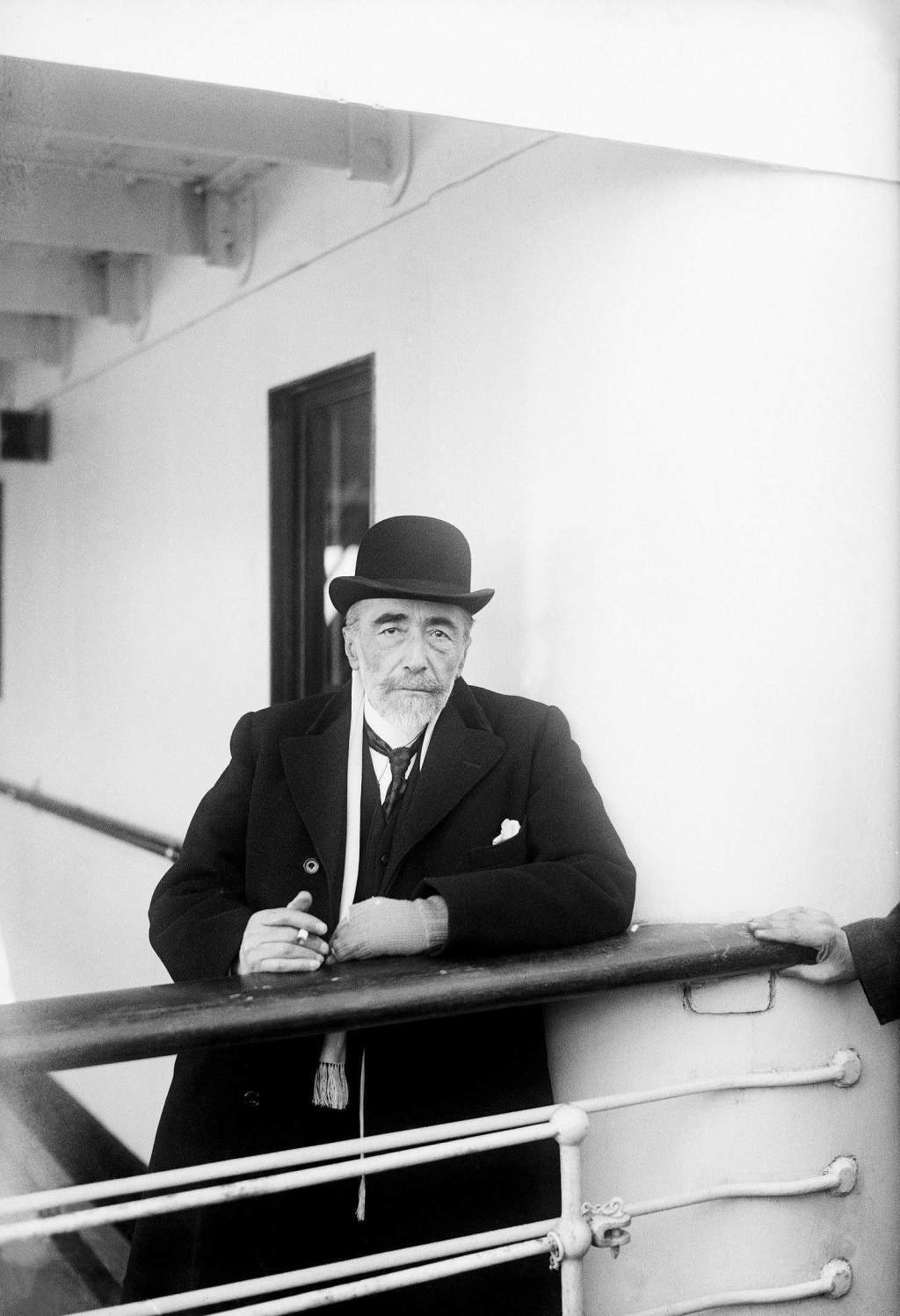
Joseph Conrad wrote about the darkness at the centre of things — not as a metaphor, not as a philosophical proposition to be argued and defended, but as a lived reality that his own extraordinary life had given him direct and repeated access to. He was a Polish nobleman who became a British subject, a sailor who became a novelist, a man who had navigated the Congo River at the height of the Belgian colonial enterprise and watched what European civilisation looked like from the inside of its most extreme expression, and who spent the rest of his life trying to find the language adequate to what he had seen. The darkness in Conrad is not romantic or decorative. It is the darkness of a man who looked at the structures through which human beings organise meaning — the ideals of duty and fidelity, the codes of seamanship and honour, the civilising mission of the European empires — and found that they were thinner than he had hoped, that the void they covered was larger than any of them admitted, and that the individual conscience, when the structures fall away, stands alone in a universe that offers no external support for whatever it decides to do. This is an uncomfortable vision. It is also, Conrad insists with the full weight of his technical mastery and his moral seriousness, the true one.
The Improbable Englishman
Józef Teodor Konrad Korzeniowski was born in 1857 in Berdychiv, in what is now Ukraine, then part of the Russian-controlled Polish territories, the only child of Apollo Korzeniowski — a poet, playwright, translator, and committed Polish nationalist — and Ewa Bobrowska, who came from a family of more moderate political temperament and who died of tuberculosis when Conrad was seven. His father, arrested and exiled to northern Russia for his political activities, took the boy with him, and Ewa died in exile. Apollo brought his son back to Kraków and died there in 1869 when Conrad was eleven, leaving the boy an orphan in a tradition of romantic nationalism, literary aspiration, and political martyrdom that would both form and haunt everything he subsequently did.
He was raised by his maternal uncle Tadeusz Bobrowski, a practical man of conservative temperament whose scepticism about romantic heroics was communicated to his ward with a patience and a consistency that left its mark, and who provided the financial support that allowed Conrad, at seventeen, to make the decision that defined his life: he went to sea. He went first to Marseille, sailed on French ships, was involved in gun-running to the Carlist cause in Spain, allegedly fought a duel — or attempted suicide, the biographical record is disputed — and then joined the British merchant navy in 1878, beginning a career at sea that would last sixteen years, take him to Asia and Africa and Australia and South America, and culminate in his qualification as a master mariner in 1886, the same year he became a British subject.
The decision to become a British subject and a British novelist — he learned English as a third language, after Polish and French, and became one of the greatest prose stylists in the language — is the most improbable fact of his improbable life. He began writing seriously in the late 1880s, published his first novel Almayer’s Folly in 1895 at thirty-seven, and produced in the following twenty years the body of work — The Nigger of the ‘Narcissus’, Lord Jim, Heart of Darkness, Nostromo, The Secret Agent, Under Western Eyes, The Shadow-Line, Victory — that established him as one of the great novelists in any language. He suffered throughout his career from depression, from the sense that the work was not achieving what he needed it to achieve, from financial anxiety and physical illness and the specific loneliness of a man who was always simultaneously inside and outside every community he inhabited. He died in 1924, at sixty-six, in the Kent farmhouse where he had lived for the last years of his life, having become in his final decade the celebrated figure he had spent his career doubting he would ever be.
The Sea and What It Teaches
Conrad’s sea fiction — The Nigger of the ‘Narcissus’, Typhoon, The Shadow-Line, Youth, The Secret Sharer — is the foundation of everything else he wrote, and the sea in Conrad is not the sea of adventure romance or the sea of lyrical description. It is the sea as moral testing ground: the environment that strips away the social conventions and comfortable assumptions of the shore and exposes the individual to conditions under which character — what a person is when the props are removed — becomes the only available resource.
The code of seamanship that Conrad revered — and he revered it with the fervour of a convert, the Polish aristocrat who had made himself a British sailor and who understood the professional ethics of the sea as one of the few genuinely sustaining structures available to the individual in a universe without intrinsic meaning — was not sentimental. It was practical: the understanding that in conditions of genuine danger, the only thing between the ship and the bottom of the ocean was the competence and the fidelity of each person to their function. The sailor who abandons his post, who fails in his duty at the critical moment, does not merely damage himself. He damages everyone who depended on him. The code is a recognition of interdependence made concrete by the fact that failure is immediately and catastrophically visible.
The Shadow-Line, one of Conrad’s last major works, published in 1917, is the most personal of the sea narratives — the story of a young captain taking command of his first ship and discovering that command means carrying the full weight of responsibility for everyone aboard without the comfort of the experience that would make the carrying easier, that the shadow line between youth and maturity is crossed not through achievement but through the acceptance of a burden whose full weight you can only understand by carrying it. The fever that strikes the crew, the calm that becalms the ship, the medicine that turns out to be worthless — all of these are external forms of the internal crisis of a man discovering what he is made of in the only way that discovery is possible: under pressure, alone, with consequences.
Lord Jim and the Failure of the Ideal
Lord Jim, published in 1900, is the novel in which Conrad’s central preoccupation — the individual conscience confronting its own failure — achieves its fullest and most complex expression. Jim is a young officer on a pilgrim ship, the Patna, that strikes something in the water and appears to be sinking. The officers, convinced the ship is lost, abandon it and the eight hundred pilgrims aboard. Jim, after a moment of paralysis that the novel spends five hundred pages examining without resolving, jumps. The ship does not sink. The pilgrims survive. Jim is the only officer who faces the inquiry.
The inquiry strips him of his certificate and his professional identity, but it cannot strip him of the burden he carries — the knowledge of the jump, of the moment of failure, of the gap between the self he imagined himself to be and the self that jumped. He moves from port to port across the East, unable to escape the knowledge, until he arrives in Patusan, an isolated trading post far from the shipping lanes and the communities in which his disgrace might be known, where he becomes, through a series of courageous acts, a figure of genuine authority and genuine respect — Tuan Jim, Lord Jim, the man who has finally become the hero he always imagined himself to be.
And then, at the novel’s end, he fails again — or rather, he makes a choice that looks like failure and might be understood as its opposite. Gentleman Brown, a pirate who has stumbled into Patusan, appeals to Jim through the code of shared white identity and, more importantly, through the shared experience of having done something one cannot forgive oneself for. Jim allows Brown and his men to leave rather than destroying them, and Brown, in gratitude or in contempt, kills the chief’s son on the way out. Jim faces the community whose trust he has finally earned, accepts responsibility for what his misjudgement has caused, and allows himself to be shot by Doramin, the boy’s father.
The ending has divided readers since the novel’s publication. Is Jim’s death heroic — the final redemption, the act of genuine courage that the jump denied him? Or is it another failure — the romantic’s choice of the grand gesture over the practical obligation, the abandonment of the woman who loves him and the people who depend on him in favour of a death that serves his own need for a narrative conclusion? Conrad does not answer the question. He presents it through Marlow — the narrator, the figure of mediation, the man who tells Jim’s story because he cannot stop thinking about it — and Marlow does not answer it either. The ambiguity is the point. The novel insists that the conscience cannot be finally adjudicated from outside, that the question of whether Jim redeemed himself is a question that only Jim could answer and that he has taken the answer with him.
Heart of Darkness
Heart of Darkness, published in 1899, is the most argued-over text in the English literary canon, and the arguments are not merely academic. Chinua Achebe’s 1977 essay An Image of Africa: Racism in Conrad’s Heart of Darkness made the charge that has defined the debate ever since: that Conrad’s novella, whatever its merits as a critique of European imperialism, cannot see the Africans it depicts as fully human, that they exist in the text as backdrop and atmosphere rather than as people, that the darkness of the title is the darkness that the European imagination has always projected onto Africa, and that a novel that does not challenge this projection but reproduces it — however ironically, however critically — is complicit in the racism it appears to critique.
The charge is serious and it is substantially correct, and any essay on Conrad that does not say so directly is being dishonest. Achebe is right that the Africans in Heart of Darkness are not individualised, not given interiority, not seen from the inside in the way that the Europeans are. He is right that the darkness of the title carries the weight of the racist association between Africa and savagery that the European imagination had been building for centuries. He is right that a novel which uses Africa as the setting for a European man’s psychological journey — as the Heart of Darkness that reveals the Heart of Darkness in the European soul — is, structurally, reproducing the colonial relationship even as it critiques colonial practice.
What Achebe is less right about is the implication that the critique of imperialism is therefore worthless, or that Heart of Darkness has nothing to say that deserves attention. The novella is the most searching examination produced in its time of what the European civilising mission actually was — of the gap between the official ideology of imperial benevolence and the reality of the rubber stations, the severed hands, the ivory extracted at the cost of everything human in the people who extracted it. Kurtz — the man who went into the Congo as the most eloquent representative of the civilising ideal, whose report to the International Society for the Suppression of Savage Customs is a masterpiece of humanitarian rhetoric, and who ends with the footnote he has added himself: Exterminate all the brutes — is the most devastating portrait of the imperial mind in literature.
The horror that Kurtz sees at the end — the famous dying words, the horror, the horror — is not the horror of African savagery. It is the horror of European self-knowledge: the recognition that the civilised man, given power without accountability and distance from the structures that constrain the worst impulses of the civilised world, is capable of exactly what he accused the savage of. The darkness was always inside, always European, always the shadow that the civilising mission cast and refused to look at. Marlow comes back from the Congo and lies to Kurtz’s fiancée, tells her that his last words were her name rather than the horror, and the lie is the lie of civilisation itself — the official story maintained in the face of the reality that would destroy it.
Both things are true: the novella is a landmark critique of imperialism and it reproduces the racist imagery of its era. The reader has to hold both simultaneously, as the tradition requires us to hold the complexity of any major text that has outrun the limitations of its author.
Nostromo and the Material Interests
Nostromo, published in 1904 and the most ambitious of Conrad’s novels, expands the frame of the individual conscience to encompass the entire life of a fictional South American republic, Costaguana, and its relationship to the silver mine that is simultaneously its potential salvation and its certain corruption. It is the most explicitly political of Conrad’s major works and the most prophetic — a novel about the relationship between capital and politics, between the material interests of foreign investment and the nominal sovereignty of the nations that receive it, that has proved more relevant with every decade since its publication.
The silver of the mine is the novel’s central symbol and its most sustained meditation on value and corruption. Charles Gould, the mine’s owner, inherits it as a curse from his father and transforms it into an ideal — the mine as the instrument of stable government, of progress, of the material conditions for civilised life in a country that has known nothing but instability and violence. The ideal is genuine and the corruption it produces is genuine, and Conrad refuses to resolve the tension between them. The material interests, once established, have their own logic that exceeds any individual’s intention or control. Gould wanted to use the silver to create stability; the silver uses him to perpetuate itself.
Nostromo himself — the Capataz de Cargadores, the man of the people, the figure of incorruptible reliability whose trustworthiness is the foundation of the entire enterprise — is corrupted not by venality but by the silver he hides, by the treasure that he has saved and that he cannot claim and that possesses him as completely as any of the idealists are possessed by theirs. The incorruptible man discovers that he has a price; the discovery destroys him more completely than any external enemy could. This is Conrad’s most political insight: that the system corrupts not by rewarding the corrupt but by corrupting the honourable, by making even integrity a form of possession that the possessor cannot escape.
Under Western Eyes and the Burden of History
Under Western Eyes, published in 1911, is Conrad’s most directly autobiographical novel in the sense that matters most — not autobiographical in its plot, which concerns a Russian student who betrays a revolutionary and spends the rest of the novel carrying the betrayal, but autobiographical in its engagement with the Poland that Conrad had left and could not leave, with the Russian power that had killed his parents and defined the political world of his childhood, with the question of what it means to be born into a history of defeat and martyrdom and how that history shapes the consciousness that carries it.
Razumov betrays Haldin — the revolutionary who has taken refuge with him, trusting him with his life — not from conviction but from fear and the desire for the ordinary future that Haldin’s presence threatens. The betrayal is immediately regretted and permanently unforgiven, by Razumov himself above all. He is sent to Geneva as a spy, falls in love with Haldin’s sister Natalia, and eventually confesses to the revolutionary circle — not because confession will save him but because the weight of the secret has become heavier than the weight of its consequences. He is deafened by a revolutionary who ruptures his eardrums and left in the road, where he is run over by a tram. He survives, permanently deaf, permanently broken, permanently at peace.
The novel’s title refers to the Western perspective — specifically the perspective of the English language teacher who serves as the novel’s narrator, who is assembling the story from Razumov’s diary and his own limited understanding of a Russian political world whose logic is alien to him. The Western eyes see clearly in some respects and not at all in others, and the limitation is not presented as a failure of intelligence but as a structural feature of the perspective: the West has always seen Russia through a glass that distorts, has always understood its politics in categories that do not quite fit, and the English narrator’s bewilderment is both honest and representative. Conrad, the Pole who had become English, understood both the Russian world and the Western incomprehension of it with a completeness that made the novel’s form — the Western narrator trying and failing to fully comprehend the Russian story — the most precise available instrument for what he needed to say.
What Conrad Gives
What Joseph Conrad gives the human condition argument is something that the comfortable traditions of both the novel and the political essay have generally preferred to avoid: the sustained, technically accomplished, morally serious insistence that the structures through which human beings organise meaning — the professional codes, the political ideals, the civilising missions, the revolutionary programmes — are thinner than they claim, and that the void they cover is darker and larger than any of them acknowledge.
This is not nihilism. Conrad was not a nihilist, though he has sometimes been read as one. He believed — with the ferocity of a man who had chosen fidelity to the code of the sea over the romantic nationalism of his parents’ tradition — in the value of doing the work well, of maintaining the standard under pressure, of being reliable in the specific, practical, unglamorous sense that the sea demands. The horror at the centre of things does not make the standards worthless. It makes them more necessary. The darkness is precisely the reason the code matters, the reason Marlow lies to Kurtz’s fiancée, the reason Jim’s jump is a tragedy rather than simply a statistic.
The darkness in Conrad is not the darkness of despair. It is the darkness of honesty — the refusal to accept the official story about what human beings are capable of and what the structures they build are actually for. He looked at the Belgian Congo and saw what European civilisation looked like from the perspective of its victims, and he did not look away. He looked at the pilgrims on the Patna, abandoned by officers whose professional code required them to stay, and he followed one of those officers for five hundred pages, refusing to let either himself or the reader escape into easy judgment or easy absolution.
The improbable Englishman from Poland, the master mariner who became one of the great novelists of the modern world, gave us the most honest account of his age of what happens when the light of civilisation is followed to its source and the source turns out to be the same darkness it was supposed to illuminate. The horror is real. The work, done well, in full knowledge of the horror, is the only available answer.
It has always been enough. It has never been quite enough. Conrad knew both things simultaneously, and wrote from the space between them, which is where the truth lives.
Sources and Further Reading
Conrad, Joseph. Heart of Darkness. Blackwood’s Magazine, 1899. Published as Youth: A Narrative and Two Other Stories. Blackwood, 1902.
Conrad, Joseph. Lord Jim. Blackwood, 1900.
Conrad, Joseph. Nostromo: A Tale of the Seaboard. Harper, 1904.
Conrad, Joseph. The Secret Agent: A Simple Tale. Methuen, 1907.
Conrad, Joseph. Under Western Eyes. Methuen, 1911.
Conrad, Joseph. The Shadow-Line: A Confession. Dent, 1917.
Conrad, Joseph. The Nigger of the Narcissus. Heinemann, 1897.
Conrad, Joseph. Typhoon and Other Stories. Heinemann, 1903.
Conrad, Joseph. A Personal Record. Harper, 1912.
Achebe, Chinua. “An Image of Africa: Racism in Conrad’s Heart of Darkness.” Massachusetts Review 18, no. 4, 1977.
Karl, Frederick R. Joseph Conrad: The Three Lives. Farrar, Straus and Giroux, 1979.
Najder, Zdzislaw. Joseph Conrad: A Life. Translated by Halina Najder. Camden House, 2007.
Said, Edward. Culture and Imperialism. Knopf, 1993.
Watt, Ian. Conrad in the Nineteenth Century. University of California Press, 1979.
Berthoud, Jacques. Joseph Conrad: The Major Phase. Cambridge University Press, 1978.
Hampson, Robert. Joseph Conrad: Betrayal and Identity. Macmillan, 1992.

Leave a Reply