
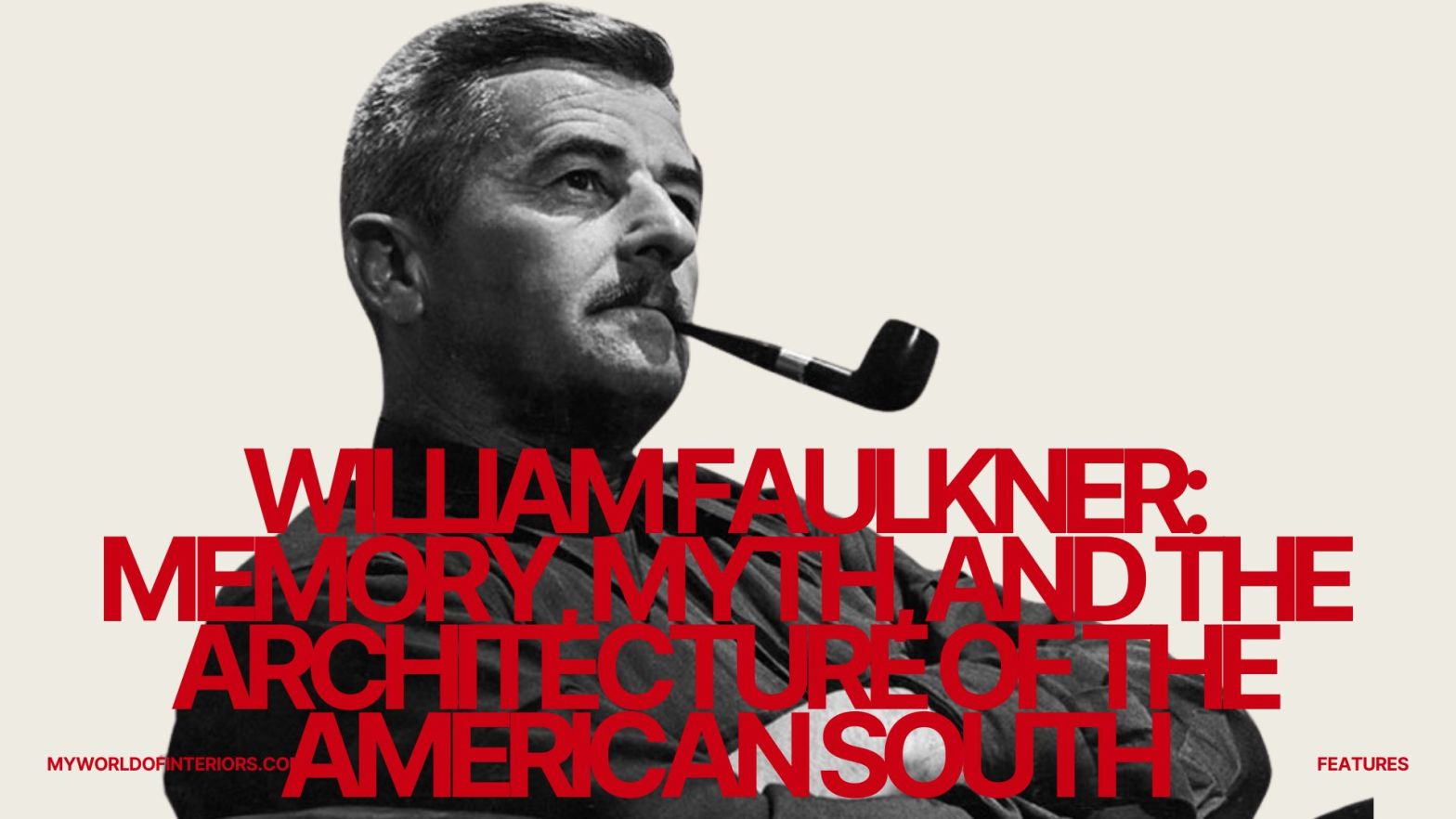
William Faulkner remains one of the most challenging and rewarding figures in American literature. Born in New Albany, Mississippi, in 1897, he spent nearly his entire life in the South, fashioning from it a fictional universe — Yoknapatawpha County — that became one of the great imaginative geographies of world literature. Like Joyce with Dublin or Balzac with Paris, Faulkner turned a provincial landscape into a cosmos, compressing history, memory, violence, and myth into sentences whose very rhythms enact the difficulty of remembering.
Faulkner’s genius lies in his confrontation with the South as both burden and muse. His novels wrestle with slavery’s legacy, the collapse of aristocratic ideals, and the violence of modernity. Yet he never reduces the region to caricature. Instead, he renders its contradictions in the polyphonic texture of multiple voices, fragmented timelines, and shifting points of view.
Time, Memory, and Form
Faulkner’s greatest innovation is his treatment of time. His narratives rarely move forward in simple chronology. Instead, they spiral, fracture, repeat. Memory constantly interrupts the present; past and present co-exist in consciousness. This is most famously dramatized in The Sound and the Fury (1929), where four narrators retell the decline of the Compson family, each filtering the story through different temporal and psychological lenses.
Influenced by modernism (Joyce, Woolf, Proust), Faulkner adapted stream-of-consciousness to the cadences of Southern speech, producing prose that is simultaneously baroque and intimate, difficult and musical. His sentences stretch across pages, their grammar breaking under the weight of thought. For readers, the effect is at once disorienting and immersive — to read Faulkner is to inhabit consciousness itself.
The South as Myth and Tragedy
Faulkner’s South is haunted. It is a world where the Civil War remains a living memory, where plantation ideals decay into grotesque remnants, where racial injustice pervades daily life. His aristocratic characters are often absurd or tragic relics; his Black characters, though sometimes confined by his own cultural blind spots, are nonetheless essential voices in the choral structure of his fiction.
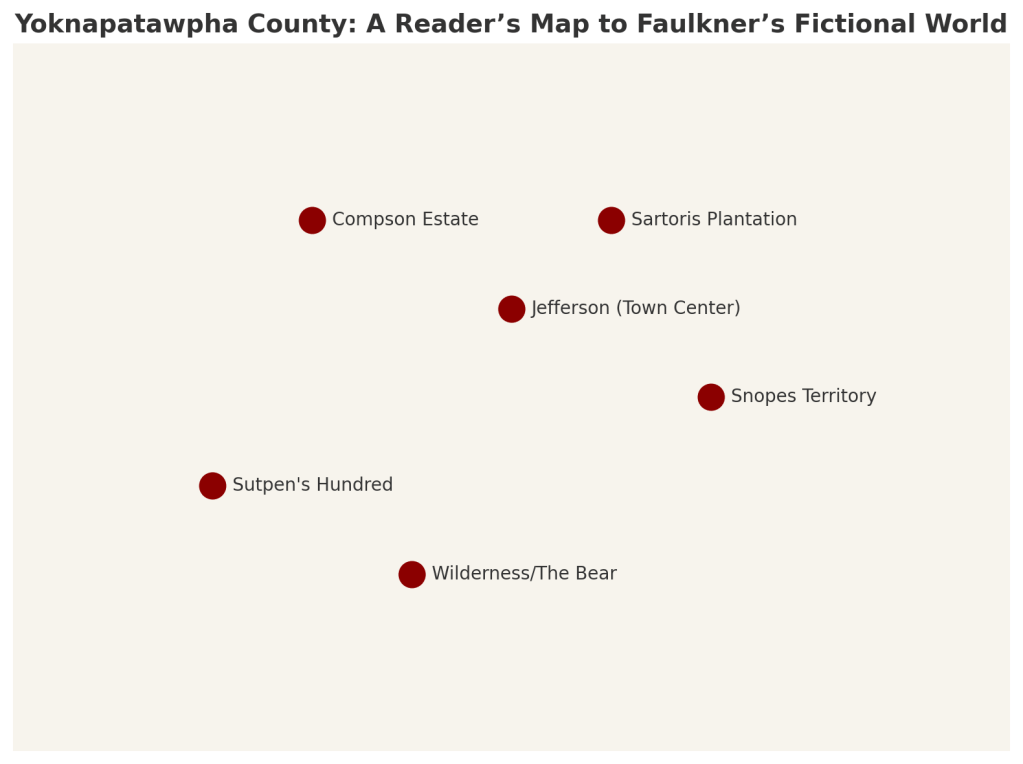
Yoknapatawpha County is not simply “the South”; it is Faulkner’s reimagining of history as myth, populated by families — the Compsons, the Sartorises, the Snopeses — who embody cycles of pride, violence, and decline. Through them, Faulkner dramatizes America’s deepest contradictions: freedom and bondage, nobility and brutality, memory and forgetting.
Style and Difficulty
Faulkner is often called “difficult.” His novels resist linear reading; his syntax can overwhelm; his refusal to guide the reader feels at times merciless. Yet his difficulty is inseparable from his vision. The fragmentation of his prose mirrors the fragmentation of history and consciousness. The reader’s labor is not incidental but essential: to read Faulkner is to wrestle with the complexity of truth itself.
Nobel and Legacy
In 1949 Faulkner was awarded the Nobel Prize in Literature. His acceptance speech is now canonical, a declaration of faith in the endurance of literature: “I believe that man will not merely endure: he will prevail.” Yet Faulkner’s vision was never simplistic. He acknowledged humanity’s capacity for cruelty as well as endurance. His Nobel honor recognized not just his stylistic daring but his ethical gravity: he expanded the form of the novel to confront the deepest wounds of his nation.
Today, Faulkner’s legacy is double-edged. He is studied as one of the titans of modernism, alongside Joyce and Kafka. Yet his depictions of race and gender are contested, forcing contemporary readers to parse genius from prejudice. Perhaps this tension is part of his importance: his work demands critical engagement, refusing comfort, embodying the unresolved contradictions of American history itself.
Major Works of William Faulkner
The Sound and the Fury (1929)
Faulkner’s masterpiece of modernism. The decline of the Compson family is narrated by four voices — Benjy, Quentin, Jason, and a third-person account — each fragmenting time and perception. Themes of memory, loss, and decay dominate. A challenging but essential work.
As I Lay Dying (1930)
A polyphonic novel with 15 narrators, recounting the Bundren family’s journey to bury their mother. Comic, grotesque, tragic, the book exemplifies Faulkner’s fascination with voice and perspective. Its opening line — “My mother is a fish” — is a touchstone of literary modernism.
Sanctuary (1931)
A dark, violent novel that shocked contemporary readers. Known for its brutality, it follows the tragic story of Temple Drake, revealing the corruption and violence lurking beneath Southern gentility.
Light in August (1932)
One of his most powerful works on race and identity. The story of Joe Christmas, a man of ambiguous racial heritage, intertwines with the lives of other characters in Yoknapatawpha. Themes of alienation, violence, and social prejudice dominate.
Absalom, Absalom! (1936)
Often considered his most ambitious novel. The story of Thomas Sutpen, who builds a plantation dynasty that collapses in violence, is told through fragmented narratives, emphasizing the impossibility of fully knowing the past. Faulkner’s most profound meditation on history, race, and the South’s tragic legacy.
The Unvanquished (1938)
Set during and after the Civil War, this novel follows the Sartoris family. It explores the South’s transformation during Reconstruction, balancing nostalgia with critique.
The Hamlet (1940), The Town (1957), The Mansion (1959) — The Snopes Trilogy
A satirical, sprawling chronicle of the rise of Flem Snopes, a ruthless opportunist. Across three volumes, Faulkner charts the encroachment of greed and mediocrity into Southern life, contrasting the Snopeses’ vulgarity with fading ideals of honor.
Go Down, Moses (1942)
A collection of interconnected stories, including the famous “The Bear.” Explores the relationship between humans and nature, family and inheritance, slavery and legacy. It is often read as one of his greatest achievements.
Intruder in the Dust (1948)
A crime story centered on Lucas Beauchamp, a Black man falsely accused of murder. Though shaped by its time, the novel addresses racial injustice and anticipates later civil rights concerns.
A Fable (1954)
Faulkner’s experimental war novel, allegorical in nature. Set during World War I, it won both the Pulitzer Prize and the National Book Award, though critical opinion remains divided.
The Reivers (1962)
His final novel, lighter in tone. A picaresque tale set in 1905 Mississippi, following a young boy on a comic adventure. Awarded the Pulitzer Prize posthumously.
Conclusion: Faulkner’s Enduring Challenge
To read Faulkner is to inhabit difficulty — not for its own sake, but because difficulty is the condition of truth. His sentences demand patience, his structures demand rereading, his characters demand recognition. Yet the reward is immense: a vision of America’s deepest contradictions, given voice in language that refuses simplicity.
Faulkner’s work endures not only because it is brilliant but because it remains necessary. In the broken cadences of his prose, we glimpse the broken cadences of history itself — a literature that forces us to remember, even when memory is unbearable.
A Reading Pathway Through Faulkner
William Faulkner’s reputation for difficulty can intimidate first-time readers. His sentences are famously labyrinthine, his structures fragmented, his timelines nonlinear. But he also wrote works of great accessibility, humor, and warmth. Approaching Faulkner through a guided pathway allows readers to experience both his range and his genius.
Stage I: Accessible Entry Points
1. The Unvanquished (1938)
A series of linked stories set during the Civil War and Reconstruction. Clearer in style than his most experimental works, it offers a view into Yoknapatawpha’s landscape while introducing themes of honor, change, and family legacy.
2. The Reivers (1962)
His final novel, comic and adventurous, won the Pulitzer Prize. A lighter entry point, it demonstrates Faulkner’s storytelling humor and Southern voice without the heavy density of his earlier masterpieces.
3. Intruder in the Dust (1948)
Though dealing with racial injustice, its prose is more straightforward. A courtroom drama of sorts, it makes Faulkner’s concerns with race and society accessible in a plot-driven narrative.
Stage II: Intermediate Works — Style and Substance
4. As I Lay Dying (1930)
Polyphonic but short, with 15 narrators across 59 brief chapters. The story of the Bundren family burying their mother balances dark comedy with pathos. A good introduction to Faulkner’s stream-of-consciousness without the density of his most complex works.
5. Light in August (1932)
One of his most powerful novels, with interwoven narratives exploring identity, race, and belonging. More linear than The Sound and the Fury, yet still stylistically bold.
6. Go Down, Moses (1942)
A story cycle often read as a novel. Its centerpiece, “The Bear,” is a masterpiece of nature writing and myth-making, and the book as a whole confronts the legacy of slavery and land inheritance in the South.
Stage III: The Major Masterpieces
7. The Sound and the Fury (1929)
Perhaps his most famous, but also one of his most difficult. The decline of the Compson family unfolds across four sections, each with a distinct voice and fractured time. A quintessential Faulkner experience — bewildering at first, luminous upon rereading.
8. Absalom, Absalom! (1936)
Arguably his greatest achievement. The story of Thomas Sutpen’s doomed plantation dynasty is told through multiple narrators and layers of memory. Dense, recursive, haunting — Faulkner at his most ambitious.
Stage IV: For the Completist and the Scholar
9. Sanctuary (1931)
Notoriously violent, it scandalized readers on publication. Difficult thematically, but crucial to understanding Faulkner’s exploration of corruption and brutality.
10. A Fable (1954)
An allegorical war novel, awarded both the Pulitzer and National Book Award, though divisive among critics. A challenging read, more symbolic than narrative.
11. The Snopes Trilogy (The Hamlet [1940], The Town [1957], The Mansion [1959])
Satirical chronicles of Flem Snopes’s rise in Yoknapatawpha. Sprawling and less tightly unified than his earlier masterpieces, but invaluable for understanding Faulkner’s long historical vision.
Suggested Route
- Start with The Unvanquished or The Reivers for orientation.
- Move to As I Lay Dying and Light in August to engage with his experimental voice in more accessible form.
- Then tackle The Sound and the Fury and Absalom, Absalom! for the full Faulkner immersion.
- Finally, turn to Go Down, Moses, Sanctuary, A Fable, and the Snopes Trilogy to complete the Yoknapatawpha cosmos.
Closing Thought
Faulkner is not a writer to be consumed quickly. He rewards patience, rereading, and immersion. His sentences, sprawling and musical, demand attention but offer vision. Through this pathway, the reader can gradually ascend into the full cathedral of his work: daunting at first, but endlessly resonant once entered.
Discover more from My World of Interiors
Subscribe to get the latest posts sent to your email.

