
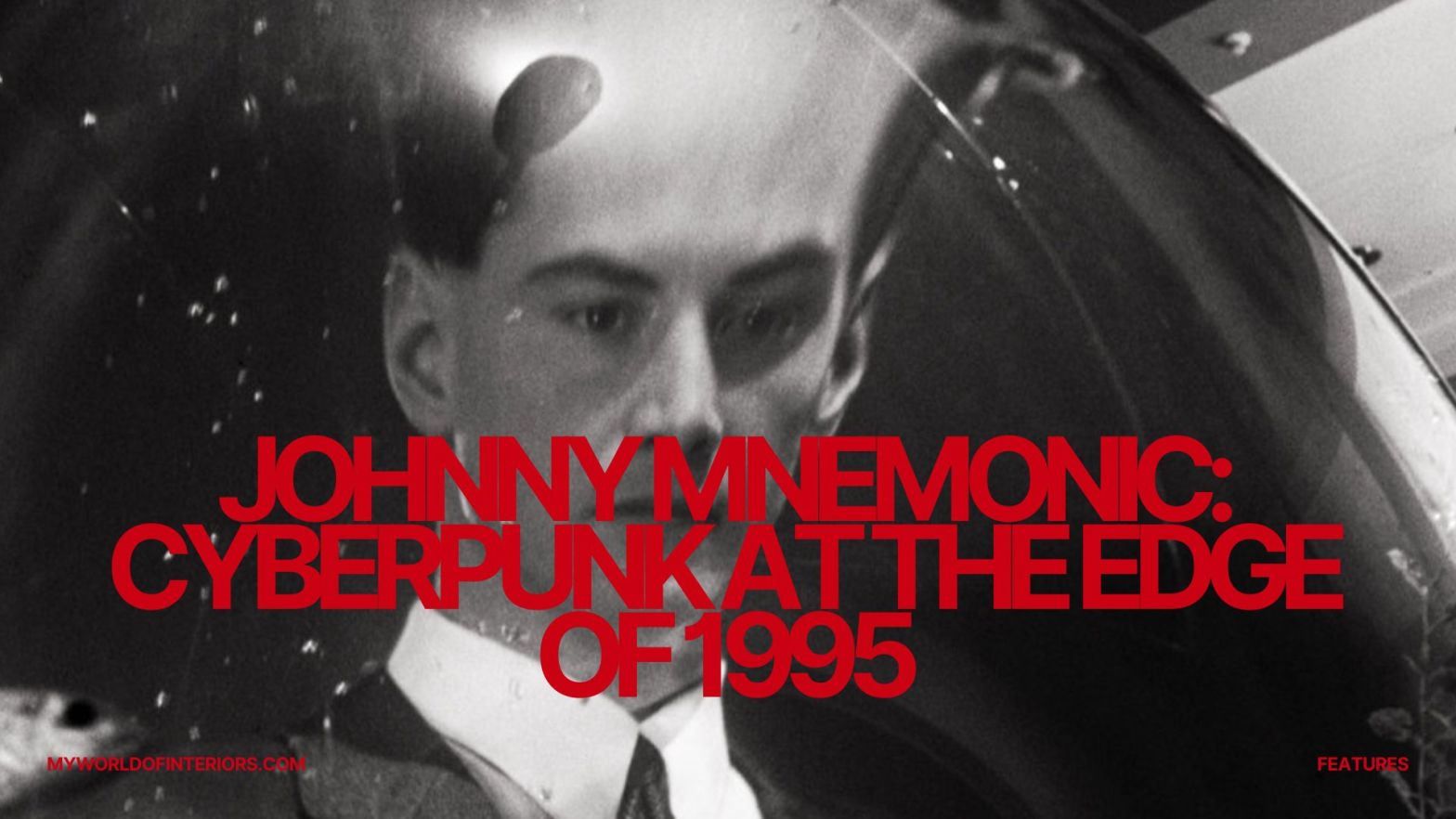
When Johnny Mnemonic premiered in 1995, it was marketed as a slick science-fiction thriller starring Keanu Reeves, riding the wave between Point Break and The Matrix. Instead, it was received as an oddity: awkward, overstuffed, more cult curio than blockbuster. Yet in hindsight, the film deserves a second look. Based on a short story by William Gibson, the godfather of cyberpunk, Johnny Mnemonic captures the anxieties and fantasies of the mid-1990s — an era just waking up to the internet, corporate globalization, and the uneasy marriage between flesh and data.
Cyberpunk on Screen
The source material is crucial. Gibson’s 1981 story envisioned a future where information is currency, neural implants replace briefcases, and hackers fight conglomerates in a shadowy networked world. Johnny Mnemonic was supposed to bring cyberpunk’s dystopian aesthetic to the mainstream.
In the film, Reeves plays Johnny, a data courier who carries sensitive information literally implanted in his brain. His payload — too large for his storage capacity — threatens to kill him unless he delivers it. Along the way he encounters Ice-T as a rebel leader, Dolph Lundgren as a psychotic street preacher assassin, and Henry Rollins as an underground doctor. It’s a cast list that reads like a 1990s time capsule.
The film’s director, Robert Longo, was known for visual art, not cinema. His outsider sensibility shows. The result is both clumsy and fascinating: a cyberpunk B-movie shot through with visual experimentation.
A World on the Cusp
Viewed today, Johnny Mnemonic feels less like a failed blockbuster than a prescient fever dream. Its anxieties — about corporate control, information overload, environmental collapse — resonate eerily with our present. In one scene, Reeves yells: “I want room service! I want the club sandwich, I want the cold Mexican beer, I want a $10,000-a-night hooker!” The speech, derided at the time, now reads as the howl of a man drowning in commodified desire — a cyberpunk Hamlet ranting against late capitalism.
The film also introduced, in embryonic form, themes that The Matrix (1999) would refine: virtual reality as battleground, Keanu Reeves as reluctant messiah, technology as both prison and salvation.
Style Over Coherence
Critics in 1995 dismissed Johnny Mnemonic as incoherent. And it is. But its incoherence is its charm. The film is part noir, part action flick, part avant-garde experiment. Its CGI — primitive by today’s standards — offers a glimpse of how filmmakers first imagined cyberspace: crude polygons, wireframe cities, surreal abstractions.
If Ridley Scott’s Blade Runner (1982) gave cyberpunk its rain-soaked melancholy, Johnny Mnemonic gave it its MTV-era flash: neon, tattoos, data streams, guitar feedback. It is cyberpunk not as meditation but as collage, stitched together from countercultural scraps.
Legacy: Cult, Not Classic
The film flopped commercially and critically. But in the decades since, it has gathered cult status — particularly the Japanese cut, longer and more coherent than the U.S. release. For fans of Gibson’s fiction and cyberpunk aesthetics, it remains an artifact of the genre’s difficult transition to cinema.
More broadly, Johnny Mnemonic reflects 1995 itself: a moment of techno-optimism and techno-paranoia. The internet was still nascent, but fears of data piracy, corporate surveillance, and information addiction already haunted culture. Reeves, Ice-T, Rollins, and Lundgren together embody that strange cultural moment when Hollywood, counterculture, and cyberpunk collided.
Johnny in the Age of the Cloud
Seen today, in an era when terabytes of data live in our pockets, the idea of a man carrying 320 gigabytes in his head seems quaint. But that quaintness is also revealing. Johnny Mnemonic dramatizes the anxieties of a world just stepping into the digital age, when the metaphors for information were still bodily, physical, dangerous.
The film’s flaws are undeniable. But its atmosphere — messy, strange, prescient — is what makes it endure. It is less a polished Hollywood product than a time capsule: a record of what the future looked like in 1995, and of how cinema tried, awkwardly, to imagine cyberspace before cyberspace truly arrived.
Five Films That Defined Cyberpunk on Screen
Cyberpunk has always been more than a literary genre — it is an aesthetic, a mood, a way of imagining the collision between technology, capitalism, and the human body. While Johnny Mnemonic captured one version of the mid-1990s zeitgeist, these five films helped define the genre’s cinematic DNA.
1. Blade Runner (1982, dir. Ridley Scott)
The mother of all cyberpunk films. Scott’s rain-drenched Los Angeles, drenched in neon and despair, gave the genre its look: towering megacities, synthetic humans, and noir fatalism. Harrison Ford’s Deckard hunts replicants, but the real subject is identity itself. Who counts as human? What does it mean to feel?
2. Akira (1988, dir. Katsuhiro Otomo)
The anime masterpiece that blew open cyberpunk’s global reach. In post-apocalyptic Neo-Tokyo, biker gangs, telekinesis, and government conspiracies converge in an explosion of animation that remains unmatched. Akira showed that cyberpunk could be cosmic in scope while still deeply rooted in urban grit.
3. Ghost in the Shell (1995, dir. Mamoru Oshii)
Released the same year as Johnny Mnemonic, Oshii’s film distilled cyberpunk’s existential core. Major Motoko Kusanagi, a cyborg security agent, questions her own identity as human and machine blur. Its visuals directly influenced The Matrix, and its questions about consciousness in the age of AI feel even sharper today.
4. The Matrix (1999, dirs. Lana & Lilly Wachowski)
The film that took cyberpunk mainstream. Keanu Reeves (graduating from Johnny Mnemonic’s prototype to full messiah) discovers the world is a simulation. Blending philosophy, martial arts, hacker culture, and leather-clad aesthetics, The Matrix redefined the genre for a new millennium.
5. Tetsuo: The Iron Man (1989, dir. Shinya Tsukamoto)
If Blade Runner was sleek, Tetsuo was punk. A low-budget Japanese body-horror film, it tells of a man transforming grotesquely into metal. Shot in high-contrast black-and-white, it is cyberpunk stripped to its core anxieties: the body consumed by technology, identity lost in industrial noise.
The Throughline
From Scott’s melancholic futurism to Tsukamoto’s body-horror nightmares, cyberpunk cinema is always about borders collapsing: human/machine, freedom/control, reality/illusion. Johnny Mnemonic may be clumsy compared to these giants, but it shares their DNA: the attempt to visualize the unease of living in a world where data, power, and flesh collide.
Discover more from My World of Interiors
Subscribe to get the latest posts sent to your email.

