Close Looking · One Painting
Everything I Am Is on This Jacket
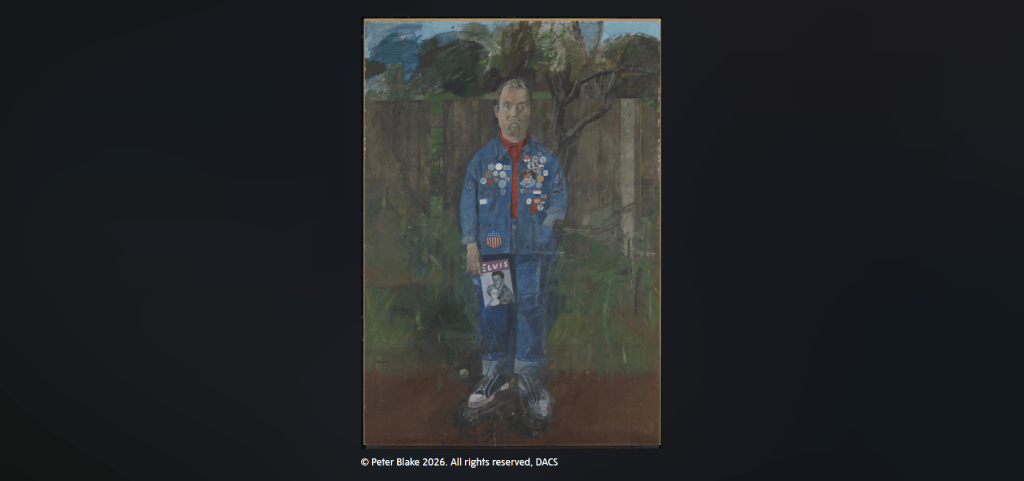
In 1961, Peter Blake painted himself in a Chiswick garden holding an Elvis magazine, wearing Converse boots and a denim jacket covered in badges. The result is the most precise and most melancholy self-portrait in British art. It is also, accidentally, a portrait of a generation.
By Bergotte
Peter Blake, Self-Portrait with Badges, 1961
Oil on board · 174.3 × 121.9 cm · Tate Britain, London
Won the Junior section of the John Moores Painting Prize, Liverpool, 1961. Featured in Ken Russell’s BBC film Pop Goes the Easel, 1962.
He is standing in a garden in Chiswick, in front of a wooden fence, and he looks faintly miserable. He is twenty-nine years old — though the painting insists on reading him as younger, as a teenager still — and he is wearing turned-up jeans and a denim jacket covered in badges and Converse basketball boots, and he is holding, in his right hand with the loose casualness of something precious, a copy of Elvis Monthly. His expression is neither sullen nor defiant nor embarrassed. It is something more interesting and more difficult than any of those: it is the expression of someone who has committed, fully and without irony, to a set of allegiances that he knows, or half-knows, may not be adequate to the self he is trying to construct from them. The badges are the argument. The face is the doubt.
Self-Portrait with Badges was painted in 1961, won the junior section of the John Moores Painting Prize in Liverpool that year, and is now in the collection of Tate Britain, where it hangs as one of the founding documents of British Pop Art. It is also, looked at without the weight of that institutional reputation, one of the strangest and most moving self-portraits in the history of British painting — a work that manages to be simultaneously a manifesto, a confession, and a joke that the painter is making at his own expense, with genuine affection for the person being made fun of.
The badges are the argument. The face is the doubt.
The Blue Boy in Denim
The painting has a source, and the source is specific: Thomas Gainsborough’s The Blue Boy, painted in 1770, in which a beautifully dressed aristocratic young man stands in a romantic English landscape, his blue silk suit catching the light, his posture easy and assured, the whole image an embodiment of inherited privilege rendered with Gainsborough’s characteristically effortless technical grace. Blake knew this painting. He built his self-portrait from it, deliberately and with great care — the frontal pose, the full-length figure, the single subject against an outdoor setting, the dominant blue of the clothing. Everything that Gainsborough’s painting asserts, Blake’s painting inverts.
The blue fabric is not silk but denim — a material that in 1961 was still scarce in Britain, still associated with American youth culture, still found not in fashion shops but in work-wear stores and military surplus outlets. Levi 501s, which Blake wears, were prized precisely because they were not easy to come by, because they carried the promise of another world — the world of Elvis and Marlon Brando and James Dean, the world of the American teenager that British youth culture was in the process of trying to translate into its own idiom. The landscape behind Gainsborough’s boy is romantic and sweeping. The landscape behind Blake is a suburban wooden fence in west London, slightly grimy, entirely unpicturesque. The aristocratic ease of The Blue Boy becomes, in Blake’s hands, the studied casualness of someone who has assembled his look with considerable effort and is now performing it for the camera with a self-consciousness that the performance cannot quite conceal.
What the Badges Say
The badges are the painting’s primary text. Blake collected them — obsessively, as he collected almost everything — and the jacket in the painting is covered in them, a dense accumulation of small circular loyalties pinned to the denim like a personal coat of arms. They include badges supporting Elvis Presley, who by 1961 had been drafted into the US Army and was, in the view of many of his original fans, in the process of going mainstream and losing whatever made him dangerous. There are political badges — one supporting Adlai Stevenson, the Democratic presidential candidate who lost to Eisenhower twice and to Kennedy once, which is to say a badge advertising commitment to a cause that had already failed three times. There is a Pepsi badge, Coca-Cola’s perennial runner-up.
The detail is not accidental. Blake chose, with considerable precision, badges that were slightly off — that represented the second-best option, the cause that didn’t win, the idol who was already fading. The painting is, among other things, a meditation on the particular condition of the enthusiast: the person who commits fully to a set of allegiances that the world has not entirely endorsed, who pins his loyalties to his chest and then stands in the garden waiting for the photograph to be taken. There is something both comic and genuinely poignant about this, and Blake holds both qualities simultaneously without resolving the tension between them. The badges are sincere. The badges are also a little ridiculous. Both things are true and the painting knows it.
He chose, with considerable precision, badges that were slightly off — the cause that didn’t win, the idol who was already fading. The painting is a meditation on the particular condition of the enthusiast.
The Elvis Monthly he holds is the other key object. Elvis had become known in Britain only recently — the painting catches the very moment of the culture’s arrival, before it had been fully absorbed or domesticated. To hold the magazine is to declare a loyalty that is still slightly provisional, still slightly transgressive, still carrying the charge of something that has not yet been entirely accepted as normal. But to hold it with that particular air of possession — loosely, confidently, as if it belongs in the hand — is to claim the loyalty as a settled part of the self rather than a temporary enthusiasm. Blake is, at twenty-nine, holding his Elvis magazine the way a child holds a favourite toy in a formal photograph: with the absolute conviction that this object is the most important thing in the room and that anyone who disagrees is simply wrong.
The Face and What It Withholds
The face is, deliberately, the least expressive element of the painting. Blake’s expression — and this has been noted by every serious writer on the work — is flat, slightly glum, disconnected from the visual energy of the badges and the jeans and the boots. He is not performing enthusiasm for the objects that surround him. He is not selling it. He is simply present, standing in the garden, wearing the things he wears, holding the magazine he holds, with the patient blankness of someone who has agreed to be photographed and is waiting for the moment to be over.
This flatness connects the painting to a tradition that Blake was aware of and drawing on: the tradition of the folk portrait, the naive effigy, the image of a person made not to flatter but simply to record. He was interested in Victorian fairground art, in tin soldiers, in the flat frontal representations of popular culture that preceded the era of psychological portraiture. In both its frontal pose and its surface quality — the paint applied with a smoothness that gives the figure something of the quality of a shop-front dummy or a carnival cutout — Self-Portrait with Badges belongs to this tradition as much as it belongs to the tradition of the painted self-portrait. The figure does not invite you inside. It presents itself for inspection, and the inspection is the whole of the relationship on offer.
He is not performing enthusiasm for the objects that surround him. He is simply present, standing in the garden, wearing the things he wears, with the patient blankness of someone who has agreed to be photographed and is waiting for the moment to be over.
The Garden in Chiswick
The setting is specific: the garden behind the studio Blake shared with the painter Richard Smith in Chiswick. He stands in front of a wooden fence — not the fence of a country garden or a park, but the kind of ordinary suburban boundary fence that surrounded the ordinary suburban houses of west London in 1961. There is a small tree visible to one side, also ordinary. The sky, such as it is, offers nothing dramatic. The whole setting has been stripped of any claim to the picturesque, any suggestion that the environment of the artist is elevated or special or in any way different from the environment of anyone else who lives in a terraced house in west London and has a garden with a wooden fence.
This is, for a self-portrait, a remarkable act of self-placement. Most self-portraits situate the artist in a studio — the space of making, the space that announces the professional identity of the painter. Blake situates himself in a garden, in the space of ordinary domestic life, in the context of the suburban world from which he came and to which, the painting quietly insists, he still belongs. The denim and the badges and the Converse boots are not the costume of an artist. They are the costume of a young man from Kent, born in 1932, who grew up without much money and who found in American popular culture a set of images and sounds and objects that seemed to offer an alternative to the England he had been born into.
The Painting as Document
When Ken Russell filmed Blake for his 1962 BBC Monitor documentary Pop Goes the Easel, he used Self-Portrait with Badges as a prop: Blake appeared to emerge from the painted image, stepping out of the canvas and into the film, the boundary between the painted self and the living one deliberately blurred. The same year, Tony Evans photographed Blake standing beside the painting in the same Chiswick garden, wearing the same clothes, in the same pose, the painted version and the living version side by side in the place where the painting was made.
These documentary moments confirm something that the painting itself seems already to know: that it is not quite a self-portrait in the traditional sense. It is a portrait of a type — the young man who defines himself through his allegiances to popular culture, who wears his loyalties on his jacket, who stands in the ordinary garden of his ordinary life and commits, absolutely and without embarrassment, to the things that matter to him. The fact that Blake was twenty-nine when he painted it — bearded, already balding, past the age at which the type is usually photographed — is part of what makes it interesting. He is painting himself as younger than he is, or rather painting himself as the person who first pinned the badges to the jacket, the adolescent enthusiasm that the adult still carries.
He is painting himself as younger than he is — painting himself as the person who first pinned the badges to the jacket, the adolescent enthusiasm that the adult still carries.
What It Invented
British Pop Art is often discussed as if it arrived fully formed, a coherent movement with a shared aesthetic and a common agenda. The reality was messier and more interesting: a group of artists, largely trained in the fine art tradition but fascinated by the visual culture of the mass media and American popular culture, trying to find a way to make paintings that could hold both things simultaneously. Richard Hamilton was making it cooler and more conceptual. David Hockney was making it more personal and more lyrical. Blake was making it more affectionate and more melancholy and more deeply embedded in the specific textures of British life — the fairgrounds, the wrestlers, the music hall, the badges on the school blazer.
Self-Portrait with Badges is the painting in which all of this comes together for the first time, in which Blake’s particular version of Pop Art — warm rather than cool, nostalgic rather than ironic, deeply personal rather than generically contemporary — announces itself fully. The painting knows that the badges are a slightly futile form of self-expression. It knows that Adlai Stevenson lost and that Elvis was going mainstream and that a Pepsi badge is, as a declaration of identity, a fairly modest gesture. It knows all of this and it pins the badges on anyway, with the stubbornness of someone who has decided that the things he loves are worth loving even if the world has not entirely agreed.
It hangs now in Tate Britain, in a room that contains some of the most significant British paintings of the postwar period, and it retains, after more than sixty years, exactly the quality that made it startling in 1961: the quality of a person standing in a garden, committed to his allegiances, waiting for the photograph. The fence is still behind him. The Elvis Monthly is still in his hand. The face is still not giving anything away. The badges, in the afternoon light, still say everything that the face will not.
PETER BLAKE: THE ART OF BEING A FAN – My World of Interiors
Self-Portrait with Badges (1961) by Peter Blake, oil on board, 174.3 × 121.9 cm, is in the permanent collection of Tate Britain, London (T02406). It won the junior section of the John Moores Painting Prize, Liverpool, 1961, and appeared in Ken Russell’s BBC film Pop Goes the Easel (Monitor, March 1962). Blake was born in Dartford, Kent, in 1932. He was knighted in 2002.

