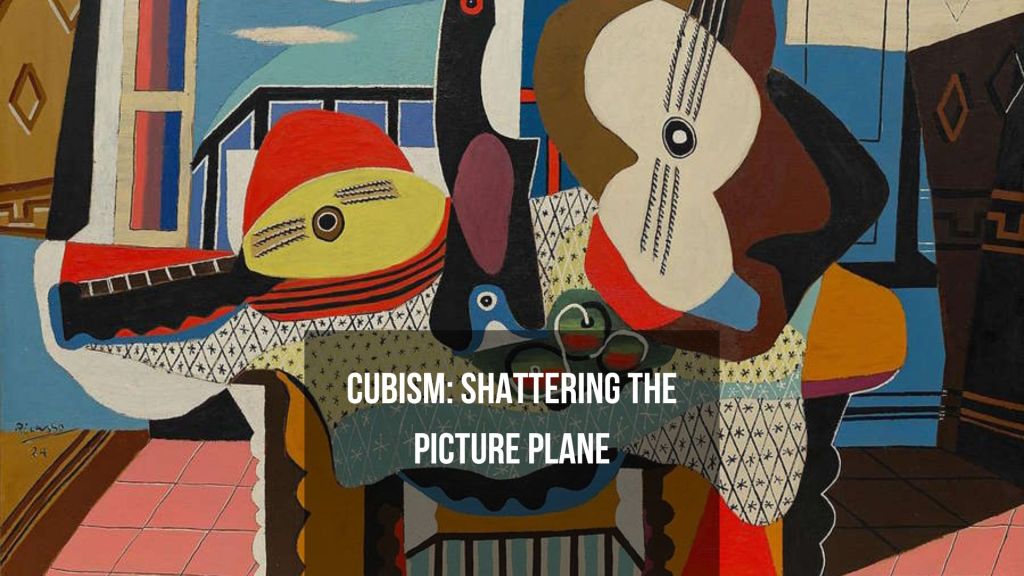
In the early years of the 20th century, painting fractured. Perspective, which had governed Western art since the Renaissance, was no longer sufficient for the modern world — a world of industrial speed, scientific discovery, and shifting perception. In the cafés and studios of Paris, two young artists, Pablo Picasso and Georges Braque, dismantled the picture plane, shattered objects into facets, and reassembled them on canvas as simultaneous viewpoints. The result was Cubism, a movement that redefined not only painting but the very act of seeing.
To call Cubism revolutionary is an understatement. It was not merely a style but a new visual language, one that questioned the stability of reality and the authority of vision. Cubism made painting self-conscious: no longer a window onto the world, but a constructed system of marks, shapes, and surfaces. It was, in short, the beginning of modernism in art.
Origins: From Cézanne to Picasso
Cubism did not emerge in a vacuum. Its roots lie in Paul Cézanne, whose late works broke down natural forms into cylinders, spheres, and cones. Cézanne’s landscapes and still lifes suggested that objects could be simplified into geometric structures, their solidity maintained even as perspective dissolved.
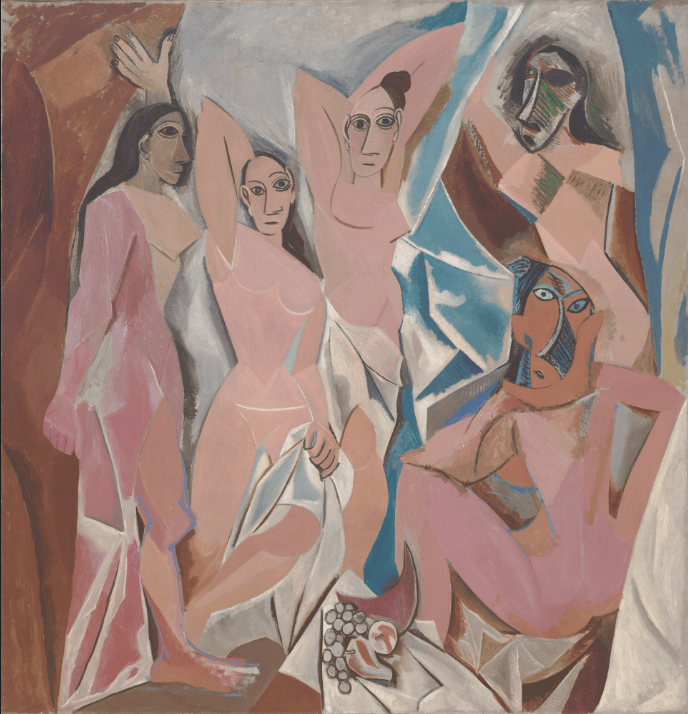
Picasso’s Les Demoiselles d’Avignon (1907) marked the real rupture: five angular female figures, their faces mask-like, some inspired by African sculpture, others by Iberian art. The canvas was shocking, aggressive, almost violent — not merely in subject but in form. Traditional perspective was abandoned; bodies became fractured planes. The painting was both a beginning and an end: the culmination of one pictorial system and the birth of another.
Analytic Cubism: The Deconstruction of Form
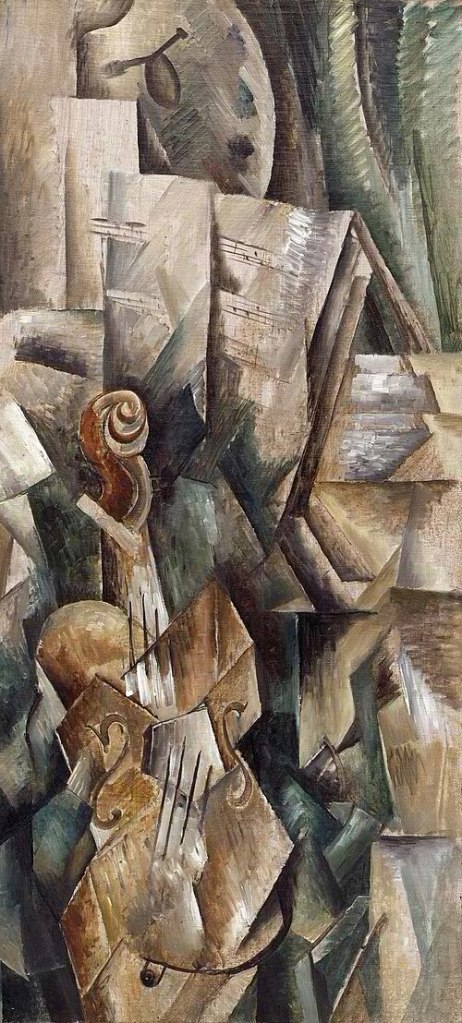
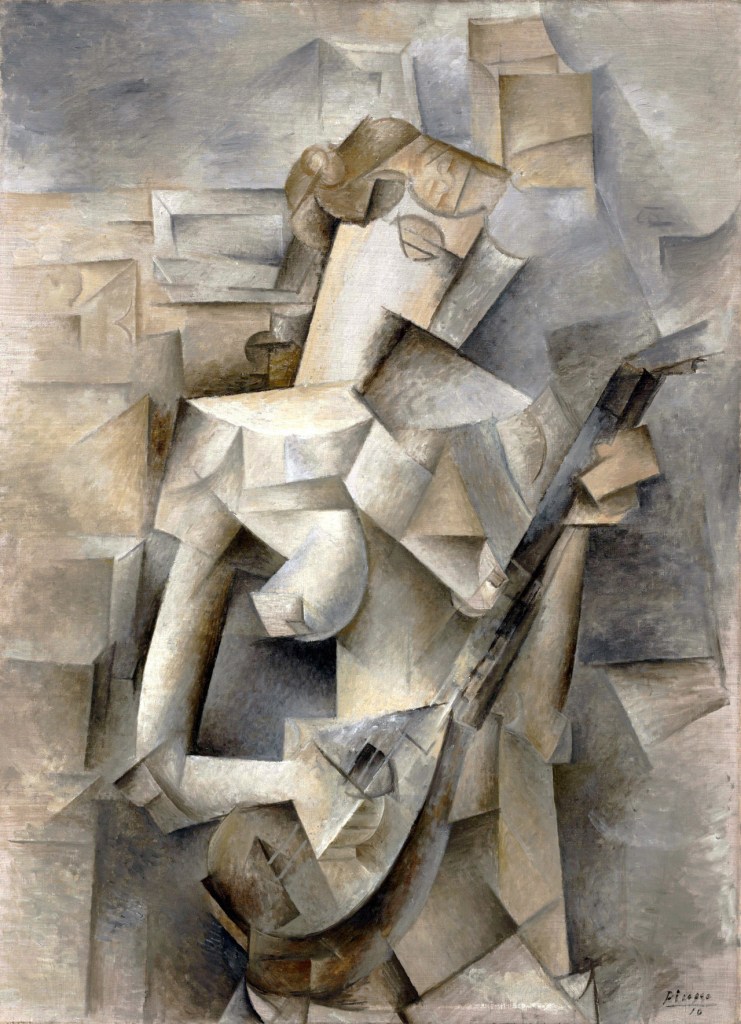
Between 1908 and 1912, Picasso and Braque embarked on what came to be known as Analytic Cubism. In canvases such as Braque’s Violin and Palette (1909) or Picasso’s Girl with a Mandolin (1910), objects dissolved into interlocking planes of muted browns and greys.
The goal was not abstraction for its own sake but analysis. A violin, a pipe, a bottle — familiar objects — were depicted from multiple viewpoints simultaneously. The eye was forced to roam the surface, reconstructing the object in time rather than seeing it instantly in space.
This was radical: a rejection of the Renaissance illusion of depth, replaced by a dynamic interplay between object and surface. The picture became less a representation than a proposition, an intellectual exercise in vision.
Synthetic Cubism: Collage and Construction
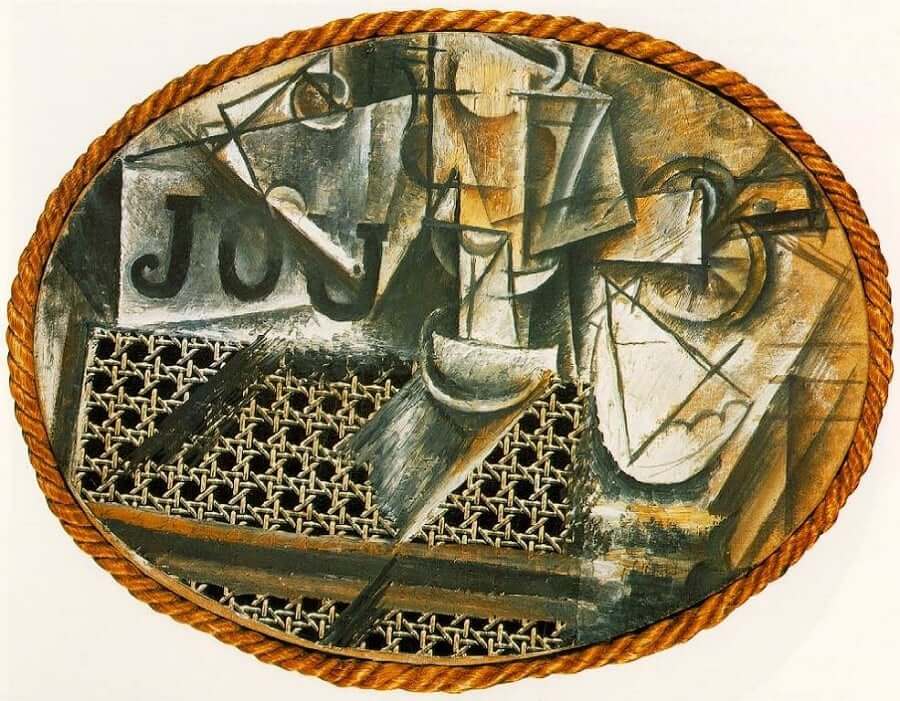
By 1912, Cubism shifted into its second phase: Synthetic Cubism. Where Analytic Cubism broke down objects, Synthetic Cubism built them up again, using collage, color, and texture.
Picasso’s Still Life with Chair Caning (1912) introduced an actual piece of oilcloth printed with chair-caning onto the canvas, blurring the line between art and life. Braque and Picasso began incorporating newspaper clippings, wallpaper, and everyday materials into their compositions. This was more than aesthetic play — it was a philosophical gesture, collapsing high art and ordinary life into the same space.
Synthetic Cubism also embraced brighter colors, more legible forms, and playful invention. It became less about analysis and more about creation, a constructive language of modernity.
Beyond Picasso and Braque: The Cubist Movement
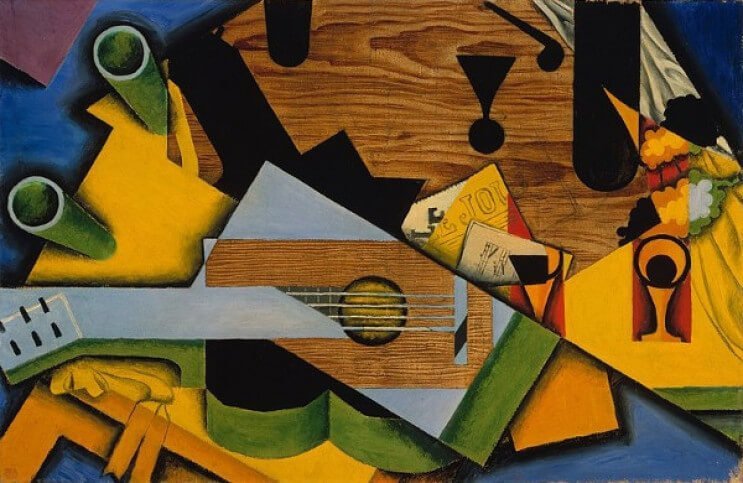
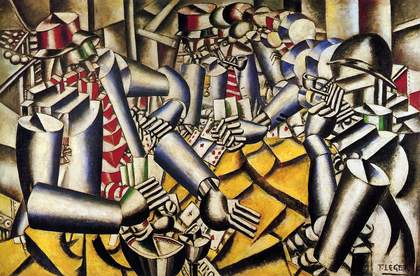
Though Picasso and Braque were the central innovators, Cubism quickly expanded into a broader movement. Artists such as Juan Gris introduced clarity and structure, bringing a crystalline elegance to Cubist still lifes. Fernand Léger pushed Cubism toward mechanization, with tubular forms and bold colors that anticipated modern design.
Writers and critics — notably Guillaume Apollinaire — championed Cubism as the avant-garde of a new century. Cubist ideas spread into sculpture (Jacques Lipchitz, Alexander Archipenko), into architecture, and even into furniture and graphic design.
By the mid-1910s, Cubism was not simply a style but a visual vocabulary shaping all modern art.
Cubism and the Modern World
Cubism must be understood not only as an artistic experiment but as a cultural response. It coincided with Einstein’s theories of relativity, which challenged fixed notions of space and time. It paralleled the fragmentation of experience in the industrial city, where simultaneity, speed, and multiple perspectives defined modern life.
To look at a Cubist painting is to experience modernity itself: fractured, layered, unstable. Cubism was not about beauty in the traditional sense but about truth — the truth that reality is complex, shifting, impossible to capture from a single vantage point.
Legacy
By the 1920s, Cubism had ceded the stage to new movements — Surrealism, Constructivism, Abstract Expressionism. Yet its impact was permanent. Without Cubism, there could be no modern art as we know it: no Mondrian grids, no Dada collages, no de Kooning abstractions.
In architecture, Cubism informed early modernist geometry; in design, it inspired Art Deco’s crystalline forms. In philosophy and literature, its simultaneity and fragmentation echoed through modernist writing, from James Joyce to Gertrude Stein.
Most of all, Cubism transformed the act of seeing. It taught viewers that a painting is not a mirror of reality but a construction, an interpretation, a set of choices. Every modern and contemporary artist — from the Abstract Expressionists to today’s conceptualists — works in the wake of that revelation.
Essential Cubist Works
- Pablo Picasso, Les Demoiselles d’Avignon (1907)
- Georges Braque, Violin and Palette (1909)
- Picasso, Girl with a Mandolin (1910)
- Braque, The Portuguese (1911)
- Picasso, Still Life with Chair Caning (1912)
- Juan Gris, Portrait of Picasso (1912)
- Fernand Léger, The City (1919)
Cubism Today
More than a century later, Cubism still feels radical. In an age of digital fragmentation, of simultaneous windows and fractured realities, Cubism’s vision seems prophetic. It was not just a way of painting, but a way of understanding the world — a recognition that reality is never singular but always multiple, layered, unstable.
Picasso once remarked: “We were trying to express what we felt was the truth, not the superficial truth of appearance but the truth that lies beneath.” That truth — fractured, multifaceted, enduring — remains Cubism’s gift to art and to modernity.

