By Bergotte
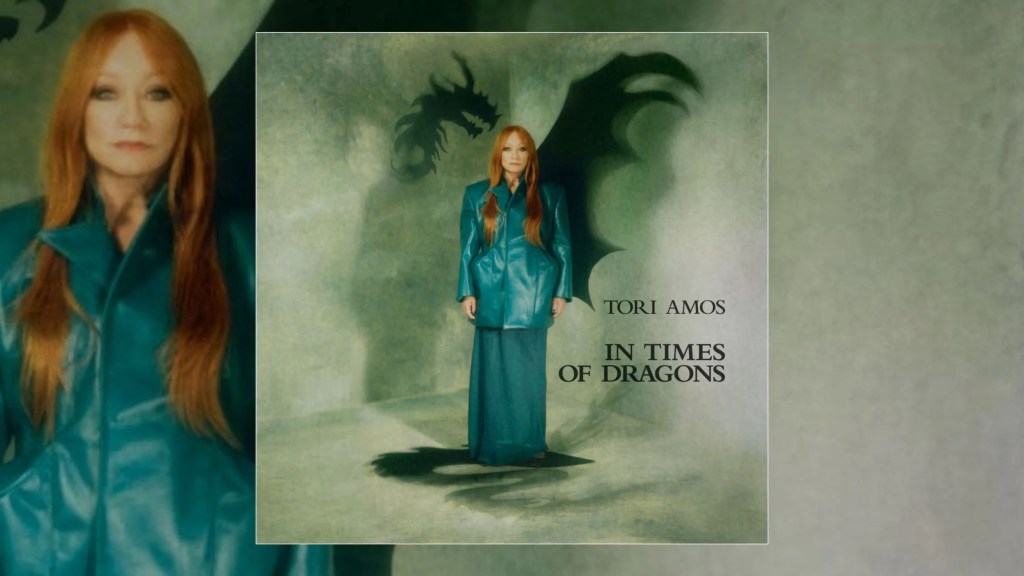
The opening line of Tori Amos’s eighteenth studio album is a command: “Shush yourself, down now.” It comes from the album’s antagonist — the “sadistic billionaire Lizard Demon husband” from whose penthouse the album’s protagonist is fleeing — and it is the most precisely chosen opening gambit she has made since the first chord of “Crucify” in 1992. In one line, the album names what it is about: the instruction to silence, the voice of authoritarian control telling the voice that matters most to stop speaking, to make itself small, to disappear. That Tori Amos has spent thirty-five years refusing exactly this instruction is the context in which In Times of Dragons must be heard. That she is still refusing it, at sixty-two, with a fury that is formally more controlled and therefore more devastating than anything she produced in the raw early years, is the argument the album makes about what it means to have a career rather than a moment.
The mythology returns
Those who have followed Tori Amos’s work across its full arc — from the raw body-centred fury of Dry and Rid of Me through the Southern Gothic darkness of To Bring You My Love through the War Requiem ambition of Boys for Pele through the conceptual grandeur of Scarlet’s Walk — will recognise immediately what In Times of Dragons is attempting. It is the return of the mythographer, the mode in which Amos has always done her most ambitious and most complete work: the construction of a symbolic world in which the political and the personal are not separated into different categories but held together in the same characters, the same images, the same songs.
The concept is elaborate in its particulars and simple in its architecture. A protagonist — an alternate version of Amos herself who made the disastrous decision to marry a Silicon Valley billionaire with authoritarian convictions — escapes from her captor and journeys through a landscape of refuge and solidarity. Along the way she encounters a Gay Witch From Brooklyn in “Provincetown,” a lesbian motorcycle gang in “Gasoline Girls,” a High Priestess in “Fanny Faudrey,” and, most importantly, a Daughter — played on four tracks by Amos’s actual daughter Natashya Hawley — whose estrangement from her mother during the marriage’s captivity and whose eventual return constitute the album’s emotional spine. The journey ends with transformation: the protagonist, told by the Order of the Dragon that she must accept what she is becoming, emerges as a human-dragon hybrid who has internalised the fight rather than merely conducting it.
This is allegory in the oldest sense — the sustained metaphor that allows truth to be said at an angle when the direct statement would be too exposed, too easily dismissed, too easily weaponised by those whose behaviour it describes. The “Lizard Demon husband” is Peter Thiel and Elon Musk and the entire ecosystem of Dark Enlightenment thinking that has found, in the Trump administration, its most complete political expression. The protagonist’s isolation from the people who loved her during the marriage is the isolation that authoritarian relationships always produce — the gradual separation from every source of independent thought and solidarity. The Daughter is every generation that inherits the consequences of the choices the previous generation made, every young woman trying to understand what happened to the world the older generation was supposed to protect.
None of this is obscure. Amos names the Dark Enlightenment directly on the title track, a song in which she examines the movement’s “vicious nihilism with calm, clear eyes while organ notes fall like droplets of water,” as one reviewer put it. She references Peter Thiel in “Shush.” She places a Bob Dylan-nodding song — “Ode to Minnesota” — in explicit solidarity with the American Midwest being told its values and its landscapes are disposable. The mythology does not replace the political content. It gives it the formal weight, the symbolic density, the capacity to mean more than the literal statement that allegory alone can provide.
“Shush” and the self-quotation
The critical detail of “Shush” — the detail that tells you more about the album’s ambitions than any other single moment — is the self-quotation. Partway through the opening track, the protagonist calls on an unlikely source of inspiration: herself. “I know a girl who wrote ‘Silent All These Years,’” Amos sings, her vowels stretched to their limits, “where is she?”
“Silent All These Years” was the song on Little Earthquakes — her 1992 debut, the record discussed at length in this series — in which a young woman articulates the experience of having been silenced, of having swallowed her voice in compliance with what was expected of her. It is one of the central songs in her catalogue, one of the songs most directly responsible for the door she opened for the generation of women artists who came after her.
To reference it here is not nostalgia. It is a formal argument. The protagonist of In Times of Dragons is calling on the woman who wrote that song as a figure of power and resistance — calling on her younger self, or the mythological version of herself, the self who had not yet been silenced again, who had not yet made the mistake of the marriage, who was in full possession of the voice that the marriage subsequently required her to suppress. The question “where is she?” is not rhetorical. It is the album’s question, the question the whole concept is designed to answer: the woman who wrote “Silent All These Years” is still here, under the silence, and she is fighting her way back.
The piano in “Shush” begins with the “dark, crawling meanderings” that characterise several of the album’s tracks — a mood of controlled menace, the Bösendorfer doing what it has always done in Amos’s hands, which is to make the subterranean emotional landscape audible — and builds into something with “a growing fury” as the protagonist’s defiance accumulates. By the song’s end, the fury has not resolved into victory. It has resolved into determination, which is a different and more durable thing.
The political and the sacred
Amos has always been a theological artist — one for whom the language of the sacred is not metaphor but the most accurate available vocabulary for the deepest human experiences — and In Times of Dragons is among her most explicitly theological records.
“St. Teresa” invokes the sixteenth-century mystic and Doctor of the Church with what one reviewer described as “a spectral languor appropriate to its titular saint’s mix of mysticism and devotion.” Teresa of Ávila was a woman who insisted on direct experience of the divine in a Church structured to mediate that experience through male institutional authority — who wrote about the interior life of prayer with a precision and a boldness that her superiors found troubling and that have made her one of the most radical spiritual figures in the Western tradition. Her appearance in an Amos album about a woman fighting authoritarian control is not accidental.
“Tempest” calls on Saint Cecilia, the patron saint of musicians, to assist in “the resurrection of a long-stilled voice.” The track’s “churning” quality and “lavishly neoclassical backdrop” — the harpsichord that has been part of her sonic vocabulary since “Cornflake Girl” making its return — give the invocation the quality of ceremony, of something being formally requested of a higher power by someone who understands the protocols of the request and intends to be heard.
What the album does with its theological material is what Boys for Pele did three decades ago and what Scarlet’s Walk did after that: it refuses the separation between the sacred and the political, insisting that the forces attacking democracy are also attacking the sacred, that the suppression of women’s voices is also a theological crime, that the appropriate response to both is the same — the gathering of whatever power is available, the refusal of the silence that is being demanded, the transformation of the self into something capable of the fight.
This is the argument that the ending dramatises. The protagonist, asked by the Order of the Dragon whether she can accept what she is becoming — the human-dragon hybrid, the woman who has incorporated the very thing that was used against her — says yes. The transformation is not corruption. It is the completion of a power she has always possessed but not yet claimed.
The daughter and what the collaboration means
The decision to include Natashya Hawley — Tori and Mark Hawley’s daughter, now twenty-five — on four tracks is not merely a touching family gesture. It is a formal choice of considerable significance.
The Daughter character in the album’s narrative is the person most damaged by the protagonist’s captivity: the child who grew up watching her mother silenced, who was herself kept at a distance from the person she needed, who arrives at the album’s midpoint with “Veins” — described as “conflicted” — and moves through “Strawberry Moon” — described as “mournful” — to the resolution of “Stronger Together,” in which mother and daughter make a vow to each other regardless of what lies ahead.
By casting her actual daughter in this role, Amos collapses the distance between the allegory and the autobiography in a way that is completely characteristic of her method. The real Natashya is not the fictional Daughter, and the real Tori is not the fictional protagonist, and yet the songs that Natashya sings are being sung by a real daughter to a real mother on a record about what happens when a woman is silenced and then finds her voice again. The biographical reality and the allegorical fiction inhabit each other, each making the other more resonant, each refusing the comfortable separation between them.
Rolling Stone noted that Hawley’s presence is particularly effective on “Stronger Together,” which they described as “gently buoyant” — the one moment of the album in which the emotional register opens into something approaching uncomplicated warmth, the vow between mother and daughter landing with a simplicity that the album’s surrounding complexity makes more rather than less powerful.
The closing and what it achieves
“23 Peaks” — the closing track, at six minutes and forty-three seconds the album’s third-longest — has attracted the strongest critical language. PopMatters called it “a towering achievement, truly unlike anything Tori Amos has ever put to record.” The description is striking and requires examination, because Tori Amos has been making records for thirty-five years and the claim that something is unlike anything she has previously achieved is not made lightly.
What the track does, from the available critical accounts, is dramatise the protagonist’s confrontation with the Order of the Dragon and her final acceptance of the transformation. The “hymnlike” quality noted by Rolling Stone suggests that the arrangement has something of the devotional about it — the closing movement of the album structured as a ceremony of acceptance rather than a moment of triumph, the transformation not a victory over the Lizard Demon but an internal completion, a becoming rather than a defeating.
This is the deepest thing In Times of Dragons understands about political resistance: that the fight against authoritarian control is not primarily external but internal. The protagonist cannot defeat the Lizard Demon by remaining the person she was before the marriage, the person who could be silenced by the instruction to shush herself down. She can only defeat him by becoming something he cannot suppress — by accepting the dragon nature that was always in her and that the captivity, paradoxically, made available to her. The wound becomes the weapon. The transformation the captor attempted to prevent is the transformation the freedom requires.
Tori Amos has been making this argument since “Sheela-Na-Gig” in 1992. The Sheela-na-gig — the grotesque, self-displaying female figure carved on medieval churches — was a woman who refused to make herself palatable. The protagonist of In Times of Dragons is a woman who refuses to remain the version of herself that the Lizard Demon found manageable. Thirty-five years later, the argument is identical. The mythology has deepened. The music has become capable of holding more. The voice has acquired the specific authority of someone who has been making it for a very long time and has not once, in all that time, been persuaded to stop.
Some honest criticism
In Times of Dragons is not without its difficulties. At seventy-six minutes and seventeen tracks, it is long — long in the way that Amos’s more ambitious concept albums have always been long, the ambition of the vision exceeding the edit that commercial sense would impose. Pitchfork’s observation that it “pales against Amos’ early work” is wrong as a general critical verdict but correct as a description of the problem that very long, very dense concept albums always face: the difficulty of sustaining the level of formal intensity across an extended runtime without some sections carrying more weight than others.
Three tracks — “Ode to Minnesota” at ninety-five seconds, “Fanny Faudrey” at one hundred and seven seconds, “Gasoline Girls” at two minutes and fifty-seven seconds — are placed consecutively in the album’s mid-section, and the structural decision to cluster the shortest tracks together has been noted by several reviewers as creating a moment of relative lightness that the surrounding darkness makes slightly disorienting. The tracks are individually effective — “Gasoline Girls” in particular, with its “jazzy melody flickering up and down as if it’s trying to jump off the piano,” sounds like an album highlight — but their grouping disrupts the album’s internal rhythm in a way that a different sequencing might have avoided.
These are the complaints of a serious listener engaging seriously with a serious work. They do not diminish the achievement. They are the kind of difficulties that arise when an artist attempts something at the limit of what the form can hold — when the ambition is large enough that the work’s imperfections are themselves evidence of the scale of what was being attempted.
The record in the context of the career
The essay this series published on Tori Amos argued that she is an artist for whom the truth of a thing and the form that expresses it are always arrived at simultaneously — an artist constitutionally unable not to burn down everything she has built in order to start again from the truth. In Times of Dragons is, in this context, the most complete fusion of her two primary modes: the mythological and the political.
The political albums — Dog Eat Dog in 1985, the various responses to specific historical moments across her career — have sometimes felt like the mythology in service of the message, the formal imagination somewhat constrained by the urgency of the argument. The purely mythological albums — Boys for Pele, Scarlet’s Walk — have sometimes felt like the myth in need of a more direct grounding in the specific political moment. In Times of Dragons achieves what those earlier records approached without quite completing: a politics so fully embedded in the mythology that the two are no longer distinguishable, a myth so rooted in the specific present moment that its timelessness and its timeliness are the same quality.
She recorded it in Cornwall, in the home studio she shares with her husband Mark Hawley, who engineered and mixed the record and played guitar throughout. The domesticity of the production context — the eighteen-studio album made at home, in the landscape she has lived in for decades, with the people closest to her — is quietly radical in an industry that continues to associate seriousness and production value with institutional settings, with the big-room studio, with the professional apparatus of the major label recording process. Amos has always made the album she needed to make rather than the album the apparatus wanted her to make. In Times of Dragons is the latest and perhaps the fullest instance of that principle.
“I know a girl who wrote ‘Silent All These Years,’” she sings at the beginning. “Where is she?” By the end of the album’s seventeen tracks, the answer is clear. She is here. She has been here the whole time. She is a human-dragon hybrid now, and she is not going to shush herself down.
Sources
Amos, Tori. In Times of Dragons. Fontana Records, 2026. Seventeen tracks; essential listening in sequence and without interruption on the first encounter.
Critical reception consulted
Yeung, Neil Z. Review of In Times of Dragons. AllMusic, May 2026.
Rolling Stone review of In Times of Dragons, May 2026.
Bristow, Poppy. Review of In Times of Dragons. Joyzine, May 2026. The most thorough track-by-track engagement with the album’s theological and political content.
Spectrum Culture review of In Times of Dragons, May 2026. Useful for the account of the album’s narrative structure.
Pitchfork review of In Times of Dragons, May 2026. The most sceptical of the major reviews; its reservations about density and opacity are worth engaging with even when they are wrong.
Context
Later in the series, the episode, “What’s So Special About Tori Amos,” provides the full career context within which In Times of Dragons should be understood. The specific connections to Boys for Pele (the mythological project), Scarlet’s Walk (the concept album form), and “Silent All These Years” (the self-quotation) are discussed there in detail.
For the Dark Enlightenment political philosophy that the album’s antagonists embody, the most accessible accounts are found in Corey Pein’s Live Work Work Work Die (Metropolitan Books, 2017) and Molly Fischer’s essays in The Cut on Silicon Valley’s political turn.

Leave a Reply