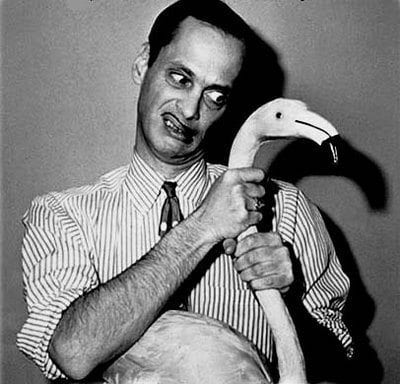
John Waters at 80: The Last Great American Trash Intellectual
By Bergotte
For more than half a century, John Waters has made an art of what polite culture tries to throw away: vulgarity, deviance, low glamour, bad taste, and the people condemned for possessing any of them. At 80, he looks less like a relic of transgression than one of the few American artists who understood exactly what transgression was for.
John Waters turns 80 today, on 22 April, and the milestone invites the usual forms of cultural bookkeeping. There will be the familiar labels: underground legend, Pope of Trash, patron saint of bad taste, elder statesman of filth. All of them are true, and none of them quite gets at his real importance. Waters is not merely a provocateur who survived long enough to become beloved. He is one of the few genuinely original American artists of the past half-century to have turned taste itself into a subject, a method, and a target.
That is what gives his work its longevity. Waters did not simply scandalise middle America. He diagnosed it.
Taste as Social Power
From the beginning, Waters understood something that many more solemn critics spent decades dressing up in theory: taste is not neutral. It is never just a matter of preference. Taste is a social instrument. It sorts people. It flatters some lives and humiliates others. It turns class anxiety into aesthetic principle. It teaches people what to admire, what to suppress, what to find embarrassing, and, perhaps most powerfully, what kinds of human excess must be banished from the realm of the acceptable.
Waters built a career by marching straight into that zone of banishment and switching on the lights.
His great subject has never really been filth, however much filth appears in the work. It has been the policing of filth. It has been the moral and aesthetic machinery by which a culture identifies certain people, bodies, pleasures, styles, and appetites as low, obscene, ridiculous, or beyond the pale. What made Waters radical was not simply that he represented the disreputable. It was that he stripped respectability of its innocence. He revealed normality itself as a performance: brittle, coercive, self-flattering, and often far stranger than the so-called freaks it claimed to exclude.
The Early Films and the War on Respectability
In that sense, the early films were not simply acts of shock. They were acts of inversion. Multiple Maniacs, Pink Flamingos, Female Trouble, and Desperate Living did not emerge from the legitimate culture asking to be let in. They arrived as though legitimacy were itself the joke. Made cheaply, performed ferociously, and pitched at the exact frequency of bourgeois disgust, they remain some of the sharpest assaults ever launched on the pieties of good taste. They were not polished, and that was not a limitation. It was part of the argument. Waters understood that refinement is often just censorship with better upholstery.
To call him merely a provocateur is to miss the precision of what he was doing. The films were outrageous, yes, but they were also exact. Waters is too observant, too formally alert, too interested in the minute codes of American life to be reduced to mere shock tactics. He notices the social meaning of upholstery, hairspray, drapery, lipstick, diction, neighbourhood aspiration, and television manners. He notices the way repression settles into domestic interiors. He notices how class longing takes visual form. In his hands, vulgarity is never random. It is patterned. It tells a story.
Divine and the Reinvention of Stardom
Divine was the indispensable instrument of that early revolution, though “instrument” is too small a word for what she was. Divine was Waters’s most brilliant act of artistic recognition: not merely a star, but a total repudiation of approved stardom. She did not invite affection on conventional terms. She overwhelmed the terms.
In Divine, glamour ceased to mean compliance and became instead a kind of anarchic sovereignty. She was excessive, comic, frightening, vulgar, and magnificent all at once. Together, Waters and Divine created one of the great subversive collaborations in American art, one that did not politely request broader representation but detonated the frame in which representation had previously been granted.
What made that collaboration so powerful was that it did not ask the audience to see the outsider as secretly respectable. It demanded that the audience reckon with a form of charisma for which respectability was irrelevant. That remains one of the boldest things in Waters’s body of work. He did not rehabilitate the freak. He enthroned the freak.
Baltimore as Method
Waters’s work is often discussed in terms of camp, but camp is only part of the story. What gives the films their weight is their exactness as social observation. He is one of the great American noticers. The joke lands because the anthropology is so good.
Baltimore, in his work, is not backdrop but text. He stayed with Baltimore in the way a serious novelist stays with the landscape that formed his moral imagination. He understood that regionality, rendered intensely enough, becomes universal. His Baltimore is not a civic postcard but a complete ecosystem of row houses, beauty salons, Catholic guilt, petty criminality, wounded aspiration, kitsch grandeur, and social claustrophobia. He made the city mythic not by idealising it, but by observing it so closely that its absurdities became revelations.
There is real affection in this, but never sentimentality. Waters loves Baltimore too much to flatter it. He sees its provincialism, its vanity, its sad glamour, its comic pathos. He sees that local life is often where national life becomes most legible. What looks narrow in lesser hands becomes, in his, diagnostic.
The Politics of Bad Taste
This is why Waters’s work, for all its gleeful indecency, is so rich as social criticism. He has always grasped that cheap glamour is not merely funny. It is ambitious, poignant, tragic, and often democratic. Tacky style does not arise from some innate failure of discernment. It arises because desire travels downward through a culture in damaged forms. Hollywood glamour becomes neighbourhood aspiration. Luxury becomes imitation. Refinement becomes décor by approximation.
And in those approximations lie whole worlds of longing, shame, theatre, and self-invention.
Waters saw that more clearly than almost anyone. He understood that bad taste is not the opposite of seriousness. In the right hands, it is evidence. It shows you what a culture worships, what it withholds, and how those left outside official elegance improvise identities from the scraps. In Waters, trash is not just refuse. It is misruled splendour. It is failed aspiration turned into style. It is comedy with class history embedded in it.
Crossing Into the Mainstream
One of the most impressive facts about Waters’s career is that he was never trapped by his own cult status. Many artists who begin in revolt eventually become curators of their own mythology, endlessly reproducing the gesture that once made them dangerous. Waters did something harder. He migrated.
By the time he made Polyester and then Hairspray, he had found a way to move into the mainstream without surrendering the intelligence of his work. Hairspray, in particular, remains one of the shrewdest popular American films of its era: buoyant, accessible, structurally sweet, and quietly ruthless about the social machinery of conformity. It understood that niceness could be a weapon, television a moral educator, and popularity a disguised system of exclusion.
That was Waters’s particular gift. He knew how to move closer to the centre without becoming centrist. He became legible to the culture without flattering it.
The later work continued the same argument by other means. Cry-Baby, Serial Mom, Pecker, Cecil B. Demented, and A Dirty Shame all turn, in different registers, on the fraudulence of the normal. In a Waters film, the enforcers of decorum are almost always the truly deranged figures. The supposedly ordinary world is where repression, vanity, cruelty, and latent violence are concentrated. The eccentrics, by contrast, may be ridiculous, vulgar, and impossible, but they are usually the only people not lying about the terms of the social game.
The Moral Seriousness Beneath the Filth
This is where Waters’s moral seriousness comes into view. Moral seriousness is not the phrase usually attached to him, which says more about critical habits than about the work itself. He is not moralistic. He has too much appetite for human absurdity, and too little interest in punishment, for that. But he is moral in a deeper sense. He despises snobbery. He distrusts virtue when it arrives in the language of exclusion. He hates cruelty, especially the kind that advertises itself as cleanliness, discipline, standards, or decency.
Again and again, he sides with the humiliated, the mocked, the tasteless, the excessive, the sexually irregular, the socially disreputable. But he does so without sentimentalising them. He grants them their vulgarity whole. That refusal to launder the outsider into innocence is part of what makes his work feel so intellectually intact. He is not interested in making the freak acceptable. He is interested in making the audience confront why acceptability became such a tyrannical category in the first place.
That is a much harder and more enduring artistic task.
Waters as Public Intellectual
It is also what has allowed Waters to endure beyond the era that first defined him. Over time, he has become something more than a filmmaker: a writer, performer, critic, lecturer, and collector of American absurdity. He is one of the last great public bohemians, and one of the very few figures capable of speaking seriously about taste without becoming either academic or dead on arrival.
His books and public persona reveal the full architecture of the sensibility: the essayist, the social historian of low pleasures, the democratic aesthete with exacting standards about what is truly boring. He understands that trash has ancestry, that camp has genealogy, that kitsch has regional accents, and that popular culture cannot be understood if one pays attention only to what institutions have certified as worthy. He has spent a lifetime preserving the archive of the disreputable.
That, too, is part of his importance. Waters is not simply a maker of cult objects. He is an interpreter of the culture that produced them.
Why He is Still Punk
Waters belongs to a generation for whom transgression still had an object. There were standards to violate, gatekeepers to affront, clean surfaces to dirty, censorship regimes to mock, and middlebrow pieties to detonate. Ours is a culture that absorbs rebellion almost instantly, packages it, markets it back, and calls that freedom. In such a climate, Waters looks not quaint but clarifying.
He reminds us of a time when bad taste was not a lifestyle accessory but a real breach in the system. He understood that vulgarity could be analytic. That a dirty joke could perform cultural criticism more efficiently than an essay. That camp, at its best, is not decorative irony but a way of exposing the instability of the categories on which seriousness depends. He grasped that laughter can reorder moral vision, and that what a culture labels disgusting often points directly to the anxieties it is least willing to name.
At 80, then, Waters does not read as a mellowed relic of a dirtier age. He reads as a critic of American life whose medium happened to be outrage, comedy, and style. He remains one of the few artists to grasp that the line between refinement and repression is often very thin, and that what society calls good taste is frequently just fear in expensive clothing.
Why We Love Him
To admire John Waters is not simply to admire his wit, his films, his outrageousness, or even his historical importance to queer and underground culture, though all of that matters. It is to admire the steadiness of the intelligence behind it all. Across decades, fashions, and changes in the culture’s tolerance for offensiveness, he has remained fixed on the same essential question: who gets shamed, and why?
Few American artists have pursued that question with such relish, such exactness, or such style.
That is his achievement. He made bad taste legible as a politics, vulgarity legible as a social text, and laughter legible as an instrument of resistance. He taught generations of viewers not merely to sympathise with the freak, but to interrogate the system that required the freak to exist in the first place.
That is more than cult status. It is criticism. It is cultural analysis. It is art.
And John Waters, at 80, remains one of its sharpest practitioners.

Leave a Reply