
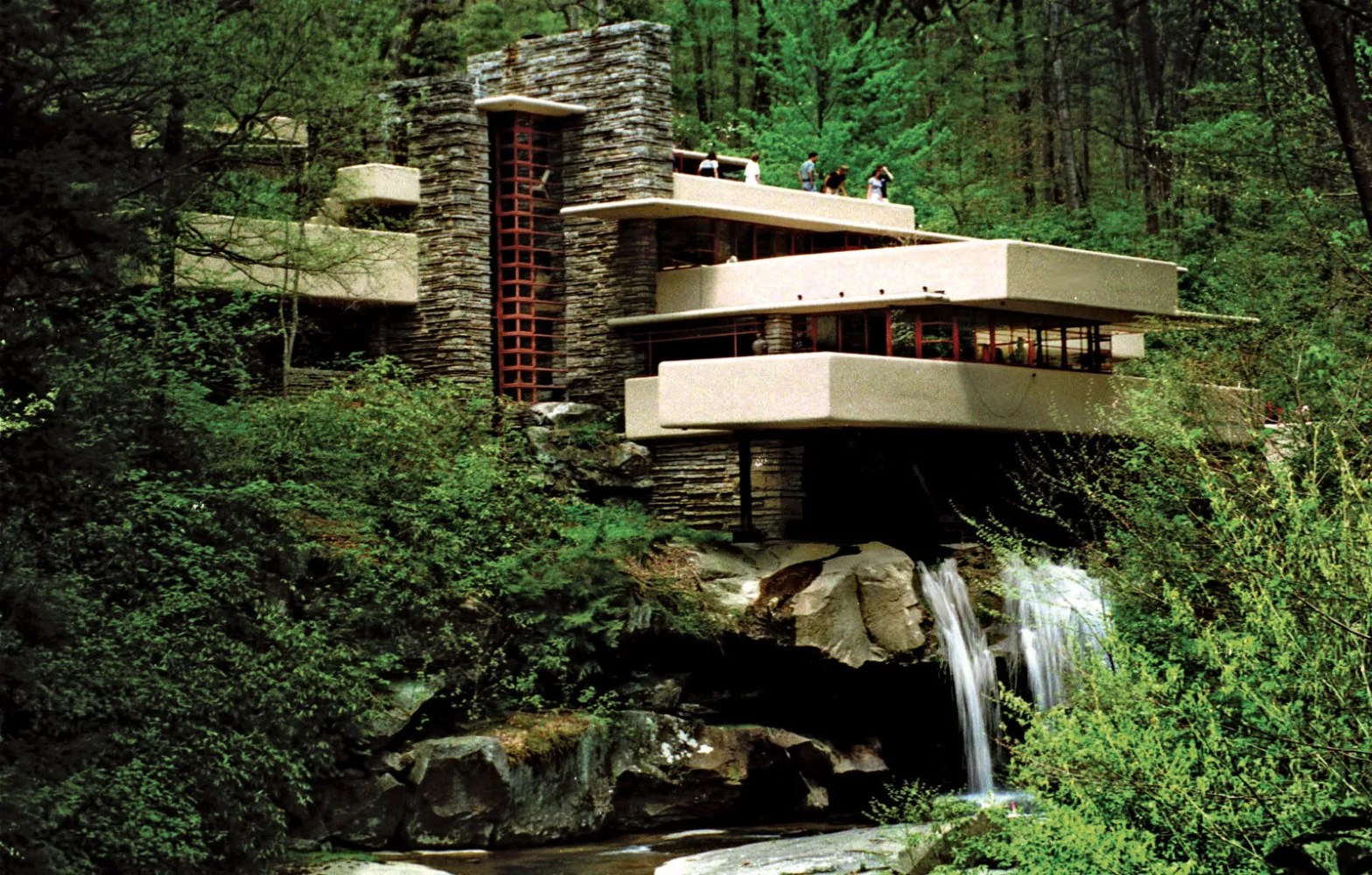
Among the landmarks of twentieth-century architecture, few possess the mythic aura of Fallingwater. Designed by Frank Lloyd Wright in 1935 for Pittsburgh department store magnate Edgar J. Kaufmann and his family, the house is a symphony of stone, concrete, glass, and water—an organic architecture that doesn’t simply sit in nature but fuses with it. Perched over a rushing waterfall in the Laurel Highlands of Pennsylvania, Fallingwater is not only Wright’s most celebrated work but also a cultural icon: the ultimate expression of his belief that buildings should grow out of their surroundings like living organisms.
A Commission in the Depression
In the depths of the Great Depression, Edgar J. Kaufmann Sr., owner of the famed Kaufmann’s department store, sought to build a weekend retreat for his family at Bear Run, a wooded property in southwestern Pennsylvania. Kaufmann admired Wright, though the architect—then in his late sixties—was seen by many as past his prime.
Wright surprised everyone. Instead of situating the house downstream with a view of the falls, as the Kaufmanns expected, he boldly positioned it directly above the cascade. “The visit to the waterfall in the woods stays with me,” he said. “The idea of the house grows from that.”
When Wright unveiled the design, with its cantilevered terraces thrusting out over the water, Kaufmann’s reaction was startled disbelief. Yet the gamble paid off.
The Design: Cantilevers and Continuity
Fallingwater is built of reinforced concrete, sandstone quarried on site, and expanses of glass. Its most striking feature is the series of horizontal cantilevered terraces, like shelves reaching into space. These platforms mimic the rock ledges of the surrounding landscape, making the house seem less constructed than grown from the geology itself.
The living room floor is paved with flagstone, its surfaces polished until they glisten like wet rock. A glass hatch in the floor opens directly to the stream below. Large panes of glass blur the line between inside and outside, dissolving walls into views. Even the color scheme reflects the site: ochre concrete for the stone, Wright’s signature Cherokee red for steelwork, all tuned to the palette of the forest.
Inside, Wright designed the furniture, lighting, and built-ins, reinforcing his vision of a total work of art. Spaces are intimate, almost compressed, before opening onto the drama of the terraces. The sound of rushing water permeates everything, so that architecture, landscape, and acoustics form a single composition.
Philosophy: Organic Architecture
For Wright, Fallingwater epitomized what he called “organic architecture.” A building, he believed, should harmonize with its environment rather than impose upon it. Fallingwater is both shelter and statement, a man-made form that celebrates rather than conquers nature.
He often described the house as “not on the waterfall, but of the waterfall.” The structure hovers, suspended, in a dialogue between gravity and flow, permanence and motion. It remains one of the purest manifestations of Wright’s philosophy that architecture should be an extension of the human spirit into the natural world.
Challenges and Preservation
Though visionary, Fallingwater was structurally daring—perhaps too daring. Its dramatic cantilevers pushed the limits of 1930s engineering. Over the decades, sagging and cracks required reinforcement, including major stabilization efforts in the early 2000s.
Yet the house endures, now managed by the Western Pennsylvania Conservancy. Visitors from around the globe trek through winding forest roads to stand on its terraces, listening to the waterfall beneath. The fragility of its cantilevers, far from diminishing the design, underscores the audacity of Wright’s vision.
Cultural Impact
Since its completion in 1937, Fallingwater has occupied a unique place in cultural memory. It appeared on the cover of Time magazine in 1938, hailed as an emblem of American modernism. The American Institute of Architects has repeatedly ranked it the “best all-time work of American architecture.”
Beyond professional accolades, Fallingwater has become an icon of aspiration. It appears in films, novels, and advertising, shorthand for a union of luxury, modernity, and nature. For architecture students, it is a pilgrimage site; for laypeople, it is a dreamscape, proof that human creativity can harmonize with the natural world.
Legacy of a Living Masterpiece
Frank Lloyd Wright designed over 1,000 buildings, but Fallingwater stands apart. It condenses his lifelong quest—to merge structure with site, to bind architecture to the rhythms of nature—into one unforgettable gesture.
Perched over a waterfall, its terraces forever echoing the rock ledges of Bear Run, Fallingwater is more than a house. It is a manifesto in stone and water, a reminder that the highest art is not separation from the natural world but immersion within it.
Visitor Information
Fallingwater is open to the public as a museum and UNESCO World Heritage Site. Guided tours explore the house, landscape, and Wright’s philosophy. Advance reservations are recommended.
Official site: http://www.fallingwater.org
Discover more from My World of Interiors
Subscribe to get the latest posts sent to your email.

