

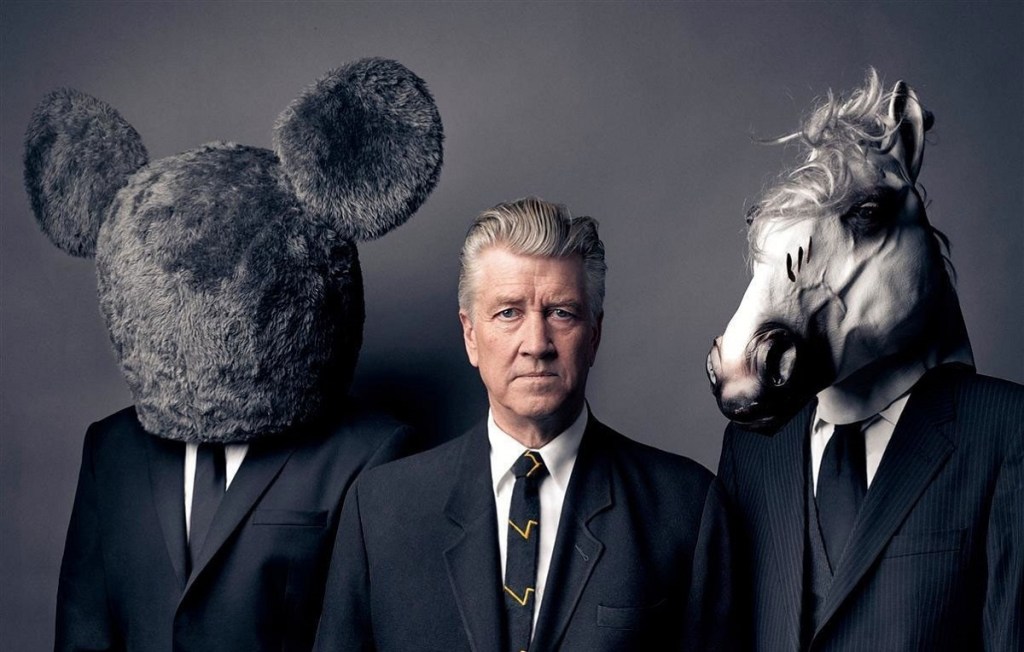
David Lynch has always resisted categorization. Filmmaker, painter, musician, and occasional actor, he has built a career on unsettling images and dreamlike narratives that hover between the familiar and the uncanny. To encounter a Lynch film is to enter a world where diners glow with menace, suburban lawns conceal darkness, and reality frays into dream. Over five decades, Lynch has become not just a director but a cultural lexicon: “Lynchian” is now shorthand for the strange, the unsettling, the uncanny lurking beneath everyday surfaces.
You can watch a film about David Lynch’s art here
Beginnings in Paint and Film
Born in Missoula, Montana, in 1946, Lynch grew up in a world of picket fences, boy scouts, and small towns—a setting he would later both mythologize and dismantle in his films. Initially trained as a painter, he studied at the Pennsylvania Academy of Fine Arts in the 1960s. It was there he first experimented with film, creating moving-image pieces that merged painting’s abstraction with cinema’s temporal flow.
His short The Alphabet (1968) and the nightmarish Eraserhead (1977) revealed a fascination with surreal imagery and industrial soundscapes. Eraserhead, shot in black and white over five years, became a midnight-movie sensation. Its grotesque baby and oppressive atmosphere marked Lynch as a visionary outsider, a filmmaker unafraid of confronting primal fears.
Hollywood and the Uncanny Mainstream
Lynch’s leap into Hollywood came with The Elephant Man (1980). Produced by Mel Brooks, the film told the true story of John Merrick, a man with severe deformities in Victorian London. Shot in luminous black and white, it combined empathy with grotesquerie. The film’s critical and commercial success earned Lynch Academy Award nominations and gave him credibility in Hollywood.
That credibility led to his most fraught project: Dune (1984), an adaptation of Frank Herbert’s science fiction epic. The film was plagued by studio interference, poor reviews, and box office failure. Yet even in Dune, Lynch’s fingerprints are visible: grotesque villains, uncanny sound design, and moments of unsettling surrealism.
It was with Blue Velvet (1986) that Lynch fully emerged as the chronicler of America’s dark subconscious. Beginning with a white picket fence and red roses, the camera plunges into the soil to reveal insects writhing beneath. Kyle MacLachlan’s Jeffrey Beaumont discovers a severed ear, drawing him into a world of psychosexual violence, embodied by Isabella Rossellini’s Dorothy Vallens and Dennis Hopper’s terrifying Frank Booth. The film divided critics but is now considered a masterpiece—a shocking, lyrical meditation on innocence and corruption.
Twin Peaks: Television Reimagined
In 1990, Lynch brought his vision to television with Twin Peaks, co-created with Mark Frost. What began as a murder mystery—the death of homecoming queen Laura Palmer—quickly evolved into a surreal exploration of small-town life, dreams, and evil lurking in the woods.
Twin Peaks broke television conventions: long silences, dream sequences, cryptic dialogue, and soap-operatic melodrama. It became a cultural phenomenon, though its network run was brief. The prequel film Fire Walk with Me (1992), initially panned, is now celebrated as one of Lynch’s most harrowing works—a portrait of trauma told through Laura Palmer’s perspective.
Decades later, Twin Peaks: The Return (2017) on Showtime reaffirmed Lynch’s mastery. More than a revival, it was an 18-hour meditation on memory, doppelgängers, and the passage of time, hailed by critics as one of the greatest achievements in 21st-century television.
Cinema of Dreams and Darkness
Lynch’s films of the 1990s and 2000s deepened his exploration of identity, dream, and violence. Wild at Heart (1990), a hallucinatory road movie, won the Palme d’Or at Cannes. Lost Highway (1997) fragmented narrative into loops of paranoia and desire.
Mulholland Drive (2001), initially conceived as a TV pilot, became one of his greatest achievements. A Hollywood dream turned nightmare, it starred Naomi Watts in a breakout performance. Its nonlinear narrative, doubling identities, and dreamlike atmosphere earned Lynch the Best Director prize at Cannes and cemented the film as one of the most acclaimed of the century.
His most recent feature, Inland Empire (2006), pushed experimentation further, using digital video to blur the line between performance and reality. Fragmented and unsettling, it remains a polarizing but quintessentially Lynchian work.
Beyond Film: Music, Art, Meditation
Lynch’s creativity extends beyond cinema. A lifelong painter, his dark canvases and sculptures echo the textures of his films. As a musician, he has released experimental albums mixing ambient soundscapes, distorted guitar, and his own falsetto vocals.
He is also a passionate advocate of Transcendental Meditation, crediting the practice with grounding his creativity. Through the David Lynch Foundation, he has promoted meditation in schools, prisons, and communities worldwide.
Legacy: The Meaning of “Lynchian”
David Lynch’s legacy is not merely a body of films but a worldview. He revealed that horror and beauty coexist, that the banal and the surreal are inseparable. His influence permeates cinema (from the Coen Brothers to Nicolas Winding Refn), television (The Sopranos, True Detective), and music videos.
The term “Lynchian” has entered the cultural vocabulary: the unsettling mixture of the ordinary and the bizarre, the dream that bleeds into waking life. Few directors have reshaped language itself.
Suggested Works to Explore
- Eraserhead (1977) – Lynch’s cult debut, industrial surrealism in its purest form.
http://www.criterion.com - The Elephant Man (1980) – A haunting biopic that balanced empathy and grotesque beauty.
www.imdb.com - Blue Velvet (1986) – A descent into the American subconscious.
http://www.criterion.com - Twin Peaks (1990–91) – Groundbreaking TV that became a cultural phenomenon.
http://www.showtime.com - Lost Highway (1997) – A noir dreamscape of paranoia and identity.
http://www.criterion.com - Mulholland Drive (2001) – Voted the greatest film of the 21st century by critics.
http://www.criterion.com - Inland Empire (2006) – Lynch’s digital labyrinth of identity and illusion.
http://www.criterion.com - Twin Peaks: The Return (2017) – A singular masterpiece of modern television.
http://www.showtime.com
Discover more from My World of Interiors
Subscribe to get the latest posts sent to your email.

