
OBITUARY
The Woman Who Taught the World Where It Was
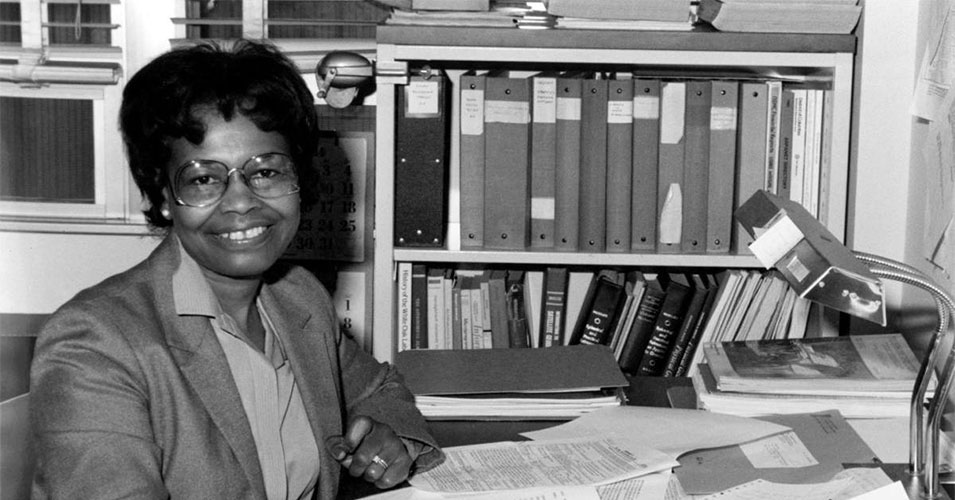
Dr Gladys West, the mathematician whose work made modern GPS possible, has died at the age of 95
By Bergotte
Every day, billions of people look at a small blue dot and ask one of the oldest human questions: Where am I?
The answer appears almost instantaneously. It guides ambulances through unfamiliar streets, pilots across oceans, farmers over fields and travellers towards home. It feels weightless and automatic, as though the information simply descends from the satellites above us. But beneath that blue dot lies decades of painstaking human labour—and, among its most important architects, a Black woman born into poverty in the segregated American South.
Dr Gladys Mae West died on 17 January 2026, aged 95. She did not single-handedly invent the Global Positioning System; no serious technological achievement has only one inventor. Her contribution was both more precise and more revealing than that mythology allows. Through her mathematical modelling of the Earth’s true shape, West helped create the geodetic foundation without which satellite navigation could never have attained its extraordinary accuracy.
She helped teach the modern world how to locate itself.
Born Gladys Mae Brown in Sutherland, Virginia, in 1930, West grew up on a small family farm during the Jim Crow era. Her father worked on the railroad and her mother in a tobacco factory; Gladys was expected to contribute to the relentless labour of rural life. She attended a segregated, one-room schoolhouse reached by a three-mile walk.
Accounts of remarkable lives often turn poverty into picturesque scenery, as though deprivation were a useful character-building exercise. It is important to resist that temptation. Poverty did not give West her intelligence, and segregation did not make her exceptional. They merely placed unnecessary obstacles before a gifted child. Her achievement lay in surviving and surpassing conditions deliberately designed to restrict what a Black girl might become.
West understood education as a route towards freedom. When she discovered that the student graduating first in her high-school class would receive a college scholarship, she became valedictorian. That scholarship took her to Virginia State College, now Virginia State University, one of America’s historically Black institutions. She earned a bachelor’s degree in mathematics in 1952 and, after teaching mathematics and science in segregated schools, completed her master’s degree in 1955.
In 1956, she was hired by the US Naval Proving Ground at Dahlgren, Virginia. She was the second Black woman employed there and one of only four Black professional employees at the facility. Formal integration had begun; social equality had not. West entered a workplace in which she was required to prove herself simultaneously as a mathematician, a woman and an African American.
She did so through exactitude.
In the early 1960s, West participated in an astronomical study of the relationship between the orbits of Pluto and Neptune. The project involved approximately five billion calculations, performed in the era of punched cards, flow charts and mainframe computers. She subsequently became one of the experts responsible for programming the IBM 7030 Stretch, then among the most powerful computers in existence.
Her most consequential work concerned the geoid: the complex and irregular form of the Earth shaped by gravity, tides, rotation and variations in mass. The planet is neither a perfect sphere nor simply a smooth, flattened ball. Its gravitational surface undulates. For satellite navigation to work, these variations must be modelled with exceptional precision. An error in the mathematical description of the Earth becomes an error in determining where anything upon it is located.
From the 1970s into the 1980s, West processed enormous quantities of satellite data to create increasingly accurate models of that surface. She became project manager for the Seasat radar-altimetry programme, working with data from the first satellite designed to observe the world’s oceans remotely. Her 1986 technical report, Data Processing System Specifications for the Geosat Satellite Radar Altimeter, set out methods for refining measurements of the geoid and satellite orbits. This work became foundational to the positioning accuracy on which GPS depends.
The abstraction of her mathematics now structures material life. GPS supports aviation, shipping, agriculture, emergency services, telecommunications, banking systems and the electrical grid, as well as the ordinary navigation performed by a telephone in someone’s hand. It guides an ambulance towards an injured person and a missile towards its target. That contradiction should not be concealed. Mathematical precision is not itself a moral programme; the purposes to which societies direct it remain political choices.
West’s career also offers a necessary correction to the heroic mythology of Silicon Valley. The infrastructure of contemporary life was not created solely by charismatic founders, private capital or young men in garages. GPS emerged from decades of publicly funded research, collective knowledge and the disciplined work of civil servants such as West. The corporations that now profit from location data and sell convenience back to us inherited a foundation built socially, over generations.
For most of West’s career, however, the world knew neither her name nor the extent of her contribution. She retired in 1998 after 42 years at Dahlgren. Even her children had known little about her work, much of which had been classified. Her public recognition began only after she submitted a short biography for an Alpha Kappa Alpha sorority reunion in 2017. A fellow member recognised the importance of what she had described and helped bring her story to wider attention.
West subsequently came to be called one of the “hidden figures” of American science. It is a useful phrase, but also an insufficient one. She was not hidden by chance. Historical recognition is distributed by institutions, and those institutions have repeatedly placed white male directors, commanders and entrepreneurs in the foreground while relegating the labour of Black people and women to the margins. History did not simply overlook women such as West; it had been trained not to see them.
In 2018, at the age of 88, West was inducted into the US Air Force Space and Missile Pioneers Hall of Fame. She was named among the BBC’s 100 Women that same year. In 2021, she became the first woman to receive the Royal Academy of Engineering’s Prince Philip Medal and was also given a Webby Lifetime Achievement Award.
Her appetite for learning had never ended. After retiring—and despite suffering a stroke—she completed a doctorate in public administration at Virginia Tech in 2000. Her memoir, It Began with a Dream, appeared two decades later.
There was a gentle irony at the centre of her fame: the mathematician who helped make GPS possible preferred to navigate with a paper map. She liked to see the road, its bends and its relationship to the surrounding landscape. Perhaps someone who had spent so many years translating the physical Earth into mathematical abstraction understood particularly well what abstraction leaves out.
West’s life will inevitably be presented as an inspirational story about overcoming adversity. It is that, but it should not be permitted to become a comforting one. A just society would not require a Black child to finish first in her class merely to gain access to an education. It would not make a brilliant woman spend her career proving that she belonged in rooms where less exceptional people were welcomed automatically. And it would not wait until she was nearly 90 to pronounce her historically important.
Individual resilience deserves admiration. It must never become an excuse for structural cruelty.
Dr West died at her daughter Carolyn Oglesby’s home in Fredericksburg, Virginia, from complications of Alzheimer’s disease. Her husband, fellow mathematician Ira West, whom she met at Dahlgren and married in 1957, died in 2024. She is survived by their daughter, Carolyn; their sons, David and Michael; seven grandchildren; and eight great-grandchildren.
Gladys West helped machines determine where we are. Her deeper legacy asks whether we can locate ourselves morally: whether we understand whose labour lies beneath our everyday conveniences, whose intelligence our institutions have neglected and what humanity might accomplish if every child’s abilities were recognised and cultivated.
The blue dot is not magic. It is human knowledge made invisible.
Gladys West gave it coordinates. History, belatedly, must give her her own.
Discover more from My World of Interiors
Subscribe to get the latest posts sent to your email.

