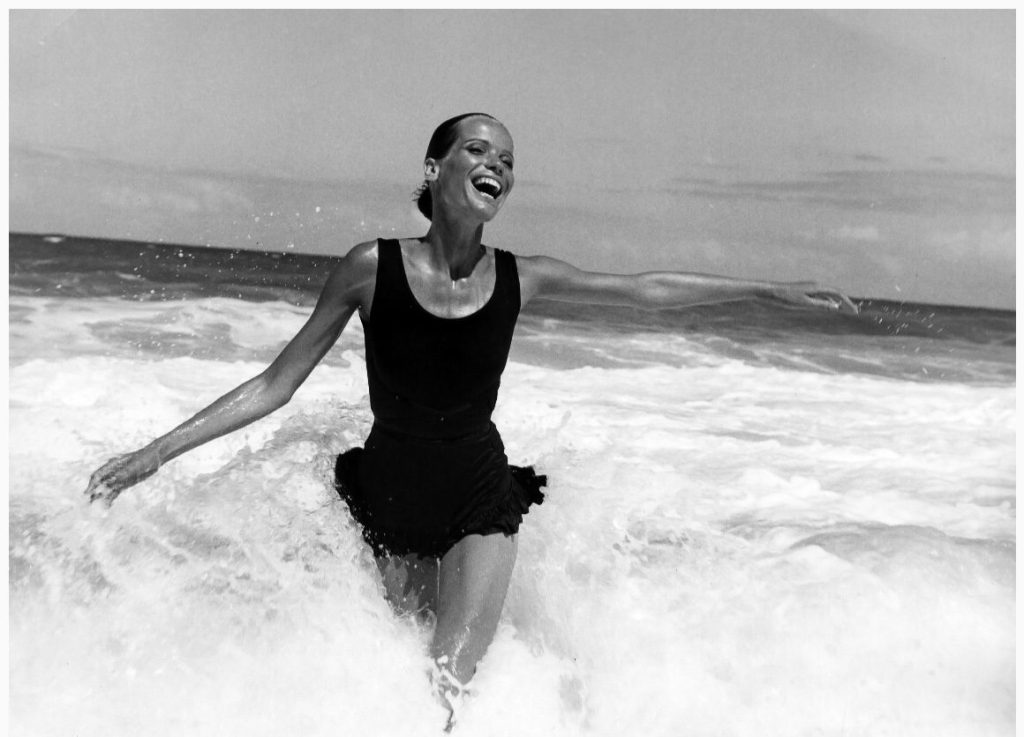
Remembering Vera von Lehndorff, the German model, actress and artist whose life spanned the destruction of aristocratic East Prussia, the creative revolution of the 1960s and some of the most intriguing experiments in twentieth-century body art.
In August 1967, the American magazine Life devoted its cover to a woman it described as “The Girl Everybody Stares At”. Veruschka had become an international phenomenon, her extraordinary physical presence lending itself to the increasingly ambitious visual language of contemporary fashion photography. Within a decade, however, she was engaged in a collaborative artistic practice in which her body would become almost indistinguishable from stone, timber and corroding metal. The woman whose appearance had commanded the attention of millions was investigating the possibilities of becoming invisible.
Vera von Lehndorff, who died in Berlin on 24 November 2026 at the age of 87, occupied an unusual position in the cultural history of the twentieth century. Her career encompassed fashion, cinema, photography, painting and performance, while her personal history belonged to one of the darkest chapters of modern Europe.
A Childhood in a Vanished World
Born on 14 May 1939 in Königsberg, East Prussia, now Kaliningrad, Vera Anna Gottliebe Gräfin von Lehndorff belonged to an aristocratic family whose ancestral home, Schloss Steinort, stood among the lakes and forests of what is today northeastern Poland.
Her childhood was irrevocably altered by her father’s involvement in the German resistance to National Socialism. Heinrich Graf von Lehndorff-Steinort participated in the conspiracy against Adolf Hitler that culminated in the failed assassination attempt of 20 July 1944. According to the German Resistance Memorial Center, he was executed at Berlin-Plötzensee on 4 September that year. Vera was five years old.
The family suffered persecution under the Nazi regime, and the end of the war brought further upheaval. East Prussia was divided between Poland and the Soviet Union, its German population displaced and the social order in which she had been born effectively dismantled.
The distance between this childhood and the fashion studios of New York in the 1960s was immense. In her later autobiographical reflections, published in German as Veruschka: Mein Leben in 2011, she addressed the more complicated personal history behind the seemingly effortless glamour of her public image.
Her original ambition had been artistic. She studied painting and design in Hamburg before moving to Italy, where photography offered an unexpected professional opportunity.
The Invention of Veruschka
Her early modelling career was far from straightforward. Exceptionally tall, with long limbs and features that did not readily conform to the prevailing commercial conventions, she initially struggled to establish herself in New York.
In Italy, however, she found photographers receptive to her unconventional appearance. Among them was Johnny Moncada, whose photographs of the young Vera remained largely unseen for decades. Their rediscovery resulted in the 2014 publication From Vera to Veruschka: The Unseen Photographs by Johnny Moncada and an accompanying exhibition at Somerset House in London.
Her adoption of the name Veruschka was a calculated act of self-invention. The Russian-sounding name suggested a mysterious provenance, while her carefully cultivated appearance allowed her to enter the fashion world on different terms.
Returning to New York in 1964, she encountered a profession undergoing profound change. Under Diana Vreeland’s editorship, American Vogue was expanding the imaginative possibilities of fashion photography, drawing increasingly upon cinema, contemporary art and distant landscapes.
Veruschka became one of Vreeland’s most celebrated models, working with Richard Avedon, Irving Penn, David Bailey, Horst P. Horst and Helmut Newton.
Avedon, whom she would later name as her favourite photographer, understood the expressive potential of her physicality. His 25-page editorial for the March 1967 issue of Vogue demonstrated how movement could transform the presentation of clothing. Leaping across the photographic frame, Veruschka brought an almost choreographic dimension to garments that might otherwise have been presented through conventional studio portraiture.
Her collaborations with the Italian photographer Franco Rubartelli were equally consequential. Working in landscapes far removed from the traditional fashion studio, they developed photographs in which costume, makeup and the environment became integral to the composition. These experiments would eventually lead her towards a more radical understanding of what could be done with the photographed body.
Antonioni and the Photographic Gaze
For audiences outside fashion, Veruschka became inseparable from her appearance in Michelangelo Antonioni’s Blow-Up (1966), which received the principal prize at the Cannes Film Festival in 1967.
Playing a version of herself opposite David Hemmings, she appeared in the celebrated photographic session that has come to epitomise the sexual and visual culture of Swinging London. The encounter between photographer and model becomes an elaborate physical performance, with the camera mediating their intimacy.
Her presence was particularly appropriate to Antonioni’s film, whose central concern is the unreliable relationship between photographic representation and reality. The fashion photographer believes that his camera grants him privileged access to the world, only to discover the limitations of what an image can reveal.
In retrospect, the film acquires additional resonance when considered alongside Veruschka’s subsequent artistic career. The relationship between photographer, subject and viewer would become fundamental to her own work.
She also appeared in Franco Rubartelli’s experimental film Veruschka, poesia di una donna (1971), a project during whose production she began developing her interest in body painting.
The Body as an Artistic Medium
By the mid-1970s, Lehndorff was increasingly devoting herself to artistic work, particularly her collaboration with the German painter, sculptor and photographer Holger Trülzsch, whom she had met in 1969.
Their investigations emerged during a period in which artists internationally were questioning the conventional boundaries between painting, sculpture, photography and performance. The body itself had become a site of experimentation, particularly in work addressing the representation of women.
In the series Mimicry-dress-art (1973), Lehndorff and Trülzsch used painted costumes and deliberately exaggerated appearances to explore the construction of cinematic and fashionable stereotypes.
Their subsequent work took a different direction. Through laborious applications of pigment, Lehndorff’s body was made to correspond to the colours and textures of architectural surfaces and natural surroundings. Photographed in carefully determined positions, she appeared to merge with the material environment.
In 1978, an abandoned fish auction hall in Hamburg became the setting for some of their most remarkable compositions. Its deteriorating industrial surfaces provided the visual material for works in which flesh assumed the appearance of oxidised metal and discoloured masonry.
The resulting photographs, subsequently exhibited under the title Oxydationen, require a peculiar kind of attention. The viewer searches for the human figure within the composition, discovering its outlines gradually. Architecture, usually understood as the space surrounding the body, appears to have absorbed it.
There is an unsettling quality to these images, particularly when viewed against the historical circumstances of Lehndorff’s life. Their interest in dissolution and material decay invites an awareness of the fragility of physical presence, although it would be reductive to explain the work solely through her childhood experiences.
The collaboration attracted the attention of Susan Sontag, whose essay Fragments of an Aesthetic of Melancholy accompanied the 1986 publication Veruschka: Trans-Figurations.
More recently, the extensive volume The Seen and the Unseen, published by Edition Patrick Frey, has brought together the artists’ photographs, archival material and critical writing, allowing their contribution to the history of performance and staged photography to be reconsidered.
The Freedom to Change
Lehndorff’s later work continued to investigate self-representation. In 2006, Berlin’s Museum für Fotografie presented her directed self-portraits, produced in collaboration with photographer Andreas Hubertus Ilse, in which she assumed a succession of fictional personalities through costume and physical transformation.
She occasionally returned to fashion and cinema, appearing in Casino Royale in 2006 and walking in Giles Deacon’s spring/summer 2011 show at the age of 71. In 2017, aged 78, she appeared in the Acne Studios Resort 2018 collection, bringing her characteristic presence to the Swedish label’s contemporary tailoring.
Her public life also included political engagement. In 1971, she participated in the landmark West German Stern campaign Wir haben abgetrieben!, in which hundreds of women publicly challenged the criminalisation of abortion.
In a particularly fitting development during the final year of her life, the Ostpreußisches Landesmuseum in Lüneburg presented The Seen and the Unseen: Holger Trülzsch & Vera Lehndorff (Veruschka), an exhibition that ran from April to October 2026. Her artistic work had thus returned to an institution dedicated to the history and culture of the region in which her life began.
In a 2015 interview with The Daily Front Row, Lehndorff was asked how she wished to be remembered. Her answer was characteristically unequivocal: “Not as the first supermodel.”
The fashion photographs will inevitably remain among the most widely circulated images of her generation. But the work she produced throughout the subsequent decades deserves an equally enduring place in the history of twentieth-century visual culture.
Veruschka was her most famous creation. Vera Lehndorff was the artist who created her.
Vera von Lehndorff, 14 May 1939 – 24 November 2026.
Cover image: Veruschka, American Vogue in Brazil 1968. Photo Franco Rubartelli
