
By Bergotte
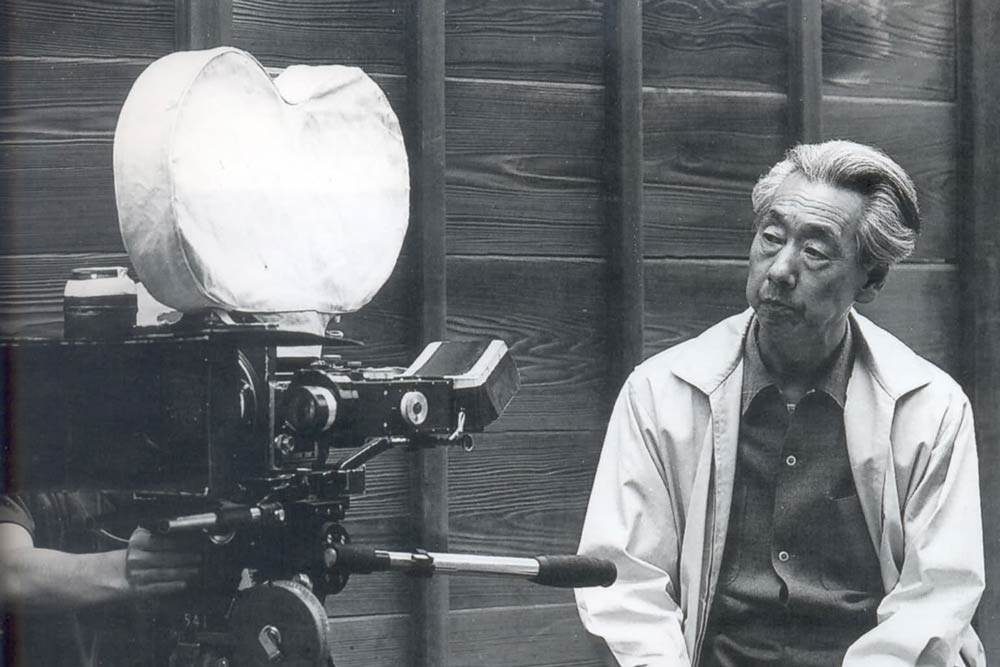
Kenji Mizoguchi made films about women being destroyed by the world, and he made them with a camera that moves like a conscience — slowly, continuously, unable to look away. He is the greatest filmmaker Japan has produced on the subject of female suffering, which is to say he is the greatest filmmaker Japan has produced on the subject of social injustice, because in Mizoguchi’s Japan — feudal or modern, it makes little difference — the woman’s body is the place where the social order enacts its most complete and most intimate cruelty, and his films follow that cruelty with a patience and a precision that make the indictment irrefutable. Where Ozu’s camera sits on the floor and holds still, Mizoguchi’s glides and tracks and circles, following his women through spaces that are simultaneously beautiful and hostile, and the beauty of the images and the horror of what they contain exist in a tension that is itself the argument: that the world which destroys these women is the same world that produces the art that records their destruction, and that this is a fact we must sit with rather than resolve.
Kenji Mizoguchi was born in Tokyo in 1898 into a family whose poverty drove his father to sell his older sister into geisha service, and this biographical fact — the sister sold, the boy watching — marks everything he made with a quality of witness that is simultaneously guilty and loving, simultaneously implicated and enraged. He spent his life making films about women in impossible situations, women ground down by poverty and desire and the specific cruelties that Japanese society organised for its female members, and the films are always in some sense about the sister, about the woman who was sold, about the irreversible damage done by a world that treats female lives as currency.
He began directing in 1923, and his surviving early films — Sisters of the Gion and Osaka Elegy, both made in 1936 — already show the fully formed sensibility that would produce the late masterworks. What they do not yet show is the camera style that would become his most distinctive instrument: the extraordinary long take, sometimes lasting five or ten minutes without a cut, in which the camera moves through a space with a fluidity that has no equivalent in cinema, following characters with the intimacy of a presence that cannot leave them, cannot cut away, cannot offer the relief of a new angle or a new scene. This style developed gradually across the 1940s and reached its full expression in the four films he made between 1952 and 1954 — The Life of Oharu, Ugetsu, Sansho the Bailiff, and Chikamatsu Monogatari — that constitute one of the greatest concentrated achievements in the history of the medium.
The camera that cannot leave
To understand Mizoguchi’s camera is to understand his moral position, because the two are the same thing. The long take in Mizoguchi is not, as in Tarkovsky, primarily about the texture of time, though it shares that quality. It is primarily about refusal — the refusal to cut away from what is happening to a woman, the refusal to offer the audience the relief of a new perspective when what is on screen is unbearable. When a woman is being humiliated or sold or abandoned or destroyed, Mizoguchi’s camera stays. It does not protect us from what is happening. It does not provide the editorial commentary of an expressive close-up or a significant reaction shot. It simply remains in the space, at a slight distance, watching the whole of what is happening with the full attention of someone who has decided that looking away is not an option.
This distance is crucial. Mizoguchi almost never uses close-ups in the conventional sense — he rarely brings the camera within intimate distance of a face in the way that Bergman or Dreyer would. He maintains what feels like a respectful remove, a distance that is not coldness but the opposite: the distance of someone who understands that to fully see another person you must give them space, that the close-up that fills a face with feeling can also, paradoxically, reduce the person to that feeling. Mizoguchi’s women are always in their world, always surrounded by the space that determines what happens to them, and the camera that holds them at this slight distance keeps both things simultaneously in view — the woman and the world, the person and the forces that will destroy her.
The tracking shots — the camera moving laterally through a space, or following a character as they move, or circling a scene with the slow inevitability of fate — are the technical instrument through which this moral position is expressed. In Sansho the Bailiff, there is a sequence in which the slave Anju walks to the pond where she will drown herself, and the camera follows her with a slowness that is devastating precisely because it is so deliberate — it will not hurry this, will not cut to a reaction shot, will not spare you the full duration of a woman walking to her death in order that her brother can live. The shot takes longer than it should, longer than you want it to, and the length is the statement: this is happening, it is real, you will not be allowed to look away.
Ugetsu and the ghost of desire
Ugetsu, made in 1953 and the film that sits at the centre of this essay, is the work in which Mizoguchi’s late style reaches its most complete and most mysterious expression. It is set in sixteenth-century Japan, during a period of civil war, and follows two peasant men — Genjuro, a potter, and Tobei, a farmer — whose ambitions drive them to abandon their wives and set out for the city, where one seeks fortune and the other seeks to become a samurai. What happens to the wives, left behind in a world of war and poverty, is the film’s real subject, though you do not understand this fully until the end.
Genjuro, the potter, falls under the spell of a mysterious noblewoman, Lady Wakasa, who buys his pots and takes him to her ancestral home and makes him her lover in a relationship of such beauty and such dread that the film’s central metaphor — the ghost, the beautiful thing that is also dead — accumulates its full weight only in retrospect. Lady Wakasa is a ghost, and the home where they live is a ruin, and the love they make is real and impossible simultaneously, and Mizoguchi films it all with a camera that slides through the spaces of the ruined estate with a dreamlike fluidity that makes the boundary between the living and the dead as permeable as it is in the best ghost stories. This is not a horror film. It is a film about desire — about the way desire blinds, about the cost of following what we want at the expense of what we owe, about the women left behind when men pursue their ambitions into the world.
The film’s final sequence is the most devastating in Mizoguchi’s work, and one of the most devastating in world cinema. Genjuro returns home, having been freed from Lady Wakasa’s spell, to find his wife Miyagi waiting for him — patient, warm, preparing his meal, entirely herself. They speak. He sleeps. He wakes to find the house empty, his son asleep, and a neighbour who tells him that Miyagi has been dead for months, killed by soldiers while he was away. The woman he spoke to was a ghost. The meal she prepared was a ghost. The warmth and the patience and the forgiveness she offered — the forgiveness he had done nothing to earn — were all, in the most literal sense, more than he deserved. Mizoguchi films the final shot — Genjuro at his wife’s grave, his son beside him, the camera pulling slowly back and up until the grave and the man and the boy are very small against the landscape — with a restraint that is almost unbearable in its completeness. Nothing is said. Nothing needs to be said. The camera’s retreat is its statement, and the statement is everything.
Sansho the Bailiff and the cost of mercy
If Ugetsu is Mizoguchi’s most mysterious film, Sansho the Bailiff, made the following year in 1954, is his most politically direct and his most emotionally overwhelming. It tells the story of a noble family in eleventh-century Japan — a compassionate father, a devoted mother, two children — separated by the cruelties of a feudal system and the violence of a society organised entirely around power and exploitation. The children are sold into slavery. The mother is sold into prostitution. The father dies in exile. The film follows these events across decades with a precision and a mercilessness that has no equal in cinema — not because it is gratuitously cruel but because it is entirely honest, because it insists on showing the full cost of a world in which mercy is treated as weakness and the poor exist only to serve the powerful.
The film’s title refers to the brutal overseer of the slave estate where the children are held — a figure of such concentrated cruelty that his name becomes a synonym for the system that created him. But Mizoguchi is not interested in villainy as a personal failing. He is interested in the structure — the feudal order, the class system, the specific mechanisms by which ordinary people become capable of extraordinary cruelty when the social order authorises and rewards it. Sansho is not a monster. He is the product of a system that has made monstrous behaviour not only possible but necessary for survival within it.
The film’s emotional centre is the mother, played by Kinuyo Tanaka in a performance of extraordinary range and restraint. She endures everything — separation from her children, slavery, the loss of her voice, the loss of her sight, the loss of everything that made her herself — with a dignity that is neither stoic nor resigned but something harder: the dignity of someone who has decided that what she values cannot be taken from her, even when everything else has been. When her son Zushio, finally free after years of slavery, comes to find her on a remote beach, and she is old and blind and does not know who he is at first, and then does, and the recognition passes between them without drama, without operatic gesture, in the specific physical way that two people find each other across an enormous absence — Mizoguchi holds the scene with his characteristic patience, and the patience is the film’s final and most complete statement about what has been lost and what, impossibly, remains.
The women of Mizoguchi
To move through Mizoguchi’s filmography is to encounter a gallery of female experience so comprehensive and so precise that it constitutes something close to a sociology of Japanese womanhood across centuries. The geisha in Sisters of the Gion, who uses her sexuality strategically in a world that has given her no other currency and is destroyed when the strategy fails. Oharu in The Life of Oharu, a noblewoman who descends through every social stratum available to a fallen woman in seventeenth-century Japan — concubine, prostitute, beggar — with a dignity that the film refuses to sentimentalise and refuses to abandon. The courtesan Osan in Chikamatsu Monogatari, drawn by circumstance into an adulterous situation she did not seek and destroyed by a moral code that cannot accommodate the complexity of actual human feeling.
What unites these women is not victimhood — though they are all, in various degrees, victims of social structures larger than themselves — but subjectivity. Mizoguchi’s women have inner lives that are as rich and as contradictory and as fully rendered as those of any male protagonist in any cinema. They are not symbols or allegories or objects of pity. They are people, in the fullest sense, and the camera’s patient attention to them — its refusal to simplify them, its insistence on following them through the full complexity of their situations — is itself the argument that the world makes against them. The world says these women do not matter. Mizoguchi’s camera says they do, with every slow tracking shot and every held scene and every refusal to cut away.
The scroll and the screen
Mizoguchi was deeply influenced by Japanese classical art — by the horizontal scroll paintings that tell their stories in long, continuous movement from right to left, by the aesthetic traditions of Noh theatre and woodblock printing — and this influence is visible in his visual style in ways that are specific and important. The lateral tracking shot that is his signature movement is related to the scroll painting: a continuous unfolding of space in which the eye moves through rather than cutting between, in which the world is revealed as a connected whole rather than a series of separate images. His frames are often composed with the attention to balance and negative space of Japanese classical painting — the figure placed not at the centre but to one side, the surrounding space as significant as the figure it contains.
This aesthetic inheritance does not make his films inaccessible to Western audiences — the emotional directness of his storytelling ensures that — but it does give them a quality of visual experience that is unlike anything in European or American cinema. Watching Mizoguchi requires a different kind of looking, a willingness to let the eye move through the frame rather than fixing on the central figure, to attend to the whole space rather than the dramatic point within it. This is not difficult in the way that Marker’s montage is difficult, requiring active intellectual engagement. It is difficult in the way that meditation is difficult: it requires patience and receptivity and a willingness to let the image do its work without rushing it.
What he left
Mizoguchi died in 1956, of leukaemia, at fifty-eight, with an unfinished film on his hands and decades of work still in him — or so it felt, because the late films had shown such an expansion of his powers that the death seems like a particular cruelty, an interruption rather than a conclusion. He left behind eighty-nine films across a career of thirty-three years, of which only about thirty survive — the rest lost to fire, to wartime destruction, to the neglect of an industry that did not always understand what it had. What survives is more than enough: a body of work that is, in its sustained focus on female experience and its formal radicalism and its moral seriousness, one of the most important in cinema.
His influence on Japanese cinema is, like Ozu’s, so pervasive as to be nearly invisible. Kurosawa, his contemporary and the third member of this cluster, acknowledged him as one of the two filmmakers — the other being Ozu — against whom any serious Japanese filmmaker had to measure themselves. Outside Japan, the influence is felt wherever cinema has tried to sustain moral seriousness about female experience over long narrative duration — in the films of Carl Dreyer, to whom he is often compared for the combination of formal austerity and emotional intensity; in the films of Robert Bresson, whose treatment of female suffering in Au Hasard Balthazar and Mouchette owes something to Mizoguchi’s example; in the films of contemporary Asian cinema, particularly the work of Hou Hsiao-hsien and Wong Kar-wai, who share his interest in the long take as a moral instrument.
But the most important thing Mizoguchi left behind is not influence but the films themselves — the specific experience of sitting with Ugetsu as the camera glides through the ruined estate at night, or with Sansho as the mother and son find each other on the beach, or with Oharu as she makes her long descent through the social world, each station of her fall filmed with the same patience and the same love. These are not comfortable films. They do not offer the consolation of resolution or the satisfaction of justice, because Mizoguchi’s Japan does not produce justice and he will not pretend otherwise. What they offer is something rarer and more necessary: the experience of being in the presence of a filmmaker who looks at human suffering — specifically the suffering of women, specifically the suffering produced by social structures rather than personal failings — with a completely honest eye and a completely loving camera, and who refuses to look away.
Watch Ugetsu first. Watch the ghost love story and let it be mysterious without demanding that it explain itself. Then watch Sansho the Bailiff and sit with what it costs you, and ask yourself whether any other film has ever made you feel the weight of historical injustice — not the abstraction of it, but the specific, bodily, irreversible weight — with this completeness. Then go back to Ozu and notice how different Japan looks from the floor. Both views are true. Both are necessary. Between them, they contain a world.
Sources and further reading
Donald Richie, The Films of Kenji Mizoguchi (1972) — the essential English-language study, rigorous and attentive, by the critic who knew the Japanese film tradition most intimately.
Dudley Andrew and Paul Andrew, Kenji Mizoguchi: A Guide to References and Resources (1981) — a comprehensive scholarly resource covering the full range of his work and its critical reception.
Mark Le Fanu, Mizoguchi and Japan (2005) — a more recent and highly readable critical account, particularly good on the relationship between Mizoguchi’s visual style and Japanese cultural tradition.
Béla Balázs, Theory of the Film (1952) — not about Mizoguchi specifically, but the theoretical framework for understanding the kind of cinema he was making: the face, the gesture, the close-up and its alternatives.
For first-time viewers, the suggested order: Ugetsu (1953) first, for the dream quality and the ghost story and the camera at its most fluid. Then Sansho the Bailiff (1954), the most emotionally overwhelming. Then The Life of Oharu (1952) for the full scope of his subject. Sisters of the Gion (1936) and Osaka Elegy (1936) last — the early masterworks that show where the late style came from, and that are devastating in their own right.
Discover more from My World of Interiors
Subscribe to get the latest posts sent to your email.

