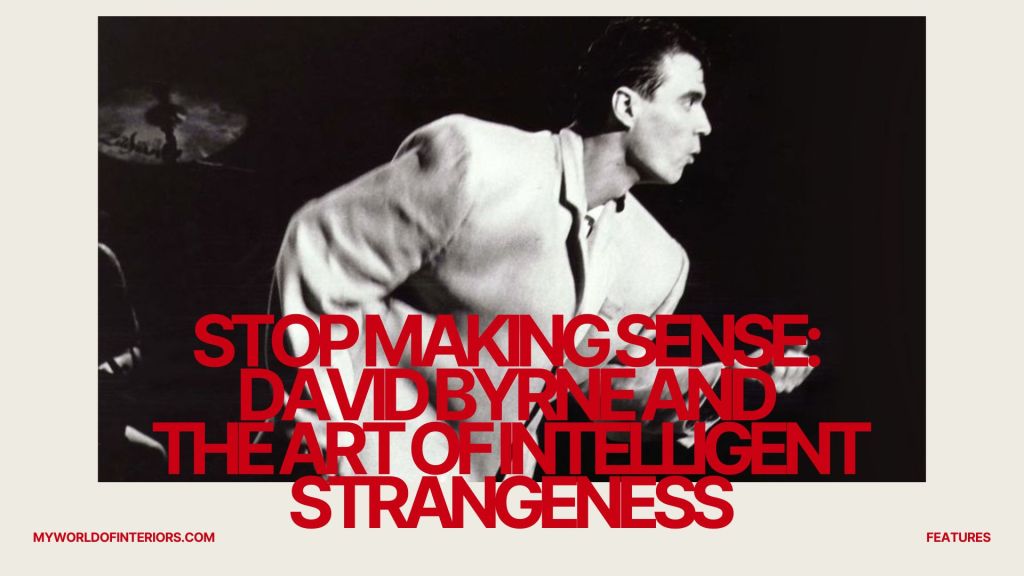
He arrived in New York with a ukulele and a stammer and an idea that pop music could be the vehicle for the most serious questions a person could ask. Fifty years later, the former lead singer of Talking Heads remains the most restlessly curious, most formally inventive, most genuinely odd figure in American popular culture — and the one who has best understood that the two things are not different things at all.
By Bergotte
There is a moment at the beginning of Stop Making Sense — Jonathan Demme’s 1984 concert film of the Talking Heads on their Speaking in Tongues tour, which is not merely the greatest concert film ever made but one of the great American films of its decade — that has not lost a frame of its strangeness in the forty years since it was shot. David Byrne walks onto an empty stage at the Pantages Theatre in Hollywood carrying a ghetto blaster and a guitar. He is wearing a shirt that is slightly too large, trousers that are slightly too short, and an expression of concentrated vulnerability that does not quite look like stage presence in any conventional sense — it looks more like someone who has just received a complicated piece of news and has not yet decided how to respond. He places the ghetto blaster on the stage. He presses play. A drum machine begins. He begins to play “Psycho Killer,” alone, his voice doing things that voices do not usually do in front of thousands of people: going quiet when it should go loud, going strange when it should go smooth, inhabiting the lyric — the confession of a murderer composed partly in French — with a literalness that makes the song feel genuinely dangerous.
The performance is not quite like anything else in the recorded history of popular music, and the quality that makes it unlike anything else is also the quality that, taken whole, defines Byrne’s fifty-year body of work: it is simultaneously completely controlled and completely exposed. There is nothing accidental in it. Every formal decision — the too-large shirt, the too-short trousers, the distance from the microphone, the specific quality of stillness before the song begins — is a choice, made by a man who thinks about performance with the seriousness of a choreographer and the analytical intelligence of a theorist. And yet the result does not feel calculated. It feels, impossibly, raw — as if the calculation had been so thorough that it had passed through artifice and come out the other side as something that resembled authenticity more completely than authenticity usually manages.
This paradox — the utterly deliberate arriving at the genuinely felt, the intellectual arriving at the emotional by routes so roundabout that the arrival feels like discovery — is the defining quality of everything Byrne has made. It is also, when you think about it, a description of what the best art does: it makes the conscious effort disappear into the result, so that what you receive is not the technique but the experience the technique was deployed to produce. Byrne has been deploying the technique for half a century, in music and film and visual art and writing and bicycle advocacy and theatrical spectacle and the systematic investigation of every musical tradition in the world that has interested him, which turns out to be most of them. The result is a body of work of extraordinary range and entirely consistent character — the range and the consistency are not in tension, because the range is itself the character. He is someone who cannot stop being interested in things. The things he is interested in have simply, over fifty years, accumulated.
Aberdeen, Baltimore, and the Education of an Outsider
David Byrne was born in Dumbarton, Scotland, in 1952, the son of a radio engineer father and a schoolteacher mother, and emigrated with his family to Hamilton, Ontario, and then to Arbutus, a suburb of Baltimore, Maryland, where he grew up and attended school and was, by most accounts — including his own, which is the most reliable, since he has been unusually honest and unusually articulate about his own formation — a strange child in the specific way of children who are not yet sure what kind of strangeness they are.
He has been diagnosed, in adult life, with Asperger’s syndrome, and he has discussed the diagnosis with the same quality of direct, analytical engagement that he brings to most subjects — neither claiming it as identity nor dismissing its explanatory power. The diagnosis, he has suggested, illuminates certain things about his childhood: the social difficulties, the particular quality of his relationship to routine and to sensory experience, the tendency to engage with the world through systematisation rather than intuition, the capacity for a kind of hyperfocused attention that, applied to music and art and the other objects of his sustained interest, has been enormously productive, and that, in the social environments of childhood and adolescence, was simply isolating. He was not popular. He was not, in the ordinary sense, comfortable. He was, however, paying very close attention to things — to the specific quality of sounds, to the way music organised experience, to the relationship between the body and the rhythms that the body responded to — and the attention was building something.
He went to the Rhode Island School of Design for two years, left, went briefly to the Maryland Institute College of Art, left again, and arrived in New York in 1974 with the combination of artistic ambition, social awkwardness, and sheer formal curiosity that New York in the mid-1970s could, if you were lucky and if you arrived at the right moment, accommodate. He arrived at the right moment. The New York he arrived in was bankrupt, ungoverned, genuinely dangerous, and more creatively fertile than any comparable urban environment since Paris in the 1920s — the Lower East Side and the Bowery producing, within a few square miles and a few years, the entire vocabulary of punk and new wave and the downtown art world that was simultaneously developing at the Kitchen and the Mercer Arts Center and the lofts of SoHo. Byrne moved into a loft, enrolled at RISD briefly, formed a band with his Rhode Island acquaintances Chris Frantz and Tina Weymouth, found a rehearsal space above a gay bar on the Bowery, and began the process of becoming something that had not quite existed before.

Talking Heads and the Anxiety of the Ordinary
The name Talking Heads came from a TV Guide description of the television format in which a head speaks directly to the camera without the distraction of other visual information — and the choice of name was, like most of Byrne’s choices, more precise than it appeared. The band was interested in talking, in the relationship between language and music, in what happens when words are subjected to the formal pressures of rhythm and repetition and the specific sonic textures of rock music. They were interested in what rock music could do with ideas, with the kind of content that rock music had conventionally disclaimed — the intellectual, the anxious, the ironic, the genuinely uncertain — and they were interested in this at a moment when the dominant modes of rock music (arena rock on one side, pub rock on the other) were not especially hospitable to any of these things.
The early records — Talking Heads: 77 (1977), More Songs About Buildings and Food (1978), Fear of Music (1979) — made in collaboration with Brian Eno, who appeared at a moment in the band’s development that was precisely right for what he brought (an aesthetic of systematic experiment, a willingness to treat the recording studio as an instrument, a gift for creating sonic environments that were simultaneously strange and inhabitable), are now so thoroughly absorbed into the vocabulary of post-punk and new wave that it is difficult to recover their original strangeness. But the strangeness was real and was not primarily sonic — it was verbal and emotional and conceptual. Byrne was writing lyrics that were unlike any that had appeared in rock music before: lyrics in which the narrator was not the conventional rock protagonist (romantic, rebellious, suffering) but something closer to a case study — a person of uncertain stability, observing the world with an attention so acute that it had curdled into something between anxiety and revelation.
“Psycho Killer” — the song that begins Stop Making Sense and that announced Byrne’s arrival as a lyricist of genuine originality — is the extreme version, the cartoon version, of a sensibility that is present in quieter forms throughout the early records: the sensibility of the person who is not quite at home in the ordinary world, who looks at the ordinary world — at “buildings and food,” at the suburban landscapes of American life, at the social rituals of the cities — and finds in it something that is not quite right, something slightly off-register, something that the confident social surface conceals and that the overly attentive observer cannot stop seeing. “This ain’t no party / This ain’t no disco / This ain’t no fooling around,” Byrne sang on “Life During Wartime,” and the line has the quality of all genuinely strange art: it sounds like a joke and means something.
The addition of Eno sharpened and deepened this sensibility by providing Byrne with a set of formal strategies adequate to the emotional content. Fear of Music (1979) and Remain in Light (1980) are the records where the synthesis reached its fullest expression: the African rhythmic structures that Byrne and Eno had absorbed from the ethnomusicological archive (particularly the work of Eno’s collaborator Jon Hassell and the field recordings of ethnomusicologist Alan Lomax, which Byrne had been studying with the focused attention of someone who has found the thing they were looking for) woven through with the anxiety and the irony and the metropolitan nervousness that were Byrne’s own, the result being music that felt both ancient and contemporary, both rooted in the body and produced entirely by minds that could not stop thinking.
“Once in a Lifetime” — the single from Remain in Light that remains the most concentrated expression of the Talking Heads aesthetic — is about this condition: the condition of waking up in the middle of your life and finding that you do not quite recognise it, that the ordinary surfaces of existence have acquired a strangeness that demands an explanation, that the question “how did I get here?” is both the most banal and the most profound question a person can ask. The lyric is assembled from fragments of American evangelical rhetoric — the cadences of the tent revival, the preacher’s rolling repetition — and uses those cadences to ask a question that is the opposite of the question evangelism usually asks: not “where are you going?” but “where are you, and how did you arrive here, and what does your being here mean?” The video, directed by Toni Basil from choreography developed by Byrne himself, in which Byrne performs a series of jerky, spasmodic physical gestures that are simultaneously ridiculous and strangely moving, is one of the handful of music videos that genuinely extends the song rather than merely illustrating it.
The Big Suit and the Phenomenology of Performance
The big suit — the oversized white suit that Byrne wore for the final section of the Stop Making Sense concerts, which was four times the size of a normal suit and required him to walk with a deliberate, constrained gait that made every movement look like a considered act — is the most theatrical and the most theoretically precise object in the history of rock music performance. Byrne has explained its origins with characteristic directness: he was thinking about Japanese Noh theatre, about the way the costuming in Noh creates a self that is larger than the body it contains, a self that the performer inhabits rather than expresses. He was also thinking about the relationship between the performer and the stage, about how the scale of the body reads differently in different spaces, about how costume can be an argument rather than a decoration.
The argument the big suit makes is, when you sit with it, a remarkable one. Rock music performance is usually concerned with the projection of the performer’s inner life outward — the stage as a space in which the self is made more present, more intense, more legible. Byrne’s big suit reverses this: it makes the self smaller relative to its container, creates a figure in which the gap between the body and what surrounds it is the subject, in which the question of who is performing and what the performance is for becomes visible in a way that most rock performance is designed to conceal. The big suit is, in this reading, a piece of performance philosophy — an argument about the nature of the self in public, about the relationship between the private person and the social role, about the way we are all, always, wearing suits that are slightly too large for us and moving through spaces that were not designed to fit our actual dimensions.

This quality — of the formal choice as philosophical argument, of the aesthetic decision as a way of thinking rather than merely expressing — is the constant in Byrne’s practice across all the media he has worked in. He does not separate the intellectual and the aesthetic. He does not make work that is interesting to look at and then provide a verbal account of what it means. The meaning is in the looking, or the listening; the argument is in the form. This puts him in a tradition — the tradition of Cage and Cunningham and Rauschenberg and the New York School more broadly — that understands art as a form of inquiry rather than a form of expression, that treats the aesthetic encounter as a way of producing knowledge rather than communicating feeling. What distinguishes Byrne from the more severe practitioners of this tradition is that he never sacrifices the pleasure. The work is always, at some level, fun — funny, even, in the specific sense of being interested in the world rather than oppressed by it.
Brian Eno and the Art of Collaboration
The relationship between Byrne and Brian Eno — which has produced, across the decades, two of the most formally adventurous records in the history of popular music (My Life in the Bush of Ghosts in 1981 and Everything That Happens Will Happen Today in 2008, with a gap of twenty-seven years between them that does nothing to diminish the coherence of the project) — is the most significant creative partnership in the history of British and American art music of the late twentieth century, and it is, characteristically, a partnership between two people whose methods and temperaments complement each other so precisely that the result is something neither could produce alone.
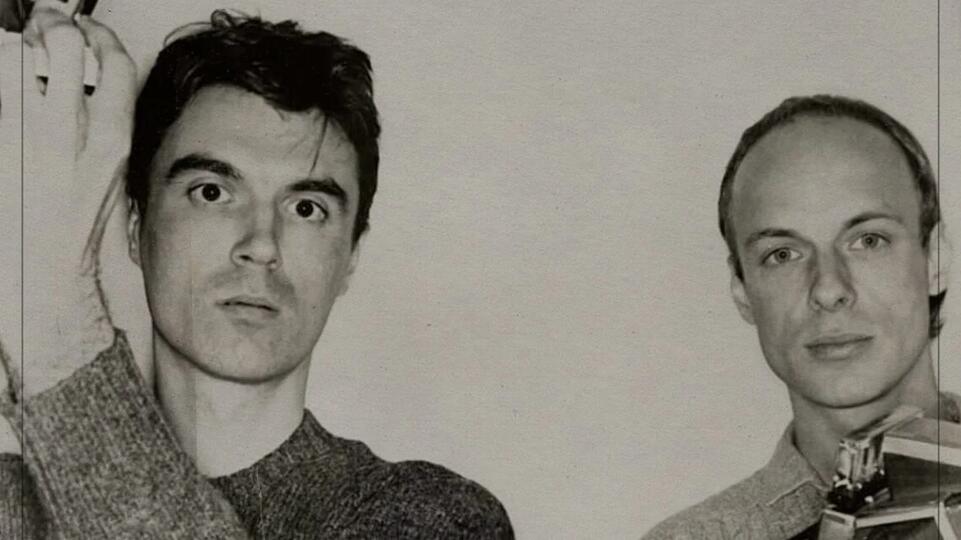
Eno brings system: the willingness to treat music as an environment rather than a narrative, to think in terms of processes and textures rather than themes and development, to create sonic spaces in which things can happen rather than songs in which things are meant to happen. He is one of the most conceptually rigorous musicians of his generation, and the concepts — ambient music as a genre, the systematic use of chance and constraint in composition, the idea of the recording studio as an instrument in its own right — have had a transformative effect on the practice of music over the past fifty years.
Byrne brings anxiety and joy and the specific quality of his vocal presence — a voice that is technically limited in the conventional sense and therefore capable of things that conventionally good voices cannot do: the sudden break into falsetto that sounds not like a technique but like a genuine fracture; the way he will hold a syllable past the point of comfort, holding it with the attention of someone who has just noticed that syllables are strange; the laugh that appears in the middle of lines where a laugh has no structural business appearing. Together they made My Life in the Bush of Ghosts, which sampled found voices — an American radio evangelist, an Arabic singer, a Lebanese mountain singer — over African-derived rhythmic structures and ambient textures, producing music that sounded like it was arriving from several temporal and cultural distances simultaneously, that was about the relationship between the local and the global, between the recorded and the live, between the intentional and the found. It was made two decades before “world music” became a commercial category, and it made most subsequent examples of the category sound like tourism by comparison.
True Stories and the Love of America
In 1986 Byrne wrote and directed a film called True Stories, which is, along with Nashville and Blue Velvet and a handful of others, one of the films most honestly in love with the specific strangeness of American life — in love with it not in the way of the satirist who loves his subject in order to punish it, but in the way of someone who finds in the subject an endless, slightly vertiginous pleasure, a pleasure that contains fear but is not reducible to it.
The film is set in Virgil, Texas, a fictional town celebrating its “Celebration of Specialness” — a sesquicentennial festival — and follows a narrator (played by Byrne, dressed in a series of Western outfits and driving a convertible and observing the proceedings with the benign curiosity of an anthropologist who has fallen in love with his field site) through a series of encounters with Virgil’s inhabitants: a woman who has not left her bed in years and who is, in her way, completely happy; a man who advertises for a wife in the personal columns because he wants someone to share his considerable collection of folk art; a preacher who incorporates advertising imagery and corporate logos into his sermons with complete sincerity; a factory that produces computer chips with a floor show performed by the workers.
The film is based on tabloid stories — Byrne had been collecting Weekly World News and National Enquirer stories for years, drawn to them not for their sensationalism but for their specificity, for the way they revealed, in their distorted and exaggerated form, genuine facts about the American experience that more respectable reportage was too sophisticated to notice. The people in those stories were real people, living real lives that the mainstream culture had decided were too strange or too poor or too provincial to take seriously. Byrne took them seriously, which is the film’s central moral and aesthetic act.
The soundtrack, performed by Talking Heads, is one of the most purely enjoyable things the band made — looser and warmer than the more theoretically intense records, connected to country and gospel and Tex-Mex in ways that felt earned rather than appropriated. And the film itself holds up, four decades later, not as a period piece but as a genuine investigation of questions that have not gone away: about what it means to live in America, about the relationship between the commercial and the spiritual, about what happens when you look at something everyone has decided is beneath notice and find it inexhaustible.
The Bicycle and the City
In 1982, faced with the practical problem of getting around New York without access to a car, Byrne began cycling. What began as transportation became, with the systematic curiosity that characterises all his engagements with the world, an extended inquiry into the relationship between the human body in motion and the urban environment that body moves through. He cycled everywhere, on every continent, in every city where touring or curiosity took him — Tokyo and Buenos Aires and Nairobi and Istanbul and Manila — and he kept notebooks and took photographs and thought about what the experience of cycling revealed about the cities he was moving through that other forms of transit concealed.
The result was Bicycle Diaries (2009), one of his most genuinely surprising books: a travel memoir organised around the bicycle as an epistemological tool, a way of knowing cities at the speed and scale at which they become legible — faster than walking, which is too slow to cover the distances that reveal a city’s structure; slower than driving, which is too fast to register the textures and the social life of the street. Byrne’s account of cycling in Manila during the Marcos dictatorship, or in Berlin in the years after reunification, or in Buenos Aires where the Mothers of the Plaza de Mayo were still circling the square, has the quality of his best work: the specific observation opening into the general argument without the argument ever overriding the observation.
He has been an advocate for urban cycling — for the redesign of cities around the needs of cyclists and pedestrians rather than automobiles — with the same sustained commitment that he brings to everything he cares about, which means not with the evangelical fervour of the committed activist but with the patient, evidence-based, completely serious engagement of someone who has thought hard about a problem and arrived at conclusions he is willing to defend. He co-designed a range of bicycles. He lobbied New York City for bike lanes. He wrote about cycling for a variety of publications. None of this is a distraction from the art; all of it is, in the Byrne sense, the art — the extension of the same quality of attention that makes the music, into the world the music is made in.
The Luaka Bop Years and the World as Archive
In 1988 Byrne founded Luaka Bop, a record label whose initial purpose was to release Brazilian music — particularly the work of Tom Zé, the São Paulo-born composer and musician whose career had stalled in Brazil but who had made records in the 1970s that were unlike anything else being produced anywhere in the world: records that combined Brazilian popular music with musique concrète and political satire and absurdist theatre, that were too strange for the Brazilian mainstream and too rooted in the Brazilian experience to be legible to international audiences. Byrne found the records, understood them, and spent the years that followed making the case that they deserved to be heard.
Luaka Bop expanded its remit: Cuban son, West African funk, Thai pop, Malian blues, Cambodian rock from the 1960s (the entire scene had been largely exterminated by the Khmer Rouge, and the surviving records, when Luaka Bop found and released them, were among the most beautiful and most heartbreaking musical discoveries of the century). The label was not a world music label in the commercial sense — it was not producing a curated product for consumers who wanted to feel cosmopolitan. It was an archive and a propaganda operation simultaneously: the archive of Byrne’s own musical education, the propaganda for the proposition that the musical traditions being catalogued were as serious, as historically important, as aesthetically rich as anything in the Western canon.
This proposition — which sounds uncontroversial stated flatly but was, in the context of the music industry and the critical establishment of the late 1980s and 1990s, genuinely radical — was one that Byrne had held since the Remain in Light recordings, since the discovery of African polyrhythm that had reorganised his understanding of what rhythm was and what it could do. Music, in his account, was not a Western European achievement with various interesting regional variants. It was a global practice of extraordinary diversity, most of which the Western market had either ignored or metabolised without acknowledgment. The label was his way of doing something about both the ignorance and the metabolisation — of creating a mechanism for acknowledgment that was also commercially serious, that could sustain the artists rather than merely celebrating them.
The Theater Works: Here Lies Love and Joan of Arc
In 2012, after several years of development in collaboration with the producer Fatboy Slim, Byrne staged Here Lies Love at the Public Theater in New York — a musical about Imelda Marcos, the wife of the Filipino dictator Ferdinand Marcos, which was simultaneously a serious engagement with the political history of the Philippines and a fully immersive disco experience, staged in a space that had been converted into a nightclub, with the audience on their feet, moving between stages as the action unfolded around them.
The choice of form was the argument: if Imelda Marcos was a creature of spectacle, of the ways in which authoritarian power clothes itself in glamour and makes the glamour complicit in the violence, then the appropriate form for examining her was the form she had inhabited — the night club, the party, the spectacle of bodies in motion that disco represented at its most culturally charged. To make a conventional Broadway musical about Marcos would have been to domesticate her, to reduce the specific horror of her regime to a narrative that audiences could consume from the safety of their seats. To make a disco musical, staged in conditions that reproduced, with considerable fidelity, the experience of being inside the regime’s own aesthetic, was to implicate the audience in the glamour — to make them feel, however briefly, the seduction that had made the Marcoses possible.
The show was controversial in the way that serious formal choices are controversial when they are mistaken for aesthetic choices — when the form is read as a celebration of what it is actually analysing. Byrne expected this and addressed it, in interviews and in the programme notes, with the usual directness. He was not celebrating Imelda Marcos. He was trying to understand how someone like her was possible, and the answer, he believed, was in the disco — in the specific affective register of the party, the spectacle, the collective surrender to the pleasure of the moment that authoritarian populism has always known how to exploit. The show transferred to Broadway in 2023, where it received the critical reassessment that time and distance usually permit.
The Knee Plays, The Forest, Songs of Dissent and Laughter: throughout his career, Byrne has returned to the theatre as the form that allows the most complete integration of the elements he is interested in — music, movement, image, text, the live body in a shared space with other live bodies. He is not a theatre director in the conventional sense; he lacks the interest in character and narrative that conventional theatre requires. He is, rather, someone who understands the theatre as an environment for collective experience, and who is interested in designing that environment with the same precision that he brings to a record or a visual artwork.
The Writing: How Music Works
In 2012 Byrne published How Music Works, a book that is, in its combination of intellectual range and personal directness, the fullest account available of how he actually thinks about music — not just his own music but music as a human phenomenon, from an evolutionary and anthropological and sociological and aesthetic standpoint, traced across its history from the acoustic properties of the earliest known musical instruments to the Spotify algorithm.
The book is characteristic in its refusal of the expected forms: it is part memoir, part musicology, part cultural history, part practical guide to the music industry, and the parts do not sit in separate chapters but interpenetrate continuously, the personal and the general illuminating each other in the way that all good criticism does. Byrne writes about the specific acoustic properties of the CBGB stage — the way the room shaped the Talking Heads sound, the way the limitations of the room became productive constraints — with the same quality of attention that he brings to the analysis of Afrobeat or the economics of the record label or the neurological basis of musical pleasure.
The central argument of the book is one that he has been making, implicitly, throughout his career: that music does not exist in a cultural vacuum, that every musical form is a response to its environment — the physical environment (the concert hall, the church, the open air), the social environment (who is the audience, what are they there for, what does the music do for the community that produces it), the technological environment (what can be recorded, how can it be distributed, who can hear it and under what conditions). This is not a relativist argument — Byrne does not conclude that all music is equally valid, that there are no aesthetic standards, that the form is entirely determined by the context. He concludes, rather, that understanding the context is the condition of understanding the form, and that the failure to understand the context is one of the reasons that so much music criticism is inadequate to its subject.
He writes plainly, which is harder than it sounds for someone with the intellectual range he is working with. There is no jargon, no theoretical apparatus, no attempt to position the argument within the existing literature in the way that academic writing requires. There is just the thinking, laid out as clearly as he can manage it, in sentences that are the prose equivalent of his best lyrics: direct, slightly odd, concerned with the specific rather than the general, arriving at the general by way of the specific.
What He Is and What He Made
David Byrne is seventy-four years old, and he is still working, still cycling, still running Luaka Bop, still making music and art and theatre and occasional public statements on matters of civic and political concern, with the same quality of sustained, slightly bewildered engagement with the world that he has maintained since the New York lofts of the 1970s. The bewilderment is important. It is not affected — it is not the performance of naivety by someone who is actually very knowing. It is the genuine condition of someone for whom the world remains strange, for whom the ordinary has not yet lost its capacity for strangeness, for whom the question “how did I get here?” is still genuinely open.
The body of work he has accumulated is genuinely various: the Talking Heads records, each of which sounds, in retrospect, like the inevitable next step in a progression that could not have been predicted from any prior step. The solo records, inconsistent and interesting. The Eno collaborations. True Stories. Stop Making Sense. The Luaka Bop catalogue. The theater works. The books. The visual art — the paintings and photographs and drawings that have accompanied the musical career, largely beneath the radar of the art world, with more seriousness and more quality than the art world has generally acknowledged. The advocacy and the cycling and the salons and the lectures and the public letters.
What holds it together is not, exactly, a vision — the word suggests something too unified, too resolved, for the productive irresolution that characterises everything Byrne makes. It is, rather, a posture: a way of being in the world that is simultaneously rigorous and playful, analytical and affectionate, convinced that the most serious questions are best approached indirectly and that the indirect approach is more likely to find something true than the frontal assault. He has always understood that the way to make people think is to make them feel, and that the way to make them feel is to construct something with sufficient formal precision that the feeling has somewhere to go.
He is, finally, one of the great democratic artists of his era — democratic in the specific sense of believing that the people on the street, the people in the tabloids, the people in the suburbs and the small cities and the cultures that the mainstream considers beneath notice, are as interesting and as significant as the people in the art world or the academy, and that the music and the art and the theatre that takes those people seriously is not compromising its seriousness in doing so but demonstrating it. This is a position that has to be proved in the work, not merely asserted, and he has spent fifty years proving it.
“Stop making sense,” he sang, in the early days, and the instruction was and remains a formal one — a direction to the listener to stop demanding that the experience reduce to a legible argument, to allow the music to do what music does when you stop interrogating it, to surrender the drive toward conclusion and sit inside the thing itself for as long as the thing lasts. The thing lasts. It has lasted fifty years. It shows no sign of being finished.
Talking Heads’s studio albums are available on Warner/Sire Records. The Criterion Collection release of Stop Making Sense (1984, directed by Jonathan Demme) is essential. David Byrne’s books, including How Music Works and Bicycle Diaries, are published by McSweeney’s and Viking respectively. The Luaka Bop catalogue is available at luakabop.com. Here Lies Love ran on Broadway at the Broadway Theatre in 2023.

Leave a Reply