
In a country reshaped by war, censorship and exile, art has become the nearest thing to a free press
There is a particular kind of vertigo that comes from trying to describe a culture at the exact moment it is happening. The historian has the comfort of distance; the critic reviewing a single film or novel has the comfort of a frame. What follows has neither. It is an attempt to take a reading of a culture in motion — Iran’s, in the summer of 2026 — across cinema, literature, visual art, music and architecture, in a year when the country has been simultaneously bombed, mourned, censored and, in its diaspora at least, more visible on the world stage than at almost any point since 1979.
This is the first in a series that will move from city to city and country to country, asking a simple but unfashionable question: what is actually being made, right now, and what does it tell us about the place that made it. We begin in Iran not because its culture is more urgent than anywhere else’s, but because it offers, in unusually stark form, a case study in what art does when the state that governs a people is no longer the only — or even the primary — author of their story.
The timing is not incidental. Iran enters the second half of 2026 having just endured a war with the United States and Israel that struck its territory directly in February, on top of years of sanctions, a stalled and repeatedly betrayed reform movement, and the still-reverberating shock of the Woman, Life, Freedom uprising that followed the 2022 death of Jina Amini in police custody. Any one of these alone would be enough to dominate a national culture. Together they have produced something more unusual: a creative output that is neither wholly a culture of crisis nor a culture of denial, but a strange third thing, in which grief, satire, craftsmanship and outright evasion of the censor sit inside the same films, the same paintings, sometimes the same sentence.
A cinema that keeps outrunning its ban
No art form makes the paradox of contemporary Iran plainer than film. Iranian cinema is, by any international measure, in a golden run: Palme d’Or winners, Oscar nominations, retrospectives at UCLA and elsewhere. And it is a golden run made almost entirely by directors who are, technically, not allowed to make films at all.
Jafar Panahi‘s It Was Just an Accident is the clearest emblem of this. Panahi has been banned from filmmaking in Iran for two decades and has been imprisoned more than once, yet he shot the film in secret and without official permission, and its actresses appear on screen without the hijab required by Iranian law. The film follows a group of former Iranian political prisoners weighing whether to take revenge on a man they believe tortured them. It premiered at Cannes in May 2025, where it won the Palme d’Or and received widespread critical acclaim, then went on to become the first Iranian film nominated for Best Motion Picture – Drama, Best Director and Best Screenplay at the Golden Globes. Critics have been near-unanimous in their praise: reviewers gathered by Rotten Tomatoes described it as among Panahi’s most overtly political films, a defiant challenge to authoritarian power that nonetheless works as a gripping thriller.
What makes the film distinctive is less its politics than its tone. One journalist who watched it noted the way the film moves between the register of state terror and outright farce — at one point a character bribing traffic police is met, absurdly, with a card reader, a small joke about the everyday corruption that flourishes in a society squeezed between sanctions and repression. Panahi’s method has always been ingenuity under constraint: his 2011 documentary was shot largely on a phone and, famously, smuggled to Cannes on a USB drive hidden inside a cake, while his 2015 film Taxi turned a car into an entire film set. He was arrested again in 2022 for protesting the detention of fellow filmmakers Mohammad Rasoulof and Mostafa Aleahmad, and held in Evin Prison until a hunger strike secured his release. Even after this year’s awards tour, he has said he intends to keep testing the state’s patience by returning to Iran, telling one interviewer that if he is imprisoned again, he will simply come out with a new script — a line that captures, better than any manifesto, how Iranian art-house cinema has learned to treat repression as raw material rather than an obstacle to be waited out.
Mohammad Rasoulof, Panahi’s contemporary and sometime collaborator, took a different route. After receiving a sentence of imprisonment and flogging for making The Seed of the Sacred Fig — a film that went on to win the Cannes special jury prize — he fled to Germany in 2024. From exile he has become, notably, the most prominent Iranian director willing to speak publicly about this year’s American and Israeli strikes on Iran. The strikes, which fell in the same window as the Cannes 2026 season, have already produced their own documentary response: the London-based director Pegah Ahangarani’s Rehearsals for a Revolution, built from her own home videos, protest footage and newspaper archives, traces four decades of Iranian history up to this year’s war, framing the country’s story as a sequence of uprisings that failed to complete themselves. Asked about the project, Ahangarani made the case, in essence, that a nation cannot free itself from dictatorship without first reckoning honestly with its own repeated failures to do so.
The war itself has entered the culture in a more oblique way too. When the veteran director Bahram Beyzaie died in December, in exile, Panahi eulogised him as someone from whom an entire generation of filmmakers learned how to resist forgetting, while the two-time Oscar winner Asghar Farhadi remarked on the bitter irony of the most Iranian of Iranians dying thousands of miles from home. It is a small, telling detail: Iran’s cinematic establishment increasingly convenes in absentia, its most honoured members scattered from Berlin to Los Angeles to London, its award ceremonies functioning as a kind of parliament-in-exile.
This is not the whole picture. Cinema also persists, more modestly and more legally, inside Iran itself. Saeed Roustaee — whose 2023 family drama landed him a jail sentence — returned to Cannes last year with a film about a widowed nurse under siege from the courts, the school system and her own family, suggesting that state pressure has not so much silenced socially critical filmmakers as pushed them toward more oblique, domestic registers. Meanwhile, institutions such as UCLA’s annual Celebration of Iranian Cinema have begun excavating an older, half-forgotten strand of the country’s film history: Cinema-ye Azad, or Free Cinema, an underground movement of self-taught, provincial filmmakers that flourished from 1969 until the 1979 revolution shut it down. That its rediscovery is happening now, curated by archivists in London and Tehran working in tandem, says something about the present moment too — a culture reaching backward for precedents of independence at exactly the point when independence feels most endangered.
Literature: the black market as publishing house
If cinema is Iran’s most visible cultural export, literature is arguably its most tightly wound. Every book published inside the country must clear the Ministry of Culture and Islamic Guidance, a process that functions less like formal law than like weather — unpredictable, locally administered, and dependent on the temperament of whichever examiner happens to read a manuscript. Publishers must apply for a fresh printing permit for each title; permits can be revoked on republication even for books that cleared review the first time.
The scale of what this produces is startling. According to researchers who have studied the system closely, well over half of previously approved books have at various points been blocked from reprinting, even though they had already passed the same ministry’s review once before. The reasons given are often vague to the point of surreal — “banal content, poor writing style” has served as an official justification for rejecting a manuscript a censor simply disliked. Sadegh Hedayat’s 1936 novel The Blind Owl, still regarded as the foundation stone of modern Iranian fiction, remains the country’s most mythologised banned book: nobody knows how many hundreds of thousands of copies have circulated outside official channels, because the black market that supplies them keeps no accounts. One essayist who grew up on the outskirts of the industry recalled that every writer she met in 1990s Tehran, regardless of temperament or politics, urged her to read Hedayat closely, and more than once — a piece of advice that has outlasted the regime that tried, repeatedly, to suppress the book its advice concerned.
That black market is not merely a nuisance economy; it is, in effect, Iran’s shadow publishing industry. Novels that fail to clear the censor circulate as photocopies, PDFs and pirated print runs, their readership impossible to measure precisely because piracy erases the paper trail that would otherwise measure it. Iran has never joined the Geneva copyright convention, partly, observers note, out of official reluctance to expose foreign publishers’ work to easier legal reproduction, and partly because domestic publishers, already squeezed by high costs and low readership, fear the additional burden of royalty payments. The result is a literature that exists in two simultaneous economies: the sanctioned one, thin and closely watched, and the unsanctioned one, richer and unaccountable to anyone.
Diaspora and academic publishing has become, in effect, a release valve. A doctoral researcher in the United States is currently translating That Mid-December Day, a novel banned in Iran for its depiction of drug use and, more quietly, for a scene of college students smoking opium while discussing the suppressed 1999 student uprisings. The translator has described the project as an act of cultural resistance in its own right — an attempt to let a silenced voice reach readers the state cannot control. It’s a useful reminder that translation into English is not a neutral act of cultural transmission for Iranian writers; it is very often the only publication a banned book will ever get.
The scholar Alireza Abiz, himself a poet forced into the same pattern of unofficial exile, has written the first systematic study of this censorship apparatus — a book that traces its machinery back to the mid-nineteenth century and is, unsurprisingly, itself banned in Iran. Abiz makes the point that the small number of Iranian books that do reach Western readers in translation are disproportionately either explicitly political or written by exiles, which distorts the wider picture: Iran’s literary culture, he argues, is far more varied — funnier, stranger, more formally adventurous — than the narrow slice that gets past both the Iranian censor and the Western market’s appetite for dissident testimony.
Visual art: memory as a medium
If literature in Iran survives largely underground, the visual arts have found a more porous relationship with the world — partly because so much of the most significant work is now made, or at least shown, outside Iran’s borders entirely.
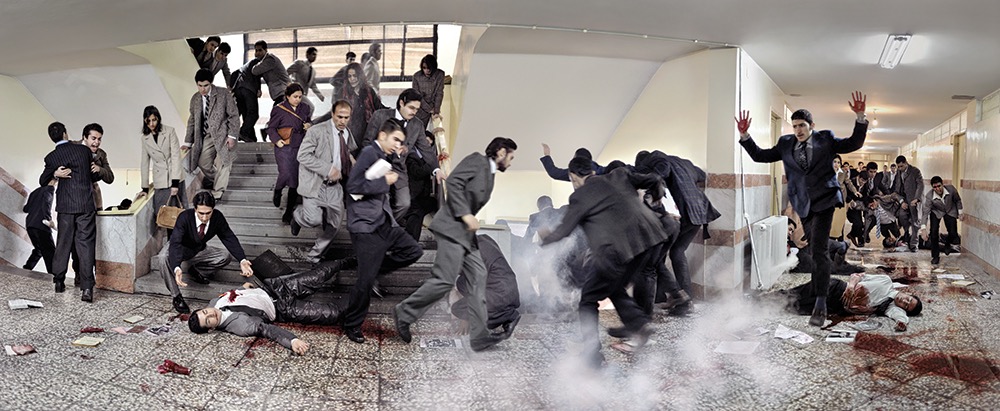
The photographer Azadeh Akhlaghi, who trained as an assistant director under Abbas Kiarostami, has spent recent years on a project called The Vicious Circle: sixteen large-scale staged photographs reconstructing eleven pivotal moments in twentieth-century Iranian history for which no visual record exists — assassinations, uprisings, turning points that happened, quite literally, off-camera. Reviewing the resulting exhibition at Harvard’s Peabody Museum, one critic noted the theatrical, almost cinematic quality of the images, comparing them to the staged tableaux of Jeff Wall or Gregory Crewdson, and observed the way Akhlaghi’s own account of the project — an attempt to interrogate how collective memory forms as much from absence as from evidence — sits somewhat uneasily with the exhibition’s claim to offer “testimony” for events nobody actually witnessed with a camera. It’s a productive tension: history painting’s oldest trick, restaged with a documentary photographer’s authority and a documentary photographer’s built-in claim to truth.
That preoccupation with memory, script and inheritance runs through much of the diaspora’s current programming. A recent Los Angeles exhibition, Falling into Language, gathered nine diaspora Iranian artists whose work returns obsessively to the Persian alphabet — its calligraphy, its handwriting, its fragments — as a way of holding onto a homeland that political rupture has made largely inaccessible. Its curators frame this attachment to script as a form of cosmopolitanism built from displacement rather than despite it: because this art belongs properly nowhere, it can, in a sense, be at home anywhere. A parallel Washington show, Maximal Miniatures, took the historic Persian manuscript tradition and asked a dozen contemporary artists — among them Arghavan Khosravi, Amir H. Fallah and the veteran Farah Ossouli — to blow it open: surreal, abstract, sculptural reworkings of a form once confined to the illumination of court manuscripts.
Since the death of Jina (Mahsa) Amini in 2022 and the Woman, Life, Freedom movement that followed, gallery and museum programming both inside Iran’s diaspora and in the wider international art world has shifted visibly toward direct solidarity. One New York exhibition staged in the movement’s aftermath showed the work of Iranian artists — some living inside Iran, some outside — entirely anonymously, a curatorial choice made explicitly to protect contributors and their families from the professional and physical risks that attach to visible dissent. It is a stark illustration of what “freedom of expression” actually costs in the Iranian context: not a metaphor, but a literal calculation about a family’s safety.
Earlier, more established generations of Iranian artists continue to be reappraised too. The Saqqakhaneh school — the mid-century movement, associated with figures like Hossein Zenderoudi and Parviz Tanavoli, that fused Shi’a devotional imagery with modernist abstraction — remains the reference point against which almost all subsequent Iranian modern art gets measured, its motifs having long since migrated from gallery walls onto scarves and shirts in a way that mirrors, in miniature, the wider tension in Iranian visual culture between avant-garde intention and eventual absorption into commerce.
Institutionally, this history is only now getting the scholarly infrastructure it deserves. It took until 2013 for a major museum — the Asia Society in New York — to mount the first substantial international survey of Iranian modern art, organized around the three decades before the 1979 revolution, when Tehran briefly functioned as a genuinely cosmopolitan art capital with its own biennials and a state apparatus actively acquiring both Iranian and international work. That the exhibition felt overdue when it opened, and still gets cited as a foundational reference more than a decade later, says something about how thin the institutional record-keeping around this period remains — most of the real archival labor has fallen to a handful of independent scholars and exiled curators rather than to institutions inside Iran itself, where the Tehran Museum of Contemporary Art’s own extraordinary collection has spent long stretches effectively inaccessible to the public that owns it.
Music: parks, basements and drill beats from south London
Of all the disciplines surveyed here, music is the one where the gap between the officially sanctioned and the actually popular is widest — and where the war and its long prelude of protest movements have left the clearest fingerprints.
Public concerts by independent Iranian musicians are, for practical purposes, unavailable to most underground artists inside the country, so performance itself has migrated into improvised space. In Tehran, a loose collective of rappers — fifteen strong, performing under names like Saghi, Salvador and Shayang — began playing informally in a city park after one member brought a speaker to share a new track with two friends. Passers-by stopped. Word spread. What started as an accident of acoustics has grown, over roughly eighteen months, into a weekly show that now draws crowds of several hundred people, entirely without official sanction, in a country where legal venues remain largely closed to artists working outside state-approved channels. The rappers, most in their mid-twenties, hold ordinary day jobs — a sound engineer, a video editor, a barber — and treat the weekly park set as both community and market research: a way of learning, in real time, what an audience that cannot legally buy a ticket to hear them actually wants.
That improvisational, semi-legal ecosystem has deep roots. Persian rap emerged in the more socially open climate of the Khatami presidency in the late 1990s, and has always defined itself in opposition to state-sanctioned music — its lyrics dwelling on the parts of Tehran official culture prefers not to see: drug use, class division, urban disorder, and, running through it all, the city itself addressed almost as an unfaithful lover. A parallel and older experimental-electronic scene has quietly persisted since the late 1970s and early ’80s despite the 1979 revolution’s near-total interruption of the arts, sustained today by promoters like Tehran’s Paraffin collective, which pushed early skepticism from local venue owners into what is now a genuine public electronic-music circuit inside Iran, alongside a wider generation of ambient and drone composers — Siavash Amini, Porya Hatami, the Paris-based duo 9T Antiope — whose work now circulates as readily through Mexican or French experimental labels as through Tehran basements.
The diaspora, meanwhile, has taken that same underground energy and translated it wholesale into new genres and new geographies. The London-based rapper who performs as 021kid — a stage name drawn from Tehran’s telephone code — left Iran at twenty-one after growing up amid what he describes simply as chaos: police raids not just over music but over the wrong tattoo, the wrong haircut, the wrong crowd. In the UK he found in drill music, born in south London and descended from Chicago’s, a vocabulary that let him translate a specifically Iranian experience of surveillance and precarity into a genre already built around locality, confrontation and lived identity. He has spoken about this year’s protest wave as something that strengthened an old, unlikely solidarity between young Iranians and young Israelis demonstrating in the diaspora together, and describes his long-term hope in almost startlingly concrete terms: touring a free Iran, city by city, Tehran included. Whatever one makes of the politics his interviews gesture toward, the artistic fact underneath them is a real one — that Persian-language music’s most vital current mutation may be happening not in Tehran or Los Angeles, the genre’s two traditional poles, but in London, Toronto and other cities where a second diaspora generation is now old enough to make its own sound rather than simply inherit its parents’.
Architecture: rebuilding, again
Architecture is the discipline in which Iran’s present moment is least legible in any single building and most legible in the pattern across many of them — because architecture, more than any other art discussed here, is inseparable from the state of the economy and the state of the ground itself.
For the past two decades, Tehran’s contemporary architects have been engaged in a fairly coherent project: translating pre-modern vernacular forms — the iwan, the courtyard, deep-set brick façades designed for shade and privacy — into a modern material language of concrete, steel and folded brick screens. The results, catalogued extensively by outlets like ArchDaily and Architizer, are often genuinely inventive: a Tehran apartment block called Woof Shadow reworks its entire origami-folded brick façade around the historic function of filtering light and preserving privacy in a dense city, while firms like NextOffice and Kanisavaran have built a substantial body of villas and cultural buildings that reintroduce the courtyard as an organizing idea for contemporary domestic life. One widely shared architectural essay went so far as to argue that this recent boom in expressive brickwork is not despite Iran’s isolation from Western markets but partly because of it — that sanctions, by cutting off easy access to imported glass-and-steel curtain-wall construction, pushed architects back toward a material, brick, that Iran has always had in abundance and always known how to use with unusual sophistication.
That momentum has now collided with the events of February 2026, when American and Israeli strikes hit Iranian territory in a conflict that also touched Lebanon, Syria, Iraq, Jordan and the Gulf states — the latest and most severe escalation in a regional pattern of infrastructural destruction that architecture critics have started to treat as a subject in its own right, alongside the war’s devastation of Gaza. It is too early, as of this writing, to say what a rebuilding architecture will look like, but Iran’s own history offers an uncomfortable precedent: after the Iran–Iraq war of the 1980s, one architectural historian has written, reconstruction consumed the country’s design culture so completely that architecture had, in his words, “nothing to say” for years afterward — a stark reminder that a building culture this articulate about memory, light and courtyard privacy has also, twice now within living memory, been forced to set all of that aside simply to put roofs back over people’s heads.
The pattern underneath
Look across these five disciplines together and a shape emerges that no single review or exhibition catalogue quite captures on its own. Iranian culture right now is not really one culture but at least three, operating in parallel and only partially aware of one another: an internal culture that negotiates daily with a censor whose logic is often theological, sometimes commercial, and occasionally simply personal; a diaspora culture, now large and increasingly self-sufficient, that treats London, Los Angeles, Paris and Toronto less as exile than as a second archipelago of Iranian cities; and a third, harder-to-name culture made of the traffic between the two — the smuggled hard drive, the anonymous exhibition, the translated banned novel, the park concert whose bootlegged recording finds its way, within days, onto a diaspora radio playlist thousands of miles away.
What is striking, across film, fiction, painting, music and architecture alike, is how rarely this produces work that reads as simple protest art. Panahi’s films are funnier than their premise suggests; the Tehran rap collective is, by its own account, mostly interested in learning what makes a crowd sing along; the brick façades of NextOffice are not slogans, they are just very good buildings. The regime’s censorship apparatus, remarkable in its reach, has not managed to flatten Iranian culture into a single register of dissent — if anything, the opposite: forced to route so much of itself through indirection, humor, staged photography, coded lyrics and vernacular form, contemporary Iranian art has become unusually fluent in the kind of ambiguity that outlasts the political moment that produced it. Farrokhzad and Hedayat both survived similar attempts to erase them; there is no obvious reason to think this generation’s work will not do the same.
Whether the coming months bring a rebuilding architecture, a wave of war documentaries, or simply more parks full of rappers testing new material on whoever happens to be walking past, the throughline will likely stay the same: in Iran, culture is not a reflection of politics happening elsewhere. For now, it may be the only sphere in which anything like a genuinely open conversation is actually taking place.
Sources
Cinema
- “It Was Just an Accident” — Wikipedia
- Jafar Panahi and the defiant evolution of Iranian cinema — The Week
- As Iran Makes Headlines, Iranian Cinema Raises Its Standing — Variety
- UCLA Celebration of Iranian Cinema 2026 — Farhang Foundation
- A Tribute to Iran’s Soulful and Revolutionary Cinema — Jacobin
Literature
- Book censorship in Iran — Wikipedia
- Iran: Book Censorship The Rule, Not The Exception — RFE/RL
- Iran’s Ultimate Banned Book — The Dial
- Doctoral student to translate English professor’s banned novel from Persian to English — Binghamton News
- Alireza Abiz’ “Censorship of Literature in Post-Revolutionary Iran” — Qantara.de
- A look at the black market for books in Iran — Peace Mark
Visual art
- Azadeh Akhlaghi’s “From Iran” exhibition: art & history in focus — The Boston Globe
- ART IRAN: Falling into Language — Craft Contemporary
- Maximal Miniatures: Contemporary Art from Iran — Middle East Institute
- Anonymously از Iran — Culture Lab LIC at The Plaxall Gallery
- Iranian modern and contemporary art — Wikipedia
- Iran Modern — Asia Society
Music
- Young Iranian Rappers Find a Stage (and a Refuge) in a Park — IranWire
- Roots: An Inside View On Iran’s Underground Electronic Scene — Half Is Enough
- A Guide to Iran’s Electronic Underground — Bandcamp Daily
- 021kid: Bringing Iran’s revolution to the London drill scene — The Jerusalem Post
Architecture
- Architecture from Iran — ArchDaily
- Tehran — ArchDaily City Guide
- Playing With Mass: 9 Projects That Speak Volumes About Contemporary Iranian Architecture — Architizer Journal
- An Iranian Architecture Appreciation Post — Naked Capitalism
- Three Mutations in Contemporary Architecture of Iran — World Architecture
Discover more from My World of Interiors
Subscribe to get the latest posts sent to your email.

