
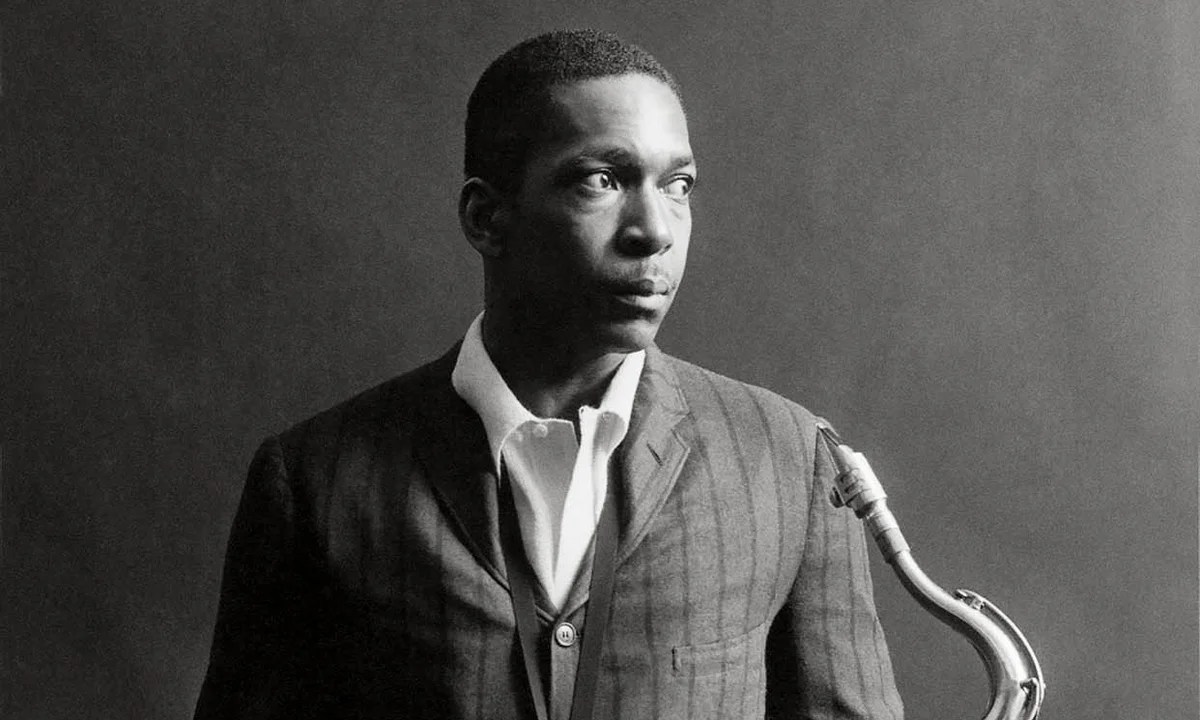
He played saxophone with the intensity of a man trying to resolve, through sound alone, questions that language could not reach. He was thirty years old before anyone noticed. He was forty when he died. In between, he remade jazz so completely that the music has never fully recovered — or needed to.
There is a recording made on the fifth of December 1961, at the Village Vanguard in New York City, of a piece called Chasin’ the Trane. It lasts just over sixteen minutes. It features no piano, no harmonic cushion of any kind — just bass, drums, and John Coltrane on tenor saxophone, playing what can only be described as a pursuit: urgent, relentless, technically staggering, emotionally raw in a way that popular music of the period was not supposed to be and that jazz, even at its most adventurous, had not quite been before. Coltrane plays through keys, through modes, through what sound like several competing ideas simultaneously, circling something that he cannot quite reach, pressing harder, going further, until the piece ends not with resolution but with exhaustion — the exhaustion of a man who has pushed the instrument and himself to their outer limits and found that the limits have moved.
The recording was controversial. Ira Gitler, who had coined the term “sheets of sound” to describe Coltrane’s earlier harmonic density, reviewed it for Down Beat and called it anti-jazz. The journal received letters from readers who agreed. A significant faction of the jazz press, the jazz public, and some of Coltrane’s fellow musicians felt that what was happening on recordings like Chasin’ the Trane was not progress but dissolution — not the expansion of a musical language but its breakdown. They were right that something was breaking down. They were wrong about whether that was a problem.
John William Coltrane was born on the twenty-third of September 1926 in Hamlet, North Carolina — a coincidence of dates that links him, improbably, to the subject of the previous essay in this series, since Attenborough and Coltrane entered the world within weeks of each other, in the same year, on opposite sides of an ocean and a set of cultural distances so vast they might as well be different planets. The coincidence is worth noting because both men spent their careers doing a version of the same thing: paying attention to something most people were too hurried or too comfortable to attend to properly, and finding ways to transmit that attention to others.
Coltrane’s early life was shaped by loss and by the Black church. His grandfather was a minister; his father died when he was twelve; the musical foundation of his childhood was the organ music and congregational singing of the African Methodist Episcopal Zion Church. These facts are not incidental biographical decoration. They explain, as much as anything can explain the inexplicable, why his mature music sounds the way it sounds — why it has the quality of testimony, of supplication, of a spirit pressing against its own limits in search of something beyond them. He did not arrive at the spiritual dimension of his music through intellectual decision. He arrived at it because it was where he had always been, temperamentally and culturally, and his musical development was largely a process of removing the obstacles between himself and the place he had always been heading.
He took up the clarinet as a teenager, switched to alto saxophone, and moved to Philadelphia at seventeen to study at the Ornstein School of Music and the Granoff Studios, absorbing the bebop revolution that was transforming jazz in the mid-1940s with the speed and comprehensiveness of a student who understands that he is late and must work harder than the people who arrived first. He switched to tenor saxophone, the instrument that would define him, in the early 1950s, and spent several years playing in the rhythm and blues bands that were, for Black musicians of his generation, both a living and a constraint — commercially viable work that paid the rent while keeping the serious music at arm’s length.
The serious music began, for practical purposes, in 1955, when Miles Davis invited Coltrane to join his first great quintet. Davis was already a significant figure; he was in the process of developing the approach — cool, spacious, melodically refined, built on mood as much as on harmonic complexity — that would make Kind of Blue the best-selling jazz album in history. Coltrane was, at this point, technically accomplished but unformed, still assembling the vocabulary that would make him who he was. He was also, in the mid-1950s, addicted to heroin and alcohol, a condition that affected his reliability, his focus, and his relationships with bandmates and employers.
Davis fired him in 1956. Coltrane went to work with Thelonious Monk, an association that proved, in retrospect, to be the most important education of his musical life. Monk’s harmonic world — angular, dissonant, full of unexpected intervals and unresolved tensions, built on a relationship with silence as active as his relationship with sound — pushed Coltrane into harmonic territory he had not previously explored. He later said that working with Monk had shown him the possibilities available in a chord, the way a single harmonic structure could be approached from multiple angles simultaneously, that what sounded like a limitation was actually a vast space if you knew how to enter it.
He rejoined Miles Davis in 1958, and it was with Davis that he recorded his first masterpiece — not as a leader, but as a sideman on Kind of Blue in 1959, where his tenor playing has a warmth and a searching quality that sits in productive tension with the album’s prevailing atmosphere of cool restraint. He was already, by this point, doing something new: what Gitler called “sheets of sound” was a technique of playing multiple notes so rapidly and so continuously that they created the impression of harmonic simultaneity, as if the saxophone were playing chords rather than a single melodic line. It was technically dazzling and, in lesser hands, would have been merely showy. In Coltrane’s hands, it felt necessary — as if the music demanded more than a single note at a time could contain.
Giant Steps, released in 1960, is where Coltrane the leader begins in earnest, and it remains one of the most analysed recordings in jazz history. The title track is built on a harmonic sequence — the so-called “Coltrane changes” — that cycles through three key centres a major third apart, moving so rapidly that the conventional approaches to improvisation over chord changes become almost impossible. Musicians who tried to sit in on sessions where Coltrane was playing these changes found themselves lost within bars; the harmonic ground was shifting too fast for the ordinary navigational tools to function. Coltrane himself had spent months working out the theory and the fingering, practising for hours each day with a discipline that his contemporaries describe as almost monastic.
The word is not accidental. By the early 1960s, Coltrane had been clean from heroin for several years — a transformation he attributed, in the liner notes to A Love Supreme, to a spiritual experience in 1957 that he described as being granted a glimpse of the divine and choosing, in response, to rededicate himself to music as a form of worship. Whether one takes this literally or metaphorically, it describes something real about the quality of his commitment. He practised with the regularity and the intensity of a devotional act. He was known to fall asleep with the saxophone in his mouth, continuing to finger the keys in his sleep. He carried the instrument everywhere, played it in the wings of venues between sets, worked on problems of technique and harmony in hotel rooms at three in the morning. The music was not something he did. It was something he was.
The Classic Quartet — Coltrane on tenor and soprano saxophone, McCoy Tyner on piano, Jimmy Garrison on bass, Elvin Jones on drums — formed in 1960 and recorded together until 1965, producing a body of work that represents one of the sustained peaks in the history of jazz. The interplay between the four musicians has a quality that is almost impossible to describe without recourse to the language of intimacy, of conversation, of people who have been talking to each other for so long that they can complete each other’s thoughts and argue with each other’s premises simultaneously. Tyner’s left-hand voicings — dense, quartal, built on fourths rather than the thirds of conventional harmony — provided a harmonic foundation that was simultaneously stable and open, a platform from which Coltrane could venture enormous distances and still, somehow, find his way back. Elvin Jones’s drumming was the most rhythmically complex in jazz — polyrhythmic, surging, built on the principle that multiple time signatures could coexist within a single measure — and it pushed Coltrane forward with a constant, propulsive pressure that the saxophonist described as feeling like the drums were always just behind him, urging him further.
A Love Supreme, recorded in December 1964 and released in January 1965, is the work that most listeners point to as the summit — the piece in which everything Coltrane had been developing coheres into something that transcends its genre and enters the category of major spiritual statement. It is a suite in four parts — Acknowledgement, Resolution, Pursuance, Psalm — and it is explicitly, unambiguously, a prayer: an act of gratitude addressed to God from a man who understood himself as a vessel for something larger than his own talent. Coltrane wrote a poem to accompany it, included in the original liner notes, that reads like a psalm in the biblical sense — direct, unadorned, fully serious in its devotion. “I will do all I can to be worthy of Thee, O Lord,” it concludes. The music itself is the worthiness, or the attempt at it.
The suite opens with a four-note bass motif — G, B flat, F, A flat — that Coltrane described as representing the words “a love supreme,” and that recurs throughout the first movement in different forms, a kind of musical mantra grounding the improvisation. The final movement, Psalm, is Coltrane playing the written poem on his saxophone — not representing it, not improvising around it, but literally playing its syllables, one note per syllable, so that the saxophone is speaking rather than singing. You can follow the poem on the page and hear each syllable in the saxophone’s voice if you know to listen for it, and when you discover this — when you understand what he is doing — the effect is not merely moving but destabilising. You have to revise your understanding of what an instrument can be, what music can be, what the relationship between language and sound might contain.
The album was a commercial and critical success by the standards of avant-garde jazz, which is to say it sold reasonably well and was almost universally praised, and it has since become one of the most celebrated recordings in American music. Churches have played it in services. It has been performed live as a sacred work in cathedrals and concert halls. Musicians who have nothing obvious in common with Coltrane — rock musicians, classical composers, hip-hop producers — cite it as a transforming encounter, the kind of work that makes you understand what your own art might aspire to.
After A Love Supreme, the music changed again, and this time the change was harder to follow. The late period — roughly 1965 to 1967, the last two years of his life — produced recordings that pushed beyond anything the jazz tradition could comfortably contain: Ascension, a collective improvisation for eleven musicians that was explicitly modelled on Ornette Coleman’s free jazz experiments but taken further; Interstellar Space, duo recordings with the drummer Rashied Ali that strip the music down to its most extreme elements; Expression, released posthumously, in which Coltrane plays flute and bass clarinet and produces sounds that seem to be testing the outer boundaries of what instruments are for.
McCoy Tyner left the band during this period, unable to hear his piano above the collective volume and intensity. Jimmy Garrison stayed but was increasingly peripheral. Elvin Jones left, replaced by Ali, whose approach was looser and more atmospheric. A second drummer was sometimes added, creating a polyrhythmic density that was more texture than pulse. The saxophonist Pharoah Sanders joined, playing in a register of controlled ferocity that complemented and sometimes competed with Coltrane’s own. The music became, in the truest sense, difficult — not difficult in the way that a complex text is difficult, requiring patience and learning, but difficult in the way that a storm is difficult, that a confrontation is difficult, that demands something from you before it will give anything back.
The controversy that had greeted Chasin’ the Trane returned, amplified. Former admirers wrote that Coltrane had lost his way, that the late recordings were self-indulgent, formless, noise. Jazz critics who had championed him through Giant Steps and the Classic Quartet years felt that he had finally gone somewhere they could not follow and chose, rather than follow, to declare the destination wrong. The response contained, as such responses generally do, some truth and considerable defensiveness — the defensiveness of people who had defined their understanding of a music around an artist who had declined to stay within the definition.
He died on the seventeenth of July 1967, of liver cancer, at forty years old. He had known for some time that he was ill and had, characteristically, told almost no one, continuing to perform and record through the final months of his illness. The recordings from this period have a quality — febrile, searching, pushing through physical limitation as well as musical — that is almost impossible to separate from the knowledge of what was happening to his body. Whether this retrospective colouring is legitimate or sentimental is a question each listener resolves for themselves. What is not in question is that the music of 1966 and 1967 does not sound like a man settling into mastery. It sounds like a man who knows that time is short and that there is still, always, further to go.
His legacy operates on several levels simultaneously. At the most immediate and measurable level, he changed the technical vocabulary of jazz saxophone so fundamentally that every tenor player who came after him has had to define themselves in relation to what he did — whether by extending it, by reacting against it, or by attempting to find territory it had somehow left unexplored. Wayne Shorter, Joe Henderson, Michael Brecker, Jan Garbarek, Branford Marsalis, Joshua Redman: all of them, in different ways and to different degrees, are conversations with Coltrane. The conversation is not always comfortable or complimentary. But it is inescapable.
At a broader cultural level, he established the proposition that jazz could bear the full weight of spiritual aspiration — that the music was adequate to the largest questions a human being could bring to it, that it did not need to be modest about its ambitions or its claims on the listener’s deepest attention. This proposition has been accepted with varying degrees of enthusiasm by subsequent musicians, but it has never been successfully refuted, and its acceptance has given a generation of jazz musicians the permission to take themselves, and their work, with a seriousness that the entertainment economy has always resisted.
And at the level of pure sound — which is, finally, the level that matters most — he produced a body of recordings that have not aged, that do not feel like historical documents but like living things, that continue to produce in new listeners the response they produced in the audiences at the Village Vanguard in 1961: the disorienting, exhilarating, occasionally frightening sensation of encountering a human consciousness operating at the absolute edge of its capacity, trying to say something that language cannot hold and that music can only approximate, but pressing toward the approximation with everything it has, relentlessly, honestly, without comfort or compromise.
Chasin’ the Trane is still running. Sixteen minutes in, the limits have still not been found.
John Coltrane (1926–1967) recorded for Prestige, Atlantic, and Impulse! Records. A Love Supreme (1965) remains his most celebrated work and was inducted into the Grammy Hall of Fame in 1999. The John Coltrane House in Philadelphia, where he lived during the years of his greatest recordings, was designated a National Historic Landmark in 1999. He was posthumously awarded a Pulitzer Prize Special Citation in 2007 “for his masterful improvisation, supreme musicianship and iconic centrality to the history of jazz.”
Discover more from My World of Interiors
Subscribe to get the latest posts sent to your email.

