
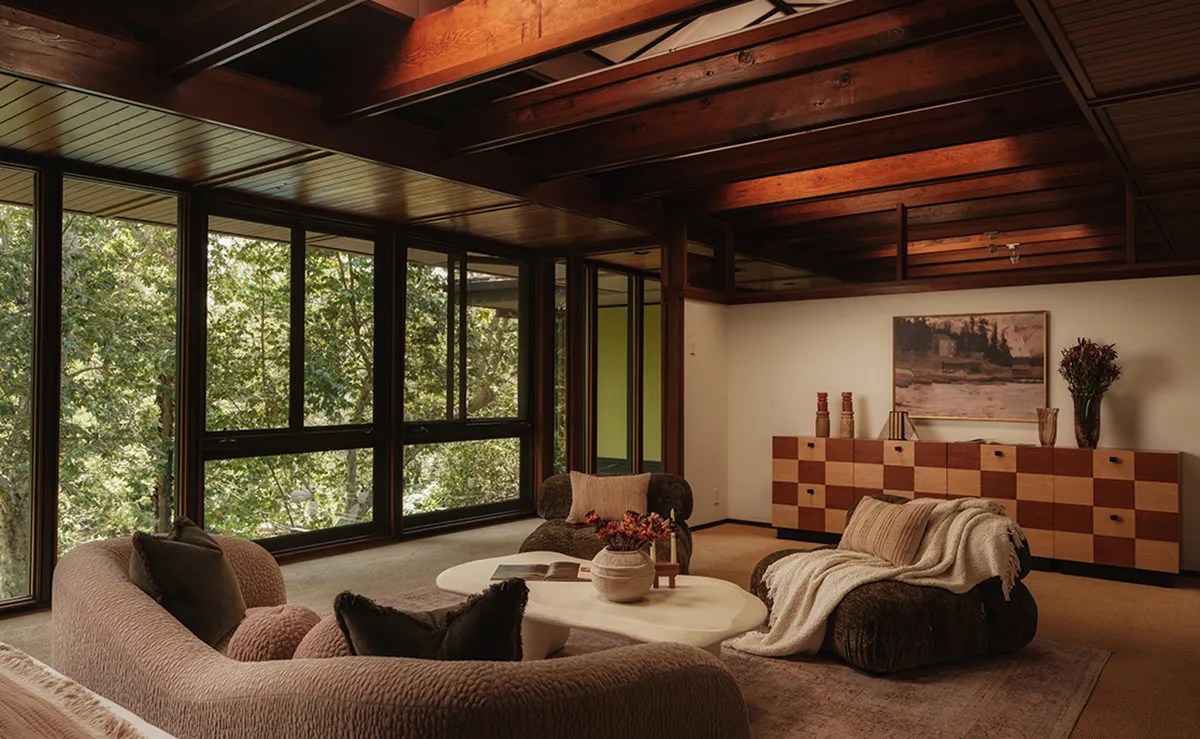
954 Hillside Terrace, Pasadena, California
There are houses that impress by arriving loudly, and others that seem to have grown into their site by degrees. The house at 954 Hillside Terrace in Pasadena belongs to the latter category: a 1965 mid-century residence folded into the trees of the San Rafael neighbourhood, where architecture, landscape and privacy appear less like separate ambitions than a single, carefully sustained mood.
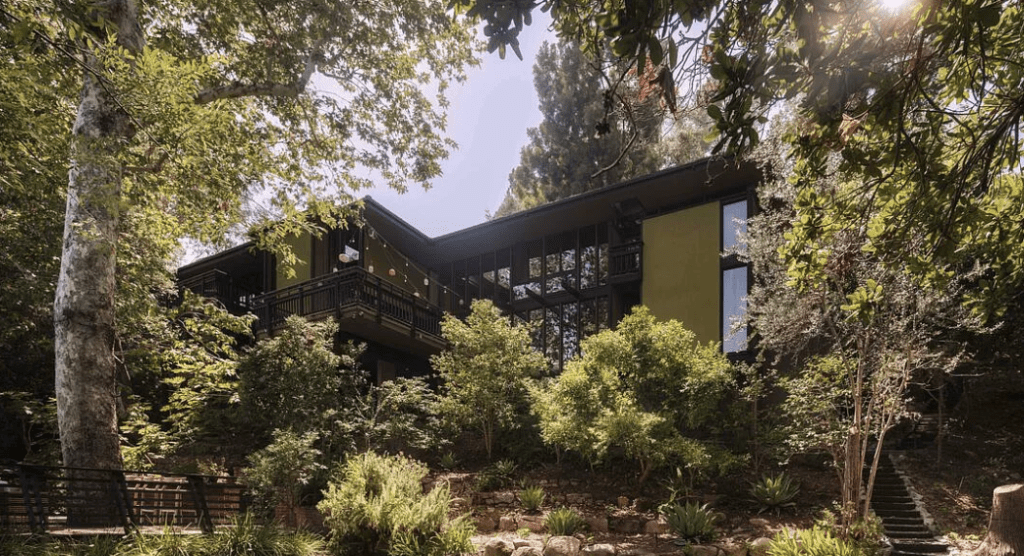
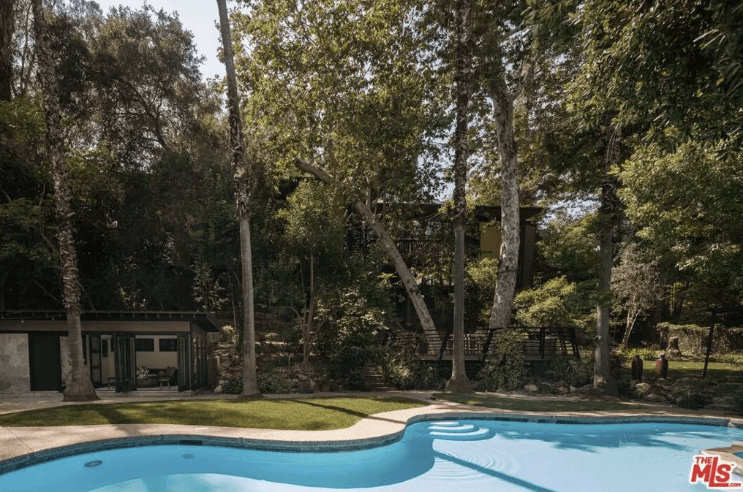
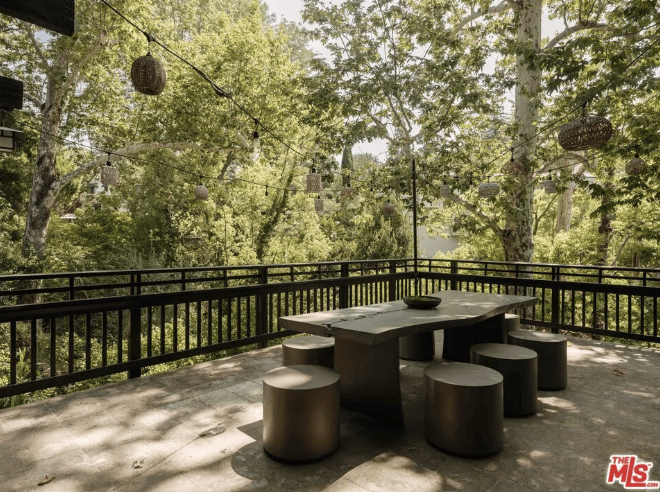
Currently for sale, and reported as having recently belonged to actress and writer Kristen Wiig, the property is more than a celebrity real-estate listing. It is a study in Southern California domestic modernism: a house of redwood, glass, stone, shade and sequence, designed by the architectural firm Ainsworth, Angel & McClellan, with landscape architecture by Kenneth S. Nakaba. Its appeal lies not simply in scale or provenance, but in the precision with which it belongs to its site.
Built in 1965, the house sits at a particularly interesting moment in the history of Californian modernism. By the mid-1960s, the language of the postwar modern house was no longer experimental in the way it had been in the late 1940s and 1950s. The glass wall, the open plan, the horizontal roofline, the built-in interior, the blurred threshold between inside and outside — all had become part of an established regional vocabulary. Yet in the best examples, these devices did not harden into formula. They became subtler, more atmospheric, and more attuned to landscape.
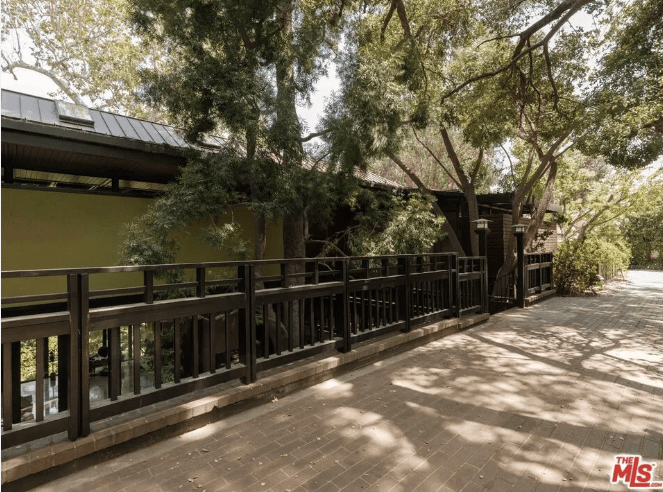
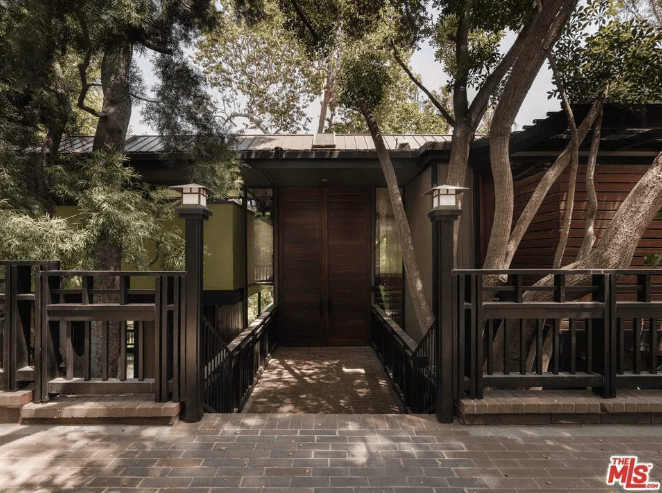
954 Hillside Terrace appears to belong to that more mature phase. It does not merely display modernist ideas; it absorbs them into a hillside composition. The approach itself is important. A suspended walkway leads through mature trees to the entrance, turning arrival into a slow architectural sequence rather than a simple passage from street to door. Before one reaches the interior, the house has already established its governing principle: movement through landscape.
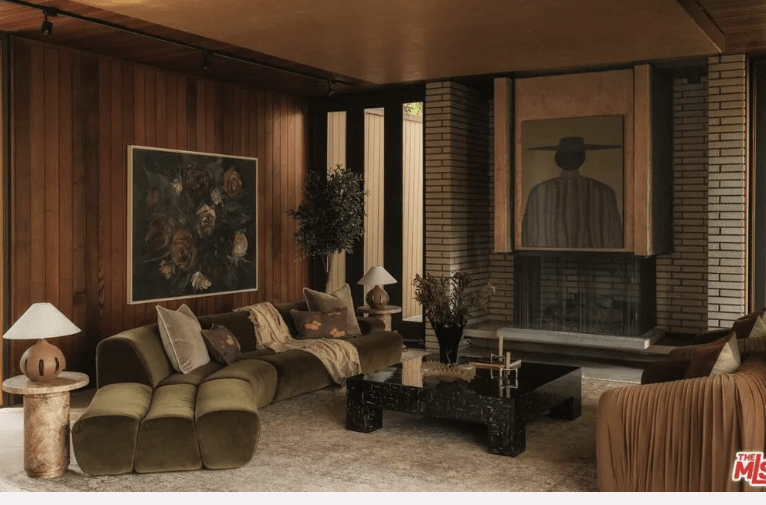
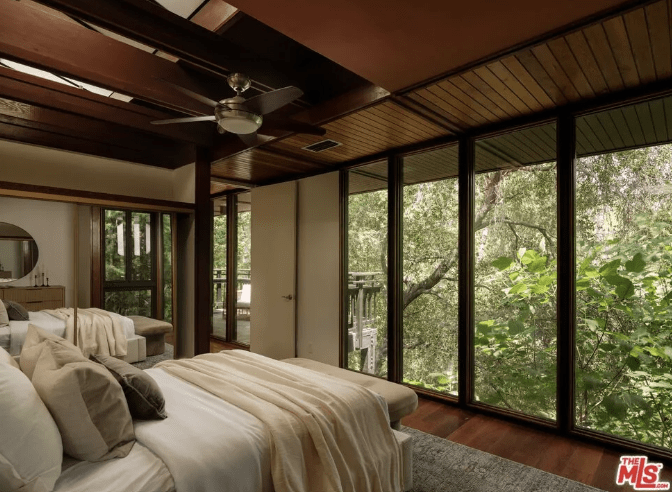
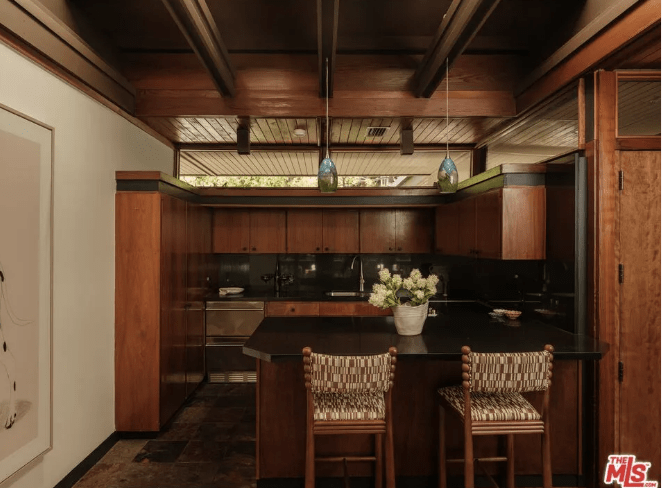
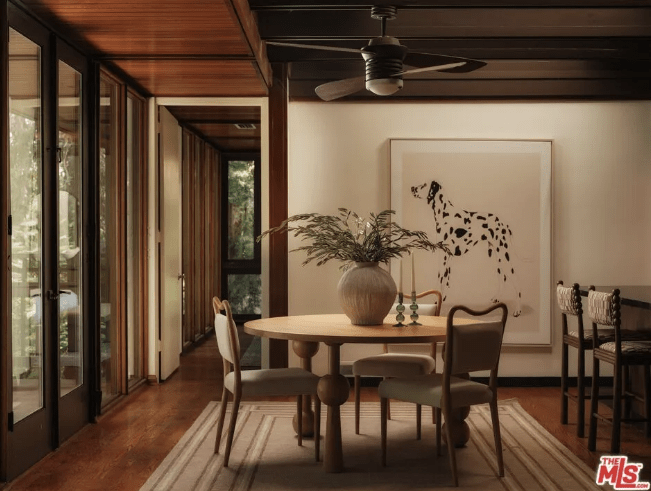
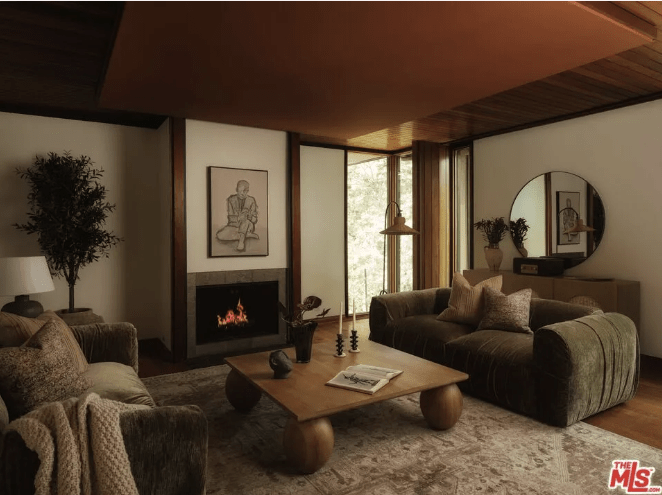
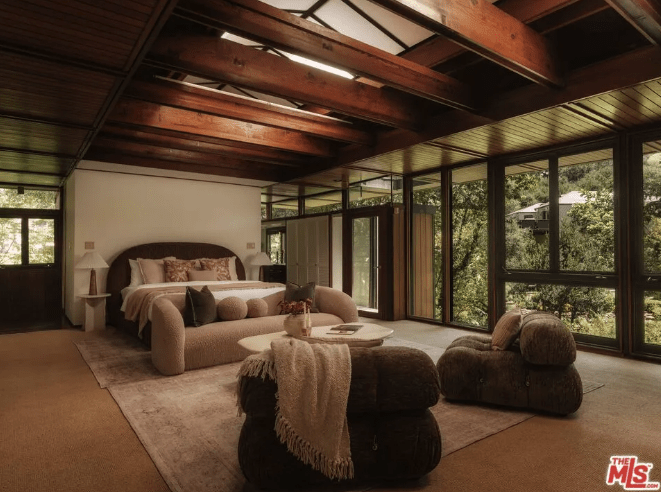
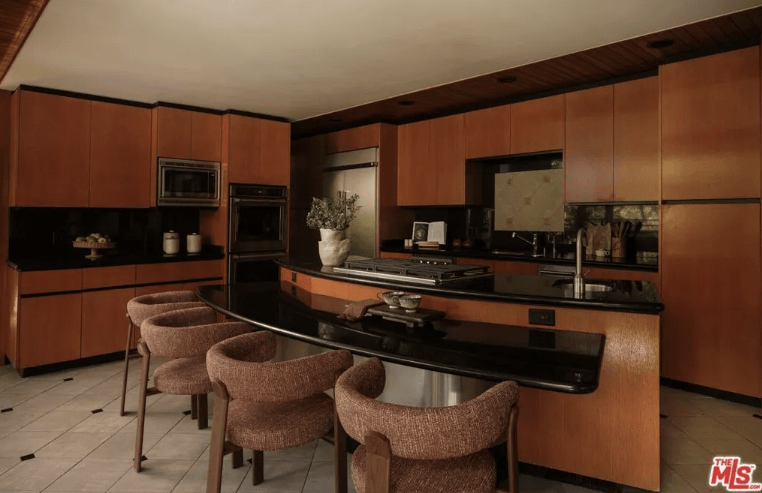
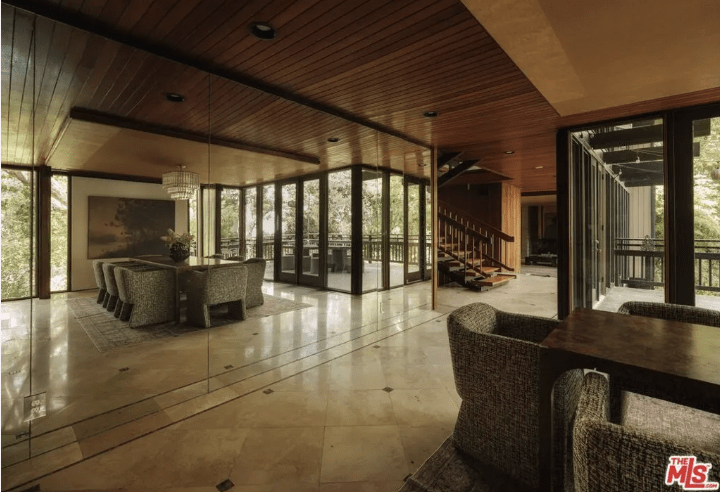
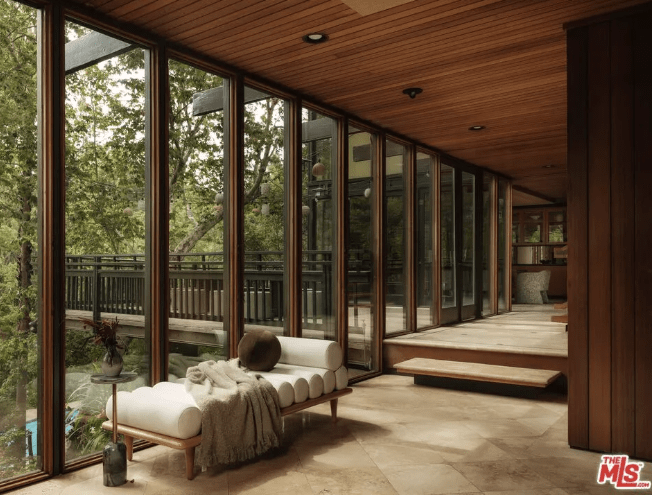
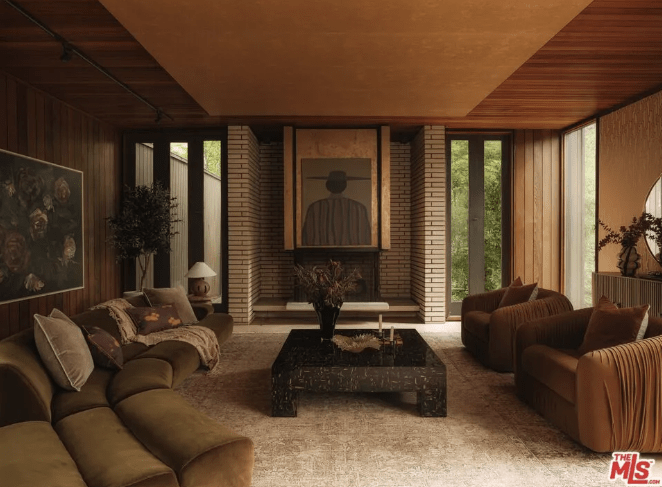
Inside, the residence unfolds across multiple levels, with living spaces shaped by wood-panelled ceilings, built-in joinery, a raised-hearth fireplace and broad expanses of glass. These are familiar mid-century elements, but here they operate with a particular softness. Redwood and stone temper the transparency of the glass. The hearth anchors the room. The views are framed rather than simply exposed. The result is not the hard, machine-like modernism of the early International Style, but something warmer and more Californian: a house at once open and sheltered.
The listing describes the design as reflecting both California modernism and Japanese architecture, and this influence should be understood with some nuance. Southern California modernism has long had a dialogue with Japanese architectural ideas: modularity, asymmetry, lightness, framed views, deep overhangs, and the close integration of house and garden. In Pasadena, as elsewhere in Los Angeles County, these ideas were often absorbed into a new regional language rather than reproduced literally.
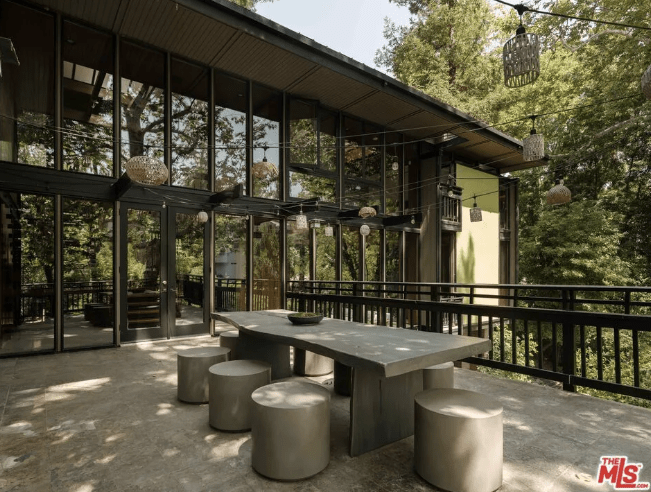
At Hillside Terrace, the Japanese influence seems to reside less in overt quotation than in atmosphere and discipline. The house is not theatrical in its references. Instead, it uses controlled approaches, natural materials, garden views and shifting thresholds to produce a sense of quietness. One feels the importance of the pause: the pause before entry, the pause at the hearth, the pause at the glass, the pause on the deck, where the architecture gives way to canopy and air.
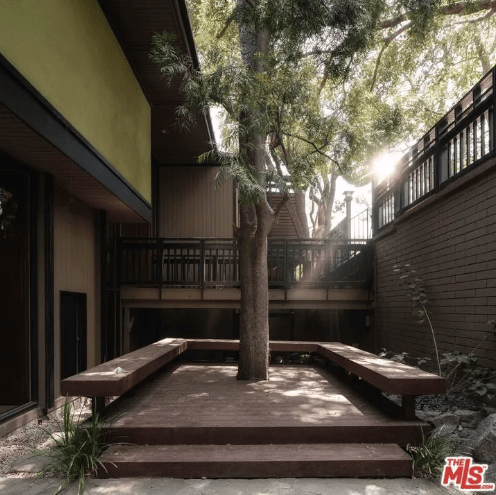
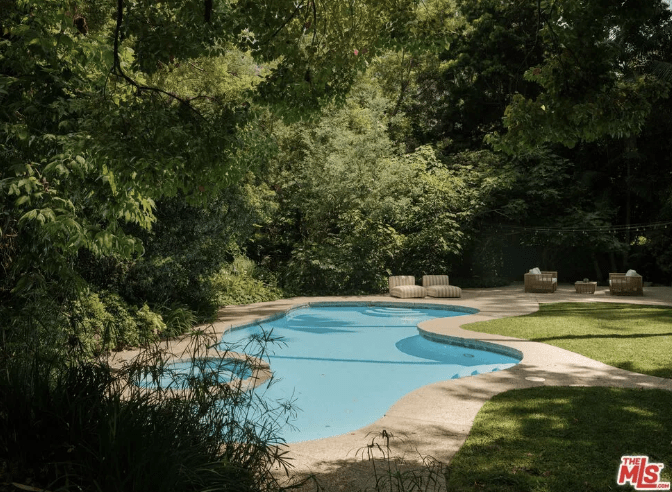
The landscape architecture is therefore central to the property’s meaning. Kenneth S. Nakaba’s design does not function as decoration around the house; it completes the architectural idea. Mature oaks and sycamores, winding garden paths, a freeform pool, an inset spa and densely planted grounds create a private world in which the building seems suspended within foliage. This is not simply a garden attached to a residence. It is a landscape framework through which the residence is experienced.
That relationship between architecture and topography is deeply Pasadena. The city is often associated with Craftsman houses, grand period revival estates and the cultural legacy of the Arroyo Seco, but its postwar hillside houses form an equally important part of its architectural identity. Pasadena’s own historic context recognises Mid-century Modern architecture as a significant post-Second World War category, and 1965 places this house near the end of that classic period. It belongs to a moment when domestic modernism had become sophisticated enough to be both formally restrained and emotionally rich.
The San Rafael setting intensifies this reading. This part of Pasadena is shaped by slopes, ravines, trees and views. Unlike flatter suburban subdivisions, hillside neighbourhoods demand negotiation. Roads curve. Houses step. Gardens become retaining devices, screens and stages. Architecture cannot pretend the land is neutral. At its best, it becomes a way of making the terrain legible.
954 Hillside Terrace does precisely that. Its decks, paths, glass walls and level changes do not erase the hillside; they choreograph it. The house turns the site into a series of experiences: enclosed and open, shaded and bright, domestic and almost woodland. The treehouse comparison often used in property coverage is understandable, but the house is more rigorous than that phrase suggests. It is not whimsical. It is controlled, quiet and spatially intelligent.
Kristen Wiig’s association with the property gives it contemporary visibility, but it also places the house within a wider pattern of creative figures being drawn to architecturally serious homes in Pasadena. Wiig has previously shown a taste for important modernist houses, including her former ownership of Pasadena’s Case Study House #10. That earlier connection matters, not because 954 Hillside Terrace is part of the Case Study programme, but because it belongs to the same larger regional story: Southern California as a laboratory for new forms of domestic life.
The Case Study Houses, launched in the postwar period through Arts & Architecture magazine, promoted new ways of living with economy, openness, technology and informality. By comparison, 954 Hillside Terrace is more secluded and more materially sensual. Yet it shares the same essential concern: how should a modern house respond to climate, landscape and the rituals of daily life?
Here, the answer is not grandiosity. Although the house is large, with guest quarters, a pool, spa and generous living spaces, its strongest quality is not excess. It is privacy. The architecture does not seek the panoramic drama of a glass box cantilevered above the city. Instead, it creates a world inwardly related to trees, stone, water and filtered light. It is a house of enclosure as much as exposure.
This is also why the property’s future matters. Houses of this period are often vulnerable to over-restoration or erasure. Their materials can be whitened, their woodwork stripped out, their plans opened beyond recognition, their landscapes simplified into generic outdoor rooms. A house like 954 Hillside Terrace asks for a more careful form of stewardship. Its value lies not only in its address or celebrity connection, but in the survival of an architectural idea.
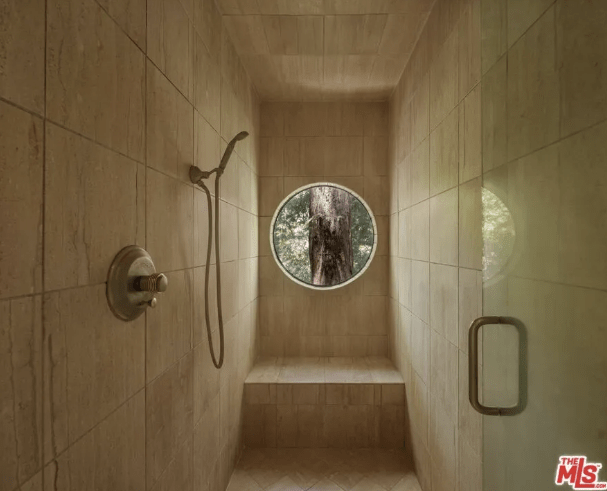
That idea is the Californian house as refuge: not a sealed object, but a living structure in conversation with its setting. Redwood, travertine, glass, plaster, stone and planting are not merely finishes; they are the vocabulary through which the house mediates between interior life and the natural world. The architecture is strongest when understood as a sequence of thresholds — between street and garden, garden and walkway, walkway and room, room and deck, deck and trees.
For Pasadena, this house is a reminder that the city’s architectural history did not end with the bungalow, the mansion or the Spanish Colonial estate. It continued into the postwar decades, into hillside experimentation, into houses where privacy, informality and landscape became the new forms of luxury. At 954 Hillside Terrace, that history remains unusually legible.
It is, in the end, less a star’s house than a house with its own quiet intelligence. Its beauty is cinematic, but not performative. It comes from sequence, material and restraint: the slow approach through trees, the warmth of timber overhead, the fireplace set low and solid, the glass opening onto foliage, the deck hovering at canopy level, the garden paths continuing the architecture after the walls have ended.
In a city rich with architectural memory, 954 Hillside Terrace offers a particularly Californian kind of elegance: private, wooded, modern, and still waiting for its next careful reader.
Discover more from My World of Interiors
Subscribe to get the latest posts sent to your email.
 My World of Interiors