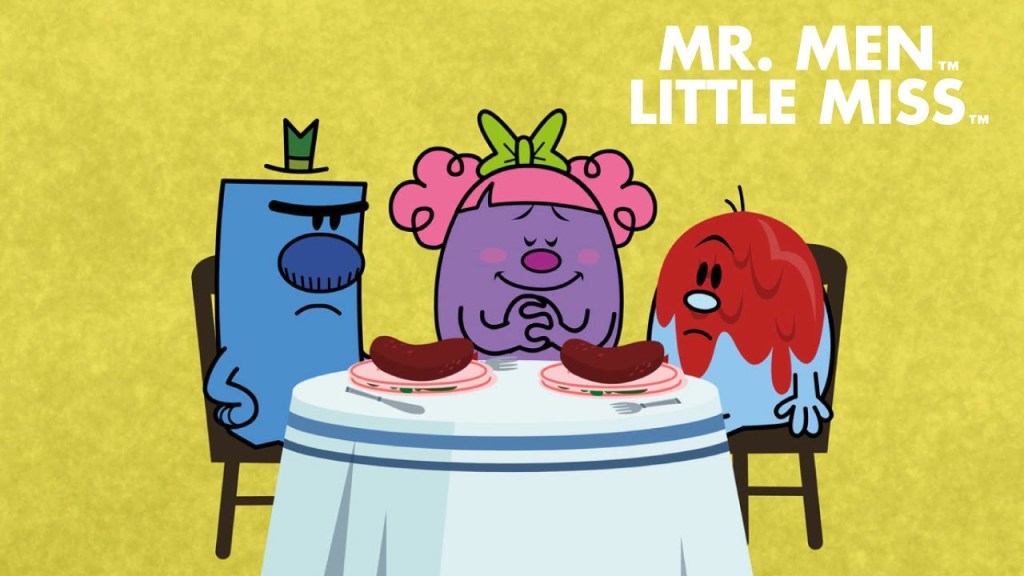
Essay · Literature & Ideas
Little Books, Absolute Selves
Roger Hargreaves set out in 1971 to answer his son’s question about what a tickle looks like, and in doing so produced one of the stranger philosophical projects of the twentieth century: a universe populated entirely by beings who are identical to their own single quality, and who must somehow live with the consequences.
Consider Mr. Worry. He is a small, pale green oval who wakes each morning to a fresh catalogue of anxieties — that the sky might fall, that his house might sink, that his breakfast might be somehow wrong. He worries without object and without relief, the worrying being not a response to circumstances but the very texture of his existence. He cannot, in any meaningful sense, stop: the name is not a description of what he does but of what he is, and the distance between doing and being, in the world Roger Hargreaves constructed across forty-six slim volumes between 1971 and his death in 1988, is precisely zero. The Mr. Men are their attributes. They have no interiority beneath the surface quality, no private life that contradicts the public face, no gap between the self they present and the self they are. They are, in the most literal possible sense, what you see.
This ought to make them boring. In the hands of a lesser imaginer, characters defined by a single trait are stock figures — the miser, the braggart, the melancholic — deployed to make a moral point and forgotten. What Hargreaves understood, perhaps intuitively, perhaps with more deliberateness than his modest public persona suggested, is that the single trait, taken seriously and followed through with rigour, does not simplify a character but radicalises it. Mr. Worry is not a simplified human being. He is a thought experiment: what would it mean to be nothing but worry, to have no resource of calm or distraction or perspective from which to observe one’s own anxiety? The answer, rendered in gentle prose and rounded shapes and colours chosen with real care, turns out to be both funny and quietly devastating, which is a more sophisticated effect than most adult fiction manages.
Hargreaves and the Question That Started Everything
Roger Hargreaves was working as a copywriter at a London advertising agency in 1971 when his six-year-old son Adam asked him what a tickle looked like. It is the kind of question that most parents deflect — the kind that arrives at bedtime or in the back of a car, apparently idle, actually pointing at something real about the relationship between sensation and form, between what we feel and what we can represent. Hargreaves took it seriously. He drew a small orange figure with long, wavy arms — Mr. Tickle — and wrote around it a story whose logic was entirely consistent with its premise: a being whose arms are so long that he can tickle anyone, anywhere, from the comfort of his own bed, and who does so with the indiscriminate enthusiasm of someone for whom tickling is not a choice but a calling.
Mr. Tickle was published in 1971 alongside five companions — Mr. Happy, Mr. Nosey, Mr. Sneeze, Mr. Bump, and Mr. Messy — and the series found its audience with a speed that suggested Hargreaves had identified something children needed and the existing literature was not providing. What he had identified, one comes to think, was the philosophical comfort of essentialism: the idea that a self can be known completely, that there is no hidden depth to navigate, no unexpected quality waiting to complicate the relationship. Mr. Happy is happy. Always. You can rely on it. In a world in which children are daily confronted with the bewildering inconsistency of the adults around them — cheerful at breakfast, inexplicably irritable by teatime, loving one moment and distracted the next — this consistency is not a limitation but a gift.
“Mr. Happy lived in a small round house in the middle of a wood, because that was the sort of house that suited somebody as round and happy as him.”
Roger Hargreaves, Mr. Happy, 1971
The books are physically small — roughly the size of a large postcard — and the smallness is part of their meaning. They fit in a child’s hand with a completeness that larger books do not, and the world they contain is correspondingly scaled: villages of two or three houses, roads that lead to exactly one destination, casts of five or six characters at most. Everything that needs to be in the story is in the story, and nothing else is. This formal economy — which looks like simplicity and is actually a refined minimalism — means that every element carries weight. The colour of Mr. Grumpy is not chosen casually. The shape of Mr. Bump’s house is load-bearing. Hargreaves was, in his quiet way, a serious formal artist, and the books repay the kind of attention that serious formal art always rewards.
Colour, Shape, and the Grammar of Identity
Each Mr. Man is a shape and a colour, and the relationship between the two is never arbitrary. Mr. Happy is yellow and circular — the sun made social, warmth given a face. Mr. Grumpy is blue and square, the angularity of the shape rhyming with the bluntness of the mood, the colour carrying its conventional associations of coldness and dissatisfaction. Mr. Messy is pink and formless, his outline a chaos of irregular curves that performs, visually, the disorder his name announces. Mr. Tall is, self-evidently, tall — stretched to improbable proportions, his shape a single quality made architectural.
This system — in which visual form and psychological attribute are collapsed into a single image — is closer to medieval allegory than to the realist character tradition that dominates the novel. The Mr. Men are not characters in the post-Romantic sense: they have no development, no backstory, no unconscious that erupts at inconvenient moments to complicate the surface self. They are, rather, personifications — the ancient literary device of giving human form to abstractions — but personifications stripped of their usual didactic weight and made warm, funny, and oddly companionable. Sloth is one of the seven deadly sins in medieval allegory; Mr. Lazy is simply a man who enjoys his bed a great deal and sees no compelling reason to leave it. The moral judgement, which allegory would press, is withheld. Mr. Lazy is not condemned. He is, within the limits of his world, perfectly fine.
This withholding of judgement is one of the most distinctive features of the series and one of its most philosophically interesting. The books do not, on the whole, moralise. They observe. Mr. Nosey pokes his nose into other people’s business not because he is wicked but because he cannot help it — the nose being, in the most literal possible rendering, who he is. The books in which a character is nudged toward self-improvement — Mr. Messy tidies himself up, Mr. Grumpy is taught to smile — feel, on reflection, slightly less satisfying than the purists, the ones in which the attribute is simply allowed to be what it is and the narrative finds its comedy in the consequences.
The Existential Case of Mr. Jelly
Mr. Jelly is the great tragic figure of the series. He is afraid of everything — leaves falling, clouds passing, the distant sound of a door closing — and his fear is not, the books make clear, a rational response to genuine danger but the very medium in which he exists, as water is the medium in which a fish exists. He cannot leave it and remain himself. The story in which a friendly worm persuades him that there is nothing to be frightened of is resolved — he overcomes his fear — but the resolution feels, to an adult reader, slightly hollow. Mr. Jelly without his fear is not a happier Mr. Jelly. He is a different character entirely, one whose name has become a misnomer.
This is the philosophical problem that runs beneath the surface of the entire series: if a character’s defining attribute is changed, is the character still themselves? If Mr. Grumpy learns to be cheerful, is he Mr. Grumpy, or is he someone else who happens to occupy the same blue square? The books raise this question without answering it, which is either an evasion or a form of intellectual honesty, depending on your view. The children who read them tend not to ask the question explicitly, but they feel its weight, which is perhaps why the books work simultaneously as light entertainment and as something else — something that stays in the mind longer than their modest appearance suggests it should.
“Mr. Jelly was frightened of almost everything. He was even frightened of the word ‘frightened’.”
Roger Hargreaves, Mr. Jelly, 1978
The Little Miss Problem
The Little Miss series, which Hargreaves introduced in 1981, deserves separate consideration, partly because its existence raises questions the Mr. Men series does not. The decision to create a parallel female universe — Little Miss Sunshine, Little Miss Bossy, Little Miss Naughty, Little Miss Tiny — was commercially logical and aesthetically awkward in ways that have become more legible with time. The Little Misses are, by and large, more conventionally gendered in their attributes than their male counterparts: more nurturing, more socially adept, more defined by their relationships to others. Little Miss Bossy is bossy, which in a male character would simply be a character trait, but which in a female one carries a freight of cultural anxiety about women and authority that the books handle with less ease than they handle almost everything else.
This is not a reason to dismiss the Little Miss books, several of which — Little Miss Contrary, Little Miss Stubborn — are as formally satisfying as the best of the Mr. Men. It is a reason to notice that the world Hargreaves built, for all its apparent neutrality, was not outside culture but inside it, and that the shapes and colours and attributes he assigned to his characters were drawing, sometimes unconsciously, on assumptions about gender and personality that have dates on them. The books are products of their moment, as all books are, and the moment was 1971 to 1988, which was a particular moment in the history of how the English imagined the self.
After Hargreaves: The Legacy and Its Complications
Roger Hargreaves died in 1988, at the age of fifty-three, having produced eighty-three books in the combined Mr. Men and Little Miss series. His son Adam — the child whose question had started everything — continued the series after his death, adding new characters with a fidelity to the formal system his father had established that is itself a form of tribute. Mr. Rude, Mr. Christmas, Mr. Cheerful: the new characters slot into the existing universe with relatively few seams showing, which tells us something about the robustness of the original conception. A system that can be extended by someone other than its creator and remain recognisably itself is a system of genuine formal integrity.
The cultural afterlife of the Mr. Men has been, by any measure, extraordinary. They have sold in excess of one hundred million copies in thirty-five languages. They have been adapted for television, for theatre, for merchandise of a range and ubiquity that would have astonished Hargreaves, who was, by all accounts, a modest and somewhat private man. They have become a shared visual language — a shorthand, in the culture, for the idea of a self reduced to its essential quality, deployable in conversation whenever someone needs to describe a Mr. Worry or a Mr. Perfect in their life without the effort of more elaborate characterisation.
This cultural function — as a vocabulary for talking about human types — is perhaps the most interesting thing the books have achieved, and it is an achievement that connects them, obliquely, to a tradition much older than the children’s picture book: the tradition of the humour, of the comedy of humours, of the long Western attempt to understand human character by identifying its dominant quality and following that quality to its logical extreme. Jonson did it on the stage. Dickens did it in the novel. Hargreaves did it in forty-six pages of large type and rounded shapes, and the reach of his version has, by now, exceeded both of theirs.
The question his books ultimately ask — and leave, with admirable restraint, unanswered — is whether we are more like the Mr. Men than we prefer to think. We tell ourselves stories of complexity, of interiority, of the self as a rich and contradictory and irreducible thing. But then someone we know does the thing they always do — worries when there is nothing to worry about, bumps into things that are clearly there, is grumpy on a sunny morning with no apparent cause — and we think: there it is. The attribute. The shape and the colour. The thing they are, underneath all the stories about why.
This essay draws on the complete Mr. Men and Little Miss series by Roger Hargreaves (1971–1988) and Adam Hargreaves (1988–present), published by Egmont UK. Sales figures are drawn from Egmont’s published records. The series is currently held in copyright by Sanrio Co., Ltd., which acquired the rights in 2011. Adam Hargreaves continues to write and illustrate new volumes.
