Essay · Fashion & Culture
The Empress of the Imaginary
Diana Vreeland did not edit magazines. She edited reality — selecting from the available world only those elements that met her standard of vividness, discarding the rest without apology, and presenting the result with a conviction so absolute that generations of readers, photographers, and designers mistook her vision for the truth. They were not entirely wrong to do so.
She once instructed a photographer, on location in a field in rural England, to wash a horse’s mane with beer so that it would shine appropriately. On another occasion she sent a fashion team to Nepal, having decided that the mountains there were the correct background for a coat. She is reported to have told a junior editor, with complete seriousness, that clean hair was vulgar. She wrote, in her famous column for Harper’s Bazaar — “Why Don’t You?” — that readers might consider rinsing their blond children’s hair in dead champagne to keep it gold, or papering a small room in brown paper and bringing in a leopard on a leash. The leopard was not metaphorical. Neither, one feels, was anything else she ever said or wrote or decreed. Diana Vreeland operated, throughout her six decades in fashion, on the principle that the imagination was not a supplement to reality but its superior, and that the duty of anyone with genuine taste was to demonstrate this as forcefully and as publicly as possible.
She was born Diana Dalziel in Paris, in 1903 — though she was characteristically vague about the year, as about much else in her biography that she considered subject to improvement. Her father was a Scottish-American stockbroker; her mother an American socialite of sharp tongue and sharper social ambitions who made clear, early and often, that she considered her elder daughter plain and her younger daughter beautiful, and distributed her attention accordingly. This wound — maternal rejection on aesthetic grounds — is not incidental to understanding what Vreeland became. It is, in some sense, the engine of the whole enterprise.
The Making of an Eye
The Paris of Vreeland’s childhood was the Paris of Diaghilev and Poiret and the first Ballets Russes seasons — a city in the grip of a convulsion of visual brilliance, where the relationship between costume and the body and the theatrical image was being reinvented nightly in ways that would set the terms of twentieth-century fashion for generations. She absorbed it all, apparently, through pure proximity and appetite. She had no formal training in art or design. What she had was an eye — a capacity for noticing, selecting, and responding to visual information that operated with the speed and certainty of instinct and the authority of deeply held conviction.
The family moved to New York in 1914, fleeing the war. Vreeland grew up in Manhattan, made her social debut, and at twenty-six married Reed Vreeland, a banker of handsome face and amiable temperament whom she loved devotedly and who reciprocated with the kind of steadfast, uncomplicated support that a woman of her requirements needed and was lucky to find. They lived in London through the early 1930s, where Vreeland began keeping a small lingerie shop in Mayfair — not, one imagines, a commercial success, but a useful proof of concept. She had opinions about beautiful things. She could communicate them. People paid attention.
“The eye has to travel.”
Diana Vreeland — her most famous maxim, repeated throughout her career
Carmel Snow, the editor of Harper’s Bazaar, saw Vreeland dancing at the St. Regis in New York in 1936 — she was wearing a white lace Chanel dress and a rose in her hair, and apparently dancing with an absorption and a physical authority that suggested a woman entirely at home in her own body, a quality that Snow, who had an eye of her own, recognised as valuable. She offered Vreeland a column. The column became a position. The position grew, over the next twenty-six years, into something that had no real precedent in magazine journalism: a force of aesthetic will so concentrated and so consistent that it effectively created the visual language of American fashion for the postwar generation.
Harper’s Bazaar: The Education of a Culture
The “Why Don’t You?” column, which Vreeland wrote from 1936, is one of the stranger documents in the history of American journalism — a monthly series of imperatives addressed to an imagined reader of limitless means, leisure, and susceptibility to instruction. Why don’t you, she asked, turn your child into an Infanta for a fancy-dress party? Why don’t you have a room done up entirely in white — walls, ceiling, furniture, flowers — which is the most flattering of all backgrounds? Why don’t you wear bare feet with jewels on your toes?
The suggestions were, taken individually, either impractical or surreal or both. Taken collectively, they were a manifesto: a sustained argument that the life of the senses was the only life worth living, that beauty was a discipline rather than an accident, that the details of how one moved through the world — what one wore, how one decorated a room, the colour of one’s children’s hair — were not trivial matters but the primary site at which a civilised life was constructed or failed to be. This was, in its own way, a serious philosophical position, and Vreeland held it with the consistency of a philosopher and the delivery of a comedienne.
The photographers she worked with at Bazaar — Richard Avedon above all, but also Louise Dahl-Wolfe and Lillian Bassman — were not merely executing her instructions. They were being educated by them, trained in a particular way of seeing that privileged the unexpected angle, the physical gesture that revealed character, the background detail that deepened the image without declaring itself. Avedon, who would become the most important fashion photographer of the century, always credited Vreeland as the decisive influence on his development. She taught him, he said, to look.
She moved to Vogue in 1962 as editor-in-chief, and the decade that followed — the great decade, by common consent, of her editorial life — was one in which the magazine became something closer to a cultural event than a publication. She sent photographers to India, to Morocco, to the beaches of Malibu and the streets of Marrakech, insisting always on the real location, the actual light, the specific texture of a place, because she believed that the body in the image needed to be somewhere, not merely in front of a backdrop. She discovered or championed or simply noticed — Twiggy, Penelope Tree, Lauren Hutton, Marisa Berenson — a succession of faces that redefined what was permissible in the idea of beauty, each of them notable for unconventionality, for the quality of being interesting rather than merely pretty. This was, again, a philosophical position: that beauty was not a fixed standard but a consequence of attention, and that the right attention could locate it anywhere.
The Firing, and What Came After
In 1971, Condé Nast fired her. The official reason was that the magazine under her stewardship had become too expensive, too rarefied, too remote from the concerns of ordinary readers in an era of political upheaval and economic anxiety. There was truth in this. Vreeland had never been remotely interested in the ordinary reader, or in political upheaval, or in economic anxiety, except insofar as these were conditions against which luxury and imagination asserted their claims more urgently. She made no particular secret of these priorities, which was part of her genius and, in 1971, the whole of her problem.
“I loathe narcissism, but I approve of vanity. Vanity is the mark of a belief in oneself.”
Diana Vreeland, D.V., 1984
She was sixty-eight years old and apparently finished. What happened instead was a second act so improbable and so perfectly suited to her particular gifts that it seems, in retrospect, designed by the same imagination that had sent photographers to Nepal. Thomas Hoving, the director of the Metropolitan Museum of Art, offered her a consultancy at the Costume Institute — the museum’s collection of historical dress, long regarded as a somewhat marginal department — and Vreeland proceeded, over the following fifteen years, to transform it into one of the most visited and most culturally significant exhibition spaces in New York.
The exhibitions she mounted at the Met — on Balenciaga, on the eighteenth-century court dress of Versailles, on the Hollywood costume, on the Imperial Russian wardrobe — were not scholarly in the conventional museum sense. They were theatrical: immersive environments of dimmed light and concentrated perfume and carefully arranged garments in which clothing was treated not as historical artefact but as the residue of a life, as evidence of how a particular human body, in a particular historical moment, had chosen to present itself to the world. The approach was controversial among curators, and it was also, by any measurable standard, a triumph. People queued for hours. The Costume Institute, under Vreeland’s direction, became a destination.
The Apartment on Park Avenue
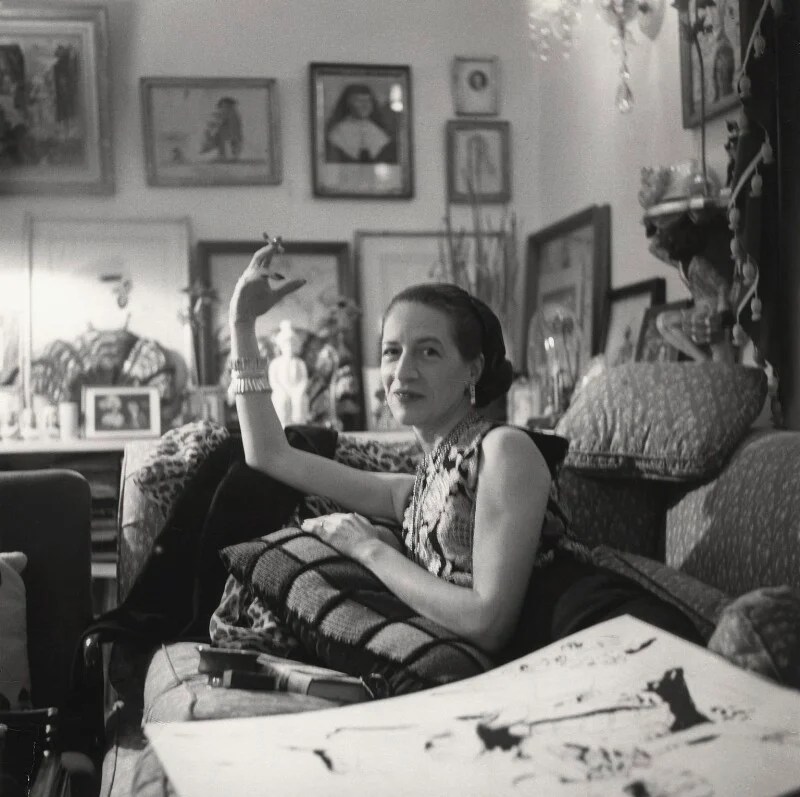
Any account of Vreeland that omits her apartment is incomplete. The rooms at 550 Park Avenue — designed with the decorator Billy Baldwin — were famously lacquered entirely in red: walls, ceiling, lampshades, bookshelves, the trim around the fireplace, the frames of the mirrors. She called it a garden in hell. It was a room so completely the expression of a single sensibility that to enter it was to enter a mind, and the mind it expressed was one that had decided, with full information and complete conviction, that the most interesting thing to look at was always red.
She received visitors there in the manner of a regent — seated, rouged to theatrical intensity, dressed with the specificity of someone who had spent sixty years thinking about what clothes mean. The younger designers who came to pay court — Yves Saint Laurent, Halston, Valentino — were not calling on an editor or a curator. They were calling on the source, on the woman who had articulated, more precisely and more vividly than anyone else of her generation, what fashion was actually for.
What She Was Actually Saying
The temptation, when writing about Vreeland, is to treat her as a monument to a particular kind of upper-class excess — a figure of comic extravagance, beloved for her outrageousness, not to be taken too seriously as a thinker. This is the reading of people who have not read her carefully, or who have read her carefully and decided, for reasons of their own, to look away from the argument beneath the performance.
The argument was this: that attention is a form of love, and that the exercise of taste — which is to say, the application of trained, disciplined, passionate attention to the question of how things look and feel and move — is not a trivial pursuit but a moral one. That the cultivation of beauty in the world is not vanity but a kind of service. That the refusal to notice, to care, to insist on the difference between the beautiful and the merely adequate, is a form of sloth with consequences not only for the individual but for the culture that individual inhabits. These are not comfortable positions, and Vreeland held them with the serenity of someone who had thought them through and found them sound.
She died in New York in 1989, at eighty-five. Her memoirs — the magnificent D.V., compiled from interviews with George Plimpton and Christopher Hemphill — are among the more entertaining autobiographies in the English language, and they are also, if you read them in the right spirit, a sustained and entirely coherent account of a life lived in complete fidelity to a set of values that the world tends to dismiss as superficial and that are, in fact, anything but. She was, in the end, a moralist. The medium was red lacquer and rinsed-champagne hair and a horse with a beer-washed mane. The message was that how we present ourselves to the world is how we declare ourselves to it, and that the declaration deserves to be made with everything we have.
This essay draws on Diana Vreeland’s memoir D.V. (1984, compiled with George Plimpton and Christopher Hemphill), Amanda Mackenzie Stuart’s biography Empress of Fashion (2012), and the documentary Diana Vreeland: The Eye Has to Travel (dir. Lisa Immordino Vreeland, 2011). Richard Avedon’s recollections are drawn from published interviews. The Costume Institute exhibitions referenced are held in the Metropolitan Museum of Art’s permanent archive, New York.
