I’m nearly halfway through college, and the final term before the summer holiday in 1955 has been something of a whirlwind.
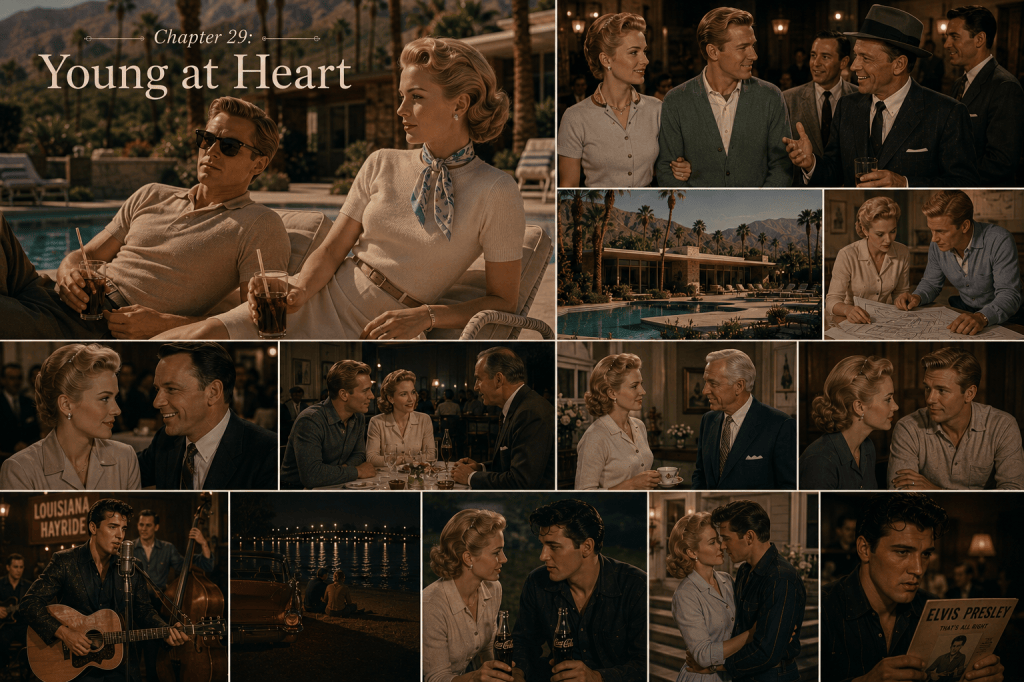
I go to Palm Springs with Topper over spring break.
We look at houses out West because Grandpa George has told me I should diversify my investment portfolio, and that real estate is always a solid option. One evening, while out for drinks with Mr Sinatra, whom I’d been introduced to by Tilly’s father at a charity ball earlier in the year, he mentions a house for sale near Twin Palms, his home in the Movie Colony. He thinks we should take a look at it.
I love it. I’ve wanted a modern house for a long time. This one is by the same architect who did Mr Sinatra’s, E. Stewart Williams, and it will be the first place I can call home that’s younger than I am.
Topper isn’t sure what he thinks, he’s been considering investing with me, but Sinatra insists I must have it.
“I’ll sort it all out,” he says.
And within a day or so, the paperwork is signed by Grandpa George, and the house is mine, mine alone.
Grandpa George tells me it’s better that way, better to own something outright than to share it with a man, especially one I am not even engaged to. He’s learned that the hard way with my mother, and with the endless money pit that’s turned out to be my father and the estate in England.
I agree with him.
Keeping at least my fiscal freedom from men intact.
It’s a strange turn my life has taken. I find myself moving within America’s upper circles. I don’t need it, not in any essential way, yet I keep being drawn into their orbit. When I was a child I longed to live among the stars. But now that I do, the constellations have dimmed. The closer I stand to the light, the more I see the machinery behind it. I am maturing out of being fooled by all that glitters.
“It’s a class thing,” Topper says. “The world is always smaller than you think it is.”
He’s right. It’s capitalism dressed as destiny. He talks about it with his new friends up at Harvard, how we live in an empire of commerce, hollow as a glossy advertisement.
To me, it feels like living inside a dream of America, a lucid dream, where beauty and unreality exist side by side. It’s everything I once wanted, and everything I’m beginning to outgrow.
I’ve noticed that celebrities like Cary and Mr Sinatra treat Tilly with a kind of awe, perhaps it’s her stature, perhaps her elegance. But the more aware I become, the more I realise it’s something else. Her people, Topper’s people, even mine, are what these stars became stars to become. They aspire upwards into the class that invented aspiration. What they sell on screen is not merely romance or beauty, but belonging: the illusion of People Like Us. And we, in turn, begin to imitate them, until glamour itself becomes the shared disguise of capitalism.
Topper says that with me, it’s different than it is with Tilly.
“They all want to look after you,” he muses. “Maybe it’s the little orphan girl in you they sense,” he laughs. “Or maybe it’s ’cause you’re cute. Or maybe it’s that childlike spirit of yours.”
I don’t know what it is, but he’s right. Cary treats me like a daughter; Frank treats me as someone in need of protection. He’s endlessly generous, always offering advice, making sure I’m safe, introducing me to people he thinks I should know.
I feel as though everyone here is kind, each bringing something into my life. I’m ever so grateful. And yet, there’s a quiet strangeness in it, this instinct people have to cast me as someone to be guided and protected. Everyone but the boy, who sees me as a tower of strength.
I wonder sometimes if what they’re drawn to isn’t innocence at all, but its performance, the way I’ve learned to soften my edges to make other people gentle.
It puzzles Topper slightly. Now and then, after a few rounds of scotch, he wonders aloud why he himself is so drawn to me. I never tell him that I wonder too.
Topper is unusually magnetic, charismatic in a way that doesn’t demand attention. He carries himself with quiet authority, needing no display. He knows who he is. He’s like a redwood tree, rooted, still, and steady.
He rarely acts out of selfishness, and when he does, it’s only to protect himself or those he loves.
“Your mother loved you well,” I tell him, holding his face in my hands before resting my head against his shoulder.
It makes me love him more, but it also makes me feel the quiet shame of my own unsteadiness.
The boy back home makes me feel good about myself, makes me feel at ease, because we both know we’re flawed and too tired to pretend otherwise. With him, imperfection feels like a kind of intimacy.
It’s complex.
The boy is an adventurer in one sense, and Topper in another. One moves through the world in search of it; the other, by standing still.
***
I’m back in Memphis around my birthday. I’ve just turned twenty.
The boy begs me to come see him at the Louisiana Hayride while I’m home.
“I really want you to experience it,” he says, his excitement infectious.
I promise to go. He’s moving faster now, both literally and metaphorically. In an almost symbolic gesture, the Cadillac, my Cadillac, is gone. The car burned out on the road in June. Not even a good American-made car could keep up with the boy.
“I cried all night when that happened,” he tells me. “Felt like my heart was breaking.”
I visit Mr and Mrs P. Mrs P asks when I’m coming back to live, and marry her son, though it feels more like nostalgia than real intent. The boy and his mamma still share their old closeness, though it’s tinged with melancholy now.
The boy remains the centre of their world: loved, indulged, the most pampered creature I know. Perhaps that’s why he’s so addicted to being adored.
***
We’re drinking Cokes down by the river, out of habit, and because it’s private enough for this budding local celebrity to hide. We park in a secluded spot, the heat pressing against the glass, the surface of the water like mercury. It’s strange, this new version of us.
“Funny,” he says. “I’ve missed you so much. Just sittin’ next to you.”
“Ditto,” I say, looping an arm around him.
After a while, I ask quietly, “Do we have Peter Pan syndrome?”
He bursts out laughing.
“You know what?” he says, delighted. “Someone’s said that to me before. But only girls. Only when I won’t do what they want.”
He guffaws. “I thought it was just me! I’m glad it’s you as well,” he says.
“You think we do?” I ask. I’m not laughing. I feel horrified.
“I don’t know, Wendy. What do you think?” he prods, hopping back into the front seat.
I shrug and mimic him. “Gee, well, I don’t know, Peter. I really don’t. Let’s fly back to Neverland.”
He grins, takes the wheel, and drives us home, both of us singing Young at Heart all the way:
Fairy tales can come true, it can happen to you
If you’re young at heart…
He is half-joking as we pull into the drive. “Please don’t go back to Kensington Gardens anytime soon. I’d be lost here without you, just me and a hundred nymphs or mermaids, however cute they may be.”
He calls me Wendy for the rest of the day, and I call him Peter. The boy doesn’t care whether he has any sort of syndrome, so long as he can be whatever he’s pretending to be in the moment.
“I’m havin’ too much fun,” he says.
The next day, I call Topper, trying to be an adult, to be considerate, to be good. I don’t want to stay suspended in that half-world between girlhood and womanhood. I want to grow up.
“How do I even start?” I ask him. “Am I capable of it?”
Topper exhales, patient as always. “You’re not that bad,” he says. “You just think you are.”
He asks how the boy’s doing and tells me to enjoy myself until I’m back on the East Coast.
“I love you,” he says before we hang up.
And then I cry.
Sitting in the downstairs office, the tears come fast. Miss Mary’s voice floats in from the hall.
“Darling child,” she says, appearing in the doorway. “Come here and tell old Miss Mary everything. We’ll sort it out over a cup of tea.”
I let her guide me into the kitchen, her hand steady on my shoulder.
I realise I’m not a teenager anymore.
I feel ancient.
And completely unprepared.

Leave a Reply