
Essay · Art & Architecture
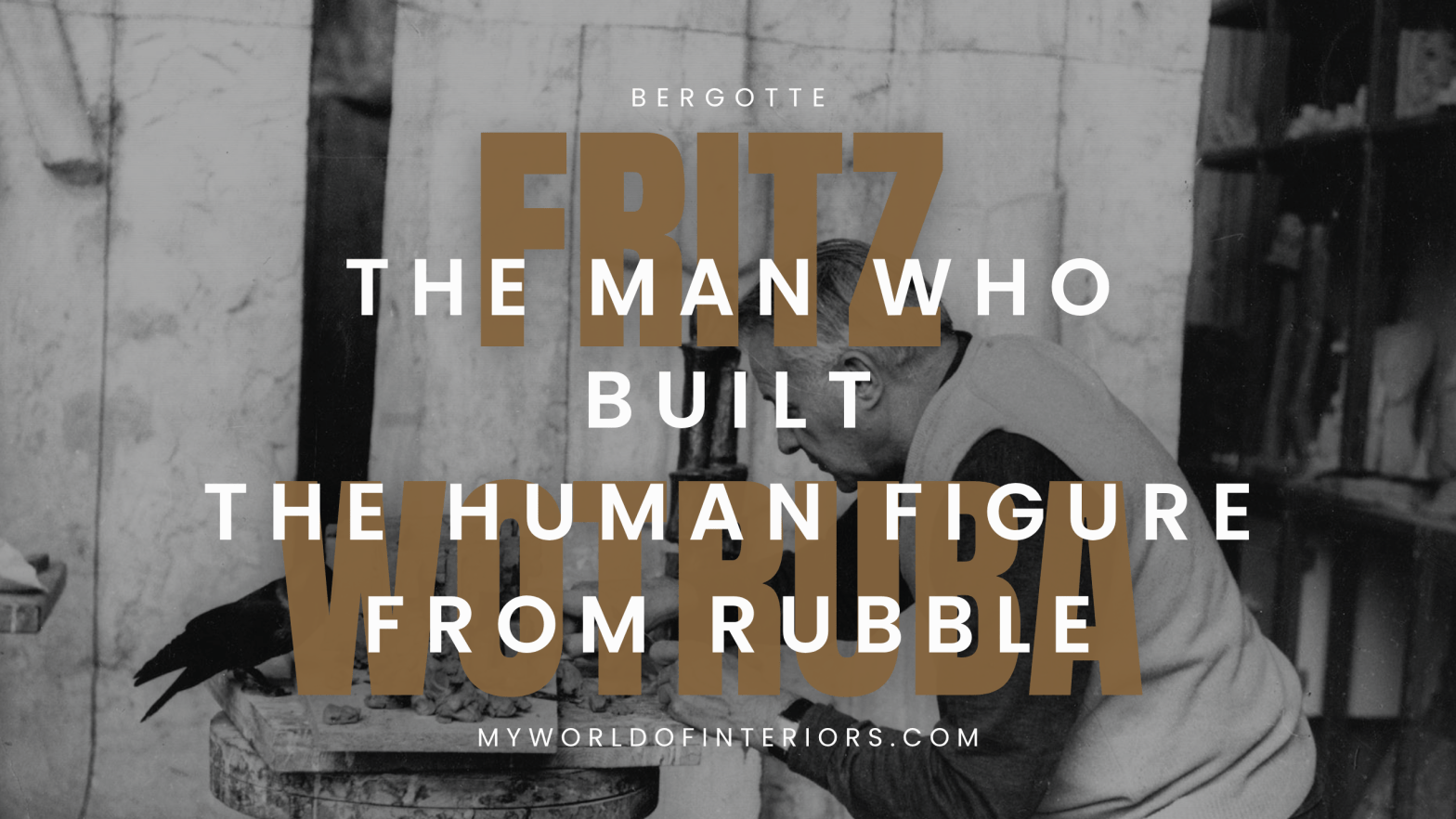
The Man Who Built the Human Figure from Rubble
Fritz Wotruba spent his life doing one thing: finding the body inside the block. That this task consumed him entirely, across five decades of exile, return, and monumental ambition, tells us something important about what sculpture is for — and about what Vienna did to its artists in the twentieth century.
Stand in front of a Wotruba and resist the first temptation, which is to name what you see. The figures — if figures they are — will not cooperate with easy identification. They are assembled from cylinders and cuboids, from smooth-cut stone that meets at angles no body has ever naturally assumed, and yet they are unmistakably human. An arm is implied. Weight is shifted. Something that might be a head tilts, infinitesimally, toward something that might be the light. The longer you look, the more fully the person inside the geometry reveals itself, until the distinction between the abstract and the figurative dissolves entirely, as distinctions tend to do when an artist has thought long enough about them.
This was Wotruba’s peculiar genius, and it was the product of a peculiar life — a life shaped by Vienna’s grandeur and Vienna’s catastrophes in roughly equal measure, by exile and return, by the patient, obsessive logic of a man who believed that sculpture had one true subject and spent forty years proving it.
Vienna, 1907: A City of Makers
Fritz Wotruba was born on April 23, 1907, in Vienna — the same city, the same year, that produced the first Vienna Secession retrospective under Klimt, the year Mahler conducted his last season at the Court Opera before departing for New York under a cloud of antisemitic hostility, the year Schoenberg was quietly dismantling the harmonic architecture of Western music in a flat nearby. The city was a pressure cooker of modernism, generating brilliance and persecution in roughly equal quantities, and Wotruba was born into its working class: his father was Czech, his mother Austrian, and the household was not one where art was an obvious vocation.
He apprenticed as an engraver. He worked with metal. He came to sculpture sideways, through the Viennese sculptor Anton Hanak, in whose studio he arrived in 1921 as a teenager and to whose influence he always acknowledged a foundational debt. Hanak was a formidable teacher — committed to the human figure, suspicious of mere decoration, insistent on the integrity of material — and in him Wotruba found both a method and a permission. The method was to work with the resistance of stone, to find form by subtraction rather than addition, to let the material’s own logic participate in the outcome. The permission was to take the figure seriously as the irreducible subject of sculpture, at a historical moment when abstraction was increasingly proposing that no subject at all was the highest ambition.
“The figure is the measure of all things. I have never found a reason to abandon it.”
Fritz Wotruba, in conversation with Werner Hofmann, 1961
By the early 1930s, Wotruba had established himself as one of the most promising young sculptors in Austria. His figures of that period — more naturalistic than what would follow, still negotiating between the influence of Rodin’s surface vitality and the blocky, archaic gravity of pre-classical sculpture — were winning prizes and commissions and the attention of serious collectors. He was, by any measure, a man on the ascent.
Then came 1938.
The Exile Years: Switzerland and the Stripping Away
The Anschluss — Germany’s annexation of Austria in March 1938, achieved in a weekend with a violence that was as much psychological as military — ended Wotruba’s Vienna life with the abruptness of a door slammed shut. His wife, Marian Schmid, was Jewish. The city that had made him was now, with the particular efficiency of ideological conversion, committed to her destruction and to the destruction of everything he valued. They fled to Switzerland, settling eventually in the canton of Fribourg, where Wotruba spent the war years in a productive isolation that seems, in retrospect, to have been exactly what his art required.
Exile does strange and not always ruinous things to artists. Stripped of the social context that had partly defined his work, cut off from commissions and institutional validation, Wotruba turned inward and found, in the inwardness, a purity of obsession that his Vienna years had not quite permitted. He worked constantly, in relative poverty, on figures that were becoming increasingly simplified, increasingly geometric, increasingly focused on the essential rather than the incidental. The musculature fell away. The specific gave way to the generic. What remained was the structure — the underlying armature of a human being, reduced to its irreducible components — and in this reduction Wotruba found not poverty but abundance.
The Swiss years produced some of his most concentrated work: figures that have the compact, self-sufficient gravity of objects that have decided not to need anything from the world. They sit, stand, recline — barely. They are presences rather than persons. A colleague who visited his studio in those years described the experience of entering a room full of Wotrubas as “like walking into a conversation between stones.”
He was also reading. Wotruba was, by the accounts of everyone who knew him, a man of serious intellectual appetite — fluent in the literature of European modernism, engaged with philosophy, attentive to what his contemporaries were doing and why. The years in Switzerland exposed him to the full range of postwar European thought, to existentialism and phenomenology and the broader cultural reckoning with what the war had revealed about the human animal. That reckoning would leave its mark on everything he made after his return.
The Return: Vienna After the Catastrophe
Wotruba came back to Vienna in 1945, to a city that had been bombed extensively and was being divided into occupation zones by the Allied powers. The Ringstrasse was partially rubble. The Opera House had burned. The particular Viennese confidence — that air of cultural superiority that had coexisted, in the city’s fin-de-siècle heyday, with the most virulent antisemitism in Europe — had been replaced by something more provisional and considerably more honest.
He took up a professorship at the Academy of Fine Arts that he would hold for the rest of his life, and became, over the following decades, the dominant figure of Austrian sculpture — a position he occupied with the particular authority of someone who had been tested by history and found, in the testing, that his convictions were load-bearing. His students became the next generation of Austrian sculptors. His influence radiated outward from the Academy with a consistency that suggested not a school of followers but something rarer: a set of questions that genuinely required answering.
“Wotruba gave postwar Austrian art something it desperately needed and did not know how to ask for: a reason to believe the figure had survived.”
Werner Hofmann, art historian, on Wotruba’s postwar significance
The sculptures of the 1950s and 1960s represent, most critics agree, the full flowering of his mature style. The figures became increasingly monumental in conception even as they retained their material restraint. Cylinders and rectangular blocks were assembled — the word Wotruba used was always gefügt, joined, as though the process were one of patient negotiation rather than imposition — into forms that suggested the human body without ever quite committing to it. They were large, and heavy, and absolutely still, and they had the quality of things that had been there for a very long time and intended to remain.
The Church on the Hill
The crowning work came last, and came after his death. The Church of the Holy Trinity in the Mauer district of Vienna — universally known simply as the Wotruba Church — was designed by the sculptor between 1965 and his death in 1975, and completed by his collaborators in 1976. It is one of the strangest and most magnificent religious buildings of the twentieth century.
The structure is assembled from 152 concrete blocks of varying size, stacked and interlocked in an arrangement that is simultaneously chaotic and perfectly resolved — the same logic, scaled to architectural ambition, that governs his sculpture. There are no conventional walls. The blocks create gaps and apertures through which light enters at angles that shift with the hour and the season, so that the interior is never twice the same. The building does not look like a church in any conventional sense. It looks, if anything, like a Wotruba — like one of his figures enlarged to the point where you can walk inside it.
To stand inside the Wotruba Church on a clear morning, when the light is coming through the concrete gaps at a low angle, is to understand in the body what the sculptures had been arguing in the mind: that geometry is not the opposite of the spiritual but one of its primary languages. The blocks press down with enormous weight. The light insists on entering. The space between them is where you stand.
The church is listed as a protected monument and draws visitors from across the world, many of whom arrive expecting a curiosity and leave having had an experience. This gap between expectation and encounter is very much in the Wotruba spirit: he was never interested in the decorative or the immediately legible. He wanted his work to require something of the people who stood before it, and in the church, as in the sculptures, it does.
What He Was Arguing
There is a temptation to read Wotruba’s insistence on the human figure — maintained through the full pressure of postwar abstraction, through the successive enthusiasms of Art Informel and Minimalism and Conceptualism, through decades when figuration in sculpture was considered a kind of stubbornness — as mere conservatism. This misreads him badly.
Wotruba’s figures are not humanist in the easy, affirmative sense of that word. They are not celebrations of the body or hymns to its beauty. They are, rather, propositions: that after everything the twentieth century had done to demonstrate the fragility and expendability of individual human beings, the individual human body remained the irreducible unit of meaning, the thing that could not be further simplified without disappearing entirely. The geometry was not a retreat from the figure but an argument about what the figure essentially was, once you stripped away everything contingent. What remained, his work insists, was not nothing. It was this: weight, stance, the particular dignity of a form that takes up space in the world and refuses to apologise for it.
He died in Vienna on August 28, 1975, at sixty-eight. The church that stands on the hill in Mauer was completed the following year and has outlasted, as stone tends to outlast, most of the theoretical positions that opposed it. His sculptures are in collections across Europe and the United States, and they continue to do what he designed them to do: make the viewer work, and reward the work, and leave something behind that was not there before the looking began.
This essay draws on Fritz Wotruba’s collected writings and interviews, Werner Hofmann’s critical studies of Austrian modernism, and the catalogue of the Wotruba Foundation, Vienna. The Wotruba Church (Kirche zur Heiligsten Dreifaltigkeit) is located at Georgsgasse 7, 1230 Vienna, and is open to visitors.
Discover more from My World of Interiors
Subscribe to get the latest posts sent to your email.

