
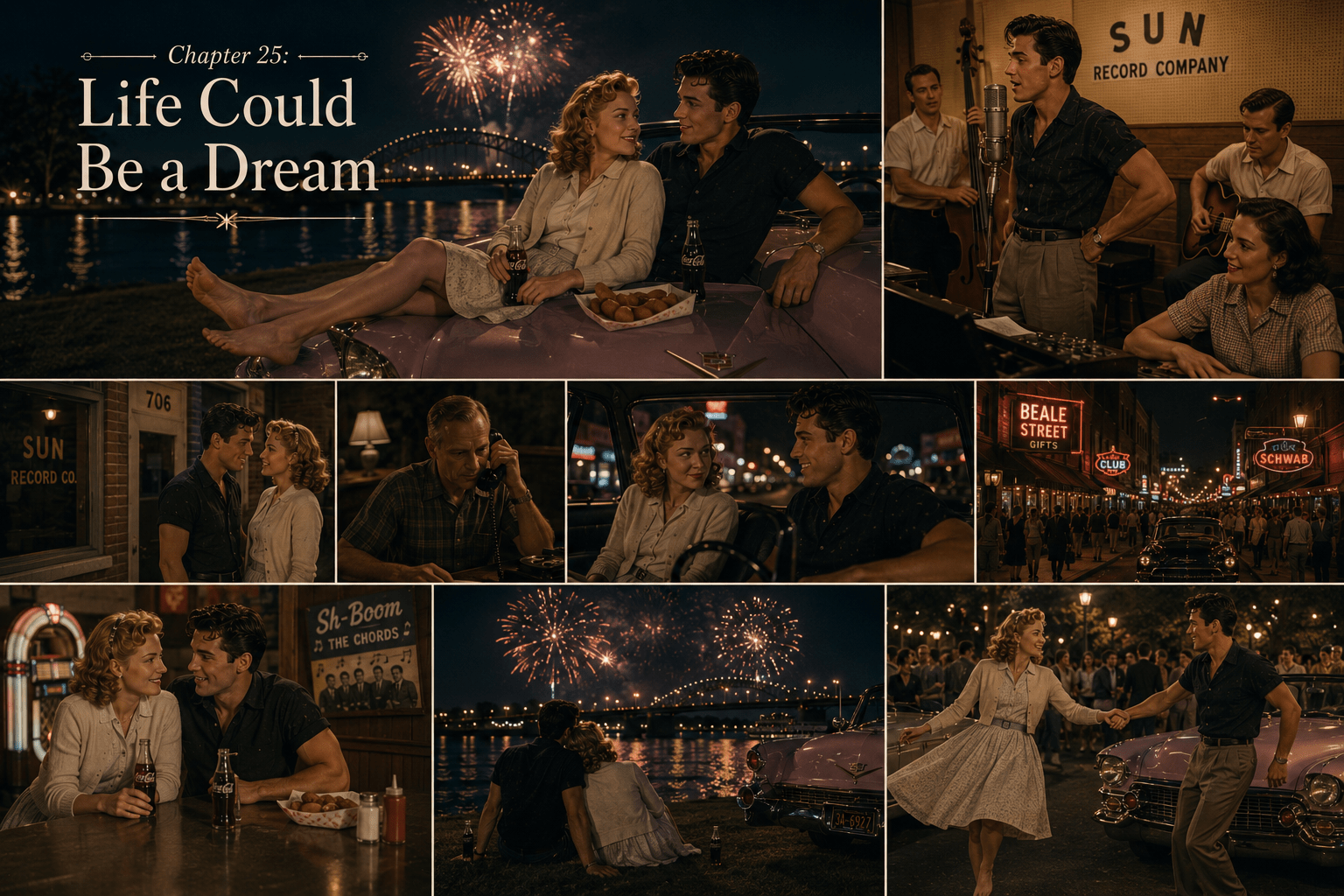
I watch the boy, Scotty from Sun, and his bass player Bill run through every song the boy knows. Scotty’s wife is warm and sweet and keeps me company, but I can tell they aren’t exactly blown away by him. The boy doesn’t seem to mind. He’s off in his own little world today, not his usual sensitive self. He even forgets to be shy, which is the strangest thing of all.
When we leave, we talk it over.
“I didn’t see any reason to be shy around those two,” he says, shaking his head.
Later that day, Sam Phillips calls the house. And just like that, before we head out to watch the fireworks at Riverside Park, the boy has lined up a session at Sun for tomorrow.
“See? I told you!” he grins, motioning for me to get in the car. “Now let’s go celebrate the birthday of our great nation.”
“Yes, sir,” I say, worn out.
“You sure have picked up an unfortunate bossy streak since I last saw you,” I slide into the seat beside him.
“It’s from gettin’ told what to do all day at work,” he laughs. “Figured I’d try some of it out on you.”
He smirks, then kisses the top of my head before setting off and driving us down to where the action is.
***
It feels as though there’s always something happening in Memphis. The music scene is electric, and change is in the air when it comes to segregation, long overdue.
Beale Street is always alive, pulsing with celebration. I haven’t seen anything like it up on the East Coast. This is where the fire is. There’s something in the air, something in the water, the dirt and the heat. The beauty and the brutality of this place… it wakes you up. It makes you feel.
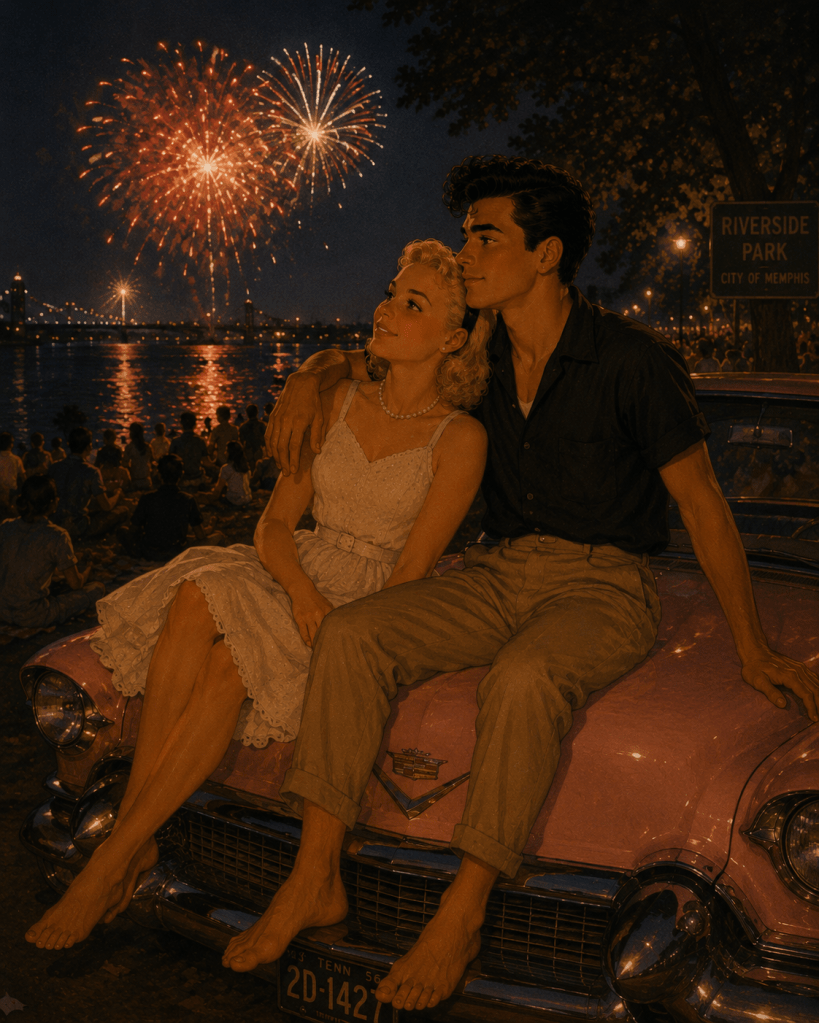
I breathe in the summer night, the thick river air, as we sit watching fireworks burst over the Mississippi, eating corndogs and drinking sodas.
“This could be heaven, and I’d have no complaints,” I tell him.
“I was just thinking the same thing,” he says.
“You have to come with me tomorrow,” he pleads.
I tell him that’s a bad idea, but he says he doesn’t think he can do it without me, so I agree to come, on the condition I stay outside.
“As long as you’re near,” he says, “otherwise I can’t think straight.”
I roll my eyes and squeeze his cheek. “Okay, baby.”
Sh-Boom by The Chords spills out from the car radio. The boy says he much prefers The Chords to The Crew-Cuts.
“Who even calls a band the Crew-Cuts? That sounds so boring.” I wonder out loud.
He laughs. “And we don’t like bores,” he says, mimicking me, and I leap off the bonnet of the car and start dancing around, bare feet on the grass.
“You know it,” I mock back, grabbing his hand.
I want to stay in this moment, in America, on the Fourth of July 1954, when change and promise and motion filled the air, when the American Dream still wore its prettiest mask.
If you were white and rich, of course.
If you weren’t, there was a different America: where the Supreme Court had only weeks ago ruled that segregation in schools was unconstitutional, and men in Washington congratulated themselves for defending freedom while helping to unseat it abroad. Only last year the CIA had toppled Mossadegh in Iran; now they were whispering about Guatemala, where an elected president was being swept aside in the name of fruit and fear.
Out on the roads, new highways were being planned, long concrete ribbons said to unite the country, though everyone knew they were also meant to move tanks and warheads from one coast to the other if it ever came to that. They called it progress, this building of roads that might one day save or destroy us.
The jukebox might be playing Patti Page, and the roads might glitter with new Chevrolets, but the shine was already thinning. I didn’t see it then, not clearly.
Discover more from My World of Interiors
Subscribe to get the latest posts sent to your email.
 My World of Interiors