
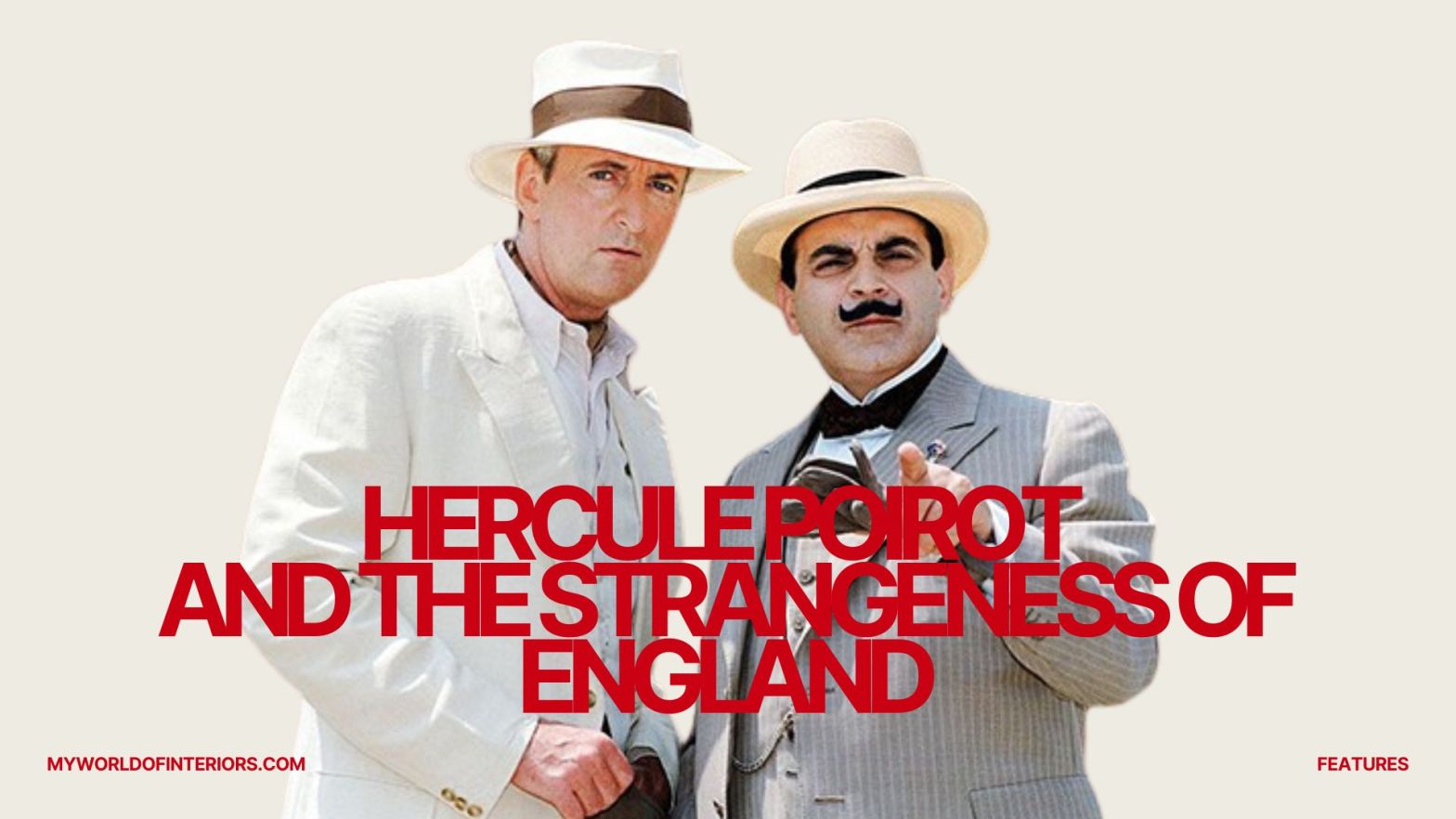
Agatha Christie gave the world’s most famous detective a moustache, a foreign accent, and a profound dislike of the English countryside. It was, in every sense, the point.
By Bergotte
There is a village in the English imagination that has never quite existed and has never stopped existing. It has a church with a Norman tower, a pub called the King’s Arms, a vicarage occupied by a clergyman of moderate faith and considerable nosiness, a manor house in mild disrepair, and a population of several hundred souls who know each other’s business with the comprehensive intimacy that only small communities and totalitarian states achieve. It is, on its surface, a place of extraordinary peace — of fetes and flower arrangements and the slow agricultural rhythm of the English seasons. And it is, beneath that surface, seething. Somebody, always, has been murdered.
Into this village — or into its urban equivalents, the country house weekend, the Orient Express, the Nile steamer, the English seaside hotel — Agatha Christie introduced, in her 1920 debut The Mysterious Affair at Styles, a small Belgian man with an egg-shaped head, an implausible moustache, patent leather shoes entirely unsuited to the terrain, and a set of intellectual habits so alien to his surroundings that he might as well have arrived from another planet. Hercule Poirot is, in many respects, the most improbable creation in the history of detective fiction — a figure so ostentatiously, so deliberately, so almost parodically foreign that his presence in the quintessentially English settings Christie favoured constitutes, on reflection, a sustained and remarkably sophisticated act of cultural criticism. Christie has been underestimated for most of her literary life, regarded as a purveyor of ingenious puzzles rather than a serious writer. The Poirot novels, read carefully, suggest that this assessment requires significant revision.
It is worth establishing, first, precisely how foreign Poirot is. He is not vaguely European in the way that fictional detectives sometimes are — gesturing toward a Continental sophistication without specific content. He is specifically and insistently Belgian, which is itself a kind of joke that Christie sustains across more than thirty novels and fifty years of writing. Belgium is not, in the English imagination, a place of romantic mystery or dangerous glamour. It is a place associated with bureaucracy, chocolate, and the unromantic practicalities of the European continent — a country that has spent much of its history being crossed by other countries’ armies without anyone asking its permission. To make your great detective Belgian is to strip him of the exotic allure that a Spanish or Russian or even French detective might carry. It is to make his foreignness mundane, slightly comic, impossible to aestheticise.
And yet Poirot is formidable. He is, within the world Christie creates, the most intelligent person in virtually every room he enters — more intelligent than the aristocrats in their crumbling houses, than the Scotland Yard inspectors with their stolid professionalism, than the bright young things and the military men and the solicitors and the country doctors who populate Christie’s social landscape. His foreignness and his superiority are not in tension; they are in direct relationship. It is precisely because he is not English that he can see England clearly. The fish, as the saying goes, is the last to discover water.
Christie was not, initially, thinking in these structural terms. She created Poirot in 1916, while working as a hospital dispenser during the First World War, and the immediate inspiration was biographical rather than theoretical: the area around Torquay where she lived had a significant population of Belgian refugees displaced by the German occupation, and it seemed natural to make her detective one of them. The Belgian policeman was a practical solution to a narrative problem — how to introduce a detective figure who exists outside the social world of the crime, who has no prior relationship with suspects or victim, who can move through an English house party as an observer rather than a participant.
But Christie was too intelligent a writer for the decision to remain merely practical. Over the course of the long series, Poirot’s foreignness becomes increasingly functional — increasingly central to what the novels are actually doing. He is not simply an outsider who solves crimes; he is an instrument of defamiliarisation, a device for making the English visible to themselves by rendering their habits and assumptions strange. When Poirot observes that the English do not understand the importance of the little grey cells — that they trust instinct and physical evidence and bluff common sense over the rigorous application of intellect — he is not merely characterising himself. He is characterising his hosts, and the characterisation is not always flattering.
The English, in Christie’s novels, have a complicated relationship with intelligence. They admire it in a general way, in the abstract, but they are suspicious of its overt display, of the person who thinks visibly, who does not disguise their mental processes under a veneer of modest diffidence. Poirot thinks visibly and without apology. He announces his methods, celebrates his own acuity, refers to his grey cells with a proprietorial pride that the English characters around him find somewhere between amusing and faintly embarrassing. He does not have the English genius for self-deprecation, which is to say he does not have the English genius for concealment. He is, in this respect, unEnglish in a way that cuts deeper than accent or cuisine.
The country house is Christie’s primary theatre of operations, and it repays attention as a social and symbolic space. The English country house, by the 1920s when Christie began writing, was an institution under considerable stress — economically threatened by death duties and the post-war collapse of the agricultural economy that had sustained it, culturally threatened by the loosening of the class hierarchies it had been built to express and perpetuate. The house parties Christie describes — those gatherings of relatives, neighbours, and house guests assembled over a long weekend in a building that is usually too cold and too expensive to maintain — are social performances of a world that is already, at some level, aware of its own obsolescence.
Into this world, Poirot arrives as a guest. He is always, in these settings, a guest — invited, usually, by someone who has heard of his reputation and wants him present as a species of social insurance, a little exotic guarantor of safety. He has no property in England, no land, no ancestral claim on the landscape. He lives, when in London, in a flat in Whitehaven Mansions that he has arranged with a geometrical precision that the English cleaning woman finds inexplicable, and he regards the English countryside with a suspicion bordering on hostility. The mud, the damp, the irregular meal times, the dogs — especially the dogs — the general cheerful indifference to comfort that the English upper classes cultivate as a form of class performance: none of it agrees with him. He endures the country house because the country house is where the crimes are.
This geographical relationship is not incidental. The English country house, in the interwar period Christie is primarily documenting, is not simply a setting. It is a container for a set of social relations — between family members, between classes, between the old money and the new, between those who belong and those who are merely tolerated — that the form of the country house weekend makes simultaneously visible and volatile. The forced proximity of a house party, the shared meals and drawing room evenings and morning walks, creates exactly the conditions under which old resentments, concealed relationships, and suppressed desires rise to the surface. The house is a pressure cooker. Poirot, installed in it as the representative of exterior reason, watches the pressure build.
What Christie understands, and what Poirot’s foreignness allows her to articulate, is that English social performance is a form of concealment so thorough and so collectively maintained that it becomes almost impossible for those inside it to perceive. The English manner — the reticence, the understatement, the horror of emotional display, the elaborate codes of behaviour that govern who may say what to whom under which circumstances — is not, in Christie’s world, simply a cultural style. It is a system for hiding things: feelings, relationships, financial desperation, sexual history, homicidal intent. The country house is not a place of safety but a performance of safety, and the performance is maintained by everyone present because everyone has something they would prefer to keep hidden.
Poirot sees through the performance because he has not been trained to maintain it. He will ask, with apparently guileless directness, the questions that English politeness has placed off limits. He will note, with apparently innocent curiosity, the discrepancy between what someone says and what their hands or eyes or the slight alteration in their voice is saying simultaneously. He will sit, apparently doing nothing, in the drawing room while the other guests attempt to project their innocence, and he will observe with a precision that his mild, somewhat comic exterior makes entirely unthreaten-ing. Nobody is quite frightened of Poirot in the way they might be frightened of a more conventionally authoritative detective. They underestimate him, consistently, because he looks and sounds like a figure of gentle comedy rather than relentless intelligence. This underestimation is, of course, the most important tool in his kit.
Christie is doing something subtle here. The assumption that foreignness implies inferiority — that the little man with the funny accent and the absurd moustache cannot possibly be as formidable as he claims — is itself a symptom of the insularity that Poirot’s presence is designed to expose. The English characters who dismiss him are demonstrating precisely the limitation that will prevent them from solving the crime themselves: the inability to see past surfaces, to take seriously what does not conform to expectation, to credit intelligence that arrives in an unexpected package. Poirot’s foreignness, in other words, is a trap that Christie has set for her characters and, by extension, for her readers.
The relationship between Poirot and Captain Hastings, his amiable, well-meaning, chronically obtuse English companion, makes this argument explicit. Hastings is not a stupid man; he is, by the standards of his class and period, a perfectly competent one — brave, honest, loyal, well-mannered, and almost entirely incapable of the kind of thinking that detective work requires. He jumps to conclusions. He is deceived by surfaces. He falls for the obvious suspect and is wrong about almost everything. He is, in short, a concentrated version of everything that Poirot is not, and his role in the novels is less to assist Poirot than to embody the Englishness against which Poirot’s methods are defined.
Christie clearly has affection for Hastings — he is too warm and fundamentally decent to be merely a satirical target — but she is also clear-eyed about his limitations. He represents a type: the English gentleman whose virtues are genuine but whose intellectual formation has actively discouraged the habits of mind that analytical thinking requires. The public school system that produced him valued games over thought, stoicism over introspection, the collective code over individual reasoning. Hastings has been very thoroughly educated, in the English sense, which means he has been thoroughly trained not to think.
Poirot does not despise Hastings for this. He is fond of him, genuinely and repeatedly, in the way one is fond of a labrador — with complete awareness of its limitations and complete acceptance of them. But the fondness does not prevent him from using Hastings as a sounding board in a very specific way: he explains his reasoning to Hastings not because Hastings will follow it, but because the process of explanation forces him to articulate what he has already, at some level, understood. Hastings is Poirot’s external grey cell, a device for making thought audible.
The question of class runs through the Poirot novels with a persistence that has not always been sufficiently acknowledged. Christie was the daughter of an American father and an English mother, raised in comfortable middle-class circumstances in Devon, and her social observation has the particular acuity of someone who is slightly adjacent to the world she is describing — close enough to know it intimately, just far enough outside it to see its seams. The world of the Poirot novels is overwhelmingly one of the privileged: the novels are set in country houses and first-class railway carriages and the better hotels and the kind of London flats where one has a manservant. Murder, in Christie’s universe, is largely a crime committed by and against people who have enough money for its commission to be worth the effort.
Poirot moves through this world as a permanent guest, permanently without the social standing that property and blood and old school ties confer. He is treated, by the aristocracy and gentry who employ him, with a condescension that the novels quietly note and quietly rebuke — the slightly excessive courtesy, the invitation to dine that is one register below what would be offered to a social equal, the assumption that he will be grateful. He is not, in fact, grateful. He is professionally obliging and personally self-contained, but he has no investment in the social hierarchy whose crimes he investigates. He does not wish to be English. He does not aspire to the world he moves through. This independence — this absence of social ambition — is another of his great analytical advantages. He cannot be flattered into blindness by his clients.
The late novels, written when Christie was old and when Poirot himself had become, in her own account, something of an irritant — she found him, she said on multiple occasions, insufferably smug and would have preferred to kill him off long before Curtain, the novel she wrote in the 1940s as a kind of insurance against her own death — are interesting for the way they develop the theme of foreignness into something darker and more explicitly melancholic. The England that Poirot observes has changed around him; the country houses are being sold or converted, the servant class has evaporated, the social world whose pathologies he had spent decades diagnosing is being replaced by something he finds no more congenial and considerably less legible. He is old, he is ill, he is more clearly than ever a man without a country — his Belgium destroyed by two German occupations, his adopted England transformed beyond the version he had learned to read.
Curtain, in which Poirot engineers a solution to the final case from a wheelchair in the house where his career began, is among other things a meditation on this double displacement: the exile who has outlasted the exile, who has no home to return to because the home no longer exists and the England he learned to navigate has dissolved around him. The little grey cells are intact; everything else has gone. It is Christie’s most honest acknowledgement of what she had been doing with Poirot all along — using a displaced person to illuminate a world that was itself being displaced, using a man without a fixed place to map a culture whose coordinates were shifting.
The longevity of Poirot as a cultural figure — the television adaptations, the stage productions, the continuing sales of the novels, the extraordinary global reach of a character created in the Devon of 1916 — is itself a form of evidence about what Christie was doing with the foreigner and his adopted country. Poirot travels well because foreignness travels well: the experience of being the person who sees a culture from outside, who understands its codes without being fully inside them, who can perform fluency without ever quite belonging, is an experience that readers in Brussels and Bombay and Buenos Aires recognise as readily as readers in Bath. He is, in the deepest sense, a diasporic figure — a man for whom the condition of displacement has become not a wound but a method.
Christie stumbled into this, as she stumbled into most of her best ideas, through practical instinct rather than theoretical intent. She needed a detective, she chose a Belgian refugee, and she spent fifty years discovering what that choice meant. What it meant, finally, was this: that the most penetrating intelligence about a culture is almost always the intelligence that arrives from outside it, that sees its performances as performances, that is not invested in its consoling fictions. England, in Christie’s novels, is a place of extraordinary beauty and extraordinary self-deception, of real virtue and concealed corruption, of surfaces so polished and so collectively maintained that only an outsider could find the crack.
Poirot finds the crack every time. He straightens his moustache, deplores the weather, requests tisane rather than tea, and gets to work. The little grey cells, he assures anyone who will listen, are in incomparable order. The English, as always, are not entirely sure they believe him. They are, as always, wrong.
The Mysterious Affair at Styles (1920) introduced Hercule Poirot, who subsequently appeared in thirty-three novels and fifty-four short stories. Curtain: Poirot’s Last Case, written in the early 1940s and published posthumously in 1975, concluded the series. Christie remains the best-selling fiction writer of all time.*
Discover more from My World of Interiors
Subscribe to get the latest posts sent to your email.

