
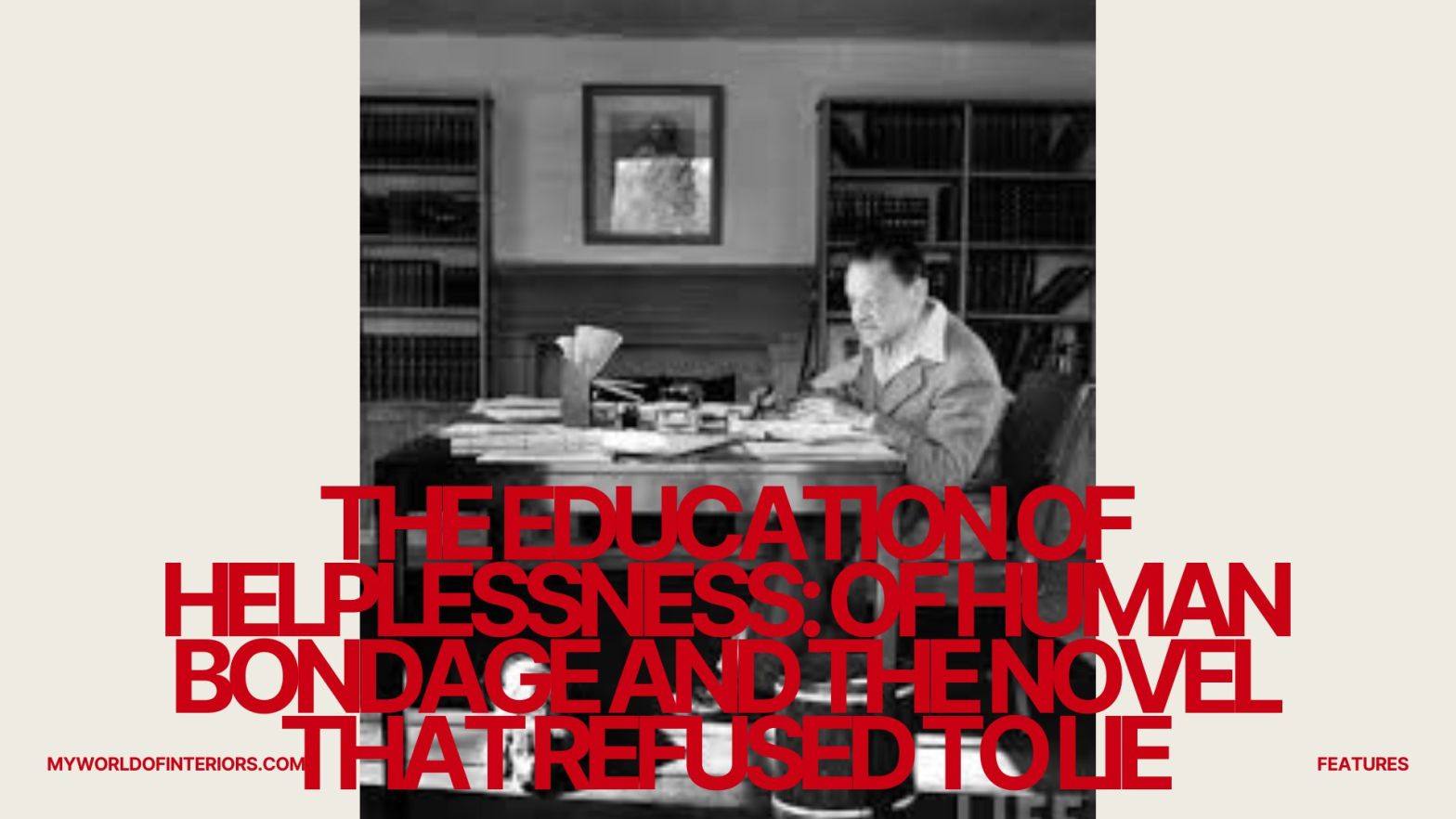
Somerset Maugham called it the book that saved his life. He also said it was the worst kind of novel — an autobiographical one. He was right on both counts, which is precisely why it endures.
By Bergotte
There is a type of novel that functions less like a work of art than like a surgical procedure. It does not offer pleasure in the conventional sense; it offers something more unsettling, which is recognition — the vertiginous sensation of seeing your own interior life rendered with a precision that feels almost violating, as if the author had been reading your correspondence. Of Human Bondage, published in 1915 after William Somerset Maugham had spent a decade writing and rewriting what was essentially his own life, is this kind of novel. It is long — very long, by the standards of an age increasingly impatient with length — and it is, in stretches, punishing. Its protagonist is not likeable in any comfortable sense. Its view of human nature is clear-eyed to the point of mercilessness. And it has never been out of print, has never stopped finding readers, has never stopped producing in those readers the particular shock of encountering a book that appears to know them better than they know themselves.
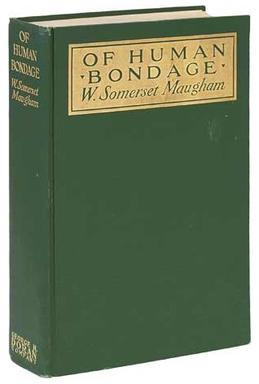
The story it tells is, in outline, simple to the point of being almost embarrassing to summarise. Philip Carey, a sensitive, club-footed orphan raised by a cold clergyman uncle in a Kentish vicarage, makes his way through a series of failed ambitions — accountancy, painting in Paris, medicine in London — while conducting a ruinous, degrading, years-long obsession with a feckless, charmless, casually cruel waitress named Mildred Rogers, who does not love him, has never loved him, and whose power over him is precisely as irrational and impervious to reason as the title promises. Around this central humiliation, Maugham constructs a bildungsroman of extraordinary scope: a portrait of a late-Victorian and Edwardian England seen from its margins, from the perspective of someone who is never quite at home in any of its rooms, who watches the social performances of his contemporaries with the alert, slightly wounded attention of a permanent outsider.
Maugham was thirty-eight when the book was published, though he had begun an earlier version, titled The Artistic Temperament of Stephen Carey, as far back as 1897, when he was in his early twenties. He destroyed that manuscript — reportedly without reading it again — and did not return to the material until 1911, by which point he was a successful playwright, socially established, financially comfortable, and in possession of the retrospective distance that the earlier attempt had lacked. The material was, in every significant respect, his own. Like Philip, he had been orphaned young and raised by an uncle who was a country clergyman. Like Philip, he had a physical disability — a severe stammer rather than a club foot, the substitution being one of the book’s most discussed and debated decisions. Like Philip, he had studied medicine, lived in Heidelberg and Paris, known poverty and near-despair, and loved, at some point in his youth, a woman who treated his devotion with a species of indifference that bordered on contempt.
The decision to fictionalise rather than confess directly was characteristic of Maugham: a man of profound emotional reticence who concealed a turbulent interior life behind a surface of social fluency and professional discipline. His homosexuality — never publicly acknowledged in his lifetime, managed through a disastrous marriage to Syrie Wellcome and a long relationship with his secretary Gerald Haxton — added a further layer of necessary indirection to the autobiographical project. Philip’s bondage to Mildred has been read, repeatedly and plausibly, as a transposition of Maugham’s experience of passionate attachment to men who held power over him precisely because social convention denied him the ability to understand or articulate that power. The heterosexual love story, in this reading, is not a distortion of the autobiographical truth but a translation of it — a way of making legible an experience that the cultural vocabulary of 1915 could not otherwise accommodate.
The novel’s central argument is contained in its title and its climactic scene, in which Philip finally achieves what the philosopher Spinoza — whose Ethics he has been reading throughout the novel — describes as freedom: not the freedom to get what you want, but the freedom from the compulsion to want it. Philip discovers, in a conversation with the dying painter Cronshaw, that life has no meaning — that meaning is not something the universe provides but something the individual weaves, as a Persian carpet weaver weaves a pattern, from the arbitrary threads of circumstance and choice. This is offered, and has generally been received, as a liberation: Philip, once he accepts that there is no cosmic purpose to be discovered or fulfilled, ceases to torment himself with the gap between his life and some imagined ideal version of it, and can at last inhabit the life he actually has.
The argument is more interesting, and more troubling, than it first appears. Maugham was writing in the tradition of nineteenth-century philosophical naturalism — Schopenhauer, Spinoza, Hardy — and his view of human motivation has a bleakness that the novel’s relatively tidy ending does not entirely dispel. The bondage of the title is not merely Philip’s bondage to Mildred; it is the bondage of every human being to the irrational forces that drive them: desire, vanity, the need for approval, the terror of insignificance. Philip’s liberation is real, but it is purchased at a cost the novel scrupulously itemises — the cost of wasted years, damaged friendships, opportunities declined, capacities atrophied. He is free, at the end, in the way a man is free when he has lost enough to no longer be afraid of loss.
Mildred Rogers is the novel’s great achievement and its great problem simultaneously. She is, on the available evidence, an unpleasant person: vain, selfish, shallow, intermittently cruel, constitutionally incapable of gratitude, a woman whose conversation is limited to grievances and whose sexuality is deployed as a transactional instrument rather than an expression of desire. Maugham does not soften her. He does not, as lesser novelists of the period would certainly have done, grant her a redemptive interior life that the reader can access even if Philip cannot. She is as thin on the page as she is in Philip’s imagination, and this thinness is arguably the point: Philip is not in love with Mildred Rogers. He is in love with a compulsion that has attached itself, for reasons the novel refuses to make fully explicit, to the person of Mildred Rogers. The distinction is precisely what he cannot make, and what the reader, observing from outside his consciousness, can.
This has made Mildred a subject of considerable critical controversy. Feminist readers, from the 1970s onward, have reasonably objected to the novel’s apparent endorsement of Philip’s perspective, to the way Maugham’s narration tends to see through Philip’s eyes even when it is most clearly aware of their distortions. Mildred, in this reading, is a woman of limited opportunities and no education who is trying to survive in an economy where her body is her primary negotiable asset, and the novel’s contempt for her is a form of class and gender prejudice masquerading as psychological realism. There is genuine force to this critique. Maugham does not give Mildred the interiority he gives his male characters. Her motivations are opaque in a way that serves the novel’s thematic purposes rather than her humanity.
And yet Maugham is doing something more subtle than simple misogyny, though the subtlety does not entirely exonerate him. He is writing about the experience of destructive obsession from the inside, with fidelity to how that experience actually feels — which is to say, from a position in which the object of obsession is necessarily obscured, necessarily reduced to a function of the obsessive’s own psychology. Philip cannot see Mildred clearly because obsession is, by definition, a failure of vision. The novel’s formal problem — that Mildred is underdeveloped — is also its psychological argument: that this is what bondage does to the person who holds power over us, renders them at once enormous and essentially unreal.
The Paris chapters — in which Philip, having abandoned his legal training, attempts to become a painter among a community of expatriate artists in Montparnasse — are the novel’s most openly autobiographical section and also, paradoxically, its most universal. What Maugham dramatises in these pages, with a mercilessness that clearly cost him something to write, is the experience of mediocrity: of being talented enough to know what good work looks like and not talented enough to produce it. Philip’s painting teacher, the blunt Fanny Price — herself one of Maugham’s finest minor characters, a woman whose ferocious commitment to an art she is constitutionally unsuited for ends in tragedy — delivers the verdict that Philip has been avoiding: he will never be more than adequate. He could spend his life in Paris, working, and produce nothing of lasting value.
The scene in which Philip accepts this verdict and decides to leave is one of the most quietly devastating in English fiction. There is no breakdown, no rebellion against the assessment, none of the self-protective denial that would be psychologically easier to read. Philip simply understands that it is true, and acts accordingly, and moves on. Maugham is arguing something here that runs against the grain of most narratives about artistic ambition — that self-knowledge, including the knowledge of one’s limitations, is a form of courage, and that the willingness to abandon a false version of yourself is as heroic as any act of creation. He knew this from the inside. He had been Philip in Paris. He had received his own verdict, from his own teachers, and the verdict on the younger Maugham had been similarly inconclusive. What had saved him was not that the verdict was wrong, but that he found, eventually, another form.
The novel’s relationship with its period is complex in ways that continue to reward attention. Maugham was writing at the tail end of the Victorian and Edwardian era, from a position of retrospective assessment that the First World War — which broke out the year before publication — made suddenly, violently relevant. The world that Of Human Bondage describes — the world of the vicarage and the medical school and the Bloomsbury boarding house and the Parisian café — was, by the time readers encountered it, a world that was being destroyed in real time in the fields of Flanders. The novel’s preoccupation with wasted time, with opportunities missed, with the self-defeating patterns that prevent people from living the lives they are capable of, spoke directly to a culture that was beginning to reckon with an entire generation’s waste.
Theodore Dreiser, reviewing the novel on its American publication, called it a work of genius — one of the few times, he suggested, that an English novelist had managed to write about ordinary human experience with the kind of unsparing honesty that American naturalism had been attempting for decades. The comparison to Dreiser’s own Sister Carrie — another novel about helpless desire, about the gap between what we want and what we deserve and what we get — is instructive. Both novels belong to a tradition that distrusts consolation, that insists on looking at the mechanics of human unhappiness without blinking, and that finds in that unflinching look something that is not, finally, hopeless — but that refuses to call itself hope.
Maugham’s reputation has had a peculiar trajectory since his death in 1965. He was, during his lifetime, one of the most commercially successful writers in the world, his plays filling West End theatres for decades, his short stories reaching millions of readers through mass-circulation magazines, his novels selling in numbers that most literary novelists of the period could only imagine. And then, with a speed and thoroughness that puzzled even those who had predicted it, the reputation collapsed. By the 1970s, he was a figure of polite condescension — skilful, certainly; readable, undoubtedly; but somehow not quite serious, not quite literary, not quite the thing. The critical establishment, having elevated him, abandoned him with the brisk efficiency of a fashion moving on.
The case against Maugham, as it was prosecuted by the post-war literary critical consensus, rested on several charges. His prose, it was argued, was too clear — that is, it lacked the textural density and deliberate difficulty that literary seriousness seemed to require. His plots were too neat. His characters, with some exceptions, were too legible, too organised around the purposes the novel needed them to serve. He was, in essence, too good at being read, and in a critical climate that had absorbed the lesson of modernism — that difficulty was a sign of seriousness, that accessibility was a form of pandering — being too readable was a genuine liability.
The charges contain some truth. Maugham was not a stylist in the way that Henry James or Virginia Woolf were stylists; he did not make the sentence itself the unit of literary meaning, did not ask the reader to dwell in the texture of language for its own sake. His is a prose of transparency, of efficiency, of extraordinary clarity about what it is doing and why. But the charges also mistake the nature of his achievement, which was precisely to make the difficult things appear simple — to write about the most painful and humiliating aspects of human experience in a language so lucid that the reader has no defences against it. Mildred Rogers is not a modernist character; she does not require a new grammar to be understood. She requires only honesty, which turns out to be far rarer and far harder than difficulty.
Of Human Bondage has outlasted almost everything that its first critical reception produced — has outlasted the novels that were considered more serious, more significant, more formally ambitious. It has done so because it addresses, with a completeness that has not been bettered, a question that does not date: the question of why intelligent people destroy themselves in the pursuit of things that will not make them happy, and what it feels like from the inside, and whether there is any way out.
Maugham said, late in his life, that he had no illusions about his place in literary history — that he was, at best, in the first rank of the second rate. It was a remark made in his characteristically self-deflating tone, the tone of a man who had learned, like his own protagonist, to protect himself from disappointment by anticipating it. But the remark is wrong, or at least wrong about Of Human Bondage, which is not a second-rate novel by any honest measure. It is a book that does what the greatest novels do: it expands the reader’s capacity for self-understanding, which is to say their capacity for compassion — for Philip, for Mildred, for the whole cast of people trying and failing and occasionally, briefly, succeeding at the business of being alive.
Philip Carey limps through more than seven hundred pages, learning, at enormous cost, to be free. The limp is Maugham’s stammer, transposed. The freedom, when it comes, is not transcendence but acceptance — not the life he imagined but the life available to him, received at last without resentment or illusion. It is a modest ending for an immodest novel. It is also, in its modesty, one of the most truthful endings in English fiction.
Of Human Bondage (1915) by W. Somerset Maugham is published by numerous houses and has never been out of print. The novel was adapted for film three times, most notably in 1934, with Leslie Howard as Philip Carey and Bette Davis in the performance widely considered the making of her career.
Discover more from My World of Interiors
Subscribe to get the latest posts sent to your email.
 My World of Interiors