
“I don’t remember my life before America anymore. Not really,” I tell Miss Mary.
“But dearheart,” she says, “you are still so young.”
She thinks for a moment while I look down, trying to summon it, but it doesn’t come.
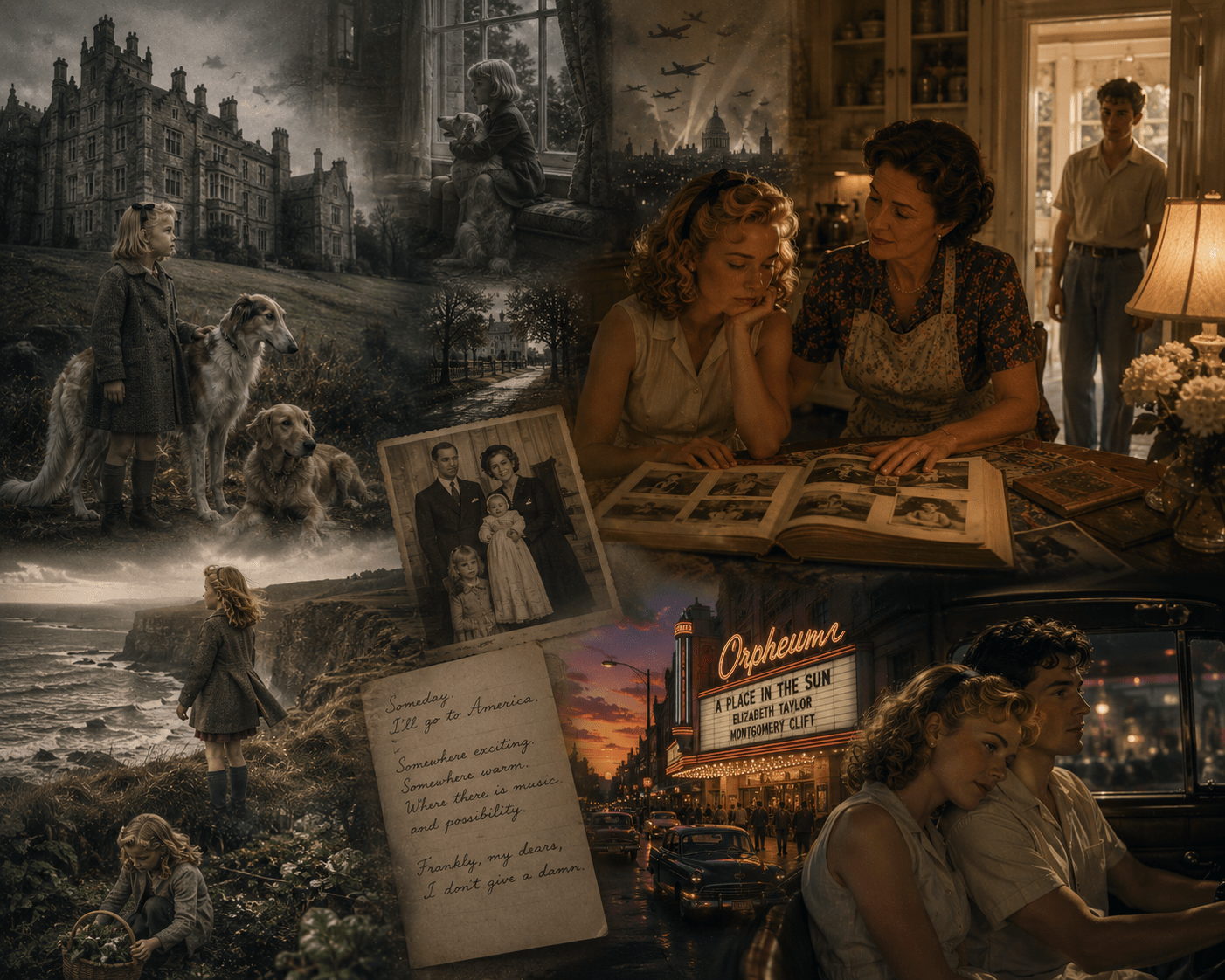
Miss Mary has an idea and fetches an old photo album from the library.
“Let’s go through it together,” she says. “From the beginning.”
She places the album on the kitchen table.
“Let’s see here.” She opens it, pulling her glasses from her apron pocket.
I see my christening, my parents, almost forgotten now. They look young and smart, and there we are: Tom and me.
And then came the war.
I remember being frightened, escaping into fantasy, going on adventures in the garden in Devon. I see the house. I remember the ocean that meant faraway freedom, beach days, my dogs, wearing tweeds, my hair in a bob with a bow.
The house was drafty. I was alone a lot. Tom away at Eton and then off in the army. The nannies telling me to be good, not to bother my parents.
“Don’t you know there’s a war on?”
“Don’t you know how lucky you are compared to all the other children?”
And they made me feel shame. I knew I would never quite be good enough, not as a human being.
My mother screaming when they brought word of Tom, how he and Hartington had both been shot by the SS whilst leading their company into some Belgian town on that horrid September day in ’44. My father, silent, locking himself in the den and never really coming out.
They used to be young and beautiful, my parents. I glance again at my christening photo, there they are, smiling, and I remember how quickly the war aged them.
I remember hiding so I wouldn’t be in the way. To be invisible. I fantasised about running off to America, where all the movies came from, where there was no Blitz. Where I had a grandfather.
I roamed the grounds with the dogs.
My paternal grandmother’s garden at the dower house, there was space to breathe, and time to talk.
How small I felt in my own big, haunted house.
I look up at Miss Mary, and suddenly, I remember all of it. She takes my hand and says it’s good I’m here with her now. She squeezes it gently.
We look through the photographs. I look drawn, even at seven or eight. There are always dogs with me. One picture shows me at the window in the great hall, all alone, surrounded by nothing, in that vast, drafty house my family owns, the one my father grew up in.
A house full of ghosts. The wind howling down corridors, doors slamming, leaving me always on the outside.
There I am: a dog beside me, another on the floor. My arm wrapped around the one next to me. I look so small, staring into the mist on the other side of the glass.
And I realise: maybe I didn’t love it there as much as I said. Maybe what I told Mr Grant was a lie I told myself first.
The war was my greatest fear. I dreamt of hell. I remember the paintings by Francis Bacon, my mother once took me to his studio, and I don’t know why. They gave me nightmares. Visions of torment and flame.
I didn’t ask questions. I had to be good. Invisible. Contained.
The nightmares. Waking up screaming.
My nanny, not Miss Mary, telling me to temper myself.
“Keep calm and carry on.”
But I felt like a storm. Weather I had to hide. A tempest under the skin.
A well-brought-up girl.
And I dreamt of America, where the women were loud and funny in screwball comedies. Where nobody had to hide. Where I had family.
I was sent away to a larger country house, with a bigger garden, after Debo married Andrew. She told Mama I could stay there for a fortnight.
I remember chickens.
The war made everyone look drawn and hollowed out. I remember death and fear and twisted cartoon memories of the Blitz, images never meant for children.
I tended the vegetable patch at my grandmother’s house.
I heard the voice calling me to America, because Europe was burning, and this life wasn’t good for me.
Standing on the Devon beach, I looked for America, wondering if I could swim there.
I dreamt of being in the movies.
I dreamt of the North and the South, the East and the West, this vast, magical land of freedom my mother had told me about, and where I had, for some reason, been born.
Something was waiting for me there. I heard its call.
As I walked back to the house, I promised myself I’d go.
Somewhere exciting. Somewhere warm. Where there was music and possibility.
And when I’d leave, I’d turn at the door of that cold house where no one begged me to stay, and say, “Frankly, my dears, I don’t give a damn.”
Then I’d go.
I pause now and look at Miss Mary.
Miss Mary is my mother now.
I’ve forgotten Devon and the war.
Maybe I didn’t love England as much as I thought.
But I did love the wild, untamed garden at the dower house.
I loved my dogs.
Running through the tall grass towards the ocean, the wind in my tweeds.
The thrill of summer. Insects in my hair when I fell asleep on a blanket, unsupervised, as always.
It’s freer.
And I am being loved.
I have Miss Mary now, not an English nanny, but a Southern lady from Arkansas.
I love the boy.
I’ve crossed the Atlantic to find my house, my great white mansion, where all is peaceful.
And finally, I am being looked after.
Miss Mary glances past me and catches someone’s eye.
She smiles and gestures.
I turn.
The boy is standing in the doorway.
Tears stream down his face, the emotion of my other life washing over him.
And I’m embarrassed.
Ashamed.
Ashamed of being unloved.
Of being alone.
Of losing face.
I try to pretend.
But he’s standing there.
And I know he knows.
He takes my hand.
“We’re goin’ to the pictures,” he says softly.
He knows I don’t want to talk.
He knows all I need is distance from memory.
We don’t need words, we’ve always had a language that existed before language.
He drives us into town, to the real cinema.
He buys two tickets for A Place in the Sun, with Elizabeth Taylor and Montgomery Clift.
He holds my hand through the whole film.
He tries to make me laugh, because the movie is sad, and probably the wrong choice for today.
But perfect for another day.
He lightens the mood and he moors me back to America, to the South.
And it is better than Europe was for me. I feel no longing for it.
A cord has been cut.
And I am free.
Discover more from My World of Interiors
Subscribe to get the latest posts sent to your email.

